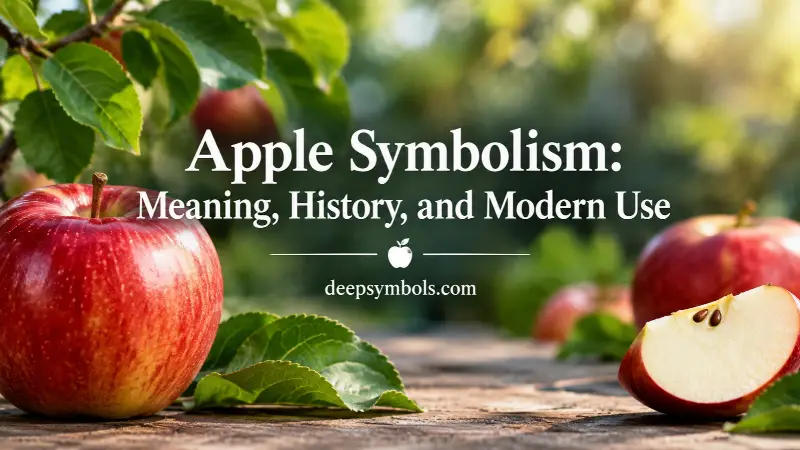
Apple symbolism is unusually varied in the United States. The same fruit can suggest good health, back-to-school appreciation, autumn harvests, romantic desire, temptation, knowledge, or even modern technology.
That range comes from the apple’s long history across religion, mythology, agriculture, art, and everyday life. In the United States, however, its meaning is often shaped less by ancient mythology than by familiar experiences: orchards, classrooms, pie, Halloween, family traditions, and seasonal decoration.
The apple also carries an interesting contradiction. It can represent wholesome qualities such as health and learning while also appearing in stories about forbidden desire and moral choice. Understanding that tension helps explain why the fruit remains such a recognizable symbol.
Quick Answer
Apple symbolism commonly represents health, knowledge, abundance, temptation, and affection in modern American culture, especially in education, food traditions, autumn imagery, and personal design. Historically, the fruit also became associated with love, immortality, fertility, and the biblical story of humanity’s fall.
TL;DR
- Apples often represent health, learning, abundance, and temptation.
- American culture links apples strongly with teachers, fall, and homemade food.
- The Bible never names an apple as Eden’s forbidden fruit.
- Greek traditions connected golden apples with love, beauty, and immortality.
- Rosh Hashanah uses apples and honey to express hopes for sweetness.
- Modern design uses apples for harvest, nostalgia, education, and technology.
What the Apple Represents Physically and Culturally
An apple is a round or slightly oval fruit with smooth skin, a stem, and a central core containing seeds. Depending on the variety, it may be red, green, yellow, or a mixture of several colors.
Its ordinary appearance matters to its symbolism. Apples are familiar, edible, portable, seasonal, and easy to recognize. Unlike rare flowers or elaborate religious objects, an apple belongs to everyday life.
That makes it especially useful as a cultural symbol. People can put one on a desk, classroom poster, kitchen sign, tattoo, greeting card, or fall centerpiece without needing an explanation.
Its visual simplicity also leaves room for different interpretations. A polished red apple can look wholesome or inviting, while the same fruit can suggest temptation when placed in a darker or religious context.
The Main Meanings Behind Apple Symbolism
Several meanings repeatedly appear around the apple, although none applies in every culture or situation.
Health comes from the fruit’s long association with nutrition and the familiar saying about eating apples and staying away from doctors. In the United States, that idea helped establish the apple as a straightforward emblem of healthy living.
Knowledge is strongly connected to education. The apple became an enduring classroom image because of its association with teachers, schools, and learning.
Abundance comes from the fruit’s place in orchards, harvests, food storage, and seasonal agriculture. Early American households could preserve apples as fresh fruit, dried food, sauce, butter, and cider.
Temptation comes largely from Christian artistic tradition, especially the later identification of Eden’s forbidden fruit with an apple.
Love and desire have older Mediterranean associations. In Greek myth and art, the apple appears in stories involving Aphrodite, beauty, marriage, and romantic attraction.
The important point is that these meanings developed in different settings. The apple does not have one universal symbolic definition.
Ancient Roots: From Central Asia to the Mediterranean
The cultivated apple has a much older history than its familiar place in American life suggests. Its wild ancestors are strongly associated with Central Asia, particularly the region that includes present-day Kazakhstan. Archaeological and botanical evidence indicates that humans were cultivating apples thousands of years ago, while trade and grafting helped spread different varieties across Eurasia.
As apples moved westward, they became part of Mediterranean foodways and literary traditions. Their symbolism expanded alongside their practical use.
In the ancient Greek world, the apple could appear in stories about beauty, competition, love, and extraordinary rewards. The golden apples guarded in the garden of the Hesperides became associated with Herakles and, in some traditions, immortality.
Another famous story is the Judgment of Paris. A golden apple was awarded to Aphrodite after Paris judged her the fairest among three goddesses. In later artistic traditions, the apple therefore became closely tied to beauty, desire, and the consequences of choosing one kind of desire over another.
This helps explain why the fruit has never been limited to wholesome meanings. Its older stories already involved attraction, rivalry, reward, and risk.
The Apple and the Biblical Story of Eden
One of the most familiar associations in Western culture is the apple as the forbidden fruit eaten by Adam and Eve.
There is an important distinction here: Genesis describes the fruit of the tree of the knowledge of good and evil, but it does not identify that fruit as an apple. The text simply refers to fruit.
So why did the apple become so strongly connected with Eden?
A major explanation involves Latin. The Latin word malum can mean both “apple” and “evil,” creating a memorable linguistic association that was reinforced in Western Christian art. Artists eventually used the apple as a recognizable visual shorthand for the Fall, sin, temptation, and humanity’s loss of innocence.
That history matters because many modern people assume the apple identification comes directly from the biblical text. It does not. The association developed through interpretation, language, art, and tradition.
This also gives the apple a second religious meaning in Christian art. Because the fruit could represent the Fall, an apple held by the infant Jesus was sometimes used to suggest redemption from sin and death.
The result is a fascinating symbolic contrast: the apple can represent both transgression and redemption.
Why Apples Became So American
The apple took on a particularly strong cultural role in the United States because of agriculture.
In colonial America, apples were important partly because they could be turned into cider and stored for later use. Early American orchards therefore connected the fruit with household production, settlement, food preservation, and rural life.
Over time, sweeter varieties and changing food habits made apples increasingly associated with desserts and fresh eating rather than primarily with cider. Apples became common in pies, sauces, butter, and other familiar foods.
This agricultural history helped transform the apple from an ordinary crop into an emblem of American rural life. Orchard visits, school events, harvest festivals, and autumn cooking all reinforced that connection.
The phrase “as American as apple pie” captures this cultural development. The saying does not mean the apple is uniquely American in origin; rather, it reflects how thoroughly the fruit became woven into American ideas of home, comfort, and national culture.
The Apple in American Education
Few modern symbols are as closely tied to school as the apple.
The traditional image of a student giving an apple to a teacher developed in the context of American schooling, particularly when teachers in rural and frontier communities sometimes received food or lodging from local families. An apple could therefore function as a practical gift as well as a gesture of appreciation.
As that practical custom faded, the image remained.
Today, an apple in an educational setting can suggest:
- learning
- gratitude toward teachers
- childhood
- discipline
- achievement
- school tradition
The symbolism can also carry a humorous edge. The expression “apple-polisher” eventually came to mean someone trying too hard to gain approval, showing that even a positive symbol can acquire an ironic interpretation.
In American classrooms, the apple generally communicates familiarity rather than formal authority. It belongs to the visual language of school itself.
Johnny Appleseed and the Meaning of Generosity
The American folk hero Johnny Appleseed added another layer to the fruit’s meaning.
John Chapman was a real nurseryman and missionary who established and sold apple trees across parts of the Midwest in the early nineteenth century. Later folklore transformed him into a wandering figure who generously scattered seeds and helped settlers. The historical record is more practical: he operated nurseries, planted trees, and sold or traded young apple trees.
The legend nevertheless shaped American cultural memory.
Because of Johnny Appleseed, apples can suggest:
- generosity
- self-sufficiency
- frontier life
- environmental stewardship
- simple living
- movement and settlement
This is an important example of how symbolism develops in real life. A fruit does not become a symbol only because of mythology or religion. Folklore can attach values to it just as strongly.
Apples, Autumn, and the American Idea of Home
In the United States, apples are strongly seasonal. Their harvest coincides with late summer and fall, when orchards, school calendars, Halloween traditions, and holiday decorating overlap.
That gives the fruit a strong emotional connection with home and autumn.
An apple basket on a kitchen table may suggest hospitality. A bowl of red apples can suggest harvest abundance. Apple pie can evoke family gatherings and homemade food. A trip to an orchard can represent leisure, childhood memories, and rural tradition.
The symbolism here is less about a single historical story and more about repeated lived experience.
For many Americans, the apple communicates comfort because it appears alongside familiar seasonal rituals. Its meaning often comes from memory as much as from history.
Apples in Jewish Tradition and Rosh Hashanah
Apple symbolism takes a notably positive form in Jewish tradition.
During Rosh Hashanah, apples are commonly dipped in honey as an expression of hope for a good and sweet new year. The apple itself also has positive associations in Jewish tradition, including references to refreshment and love in the Song of Songs.
The custom became especially established among Ashkenazi Jewish communities in medieval Europe before becoming widely recognizable as a Rosh Hashanah practice.
For American Jews, the apples-and-honey tradition can therefore represent:
- sweetness
- renewal
- blessing
- hope
- family continuity
- a new beginning
This is an important reminder that the apple is not inherently a symbol of sin or temptation. Religious traditions can assign the same fruit very different meanings.
The Apple in Greek Mythology and Love Symbolism
Greek mythology adds another major strand of meaning.
The apple awarded to Aphrodite in the Judgment of Paris became associated with beauty and desire. Ancient and later artists frequently portrayed Aphrodite holding an apple, making the fruit part of her visual identity.
The symbolic connection becomes even more interesting when considering the quince, a related fruit that was identified in antiquity with certain “golden apples” and associated with Aphrodite, love, fertility, and marriage.
This means that older Mediterranean traditions can give an apple-like fruit meanings involving:
- attraction
- beauty
- courtship
- fertility
- marriage
- desire
- reward
Modern Americans encountering an apple in a romantic design may not know these ancient details, but the broader association between a beautiful red fruit and romantic desire remains familiar.
Emotional and Psychological Meanings
Symbols work partly because people attach feelings to ordinary objects.
The apple can trigger several emotional responses at once. Its familiar shape may suggest safety and comfort, while its seasonal availability can evoke childhood memories. A polished red apple can feel inviting, but in a darker setting the same object can suggest temptation or danger.
Color changes the emotional signal as well, although these associations are cultural rather than universal.
| Apple Context | Common U.S. Association | Emotional Signal | Typical Use |
|---|---|---|---|
| Red apple | Love, temptation, warmth | Desire, affection, nostalgia | Art, gifts, tattoos |
| Green apple | Freshness, youth, health | Energy, simplicity | Food branding, decor |
| Apple in classroom | Knowledge, appreciation | Respect, gratitude | School imagery |
| Apples in fall decor | Harvest, home, abundance | Comfort, nostalgia | Kitchens, seasonal displays |
| Apple with honey | Sweetness, renewal | Hope, blessing | Rosh Hashanah traditions |
Psychologically, the apple often works through contrast. It can be innocent and tempting, ordinary and meaningful, seasonal and nostalgic, healthy and indulgent.
That flexibility makes it useful in visual storytelling.
Apple Symbolism in Tattoos, Jewelry, and Decor
An apple tattoo can mean very different things depending on its design.
A simple red apple may represent childhood, education, family, or a love of autumn. A bitten apple may point toward knowledge, temptation, curiosity, or a personal interest in technology. An apple paired with a snake or serpent can make the biblical association much more obvious.
A branch covered with apples can suggest abundance, family roots, cultivation, and harvest.
In jewelry, apple-shaped pendants are often interpreted more personally. Someone may choose the fruit because of a teacher, a family orchard, a favorite season, or a memory from childhood rather than because of an ancient symbolic tradition.
In home decor, the interpretation is usually more domestic. Wooden apples, ceramic apples, apple prints, and orchard-themed designs often communicate warmth, country living, harvest season, and nostalgia.
The Modern Apple: Technology, Branding, and Digital Culture
There is now another meaning Americans may encounter immediately: the apple as a symbol of technology.
The well-known bitten apple logo belongs to a specific corporate identity rather than to the universal symbolism of the fruit. The company’s current materials describe its long-running identity around personal technology, invention, and progress, which has given the apple shape a strong association with computers, phones, software, and digital life.
This creates an interesting modern split.
A traditional apple may suggest:
school, food, harvest, health, home
A branded bitten apple may suggest:
technology, design, innovation, personal devices, digital culture
The two meanings can overlap, especially around the idea of knowledge. But they should not be treated as the same symbol. One comes from centuries of cultural interpretation; the other comes from a modern brand identity.
Common Misunderstandings About the Apple
The most common misconception is that the Bible explicitly says Adam and Eve ate an apple. It does not. Genesis names the tree and its fruit without identifying the species.
Another mistake is assuming that apples universally mean temptation. That interpretation is particularly prominent in Western Christian art, but other traditions use the fruit positively.
It is also easy to treat every red-apple image as romantic or sexual. Sometimes red simply means ripeness, warmth, autumn, or visual familiarity.
Likewise, not every apple image has a hidden message. An apple on a kitchen towel may simply be decorative. Symbolic interpretation works best when context supports it.
How Apple Meanings Have Changed Over Time
The apple’s history is best understood as an accumulation of meanings rather than a single evolution from one fixed definition.
In ancient traditions, apples and related fruits could appear in stories about beauty, divine rewards, love, and immortality. In Christian art, the apple became a visual shorthand for temptation and the Fall. In Jewish practice, it became part of a ritual expressing hopes for a sweet new year. In America, agricultural life added meanings of abundance, settlement, education, health, and home.
Modern culture adds yet another layer through branding and technology.
As a result, the apple now operates like a symbolic crossroads. Its interpretation depends on whether it appears in a Bible illustration, school poster, orchard photograph, Halloween activity, wedding design, tattoo, kitchen decor, or technology advertisement.
FAQs
What does an apple symbolize in American culture?
In the United States, an apple commonly represents health, learning, harvest, home, and appreciation for teachers. Depending on context, it can also suggest temptation, romance, or nostalgia.
What does an apple tattoo mean?
An apple tattoo often represents knowledge, childhood, education, love, temptation, or a personal connection to autumn and family. Details such as a bite, serpent, leaves, or surrounding flowers can change the interpretation.
Is the apple a symbol of temptation?
Yes, especially in Western Christian artistic tradition. The association developed over time because the biblical fruit was later represented as an apple, with Latin language helping reinforce that connection.
Does the apple have a positive religious meaning?
Yes. In Jewish tradition, apples dipped in honey on Rosh Hashanah represent hopes for a sweet new year. Christian art has also used the apple in connection with redemption as well as the Fall.
What does a red apple symbolize?
A red apple can suggest affection, desire, temptation, warmth, health, or seasonal abundance. The surrounding imagery usually matters more than the color alone.
What does an apple symbolize in education?
It commonly represents learning, teachers, respect, childhood, and academic tradition. In the United States, the apple-and-teacher image developed from practical gift-giving customs and became a lasting school symbol.
Conclusion
Ultimately, apple symbolism works because the fruit sits at the intersection of ordinary life and cultural memory. An apple can represent health, harvest, temptation, knowledge, renewal, childhood, or abundance depending on the setting. The Metropolitan Museum of Art’s discussion of food and drink in European painting provides useful historical context for the apple’s religious symbolism in Western art, including its association with the Tree of Knowledge and redemption.
The same fruit can mean something very different in a classroom, a Rosh Hashanah meal, a family kitchen, a tattoo, or a technology logo. The object remains recognizable, but the cultural setting changes what viewers are asked to see in it.
That flexibility is what makes apple symbolism so enduring. Its meaning is not contained in the fruit alone; it develops through history, context, memory, and the purpose for which the apple is chosen.