
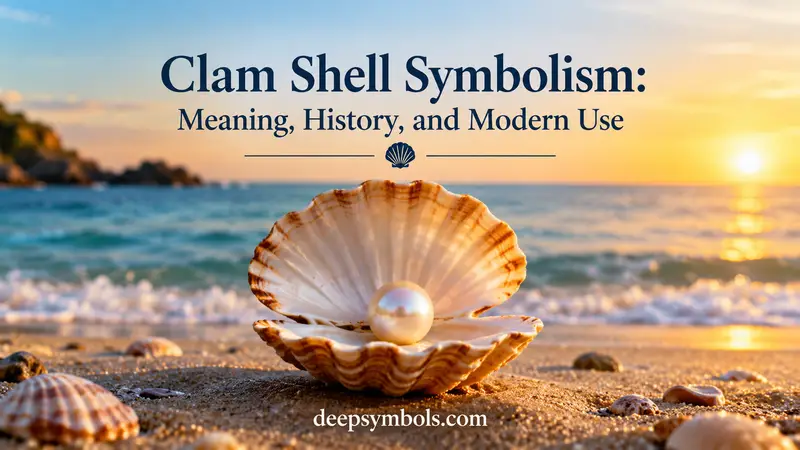
Clam shells are familiar sights along the American coastline, tucked into beach sand, scattered across tidal flats, or displayed in seaside shops. Their hard outer surfaces protect the soft animals within, making clam shell symbolism closely associated with protection, resilience, hidden beauty, and the value of what lies beneath the surface. For many people, a shell also recalls childhood beach trips, quiet moments by the ocean, and the natural cycles that shape coastal life.
Unlike a generic seashell, a clam shell has a distinctive structure: two hinged halves that fit together to enclose the animal. This form offers a natural starting point for symbolic interpretation. A closed shell suggests boundaries and security, while an opened shell can suggest vulnerability, discovery, or the revelation of something previously hidden.
Clam shells have also served practical purposes throughout human history. Coastal communities have used shellfish as food, and shells have been collected, traded, incorporated into crafts, and studied as evidence of marine environments. Their symbolic meanings therefore emerge from both their physical characteristics and the experiences people associate with them.
In modern American culture, clam shells appear in beach decor, jewelry, coastal art, environmental education, and personal collections. Their meaning is not fixed by one universal tradition, but their connection with shelter, the sea, and the passage of time makes them useful symbols for understanding protection, simplicity, and our relationship with nature.
Quick Answer
Clam shell symbolism commonly represents protection, resilience, hidden beauty, and the connection between human life and the ocean in modern American culture. Historically, shells have also served as practical resources, decorative objects, and culturally significant materials, with meanings shaped by the coastal communities and traditions that used them.
TL;DR
Modern decor and jewelry use shell imagery to express simplicity and coastal identity.
Clam shells symbolize protection because their paired halves shelter a living animal.
Their hard exterior can represent resilience and personal boundaries.
Open shells may suggest discovery, vulnerability, or new perspectives.
Coastal American culture connects shells with beach memories and ocean life.
Shells have practical, artistic, ecological, and cultural significance across societies.
1. Why Clam Shells Symbolize Protection
A clam’s shell is more than an attractive object washed onto a beach. In nature, its two hard halves protect a soft-bodied animal from physical threats and environmental stress. This structure provides the foundation for interpreting clam shells as symbols of safety, personal boundaries, and self-preservation.
The symbolism is especially clear when a clam closes its shell. The animal withdraws from its surroundings, creating a barrier between itself and potential danger. For people, this can represent the need to protect personal space, establish emotional boundaries, or take time away from stressful situations.
A clam shell may therefore appeal to someone who values privacy or has learned to be cautious after a difficult experience. Its meaning need not suggest fear or isolation. Protection can also represent healthy self-respect and the ability to decide when to be open with others.
There is an important distinction between the natural function and the symbolic interpretation. Clams do not consciously use their shells to communicate human ideas about emotional boundaries. Rather, people recognize a parallel between the shell’s protective role and their own need for security.
2. Resilience, Endurance, and Inner Strength
Clam shells can also symbolize resilience because they form a durable exterior around a vulnerable living organism. Their strength offers a natural image of enduring difficult conditions without losing the ability to continue growing.
This association is particularly relevant to coastal environments, where shellfish live amid shifting sediment, changing tides, and other environmental pressures. Different clam species have different adaptations, and no shell is indestructible, but the protective structure helps the animal survive.
In personal symbolism, a clam shell can represent the ability to withstand adversity while preserving one’s identity. Someone recovering from a difficult relationship, navigating a major life change, or rebuilding confidence might connect with this image of protection combined with continued life.
The shell also suggests that resilience does not always look dramatic. It may involve quiet persistence, careful decisions, and steady progress rather than visible displays of strength.
A shell-inspired piece of jewelry or tattoo can express this idea without suggesting that a person must remain guarded forever. Strength includes knowing when protection is necessary and when it is safe to become more open.
3. Hidden Beauty and the Value Beneath the Surface
A clam shell often looks ordinary when found on a beach. Its exterior may be weathered, ridged, discolored, or partly covered with sand. When examined closely, however, it can reveal delicate patterns, subtle colors, and distinctive textures.
This contrast makes the shell a useful symbol of hidden beauty and qualities that are not immediately visible.
In human relationships, the idea can refer to character that becomes apparent only with time. A reserved person may have considerable warmth, humor, or insight that is not obvious during a first meeting. Similarly, a meaningful experience may contain lessons that become clearer only after reflection.
The shell can also represent the difference between appearance and substance. An object does not need to be rare or expensive to hold personal value, and a person’s worth cannot be reliably judged by outward presentation.
This interpretation should not be confused with the symbolism of a pearl. Some mollusks produce pearls, but ordinary clams do not necessarily contain one, and the presence of a shell does not imply hidden treasure.
The more grounded message is that careful attention can reveal value in places people initially overlook.
4. The Historical Importance of Clam Shells
Clam shells have been important to coastal communities for practical reasons long before beach collecting became a leisure activity. They provided evidence of food gathering, could be fashioned into useful objects, and supplied material for ornaments and other forms of craftsmanship.
Archaeological shell deposits, often called shell middens, help researchers understand how communities obtained food and interacted with coastal environments. The accumulation of shells at former settlements can reveal patterns of diet, habitation, and resource use.
In parts of North America, shell material also became important in the production of beads and ornaments. These objects could communicate social relationships, status, memory, or agreements, depending on the community and context.
Such uses show why shell symbolism cannot be reduced to modern ideas about relaxation or ocean scenery. For many communities, shells were valuable materials connected with everyday survival and established cultural practices.
The meaning of a particular shell object depends on its history, how it was made, and how people used it. A shell collected as a beach souvenir, a tool fashioned by an Indigenous craftsperson, and a ceremonial object may look related but carry very different significance.
5. Clam Shells and Indigenous North American Traditions
One important part of clam shell history in North America is wampum, a tradition involving carefully crafted shell beads used by several Indigenous nations, particularly in the Northeast.
Wampum beads were made from shells including the hard clam, also known as the quahog, and the whelk. White and purple beads could be arranged into strings and belts, sometimes forming patterns that conveyed messages or preserved important relationships.
Among the Haudenosaunee and other Indigenous peoples, wampum has been associated with diplomacy, condolence, agreements, ceremony, and the communication of collective memory. Its significance cannot be adequately described as decorative jewelry alone.
European colonists later adopted wampum for trade and, in some colonial settings, used it as a form of currency. This development altered the role of shell beads in cross-cultural exchange. It is important, however, not to assume that Indigenous peoples originally understood wampum simply as money.
This history offers a valuable lesson about material symbolism: an object’s significance is shaped by the people who make, exchange, preserve, and interpret it.
Modern discussions of clam shells should therefore avoid treating Indigenous traditions as a single, interchangeable set of beliefs. The meanings of wampum differ according to the nations and specific practices involved, and living communities continue to maintain these traditions.
6. Clam Shell Symbolism in American Coastal Culture
In the United States, clam shells are closely associated with coastal living, especially in communities where shellfish harvesting, fishing, and beach recreation are part of local life.
Along the Atlantic coast, clamming is both a commercial activity and a recreational pastime. Shells can evoke family outings, seafood traditions, working waterfronts, and memories of time spent near the water.
For many Americans, finding a clam shell also creates a small moment of discovery. The object connects a person with a particular place and can become a keepsake from a vacation or a reminder of a meaningful day.
Coastal businesses use shell imagery in signs, restaurant decor, gift shops, and regional artwork. These designs often suggest a relaxed atmosphere, familiarity with the ocean, and appreciation for seaside environments.
The symbolism is not limited to people who live near the coast. Someone in a landlocked state may display shells because they recall a childhood trip, a honeymoon, or a favorite destination.
In this way, the clam shell can represent a place as much as an abstract idea. Its emotional meaning often comes from the experiences people associate with the shoreline.
7. The Shell as a Symbol of Home and Belonging
A clam’s shell forms a protective enclosure around its body. This makes it a natural image for home, shelter, and the desire to feel secure in one’s surroundings.
Unlike a house built by people, the shell grows with the animal. Its structure is closely connected to the clam’s life, offering a useful comparison for the way people develop their own sense of home over time.
In personal interpretation, a clam shell might represent the comfort of familiar surroundings or the importance of creating a place where one can rest without feeling judged. It may also suggest the experience of carrying a sense of home through periods of change.
For someone moving to a new city or rebuilding life after a major transition, the shell can serve as a reminder that belonging develops through relationships, habits, and a sense of safety.
The symbol also has a more complicated side. A shell can suggest retreat when a person feels overwhelmed or uncertain. Taking time to withdraw may be restorative, but remaining isolated indefinitely can make connection more difficult.
The image is therefore most useful when it represents a healthy balance between having a safe personal space and remaining connected to the wider world.
8. Emotional and Psychological Interpretations
People often interpret natural objects through the feelings and memories they bring to mind. Clam shells can evoke calm, curiosity, nostalgia, privacy, or a desire for simplicity.
Their connection with beaches may explain some of their emotional appeal. The sound of waves, the movement of tides, and the experience of walking along the shoreline can be associated with rest and temporary distance from daily responsibilities.
The shell itself can suggest a pause. Its closed form offers a visual reminder that people sometimes need time to process emotions before discussing them with others.
For some, the shell represents the ability to keep personal matters private. For others, it symbolizes a willingness to explore what lies beneath an initial impression.
Neither interpretation is universal. A clam shell may remind one person of a peaceful vacation and another of work, harvesting, or a difficult experience associated with the sea.
Psychological interpretations are most useful when treated as personal reflections rather than fixed truths. The shell does not have a scientifically established emotional message, and its appearance cannot reveal someone’s personality or future.
Its value lies in the associations that a person consciously connects with it.
9. Clam Shells in Art, Jewelry, and Home Decor
Clam shells appear in many forms of contemporary design, from simple natural displays to carefully crafted decorative objects.
In home decor, shells may be placed in glass jars, framed artwork, bowls, or coastal arrangements. These designs often evoke the shoreline, natural textures, and a preference for relaxed interiors.
Jewelry makers may incorporate shells into pendants, earrings, and other accessories. Depending on the design, a shell can suggest a connection with nature, a meaningful travel memory, or an appreciation for handmade materials.
Artists may also use the shell’s two-part structure to explore contrasts. A closed shell can suggest concealment, while an open shell may communicate exposure or discovery. Weathered surfaces can evoke age and environmental change, whereas polished shells may emphasize pattern and form.
These interpretations are creative choices, not universal cultural rules. A shell necklace does not automatically signify protection, and a decorative arrangement does not necessarily express spiritual beliefs.
The most meaningful designs often connect the object’s appearance with a specific story or intention. A shell gathered during a family trip, for example, may have more personal significance than an expensive decorative item with no particular history.
10. Clam Shell Tattoos and Personal Identity
A clam shell tattoo can represent several ideas, depending on the wearer’s experiences and the design.
Some people may choose the image to express protection or resilience. Others may associate it with a love of the ocean, a coastal hometown, or a memory of someone with whom they shared time near the water.
A closed shell can emphasize privacy and self-preservation, while an open shell may suggest growth, openness, or the willingness to reveal something personal. These meanings come from the wearer’s interpretation rather than a standard tattoo tradition.
Clam shell tattoos can also commemorate family ties or a particular place. Adding a date, a shoreline outline, or another meaningful element can make the design more specific to the individual.
Before choosing the image, it helps to distinguish a clam shell from other marine motifs. A scallop shell, for instance, has a fan-shaped outline and appears in particular religious and artistic traditions, while a clam shell usually has two rounded or elongated halves connected by a hinge.
The distinction matters because the symbols do not have identical histories. Choosing the image that genuinely reflects one’s intended meaning is more useful than relying on a broad category of seashell symbolism.
11. Spiritual Interpretations and Religious Associations
Some people interpret clam shells spiritually as reminders of protection, patience, humility, or the importance of inner life. These associations are understandable extensions of the shell’s natural characteristics, but they should not be mistaken for universally established religious teachings.
In Christianity, shells appear in some forms of religious art and devotional practice. The scallop shell, in particular, is associated with Saint James and the pilgrimage to Santiago de Compostela. This tradition should not automatically be transferred to clam shells, whose shape and cultural history differ.
Similarly, the fact that shells occur in religious art across different societies does not mean all shell-bearing objects share one spiritual meaning.
A person may choose to use a clam shell as a personal reminder of faith, gratitude, or the value of protecting what matters. Such an interpretation can be meaningful without claiming that a specific religious tradition assigns the object that meaning.
A grounded spiritual reading begins with the object itself and the individual’s intention. It leaves room for personal reflection while respecting the distinct histories of established religious symbols.
12. Positive and Negative Meanings of Clam Shells
Clam shells are often interpreted positively, but their symbolism can include less comfortable ideas.
| Context | Possible meaning | Interpretation |
|---|---|---|
| Closed shell | Protection and privacy | Keeping boundaries around personal life |
| Open shell | Discovery and vulnerability | Allowing something hidden to become visible |
| Weathered shell | Endurance and change | Evidence of time and environmental exposure |
| Empty shell | Absence or transition | A reminder that something has ended or moved on |
| Shell found on a beach | Memory and connection | A keepsake associated with a place or experience |
A closed shell may represent healthy self-protection, but it can also suggest emotional guardedness. An empty shell may feel peaceful to one person and evoke loss for another.
These contrasts demonstrate why symbols should not be classified as entirely positive or negative. Their meaning depends on the situation, the viewer’s experiences, and the intention behind their use.
There is also no reliable basis for claiming that finding an empty clam shell predicts a coming loss or that a particular shell color guarantees good fortune. Such claims belong to individual interpretations or modern folklore rather than established facts.
13. Environmental Meaning: What a Clam Shell Can Teach Us
Beyond personal symbolism, clam shells can draw attention to the ecological relationships that sustain coastal environments.
Clams are bivalve mollusks, a group that includes oysters, mussels, and scallops. Many live in or on sediment and feed by filtering particles from water. Depending on the species and habitat, they can contribute to ecosystem processes and serve as food for other animals.
A shell found on the beach is therefore not merely a decorative object. It is part of a biological life cycle and may eventually contribute calcium-rich material to the coastal environment.
This perspective gives the shell a possible modern association with environmental responsibility. It can remind people that beaches are living systems rather than collections of souvenirs.
Shell collecting also requires awareness of local conditions and regulations. Some shells may still house living animals, and removing natural materials can affect particular habitats. Rules vary by location, protected area, and species, so visitors should check local guidance before collecting.
The environmental interpretation of a clam shell is grounded in its actual role in nature. It encourages people to appreciate coastal life while considering how their actions affect the places they visit.
14. Common Misunderstandings About Clam Shell Symbolism
One frequent misunderstanding is that every shell has the same meaning. Clam shells, scallop shells, oyster shells, and conch shells have different physical forms and cultural histories. Their symbolic associations may overlap, but they should not be treated as interchangeable.
Another misconception is that clam shells universally represent wealth because some shellfish produce pearls. Ordinary clams do not necessarily contain pearls, and the symbolic association between shells and hidden treasure is a modern or personal interpretation rather than a general fact about clam shells.
It is also misleading to attribute a single spiritual meaning to all Indigenous North American shell traditions. Wampum has specific cultural histories and continuing significance among particular Indigenous nations. Its meaning cannot be reduced to a generic claim that shells represent luck, abundance, or protection.
Finally, finding a clam shell does not establish that the universe is sending a particular message. People may use such encounters as prompts for reflection, but there is no universal rule connecting them with future events.
Recognizing these distinctions makes shell symbolism more meaningful. It allows natural observation, cultural history, and personal interpretation to coexist without confusing one for another.
15. How Clam Shell Meaning Continues to Evolve
The significance of clam shells has changed alongside the ways people interact with coastal environments.
For communities that depended on shellfish, the shell was first and foremost part of a practical relationship with food and materials. In particular Indigenous traditions, shells could also become carefully crafted objects used in communication, adornment, and ceremony.
Later, coastal tourism helped make shells familiar souvenirs. Visitors carried them home as reminders of holidays, while artists and designers incorporated them into decorative objects.
In contemporary American culture, clam shells can communicate a preference for natural materials, a connection with coastal places, or an interest in simple, organic forms. Tattoos and personal keepsakes also allow individuals to develop meanings tied to their own experiences.
Environmental awareness adds another dimension. As people become more attentive to coastal ecosystems, a shell may prompt questions about marine life, habitat preservation, and responsible recreation.
These meanings do not replace the shell’s practical or cultural history. They add new interpretations to an object whose significance continues to depend on the people and places connected with it.
FAQs
1. What does a clam shell symbolize spiritually?
A clam shell may represent protection, patience, humility, or the value of what lies beneath the surface. These are personal spiritual interpretations rather than universal meanings prescribed by one religious tradition.
2. What does finding a clam shell on the beach mean?
Finding a clam shell usually means that a shell has washed ashore or become exposed by changing tides and beach conditions. Personally, it may serve as a reminder of a coastal visit, a meaningful memory, or an appreciation for nature.
3. Are clam shells symbols of protection?
Yes, protection is a common symbolic interpretation because the shell physically encloses and shields the clam’s soft body. People may use this image to reflect on safety, privacy, and healthy personal boundaries.
4. What does an empty clam shell symbolize?
An empty shell may represent change, absence, transition, or the traces left by a living thing. Its meaning depends on the viewer’s experience; it is not an established omen of death or misfortune.
5. What does a clam shell tattoo mean?
A clam shell tattoo may express resilience, privacy, a connection to the ocean, or a personal memory associated with the coast. The design has no single standardized meaning, so the wearer’s intention is the most important guide.
6. Are clam shells and scallop shells symbols of the same thing?
Not necessarily. Scallop shells have distinctive associations in some Christian pilgrimage traditions, while clam shells have their own natural and cultural histories, including their use in wampum production among Indigenous peoples of northeastern North America.
Conclusion
Clam shell symbolism brings together protection, resilience, hidden beauty, memory, and the connection between people and coastal environments. The shell’s paired structure provides a natural image of shelter, while its history reveals how a simple material can acquire cultural and personal significance. The National Park Service’s guide to clams explains how Indigenous communities in the northeastern United States used clam shells to create wampum beads, illustrating how shells became part of meaningful cultural and exchange traditions.
In modern American life, a clam shell may preserve a favorite beach memory, represent personal boundaries, express a connection with the ocean, or reflect an appreciation for cultural heritage. Its significance depends on the setting, the history of the object, and the meaning its owner chooses to give it.
Ultimately, clam shell symbolism reminds us that meaningful things do not need to be rare or extraordinary. A shell can connect us with a place, preserve a memory, or encourage us to consider the ways natural materials support life and human communities. Its value lies not in a guaranteed supernatural message, but in the relationship between the natural world, cultural history, and the experiences we choose to carry forward.


