
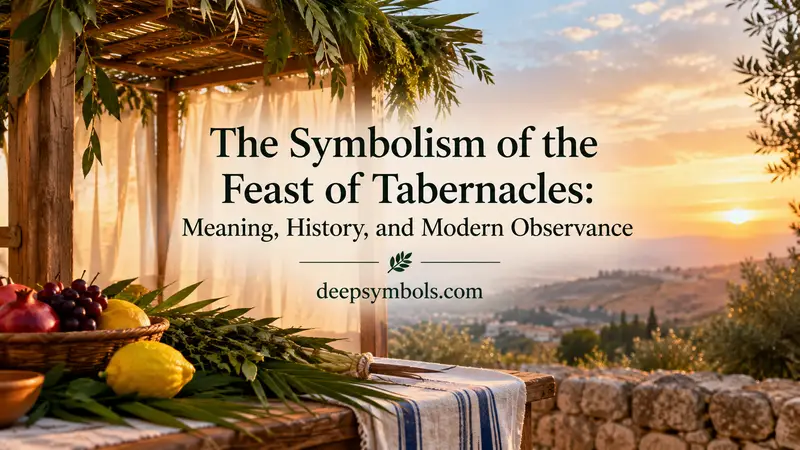
The Feast of Tabernacles — known in Hebrew as Sukkot — is one of the most physically distinctive observances in the biblical calendar. For seven days, families build and dwell in temporary shelters, waving branches of palm, willow, and myrtle alongside a citrus fruit called an etrog, in a festival the Torah itself describes as a time of unusual, deliberate joy. The symbolism of the Feast of Tabernacles operates on several levels at once — historical remembrance, agricultural gratitude, and, in later Jewish and Christian tradition, a forward-looking hope — and untangling those layers is essential to understanding why this particular festival has remained so richly interpreted for thousands of years.
This guide traces the feast from its instructions in the Torah through its development in later Jewish practice and its distinct role in Christian theological tradition, while being careful to keep those traditions clearly separated rather than blended into one unified account. Jewish and Christian communities read the festival’s symbolism in genuinely different ways, and that difference deserves to be represented accurately rather than flattened.
Quick Answer
The Feast of Tabernacles symbolizes God’s provision and protection during Israel’s wilderness wandering after the Exodus, commemorated by dwelling in temporary booths, or sukkot, for seven days each autumn. It also functions as a harvest festival of gratitude and, in Jewish tradition, a season of commanded joy, while some Christian traditions additionally read the feast typologically as pointing toward God’s presence dwelling among humanity and, in various interpretations, toward a future messianic age.
TL;DR
- The feast commemorates the temporary shelters used during Israel’s wilderness wandering
- It doubles as a harvest festival marking the end of the agricultural year
- Leviticus 23 instructs Israelites to dwell in booths and rejoice for seven days
- The four species — palm, willow, myrtle, and etrog — carry their own layered symbolism
- Jewish tradition calls it “the season of our rejoicing,” emphasizing commanded joy
- Christian tradition has developed separate, typological readings of the feast’s symbolism
The Biblical Instruction: Leviticus 23 and the Command to Dwell in Booths
The Feast of Tabernacles is established directly in the Torah, most fully in Leviticus 23:33–43, where God instructs the Israelites to observe a seven-day festival beginning on the fifteenth day of the seventh month, following the harvest. The text explicitly ties the festival’s central practice — dwelling in temporary booths — to a specific historical memory: so that future generations would know that God had the Israelites live in booths when he brought them out of the land of Egypt.
That stated purpose matters enormously for understanding the feast’s core symbolism. The booths, or sukkot, aren’t decorative structures chosen for their beauty; they’re intentionally fragile and temporary, built to be lived in briefly rather than to last.
The instruction asks each generation to physically re-enter that vulnerability for a week, sleeping and eating under a roof deliberately built to let starlight through, as a way of remembering both the hardship of the wilderness and the divine protection that carried the people through it.
A Harvest Festival of Gratitude
Alongside its historical commemoration, the Feast of Tabernacles is explicitly agricultural in origin, sometimes called the Feast of Ingathering, since it falls at the conclusion of the harvest season. This dual identity — historical memorial and harvest celebration happening simultaneously — is not a contradiction so much as a deliberate pairing: the festival asks participants to feel grateful for a completed, successful harvest while simultaneously remembering a time when the people had nothing but temporary shelter and had to depend entirely on provision from beyond themselves.
This combination gives the festival a distinctive emotional register compared with other biblical observances. It isn’t purely solemn, the way Yom Kippur is, nor is it centered on a single dramatic historical event the way Passover is. Instead, it holds gratitude and vulnerability together at once — celebrating abundance while physically re-creating a memory of having very little.
The Symbolism of the Sukkah Itself
The sukkah, or temporary booth, carries symbolic weight through its very construction. Jewish law traditionally requires the roof covering to be made from organic plant material, loosely arranged rather than solidly fixed, so that it provides some shade while still allowing those inside to see the stars through gaps in the covering. This isn’t an incidental architectural detail — it’s central to the structure’s meaning. A sukkah is deliberately built to be insufficient as permanent shelter, a physical reminder that ultimate security doesn’t come from a structure’s strength but from what the festival identifies as divine protection during a genuinely precarious period in Israel’s history.
Living in the sukkah for a week, even in a modern home with a permanent house standing nearby, is meant to be a lived reenactment rather than a purely symbolic gesture — meals are eaten there, and depending on tradition and climate, people may sleep there as well. The temporary, exposed nature of the structure is the whole point, standing in deliberate contrast to the security of a permanent home most participants return to once the festival ends.
The Four Species: Palm, Willow, Myrtle, and Etrog
Leviticus 23:40 instructs the Israelites to take branches from specific trees and rejoice before God for seven days. Later Jewish tradition developed this command into the ritual use of what became known as the Four Species: the palm branch (lulav), myrtle branches (hadassim), willow branches (aravot), and a citron fruit called the etrog.
These four elements are held and waved together during the festival, particularly as part of morning prayers. The practice became one of the most recognizable rituals associated with the Feast of Tabernacles.
Jewish tradition has developed rich, sometimes multiple, interpretations of what each of the four species represents. It’s worth noting, however, that these interpretations developed over the centuries following the biblical text rather than being explicitly spelled out within Leviticus itself.
One well-known rabbinic reading connects each species to a different combination of taste and fragrance. The etrog has both taste and fragrance, the palm has taste but no fragrance, the myrtle has fragrance but no taste, and the willow has neither.
In this interpretation, the four types symbolically represent different kinds of people within a community. They are brought together and united in a single act of celebration regardless of their individual qualities.
This reading emphasizes communal unity as a central theme of the festival, layered on top of its historical and agricultural symbolism.
Zeman Simchateinu: The Season of Our Rejoicing
Jewish liturgical tradition refers to the Feast of Tabernacles as zeman simchateinu — “the season of our rejoicing” — a title that highlights joy as a defining, almost commanded characteristic of the observance rather than an optional mood. This distinguishes Sukkot from festivals with a more solemn or penitential character, and the timing reinforces the theme directly: the feast follows immediately after the more introspective High Holy Days of Rosh Hashanah and Yom Kippur, creating a deliberate movement from repentance and self-examination toward celebration and gratitude within the same autumn season.
Historically, this joy found dramatic expression through the Simchat Beit HaShoeivah, the Celebration of the Place of Water-Drawing, a nighttime ceremony held at the Temple in Jerusalem during the festival involving music, dancing, and torches, connected to a water libation ceremony performed as part of the festival’s Temple rites. Rabbinic literature describes the celebration in strikingly enthusiastic terms, suggesting that whoever had not witnessed this particular celebration had never truly witnessed joy in their life. Though the Temple ceremony itself ended with the Temple’s destruction, the tradition of celebratory dancing and music during Sukkot has continued in adapted forms within Jewish communities.
The Feast of Tabernacles in Later Jewish History
The festival continued to hold central importance well beyond the Torah’s initial instruction. The book of Nehemiah records a notable post-exilic observance of the feast after the Israelites returned from Babylonian captivity, describing a celebration of unusual scale and joy connected explicitly to the community rediscovering and following the Torah’s instructions for the festival after a period of neglect. This historical episode reinforces a theme that runs throughout the feast’s later reception: Sukkot repeatedly functions, across different periods of Jewish history, as an occasion for renewed communal identity and rededication, not simply a fixed ritual performed unchanged year after year.
A related custom, Ushpizin, developed in later Jewish mystical and folk tradition, in which each night of the festival is symbolically dedicated to welcoming one of several significant biblical figures as a symbolic guest into the sukkah. This custom adds a further symbolic layer connecting the temporary, open structure of the sukkah with themes of hospitality and connection to Jewish ancestral history.
The Feast of Tabernacles in Christian Tradition
Christian engagement with the Feast of Tabernacles takes a substantially different form from Jewish observance, and it’s important to keep this distinction clear rather than merging the two traditions into one account.
The feast appears directly in the New Testament in John 7, which describes Jesus teaching in the Temple during the festival. This setting has led various Christian interpreters to connect specific teachings and imagery in that chapter — including references to water and light — with the festival’s own water-drawing ceremony and Temple lighting customs, though the Gospel text itself doesn’t explicitly spell out this connection in the way some later commentary assumes.
A separate and more foundational Christian typological reading connects the Feast of Tabernacles to the opening of John’s Gospel. There, the statement that “the Word became flesh and dwelt among us” uses a Greek verb, skēnoō, etymologically related to the word for “tabernacle” or “tent.”
Some Christian traditions read this linguistic connection as an intentional echo, interpreting the incarnation itself — God taking on a temporary, physical human dwelling — as a fulfillment or deeper layer of meaning building on the Feast of Tabernacles’ own symbolism of divine presence dwelling temporarily among a vulnerable people.
This is a theological interpretation specific to Christian tradition, however, and shouldn’t be presented as the festival’s original or universally accepted meaning within Judaism. In Jewish tradition, the feast retains its own complete and independent significance rooted in the Exodus narrative and harvest tradition described above.
Zechariah 14 and Future Hope
Another significant biblical reference connecting to the feast’s broader symbolic reception appears in Zechariah 14:16–19, a prophetic passage describing nations coming to Jerusalem in a future age specifically to observe the Feast of Tabernacles, with the passage warning of consequences for nations that refuse to participate. This passage has been read in different ways across different traditions — within Jewish messianic and eschatological thought, and, separately, within various Christian traditions that connect the passage to their own expectations about a future messianic age or millennial kingdom.
It’s worth being cautious here rather than presenting one reading as definitive: Zechariah’s passage has generated substantial and varied interpretation across centuries of both Jewish and Christian scholarship, and any single confident claim about exactly what the passage predicts should be treated as one interpretive tradition among several rather than a settled consensus.
A Comparison of Key Symbolic Elements
| Element | Primary Symbolism | Tradition | Notes |
| The sukkah (booth) | Divine protection during wilderness wandering | Jewish, biblical | Deliberately temporary and fragile by design |
| The Four Species | Communal unity, agricultural blessing | Jewish, rabbinic | Interpretations developed after the biblical text |
| Water-drawing ceremony | Joy, and in later tradition, divine provision | Jewish, Temple-era | Connected by some Christian readers to John 7 |
| “Dwelt among us” (John 1:14) | God’s presence among humanity | Christian, typological | A theological reading distinct from Jewish tradition |
| Zechariah 14 | Future hope and universal recognition | Both, interpreted differently | Subject to varied interpretation across traditions |
Common Misunderstandings About the Feast’s Symbolism
One common mistake is treating the Feast of Tabernacles as though it has a single, universally agreed meaning shared identically across Jewish and Christian tradition. It doesn’t. Jewish observance centers on the festival’s own biblical instructions, its historical commemoration of the Exodus wilderness period, and its character as a harvest festival of commanded joy, complete and meaningful entirely on its own terms. Christian typological readings represent a separate interpretive tradition, developed later and specific to Christian theology, and presenting that typological reading as the festival’s original or primary meaning misrepresents Jewish tradition significantly.
Another common oversimplification treats the symbolism of the Four Species as though rabbinic tradition offers one single, fixed interpretation. In reality, Jewish tradition has developed multiple layered readings of the four species over centuries, and treating any one interpretation as the definitive explanation overlooks the richness and diversity of that interpretive history.
How the Feast’s Symbolism Has Developed Over Time
The feast’s symbolic core has remained remarkably stable across an extraordinarily long history — a seven-day festival of dwelling in temporary shelters, rooted in Leviticus’s instruction to remember the wilderness period, celebrated with unusual emphasis on joy. What has developed and expanded over time is the layered interpretive tradition built on top of that stable core: rabbinic readings of the Four Species, the Ushpizin custom of symbolic hospitality, and the historical episodes of renewed observance recorded in books like Nehemiah all represent later Jewish tradition elaborating on the festival’s original instruction rather than replacing it.
Christian typological interpretation represents a separate later development entirely, emerging from within a different religious tradition that read the festival through its own theological framework centered on the incarnation and, for some traditions, eschatological expectation. Understanding the feast’s full symbolic history means recognizing these as parallel, related, but ultimately distinct interpretive traditions rather than one continuous, unified meaning.
FAQs
What does the Feast of Tabernacles symbolize?
It primarily symbolizes God’s protection and provision during Israel’s wilderness wandering after the Exodus, commemorated by dwelling in temporary booths. It also functions as a harvest festival of gratitude and, in Jewish tradition, a season of commanded joy.
Why do people build temporary shelters for the Feast of Tabernacles?
The shelters, called sukkot, recreate the temporary dwellings the Israelites used during their journey through the wilderness, as instructed in Leviticus 23. Their intentionally fragile construction is meant to symbolize dependence on divine protection rather than permanent human security.
What do the Four Species represent?
The palm, myrtle, willow, and etrog carry several layered interpretations in Jewish tradition, including a well-known rabbinic reading that connects each species’ taste and fragrance to different qualities within a community, emphasizing unity among diverse individuals.
Is the Feast of Tabernacles the same as Sukkot?
Yes. Sukkot is the Hebrew name for the festival, and “Feast of Tabernacles” is a common English translation reflecting the temporary booths, or sukkot, that are central to its observance.
How does Christianity interpret the Feast of Tabernacles?
Some Christian traditions read the feast typologically, connecting it to the incarnation described in John 1:14 and to Jesus’s teaching at the festival in John 7. This is a distinct theological interpretation developed within Christian tradition rather than part of the feast’s original or Jewish meaning.
What does Zechariah 14 say about the Feast of Tabernacles?
It describes nations coming to Jerusalem in a future age to observe the festival. The passage has been interpreted differently across Jewish and Christian traditions regarding a future messianic or eschatological age, and no single interpretation should be treated as universally agreed upon.
Why is joy such an important theme in the festival?
Jewish liturgical tradition calls the festival “the season of our rejoicing,” and its timing immediately after the more solemn High Holy Days reinforces a deliberate movement from repentance toward celebration and gratitude.
Conclusion
The symbolism of the Feast of Tabernacles ultimately rests on a deliberate tension: abundance is celebrated inside a structure that is temporary, open to the elements, and incapable of offering the security of a permanent home. Sukkot therefore joins harvest gratitude with a physical reminder of dependence, while later traditions add their own layers through the Four Species and the joyful Temple-era water ritual. My Jewish Learning: History of Sukkot
That combination helps explain why the festival remains meaningful across generations. Its symbols are not detached ideas; they are practiced through eating, dwelling, gathering, rejoicing, and remembering.
At its heart, the Feast of Tabernacles asks people to celebrate what they have while remembering how little of life is ultimately permanent. The temporary shelter makes that lesson unusually concrete: gratitude does not require pretending that human security is permanent.


