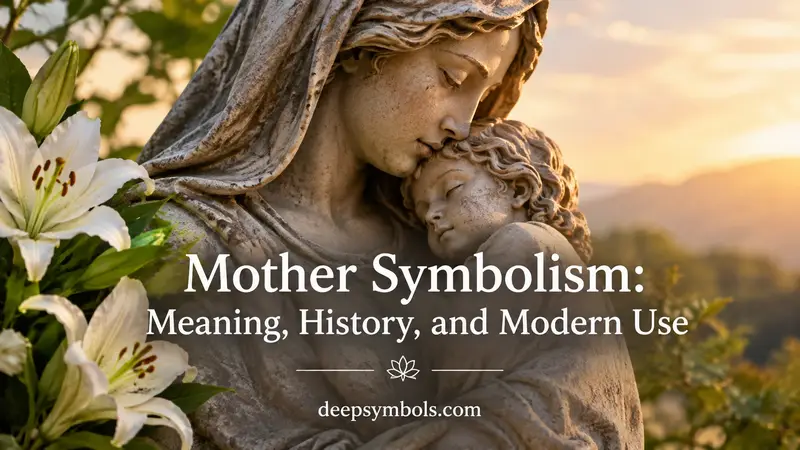
A mother often symbolizes nurture, protection, love, family, and the creation of life, which is why mother symbolism remains so recognizable in American culture. Beyond the personal relationship, the mother can also represent home, fertility, sacrifice, memory, belonging, and the responsibility of caring for others.
People encounter maternal symbolism in religious art, family photographs, jewelry, tattoos, literature, advertising, holidays, and public memorials. The familiar image of a mother holding or protecting a child can communicate affection immediately, but the meaning is not always sentimental. Motherhood has also represented authority, grief, endurance, social responsibility, and even the land itself.
Quick Answer
Mother symbolism commonly represents love, nurturing, protection, family, and emotional security in modern American culture, especially in family traditions, Mother’s Day, art, and personal keepsakes. Historically, motherhood has also symbolized fertility, creation, caregiving, spiritual protection, and the continuity of life across religious and cultural traditions.
TL;DR
- Mothers commonly symbolize love, care, protection, and family.
- Ancient traditions connected motherhood with fertility and creation.
- American culture often links mothers with home and sacrifice.
- Religious imagery expands maternal symbolism beyond biological motherhood.
- Modern tattoos and keepsakes emphasize memory, identity, and personal bonds.
- Motherhood can also symbolize grief, resilience, authority, and responsibility.
What Mother Symbolism Represents Today
The most familiar maternal symbol is a person who gives care and protection to someone vulnerable. A mother holding a baby, a hand resting on a child’s shoulder, or a family portrait can communicate safety without requiring explanation.
In the United States, motherhood is frequently associated with home, emotional support, patience, sacrifice, and unconditional care. These associations appear in greeting cards, Mother’s Day advertising, films, novels, family photography, and personal memorials.
Yet motherhood does not have one universally accepted meaning. For one person, a mother may represent comfort and belonging. For another, the image may bring grief, complicated family memories, adoption, separation, infertility, or the memory of a mother who has died.
That personal dimension matters because maternal symbolism is often rooted in lived experience rather than abstract mythology.
Ancient Roots and the Idea of the Mother as Creator
One of the oldest recurring maternal ideas is the connection between motherhood and the creation or continuation of life.
Ancient societies developed stories about female deities associated with fertility, birth, agriculture, protection, and the natural world. Egyptian, Mesopotamian, Greek, Roman, South Asian, and other traditions contain maternal divine figures, although their roles differed considerably from one culture to another.
Modern discussions sometimes describe all these figures collectively as versions of a universal “Great Mother.” That comparison can be useful psychologically, but it can also flatten important cultural differences. Ancient goddesses were not interchangeable symbols, and their identities depended on specific religious traditions.
Still, one broad pattern appears repeatedly: the ability to give life became a metaphor for creation itself. A mother could therefore symbolize not only childbirth but crops, the earth, abundance, protection, and renewal.
The Mother as Protection and Shelter
Protection is one of the strongest maternal associations.
The symbolism becomes especially clear in visual art. A mother wrapping a child in her arms suggests physical safety, while a mother standing beside a child can imply guidance and vigilance. The child does not need to be an infant for the symbolism to work.
This protective meaning also explains why maternal imagery sometimes appears alongside symbols of shelter, such as houses, trees, blankets, nests, gardens, or enclosed spaces.
Psychologically, the mother figure can become associated with the first environment in which a person experiences dependence and care. Carl Jung’s discussion of the mother archetype expanded this idea beyond the biological mother, connecting maternal imagery with nourishment, fertility, growth, shelter, and places that sustain life.
That does not mean every person experiences motherhood as safe. Psychological symbolism is shaped by individual experience, so maternal imagery can evoke either security or vulnerability.
Motherhood in American Culture
Motherhood has held an especially visible place in American cultural ideals.
In early American history, motherhood was not simply a private family role. Ideas about motherhood became connected with morality, family order, citizenship, and women’s expected behavior. At the same time, those ideals were shaped by race, class, freedom, and social status, meaning that the celebrated image of the “ideal mother” never represented all American women equally.
Over time, the cultural image of the American mother expanded beyond homemaking. Mothers came to be portrayed as educators, workers, advocates, caregivers, organizers, and community leaders.
That evolution changed the symbolism as well. The mother could represent both care within the household and influence beyond it.
This is one reason maternal imagery can appear in political speeches, social campaigns, public monuments, and stories about national hardship. The “mother” can symbolize care for an entire community rather than only one family.
Mother’s Day and the Symbolism of Appreciation
Perhaps nowhere is maternal symbolism more visible in the United States than on Mother’s Day.
The American holiday emerged from several different traditions. Julia Ward Howe promoted a peace-oriented Mother’s Day appeal in the nineteenth century, while Anna Jarvis later organized a memorial observance honoring her mother. In 1914, Mother’s Day became a national observance on the second Sunday of May.
The symbolism of the holiday gradually became associated with flowers, cards, meals, gifts, photographs, and expressions of gratitude.
Those traditions reinforce several common ideas:
| Context | Meaning in the USA | Common Associations | Notes |
|---|---|---|---|
| Mother’s Day | Appreciation and gratitude | Flowers, cards, gifts | Often celebrates caregiving as well as motherhood |
| Mother-and-child art | Love and protection | Holding, embracing, nursing | Meaning can vary with the artist and culture |
| Memorial jewelry | Remembrance and connection | Names, birthstones, photographs | Frequently used after a mother’s death |
| Tattoos | Identity and devotion | Names, dates, portraits, flowers | Usually highly personal rather than universal |
| Literature and film | Family, sacrifice, conflict | Home, separation, reunion | Mothers may be nurturing, flawed, absent, or heroic |
Mother’s Day also reveals an important tension: the holiday celebrates mothers, but popular culture can sometimes reduce motherhood to self-sacrifice. Contemporary Americans increasingly recognize that caregiving has emotional, economic, and practical costs, complicating the older ideal of the endlessly giving mother.
Religious Meanings of the Mother Figure
Maternal symbolism is prominent in several religious traditions, but it takes different forms.
In Christianity, Mary is one of the most influential maternal figures in religious art and devotion. Images of Mary holding the infant Jesus emphasize tenderness, care, humility, and protection. Christian traditions also developed imagery of Mary as a mother to believers, giving maternal language a spiritual dimension that extends beyond biological motherhood.
Other Christian imagery can also use maternal language for the Church, divine care, or spiritual nourishment, although these meanings vary considerably among denominations.
In Hindu traditions, divine motherhood can take forms that combine nurturing and fierce protection. The feminine divine may be portrayed as a source of life while also possessing the ability to destroy threats and restore order. This means maternal symbolism does not always imply softness; it can also represent strength, authority, and defense.
The broader lesson is that “mother” in religious symbolism can mean much more than biological parenthood. It can describe a source of life, protection, spiritual belonging, or moral care.
The Earth as a Mother Symbol
The phrase “Mother Earth” reflects one of the oldest ways people have used maternal language symbolically.
Earth provides food, water, shelter, and the conditions necessary for life, making the maternal metaphor easy to understand. Soil can be imagined as a place from which life emerges, much like a child develops within a mother’s body.
In modern American environmental culture, “Mother Earth” can therefore symbolize stewardship, interdependence, fertility, and responsibility toward nature.
The metaphor also changes the moral question. If the earth is imagined as a mother rather than merely as a resource, environmental damage can be framed as a failure of care rather than only a technical or economic problem.
The Emotional Psychology of Mother Symbolism
Mother imagery can trigger unusually strong emotional responses because motherhood is frequently tied to early experiences of dependence and attachment.
For people with supportive childhood relationships, a mother symbol may suggest reassurance, acceptance, and belonging. For others, it may represent absence, disappointment, loss, or an unresolved relationship.
This explains why two people can see the same mother-and-child image and interpret it completely differently.
Jungian psychology is particularly influential in discussions of maternal archetypes, where the mother can represent nurturing and fertility while also having a darker or more threatening aspect. The maternal figure may symbolize something that sustains life, but also something that controls, overwhelms, or refuses separation.
That duality makes maternal symbolism more realistic than the simplified image of the endlessly loving mother.
Mother Symbolism and Sacrifice
American popular culture often connects motherhood with sacrifice.
This idea appears in stories about mothers working multiple jobs, protecting children during crises, putting family needs ahead of their own, or enduring hardship for their children.
There is genuine emotional truth behind some of these stories, but the symbolism can become restrictive when sacrifice is treated as the defining requirement of a “good mother.”
Modern interpretations increasingly make room for boundaries, ambition, independence, and self-care. A mother can represent devotion without symbolizing the disappearance of her own identity.
This shift is particularly important in contemporary discussions of working mothers, single parents, adoptive parents, and families that divide caregiving responsibilities differently from older household models.
The Mother as a Symbol of Identity and Belonging
Mother symbolism can also represent where a person comes from.
A mother’s name, handwriting, photograph, recipe, jewelry, clothing, or favorite flower may become an emblem of family history. These objects preserve stories that might otherwise disappear across generations.
That is why maternal symbols frequently appear in family heirlooms and memorial objects. The object is not necessarily valuable because of its material cost. Its value comes from the relationship attached to it.
The symbolism becomes especially strong after a mother’s death. A photograph may represent memory; a piece of jewelry may become a tangible connection; a familiar recipe can preserve everyday knowledge.
Motherhood, in this sense, can symbolize continuity between generations.
Why Mothers Appear in Tattoos and Personal Style
Mother tattoos are common because the meaning can be extremely specific.
A tattoo might feature a mother’s name, a birth date, a portrait, a handwritten phrase, flowers associated with her, or a small symbol that only family members understand.
Unlike standardized symbols, these tattoos often function as private visual language.
A rose may represent a mother’s favorite flower. A birthstone may mark a shared family month. A heart may express affection, while a date may commemorate either a birth or a death.
The same principle applies to necklaces, bracelets, rings, lockets, and engraved gifts. Maternal symbolism in personal style is usually less about a universal symbolic dictionary and more about making a relationship visible.
Mothers in Literature, Film, and Popular Culture
American storytelling offers many different versions of the mother.
Some mothers are nurturing anchors who keep families together. Others are ambitious, flawed, absent, strict, rebellious, protective, or emotionally complicated.
That variety matters because popular culture has gradually moved away from portraying mothers only as morally flawless caregivers.
A fictional mother can now represent family pressure, generational conflict, economic struggle, personal independence, grief, or changing expectations about gender and parenting.
This makes maternal symbolism especially flexible. The mother can represent the ideal of home while simultaneously becoming a character through whom audiences question what “home” actually means.
Positive and Negative Forms of Mother Symbolism
Mother symbolism is often presented positively, but it has a clear shadow side.
On the positive side, maternal imagery can suggest:
- compassion
- protection
- generosity
- patience
- fertility
- belonging
- guidance
- resilience
- continuity
Negative or conflicted interpretations can include:
- overprotection
- control
- dependence
- guilt
- emotional pressure
- possessiveness
- loss of individuality
These interpretations are especially visible in psychology and literature, where the mother is not required to be idealized.
Calling a symbol “positive” or “negative” without context can therefore be misleading. The meaning depends on the story surrounding the maternal figure.
Common Misunderstandings About Mother Symbolism
One common mistake is assuming that all motherhood symbolism comes from ancient religion. In reality, modern meanings have also been shaped by family life, psychology, literature, advertising, social movements, and national holidays.
Another mistake is treating the mother archetype as proof that every culture understands motherhood in exactly the same way. Cultures have developed different family structures, religious ideas, parenting traditions, and expectations for women.
It is also inaccurate to assume that every person associates motherhood with comfort. Adoption, estrangement, infertility, pregnancy loss, bereavement, and difficult family relationships can give maternal symbols entirely different emotional meanings.
Finally, motherhood should not automatically be equated with biological parenthood. In everyday American life, maternal roles can be fulfilled through adoption, stepfamilies, grandmothers, foster care, chosen family, and other caregiving relationships.
How Mother Symbolism Has Evolved
The symbolic mother has changed from an image focused heavily on fertility and household care into a much broader cultural figure.
Older religious and mythological traditions often emphasized birth, nourishment, fertility, or divine protection. American cultural history added ideas about domestic virtue, family morality, and national identity. Contemporary culture has expanded the picture further, making room for professional identity, independence, emotional complexity, and diverse family structures.
The result is not the disappearance of older symbolism but its expansion.
A mother may still symbolize home and protection, while also representing leadership, resilience, memory, activism, or personal identity. The same image can carry several of these meanings simultaneously.
FAQs
What does a mother symbolize spiritually?
A mother can symbolize creation, nourishment, protection, compassion, and spiritual belonging. In religious traditions, maternal figures may also represent divine care, fertility, wisdom, or protection from harm.
What does a mother tattoo symbolize?
A mother tattoo commonly represents love, gratitude, remembrance, family identity, or devotion. Names, dates, portraits, handwriting, flowers, and birthstones can make the symbolism highly personal.
What does a mother symbolize in American culture?
In the United States, mothers commonly symbolize family, caregiving, emotional support, sacrifice, and home. Modern interpretations increasingly include independence, work, resilience, and different forms of family life.
Does motherhood always have a positive symbolic meaning?
No. Motherhood can also symbolize control, dependence, grief, guilt, conflict, or loss. Personal experience strongly influences whether maternal imagery feels comforting or painful.
What does the mother archetype mean in psychology?
In Jungian psychology, the mother archetype represents patterns associated with nurturing, fertility, growth, protection, and dependence. It can also have a darker side involving control, engulfment, fear, or unresolved emotional conflict.
Why is Mother’s Day so strongly connected with symbolism?
Mother’s Day uses flowers, cards, gifts, family gatherings, and remembrance to make appreciation visible. In the United States, the holiday grew from several nineteenth- and early-twentieth-century efforts before becoming a national observance in 1914.
Conclusion
Mother symbolism is ultimately about connection, care, protection, creation, memory, and belonging. It can describe a deeply personal relationship with a mother, honor someone who provided care, or represent the broader work of sustaining family and community. The Smithsonian Institution’s collection on motherhood shows how maternal relationships have been represented through art and visual culture across different people and experiences.
That range matters because motherhood does not have one universal emotional story. For one person, a mother symbol may represent safety and affection; for another, it may evoke sacrifice, resilience, loss, memory, or a complicated family history.
Ultimately, mother symbolism remains meaningful because it can honor care without simplifying the person behind it. Its strongest meaning comes from the relationship, experience, and story that the symbol is being used to remember or express.