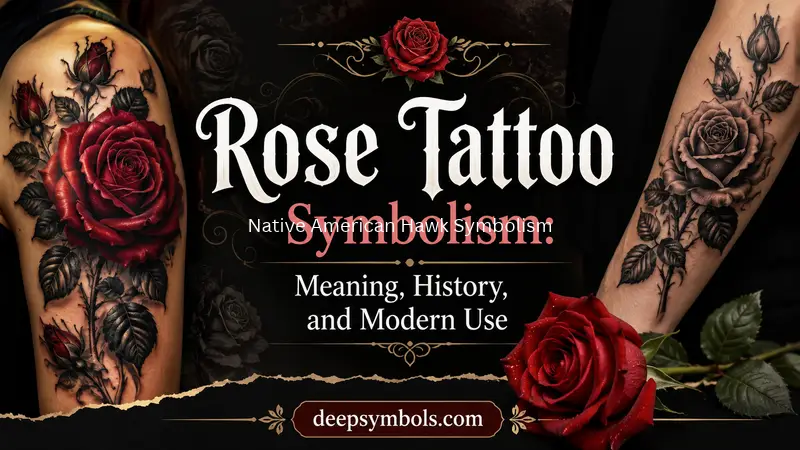
A rose tattoo is one of the most recognizable floral designs in American tattoo culture. Rose tattoo symbolism can express love, remembrance, beauty, devotion, grief, or personal strength, depending on the flower’s color, style, accompanying imagery, and the reason the wearer chose it.
The rose carries this flexibility because its symbolic history existed long before modern tattooing. Ancient Mediterranean traditions connected roses with love and desire, Christian traditions gave the flower religious associations, and Victorian flower language helped establish particular color meanings in English-speaking culture. By the 20th century, American tattoo artists had transformed the rose into a defining image of traditional tattoo art. (For how the rose functions as a symbol outside tattooing specifically, see our broader guide to rose symbolism.)
Today, an American may choose a rose tattoo simply because they appreciate its appearance. Others use it to remember someone, mark a relationship, represent personal growth, honor family, express faith, or acknowledge the mixture of beauty and hardship in their lives.
Quick Answer
Rose tattoo symbolism commonly represents love, devotion, remembrance, and beauty in modern American culture, especially when the design honors a person, relationship, or meaningful life experience. Historically, roses have also been associated with desire, secrecy, religious devotion, purity, mourning, and the tension between beauty and danger.
TL;DR
- Roses commonly represent love, remembrance, beauty, and devotion
- Thorns can suggest protection, hardship, sacrifice, or emotional boundaries
- Red roses usually carry romantic or passionate associations
- American traditional tattooing made the rose a classic tattoo image
- Black, white, pink, and yellow roses can suggest different intentions
- Modern meanings depend heavily on design, color, and personal experience
What Does a Rose Tattoo Commonly Mean?
The most common interpretation is love. A rose can represent romantic affection, loyalty to a partner, family love, friendship, or appreciation for someone important. But reducing every rose tattoo to romance misses much of its meaning — the same flower can commemorate someone who has died, represent faith, mark personal transformation, or express resilience just as easily.
The thorns matter too, and get a fuller treatment later on: a rose combines a soft, attractive flower with sharp natural defenses, and that contrast alone lets a tattoo communicate the idea that beauty and vulnerability can coexist with strength and self-protection. For some wearers, the thorns are actually the most meaningful part of the design.
Where Rose Symbolism Comes From
The rose already carried a large symbolic vocabulary by the time tattoo artists began using it extensively, and that inherited history is worth tracing directly.
In ancient Greek and Roman tradition, the flower was connected with love and with deities associated with love — Aphrodite and Venus chief among them — making the rose a natural emblem of desire and beauty from a very early point. Roman culture also gave the rose an association with secrecy through the expression sub rosa, or “under the rose,” used in social and ceremonial contexts where confidentiality mattered.
Christian tradition later folded the rose into religious imagery on top of that classical foundation. The flower could represent purity and divine love, and in some devotional traditions the Virgin Mary became associated with the title “Mystical Rose” — a connection explored more fully in the Religious and Spiritual Meanings section below. European literature, meanwhile, kept the rose firmly tied to romantic desire and beauty across the same centuries, running in parallel with its religious symbolism rather than replacing it.
None of this adds up to one continuous, universal definition. Different cultures and periods used the rose differently, and what matters most for tattoo symbolism is simply that the flower accumulated associations with both earthly affection and spiritual devotion over a very long stretch of time — which is exactly why a rose tattoo can feel equally appropriate for a romantic tribute, a memorial, or a faith-based design without needing to mean the same thing in each case.
Victorian Flower Language and Rose Colors
Victorian floriography gave flowers an organized symbolic vocabulary. From the early 19th century onward, books and social customs encouraged people to use flowers as coded expressions of affection and emotion, a practice popular in Britain, France, and North America alike. Rose colors in particular became recognizable enough to survive into modern tattoo interpretation almost unchanged.
| Rose Design | Common U.S. Association | Common Associations | Notes |
|---|---|---|---|
| Red rose | Love and passion | Romance, devotion, desire | The most familiar romantic reading |
| Pink rose | Affection and tenderness | Gratitude, admiration, gentleness | Often feels softer than red |
| White rose | Purity and remembrance | Innocence, peace, new beginnings | Can also appear in memorial designs |
| Yellow rose | Friendship and warmth | Joy, companionship, optimism | Usually less romantic than red |
| Black or dark rose | Mourning or change | Loss, farewell, transformation | Meaning is highly personal |
| Thorned rose | Resilience and protection | Pain, boundaries, sacrifice | Often emphasizes the flower’s duality |
These associations are cultural conventions rather than fixed rules. A person can choose a red rose to honor a parent rather than a romantic partner, or a black rose to represent survival rather than grief.
Rose Tattoos in American Culture
The rose has an unusual double life in American symbolism — official on one hand, deeply personal on the other. In the United States, the flower is closely connected with romance, Valentine’s Day, weddings, anniversaries, memorials, and tattoo culture broadly, and it also became the official national floral emblem of the United States in 1986, adding a layer of civic symbolism most tattoo wearers probably aren’t thinking about when they choose the design.
American tattoo culture gave the rose an identity distinctly its own, though, largely through the American Traditional movement. Artists such as Norman “Sailor Jerry” Collins helped popularize bold rose designs during the mid-20th century, developing the style within a broader maritime and American tattoo culture where roses could be combined with names, banners, hearts, anchors, daggers, and other motifs. Traditional American tattooing’s bold outlines, strong shapes, and limited color palettes suited the rose exceptionally well, since its petals, leaves, and thorns stayed recognizable even simplified down to their essential shapes — a traditional rose with a banner, for instance, could function as a memorial, a declaration of love, or a tribute to a specific person, all using the same visual vocabulary.
This history explains why roses remain so common in American tattoo flash today. The design is visually clear, adaptable to many body locations, and capable of carrying additional imagery without losing its identity — which is also why a traditional rose can communicate something noticeably different from a delicate botanical tattoo of the same flower. The subject is identical; the artistic language changes the emotional impression entirely.
Rose Tattoos as Memorials
A rose doesn’t have to symbolize romantic love. Memorial rose tattoos are common because the flower can connect affection with loss at once — a wearer might incorporate a loved one’s name, initials, birth date, death date, or a meaningful phrase directly into the design.
A white rose may suggest remembrance or peace, while a dark or black rose can emphasize grief and absence instead. A rose alongside a portrait, cross, angel, or date makes the memorial interpretation more explicit still. The symbolism works especially well here because roses already have a long relationship with both love and mourning simultaneously — a person may permanently wear a rose because the relationship it represents continues emotionally even after someone has died.
Religious and Spiritual Meanings
Roses can carry religious meaning, particularly within Christian visual tradition. Christian art has used the rose to represent purity, divine love, martyrdom, and devotion, and Marian symbolism sometimes describes Mary as the “Mystical Rose” specifically — the tradition introduced above — with the rose also appearing more broadly in imagery associated with spiritual beauty and sacrifice.
A rose tattoo paired with a cross, rosary, praying hands, or other Christian imagery can therefore communicate faith or religious devotion clearly. A rose alone, though, shouldn’t automatically be read as a religious symbol — in contemporary American tattoo culture, most rose tattoos are more likely interpreted through personal, romantic, aesthetic, or memorial meaning unless other religious elements make the intention explicit.
The Emotional Psychology of the Rose
The rose works emotionally because its appearance contains a built-in contradiction: petals that are soft and visually delicate, thorns that are sharp and defensive. That combination gives the flower an obvious metaphor for vulnerability and defense existing in the same image at once.
A person who has experienced hardship might use a thorned rose to represent resilience without choosing an overtly aggressive image instead. Someone celebrating recovery or a major life change may use a blooming rose to suggest development and renewal. A closed bud can suggest something not yet revealed, while a fully opened flower can imply maturity, expression, or fulfillment. None of these interpretations are universal psychological rules — they’re simply ways people use a familiar visual contrast to tell a personal story through a shared symbol.
What Different Rose Styles Can Communicate
The artistic treatment can change the impression of the tattoo considerably. American Traditional reads as bold, confident, nostalgic, and connected with classic U.S. tattoo culture. Fine-line rose designs feel more delicate, understated, and contemporary — often intimate or purely decorative. Realistic rose tattoos emphasize the actual appearance of the flower and can create a strong memorial or personal-portrait effect. Blackwork rose designs use dark ink and contrast for a more dramatic, minimalist, or serious impression. Watercolor rose tattoos often feel expressive and artistic, with less emphasis on traditional tattoo convention. Gothic rose treatments lean darker, emphasizing mortality, grief, transformation, or the contrast between beauty and darkness directly.
None of these styles carries one mandatory meaning on its own. The style sets a visual tone; the wearer supplies the personal significance.
Why Rose Tattoos Appear With Other Symbols
Rose tattoos frequently appear beside objects that clarify or complicate their meaning. A rose and dagger can suggest love, betrayal, sacrifice, danger, or the coexistence of beauty and violence. A rose and skull often creates a contrast between beauty and mortality, representing remembrance, death, or the temporary nature of life. A rose and cross combines affection, sacrifice, faith, and Christian devotion in one image. A rose and butterfly tends to emphasize transformation, beauty, and personal change. A rose with a name or date usually makes the tattoo more explicitly commemorative than any of the above.
The important point is that the accompanying symbol doesn’t simply add another separate definition alongside the rose’s own meaning — together, the images create one new visual statement that neither element would communicate alone.
How Rose Tattoos Are Used Today
Modern American tattoo culture has expanded the rose far beyond traditional flash. People now choose roses for sleeves, fine-line wrist tattoos, small ankle pieces, chest designs, back pieces, and highly detailed botanical compositions, and social media has made many different styles familiar to people who might never have encountered them through older tattoo tradition directly.
Some people choose roses for purely aesthetic reasons. Others intentionally research color symbolism, combine the flower with personal dates, or adapt the design to represent family heritage. Rose imagery also appears well outside tattooing — in jewelry, clothing, home decoration, wedding arrangements, stationery, digital graphics, and memorial objects — and its recognizability is exactly why designers reach for it whenever they need to communicate affection, beauty, romance, or remembrance quickly.
Common Misunderstandings About Rose Tattoo Symbolism
The biggest misunderstanding is that every rose tattoo has one fixed meaning. It doesn’t — a rose doesn’t automatically mean romantic love, and a black rose doesn’t automatically mean death. Color traditions can influence interpretation, but individual intention usually matters more than the color chart alone.
Another misconception is that tattoo placement creates a universal symbolic code. While certain placements may be culturally associated with visibility or privacy, there’s no universal rule saying a rose on one body part carries a completely different meaning than the same rose placed elsewhere. Finally, the presence of thorns shouldn’t automatically be read as anger or aggression — for many wearers, thorns simply acknowledge that love, beauty, and meaningful relationships can involve vulnerability and difficulty at the same time.
How Rose Tattoo Meaning Has Evolved
The rose has changed without abandoning its older associations along the way. Ancient Mediterranean tradition emphasized love, beauty, desire, and secrecy. Christian tradition added religious and devotional interpretation on top of that. Victorian flower language gave roses more specific emotional associations by color. American tattoo artists then translated the flower into a bold visual vocabulary suited to skin rather than paper.
Contemporary tattoo culture has made the symbol even more personal since. Today, a rose can represent a relationship, a family member, a personal transformation, a memory, a faith tradition, or simply an appreciation of the flower itself — and digital culture has accelerated the exchange of tattoo styles further, letting American tattoo imagery coexist comfortably with Japanese, fine-line, botanical, realism, and other artistic approaches. The result isn’t the disappearance of traditional symbolism; it’s an expansion of it into more forms than the flower has ever had at once.
FAQs
What does a rose tattoo mean for a woman?
A rose tattoo doesn’t have a meaning determined by gender. It may represent love, family, remembrance, independence, beauty, personal growth, or simply an appreciation for floral art.
What does a red rose tattoo symbolize?
A red rose tattoo most commonly suggests romantic love, passion, devotion, or strong emotional attachment. In a memorial design, however, the same red rose can represent enduring love for someone who has died.
What does a black rose tattoo symbolize?
A black rose can represent mourning, loss, farewell, change, or a darker aesthetic. Some people use it to mark the end of a difficult period rather than to symbolize death.
Does a rose tattoo always mean love?
No. Love is the most familiar association, but roses can also symbolize remembrance, faith, friendship, resilience, beauty, grief, and personal transformation.
What does a rose tattoo with thorns mean?
Thorns often emphasize protection, hardship, boundaries, sacrifice, or the idea that beauty can coexist with pain. The interpretation depends on the wearer’s personal story and the rest of the design.
What does a rose tattoo mean in American Traditional style?
In American Traditional tattooing, roses commonly appear as symbols of love, remembrance, loyalty, and personal devotion. Their bold outlines and classic colors also connect them with the history of American maritime and working-class tattoo art.
Is a rose tattoo religious?
It can be, but it’s not inherently religious. Roses have Christian associations, particularly in Marian and devotional symbolism, yet most modern rose tattoos in the United States are interpreted according to personal, romantic, memorial, or artistic context.
Conclusion
Rose tattoos remain meaningful because the flower can hold opposing ideas without becoming confusing: beauty alongside thorns, affection alongside loss, vulnerability alongside protection. Its long history in mythology, religion, literature, flower language, and American tattooing gives the image a broad cultural vocabulary. The Smithsonian Gardens’ history of the language of flowers also shows how roses became associated with love and passionate emotion through Victorian-era floriography, helping explain why those meanings remain recognizable today.
Ultimately, rose tattoo symbolism is less about following a single dictionary definition and more about choosing which part of that vocabulary belongs to your story. A rose can honor love, preserve a memory, mark change, express faith, or simply celebrate an image that has remained recognizable across generations. Understanding the flower’s history can make that personal choice even more meaningful, especially when the tattoo combines traditional rose imagery with colors, thorns, names, dates, or other symbols.