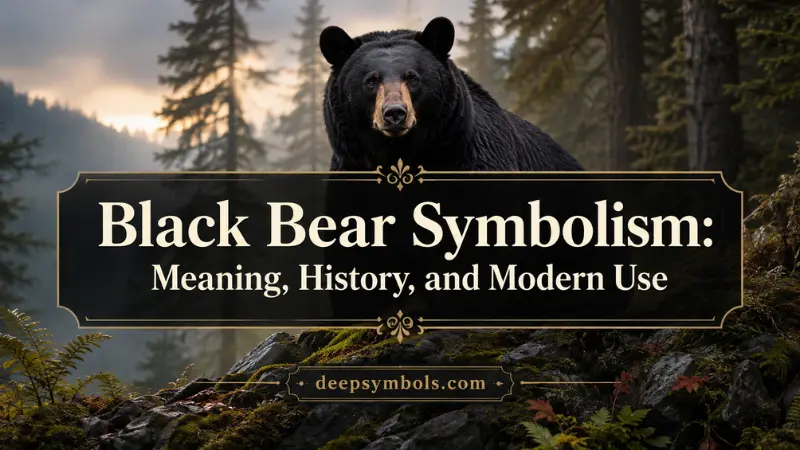
Black bear symbolism is closely connected with qualities Americans often associate with the animal itself: strength, independence, protection, resilience, and a strong connection to the natural world. The American black bear (Ursus americanus) is one of North America’s most widely distributed mammals, appearing in forests, mountains, wetlands, and even areas near human communities.
People encounter the black bear in far more places than wildlife documentaries. It appears on outdoor clothing, conservation logos, sports mascots, children’s stories, tattoos, artwork, souvenirs, and regional imagery. For many Americans, the animal represents wilderness and self-reliance, while for others it carries older cultural associations involving healing, family, courage, and respect for nature.
Understanding its symbolism requires some care. There is no single universal “black bear meaning.” Indigenous nations have distinct traditions, and modern American culture has added new interpretations through folklore, conservation, popular entertainment, and personal expression.
Quick Answer
Black bear symbolism commonly represents strength, independence, protection, resilience, and a close relationship with nature in modern American culture. Historically, bears have also held important roles in Indigenous North American stories, ceremonies, place names, and relationships between people and the natural world.
TL;DR
- Black bears commonly symbolize strength, independence, and resilience.
- Indigenous traditions give bears varied and culturally specific meanings.
- Their wilderness association strongly shapes modern American symbolism.
- Black bear imagery often represents protection and family.
- Hibernation can suggest renewal, retreat, and seasonal transformation.
- Tattoos and outdoor designs often emphasize freedom and nature.
What the Black Bear Represents in American Culture
In the United States, the black bear is often understood first as a symbol of strength without constant aggression. Unlike the stereotypical image of a predator that dominates through force, black bears are adaptable omnivores capable of climbing, foraging, swimming, and changing their behavior according to their environment.
That combination creates an interesting symbolic profile. A black bear can represent physical strength while also suggesting patience, adaptability, and independence.
The animal’s connection with wilderness is equally important. Seeing a black bear immediately brings forests, mountains, national parks, camping, and remote landscapes to mind. As a result, black bear imagery frequently communicates a desire to remain connected to the outdoors.
For some people, the symbol also represents knowing when to stand one’s ground and when to withdraw. A bear does not need to be constantly active to survive. Its seasonal rhythms provide a natural metaphor for conserving energy, protecting oneself, and returning to activity when circumstances are favorable.
Why Strength Is One of Its Central Meanings
Strength is perhaps the most straightforward association with the black bear.
An adult black bear can be large, muscular, fast, and remarkably capable in difficult terrain. Its claws, climbing ability, sense of smell, and physical endurance make it an imposing animal even though it is generally smaller than the North American grizzly.
Symbolically, this physical reality has translated into ideas about inner strength, confidence, courage, and the ability to withstand hardship.
A black bear design therefore does not necessarily communicate aggression. Someone may choose bear imagery because they want to express quiet confidence rather than confrontation.
This distinction matters. The bear can symbolize the capacity to defend oneself without suggesting a desire for conflict.
In personal symbolism, the message might be:
“I am capable of protecting myself, but I do not need to prove my strength constantly.”
That interpretation fits particularly well with modern American ideas about resilience and self-reliance.
Independence, Solitude, and Self-Reliance
Black bears are often associated with independence because they are generally solitary animals outside particular social circumstances such as mothers raising cubs.
This has made the bear a natural symbol for people who value autonomy.
A person wearing a black bear pendant, displaying bear artwork, or choosing a bear tattoo may be expressing ideas such as:
- independence
- personal freedom
- confidence
- self-sufficiency
- comfort with solitude
- resistance to social pressure
The symbolism is especially common in outdoor culture. Someone who identifies strongly with hiking, hunting, camping, wilderness travel, or rural life may see the black bear as a representation of living close to the land rather than depending entirely on urban environments.
However, solitude does not have to mean loneliness. In this context, it can mean being comfortable with one’s own company and capable of making decisions independently.
Protection, Family, and the Mother Bear
The black bear also has a strong association with protection, particularly through the image of the mother bear defending her cubs.
This has become a familiar idea in American language and popular culture. Calling someone a “mama bear” commonly describes a parent who becomes especially protective when a child’s safety or well-being is threatened.
The symbolism therefore extends beyond physical power. The bear can represent:
- parental protection
- loyalty
- responsibility
- family bonds
- courage on behalf of others
A black bear with cubs has a different emotional message from a solitary bear. The solitary animal may emphasize independence, while a mother and cubs can communicate caregiving and family responsibility.
This duality is one reason bear imagery works across many different personal situations. The same animal can represent both independence and devotion to family.
Ancient Roots and Indigenous North American Traditions
Bears have been important to Indigenous peoples of North America for thousands of years, but it is misleading to describe all Indigenous traditions as if they shared one “Native American bear meaning.”
Different nations have their own languages, histories, ceremonies, oral traditions, and relationships with bears. In some communities, bears have been associated with healing, strength, protection, spiritual power, hunting, food, or particular ancestral and ceremonial traditions.
Archaeological and historical evidence from eastern North America shows that black bears had practical and cultural importance. They provided meat, fat, hides, bones, and other materials, while stories and ceremonial practices gave the animal meanings that went beyond its physical usefulness.
Some traditions also connect bears with healing or knowledge. In the Black Hills, for example, bear-related traditions are connected with sacred places and Lakota cultural history.
Place names provide another indication of the bear’s importance. Across North America, locations have names referring to bears, bear lodges, bear ears, or places where bears live.
These traditions should not be reduced to a single generalized spiritual definition. The most accurate conclusion is that bears have held many different cultural roles, with meanings determined by particular communities and historical contexts.
Black Bears and the American Wilderness
The black bear has become one of the clearest visual symbols of American wilderness.
National parks, wildlife refuges, forests, and mountain regions frequently use bear imagery because the animal is recognizable and strongly associated with wild landscapes. For many Americans, the sight of a black bear immediately evokes places such as the Appalachian Mountains, the Great Smoky Mountains, the Sierra Nevada, or other forested regions where black bears live.
This gives the animal a symbolic meaning beyond individual character traits.
The black bear can represent untamed nature itself.
That association has become especially important as conservation has changed the relationship between Americans and wildlife. Black bears once disappeared from or declined sharply in portions of their historic range because of habitat loss, hunting, and human persecution. In many regions, conservation and changing land-use patterns have allowed populations to recover.
Consequently, the modern black bear can also symbolize coexistence between people and wildlife.
Hibernation, Rest, and Renewal
One of the most interesting symbolic associations comes from the black bear’s winter denning behavior.
Black bears enter a prolonged period of reduced activity during winter. Although scientists often distinguish bear dormancy from the classic definition of hibernation, ordinary American language commonly describes the behavior as hibernation.
Symbolically, this creates an obvious metaphor for rest, retreat, renewal, and preparation.
The bear does not remain inactive forever. It withdraws during a difficult season and later emerges to resume feeding, moving, and reproducing.
For people, this can represent the idea that rest is part of survival rather than a sign of weakness.
A black bear symbol may therefore be meaningful to someone recovering from a difficult period, beginning a new chapter, or intentionally stepping away from constant activity.
The seasonal cycle gives the symbol a useful message: periods of withdrawal can prepare a person for renewed activity.
Black Bear Symbolism and Emotional Strength
The emotional symbolism of the black bear is often more nuanced than simple “strength.”
The animal can represent the ability to tolerate uncertainty, protect personal boundaries, and remain grounded under pressure.
Its symbolism may appeal particularly to people who see emotional strength as something quiet rather than dramatic.
A bear standing alone in a forest, for example, can communicate calm confidence. A bear emerging from winter can suggest recovery. A bear with cubs can represent protective love. A bear in motion can emphasize determination and independence.
This flexibility makes black bear imagery useful for expressing personal experiences that are difficult to communicate with words.
The symbol can essentially become a visual statement about how someone wants to face life: strong, self-directed, protective, and connected to the natural world.
Black Bear Symbolism in Tattoos and Personal Style
Black bear tattoos are popular because the animal can be interpreted in several personal ways without requiring an elaborate symbolic system.
A realistic black bear may represent a love of wildlife, wilderness, or a particular place. A bear with cubs can emphasize family. A roaring bear may communicate courage or defense, while a calm bear can suggest confidence and self-control.
Tattoo placement can also influence interpretation, although there is no fixed symbolic rule.
A person may choose black bear imagery after surviving a difficult experience, moving away from dependence on others, becoming a parent, reconnecting with nature, or simply developing a strong personal attachment to bears.
Outdoor brands and personal fashion similarly use bear imagery to communicate ruggedness, adventure, independence, and regional identity.
In these modern settings, the meaning usually comes from the individual’s intention rather than from an ancient symbolic code.
Black Bears in American Folklore and Popular Culture
The black bear has a substantial presence in American storytelling.
Bears appear in children’s literature, folklore, cartoons, advertising, toys, sports imagery, and movies. The famous teddy bear is one of the most recognizable examples of how American culture can transform an animal associated with wilderness into a symbol of childhood comfort.
This creates an interesting contrast.
The real black bear is a wild animal that deserves distance and respect. The teddy bear, by contrast, represents softness, security, affection, and childhood.
Popular culture has therefore created two very different emotional images of bears: the wild protector and the comforting companion.
This contrast helps explain why bear imagery can feel both rugged and friendly. A black bear on a national park sign communicates wilderness, while a stylized bear on children’s merchandise can communicate warmth and safety.
How Black Bear Meanings Compare Across Contexts
| Context | Meaning in the USA | Common Associations | Notes |
|---|---|---|---|
| Wilderness | Nature and independence | Forests, mountains, freedom | Strongly connected with outdoor culture |
| Family | Protection and loyalty | Mother bear, cubs, caregiving | Often used for parental identity |
| Personal growth | Resilience and renewal | Winter rest, emergence | Reflects seasonal behavior |
| Tattoos | Strength and individuality | Courage, freedom, identity | Meaning depends heavily on design |
| Conservation | Wildlife and coexistence | National parks, habitat | Highlights the animal as a living species |
Religious and Spiritual Interpretations
There is no single religious meaning assigned to the black bear across the United States.
Some Indigenous traditions have sacred or ceremonial relationships with bears, but those traditions belong to specific peoples and should not be combined into one generalized “Native American spirituality.”
In broader contemporary spiritual culture, people sometimes interpret bears as symbols of protection, grounding, courage, or introspection. These interpretations are modern and personal rather than universal religious teachings.
The distinction is important because symbolic websites and social media posts sometimes present one generalized bear meaning as though it represents every Indigenous tradition. That approach can erase meaningful differences between nations and communities.
A respectful interpretation recognizes that some bear traditions are culturally specific and should be understood within their own histories.
What the Color Black Adds to the Symbol
The black bear’s name creates another layer of symbolism, although the animal itself is not necessarily black. American black bears can have black, brown, cinnamon, blonde, gray, and other coat colors.
In symbolic artwork, however, a black-colored bear can combine bear symbolism with common Western associations of the color black.
Black may suggest seriousness, authority, mystery, formality, mourning, or visual strength depending on context. When combined with a bear, these associations can make the image appear more imposing or dramatic.
This does not mean that a black bear automatically symbolizes darkness or death. The animal’s established symbolism generally remains more important than the literal color.
For example, a black bear silhouette in a wilderness logo may simply represent wildlife and rugged outdoor identity.
Black Bear Symbolism in Modern American Identity
Today, black bear imagery can communicate regional identity as much as personal symbolism.
Communities surrounded by bear habitat sometimes use bears in local signs, souvenirs, festivals, businesses, and public imagery. Outdoor enthusiasts may use bear designs to signal an attachment to forests and wilderness.
Sports teams and schools also use bears as mascots because the animal provides an immediately recognizable image of determination, toughness, and competitive spirit.
Conservation organizations use the image differently. In that context, the bear represents biodiversity, habitat protection, and the responsibility to coexist with wildlife.
This range of uses shows how symbolism changes according to context. The same animal can represent competition on a sports field, family in a tattoo, wilderness on a national park sign, and conservation in a wildlife campaign.
Common Misunderstandings About Black Bear Symbolism
One common mistake is assuming that every bear symbolizes aggression. Black bears are capable of defending themselves and can be dangerous, but their symbolic meaning is not limited to violence.
Another misconception is that black bears are always black. The species name refers to the species, not a guaranteed coat color.
It is also inaccurate to assume that all Indigenous peoples share one bear mythology. North American Indigenous nations have distinct cultural traditions, and bear symbolism varies considerably between communities.
Finally, symbolic meanings should not replace knowledge about real animals. A black bear may represent protection or strength in artwork, but a wild black bear should still be treated as wildlife rather than as a friendly symbolic creature. Human feeding and habituation can create serious problems for both bears and people.
Positive and Negative Meanings of the Black Bear
Most modern uses of black bear imagery are positive, but the symbol can carry contrasting meanings.
Positive interpretations include:
- strength
- courage
- independence
- protection
- resilience
- family loyalty
- wilderness
- renewal
- self-confidence
- adaptability
Less positive interpretations may include:
- aggression
- isolation
- stubbornness
- unpredictability
- excessive independence
- territorial behavior
These negative meanings usually arise from the bear’s physical power or solitary behavior rather than from a universal cultural tradition.
The interpretation depends heavily on how the bear is depicted. A sleeping bear suggests something very different from a charging bear. A mother with cubs communicates something different from a bear standing alone.
How Black Bear Symbolism Has Evolved
The symbolism has changed as American relationships with bears have changed.
In earlier periods, bears were simultaneously sources of food and materials, dangerous wildlife, subjects of stories, and culturally significant beings. European American expansion brought hunting, settlement, habitat transformation, and periods of severe population decline.
Later, wildlife conservation and the creation of national parks changed public attitudes. The bear increasingly became an emblem of protected wilderness rather than simply an animal to be eliminated or feared.
Popular culture then softened the image further through toys, cartoons, children’s books, and mascots.
Modern symbolism combines all of these layers. The black bear can now represent wilderness conservation, personal strength, family protection, outdoor recreation, regional pride, childhood memories, and cultural history.
Black Bear Symbolism in Everyday Life
People do not always consciously think about symbolism when they choose bear imagery.
A person may buy a bear carving because it reminds them of a mountain trip. Someone else may choose a bear tattoo because it represents surviving a difficult period. A parent may call themselves a “mama bear” because they identify with protective family instincts.
The meaning develops from personal experience.
This is one reason modern symbolism cannot be reduced to a single dictionary definition. Symbols work because people connect recognizable images with memories, values, places, relationships, and identities.
For the black bear, the strongest modern associations remain remarkably consistent: strength, independence, protection, resilience, and wilderness.
FAQs
What does a black bear symbolize spiritually?
In modern personal spirituality, black bears are often interpreted as symbols of grounding, protection, courage, solitude, and renewal. However, specific spiritual meanings vary greatly among cultures and should not be presented as universal.
What does a black bear tattoo mean?
A black bear tattoo can represent strength, independence, resilience, family protection, or a connection with nature. The design often changes the emphasis: a mother and cubs may suggest family, while a solitary bear may emphasize independence.
Is a black bear a symbol of protection?
Yes. The protective behavior associated with mother bears and cubs has made the bear a common symbol of parental protection and loyalty. In modern American culture, “mama bear” imagery is particularly associated with defending children and family.
What does a black bear symbolize in Native American culture?
There is no single Native American interpretation. Different Indigenous nations have their own bear traditions, and bears have been connected in different contexts with healing, strength, ceremony, food, stories, sacred places, and relationships with the natural world.
Does a black bear symbolize strength or aggression?
Strength is the more common symbolic interpretation. Although bears can be dangerous when threatened, modern symbolism often emphasizes controlled strength, confidence, protection, and the ability to defend oneself rather than aggression for its own sake.
What does a black bear symbolize in dreams?
Dream interpretations are personal rather than scientifically fixed. A black bear in a dream might be associated by the dreamer with strength, fear, protection, solitude, wilderness, or a difficult challenge, depending on what happens in the dream and the person’s own experiences.
Why are black bears associated with nature?
American black bears are strongly connected with forests, mountains, national parks, and other wild habitats. Their recognizable appearance has made them an effective visual shorthand for wilderness, wildlife conservation, and outdoor life in the United States.
Conclusion
Black bear symbolism in modern America often represents strength, independence, protection, resilience, and a deep connection to the wilderness. These meanings are influenced by the black bear’s real-world behavior, habitat, and role in North American ecosystems. The National Park Service’s information on black bears offers reliable background on their behavior, habitat, and conservation.
However, Black Bear Symbolism does not have one universal meaning. Indigenous traditions vary widely, personal interpretations differ, and modern uses range from conservation and outdoor identity to family symbolism, tattoos, mascots, and childhood imagery.