
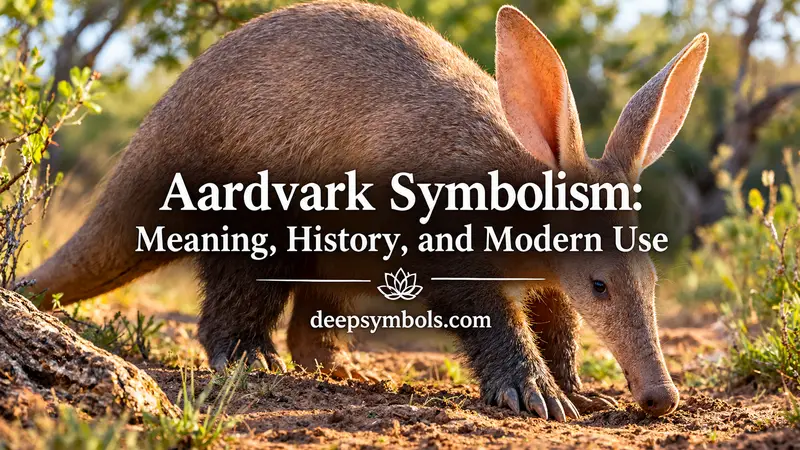
Aardvark symbolism often centers on persistence, resourcefulness, quiet strength, and the ability to find what others overlook. This unusual African mammal digs through hard ground to reach its food, works mostly at night, and creates underground shelters that other animals may eventually use. Its behavior offers several practical ways to understand the animal as a symbol.
Unlike the lion, eagle, or wolf, the aardvark does not have one widely recognized symbolic meaning in American culture. Many people know it through children’s books, zoos, wildlife documentaries, or the animated character Arthur. Its distinctive appearance makes it memorable, but its habits reveal more interesting associations than its unusual nose and large ears alone.
The aardvark also has a place in specific African cultural traditions, where reported beliefs connect it with resilience, protection, and unusual abilities. These traditions differ by community, so the animal should not be assigned one universal meaning across the African continent.
Understanding the aardvark means looking at both the real animal and the interpretations people have built around it. Its life underground, patient search for food, and role in creating shelter provide a grounded starting point for understanding what it can represent today.
Quick Answer
Aardvark symbolism in modern American culture can represent persistence, resourcefulness, quiet strength, and the ability to create security through practical effort. In some documented African traditions, the animal has also been associated with resilience and protective charms, although its cultural meanings vary by community.
TL;DR
- Aardvarks can represent persistence and practical problem-solving.
- Their powerful digging ability suggests determination and self-reliance.
- Underground burrows connect them with privacy, security, and shelter.
- Nocturnal habits can suggest intuition and working beyond public attention.
- Certain African traditions associate aardvarks with resilience and protective qualities.
- American popular culture often presents aardvarks as curious, approachable, and distinctive animals.
What an Aardvark Represents in Modern Symbolism
The aardvark is not associated with one fixed symbolic meaning. Instead, several interpretations arise from its physical abilities, behavior, and place in the natural world.
Persistence is one of the clearest associations. An aardvark uses strong forelimbs and large claws to break into termite mounds and reach insects hidden beneath the surface. Symbolically, this behavior can represent continuing toward a goal even when the reward is difficult to reach.
Resourcefulness is another natural interpretation. Aardvarks use smell, hearing, digging, and specialized feeding adaptations to locate food and survive in varied environments. Their survival depends on making effective use of the resources available to them.
The animal can also represent privacy and protection because it spends much of the day resting in underground burrows. These shelters provide a place to retreat from danger and harsh conditions.
Other possible associations include independence, patience, adaptability, and hidden potential. These are interpretations drawn from observed animal behavior, not universal beliefs shared by every culture.
The Physical Characteristics Behind Its Symbolism
An aardvark has a long, tubular snout, large upright ears, a stocky body, strong forelimbs, and substantial claws. Its appearance can seem like a combination of several familiar animals, although it belongs to its own distinct mammalian order, Tubulidentata.
Its body is adapted for a specialized way of life. The snout helps it locate food, the tongue gathers ants and termites, and the forelimbs allow it to excavate soil efficiently. Its strong claws also help it create burrows for shelter.
These characteristics provide the foundation for many modern symbolic interpretations.
The claws suggest the ability to overcome obstacles through effort. The sensitive snout suggests searching carefully before acting. The ears can evoke attentiveness, while the burrowing habit suggests privacy and security.
Its unusual appearance also invites another interpretation: individuality. An aardvark does not look like a conventional emblem of beauty, speed, or dominance. It succeeds through specialized abilities rather than resemblance to more familiar animals.
For someone drawn to unconventional animal symbols, the aardvark can represent the value of having a distinctive way of approaching life.
Historical Origins of Aardvark Symbolism
The aardvark’s scientific classification is much more straightforward than its symbolic history. It is native to sub-Saharan Africa, where it feeds primarily on ants and termites and generally spends the daylight hours in a burrow.
Its name comes from Afrikaans and means approximately earth pig, reflecting its digging habits and somewhat pig-like appearance. The name describes the animal’s physical characteristics rather than an inherited spiritual meaning.
Unlike animals with extensive documented roles in ancient mythology, the aardvark has a less widely known symbolic record. Some beliefs and practices involving the animal have been recorded in African cultural contexts, but they should not be combined into a single continent-wide tradition.
Its nocturnal habits, impressive claws, and ability to disappear underground help explain why people might associate it with secrecy, strength, or unusual abilities. Nevertheless, a plausible interpretation is not automatically evidence of an ancient belief.
A careful reading distinguishes between documented cultural traditions and meanings people develop from observing the animal today. Both can be meaningful, but they represent different kinds of symbolism.
Aardvark Symbolism in Specific African Traditions
The aardvark’s African background matters because it places the animal within the environments and cultural histories where people have lived alongside it.
A South African museum publication describes traditions in which the aardvark is associated with strength and resilience. It also records reports of Hausa folk practices in West Africa involving charms made with aardvark parts and other ingredients, which were believed to provide extraordinary abilities, including invisibility at night.
Such accounts belong to particular cultural settings. They should not be treated as evidence that all African communities assign the aardvark the same meaning.
In some reported traditions from Central African communities, aardvark teeth have also been used in bracelets regarded as good-luck objects. This points to an additional way an animal can acquire symbolic value: its physical remains may become associated with protection, fortune, or personal security.
These examples differ from the modern American tendency to read an animal’s personality through its behavior. They involve specific cultural beliefs and practices rather than symbolism derived solely from observation.
Respectful interpretation means preserving those distinctions and avoiding the assumption that every traditional animal belief is interchangeable with modern spiritual symbolism.
Persistence and Quiet Strength
The aardvark is an example of an animal whose abilities are more impressive than its appearance might initially suggest.
It can dig through soil to reach insect nests, use its claws defensively when threatened, and move between feeding locations in search of suitable resources. Its survival depends on persistence rather than conspicuous displays of dominance.
As a modern symbol, the aardvark can therefore represent quiet strength: the ability to keep working without needing recognition.
This interpretation may appeal to people who value steady progress over competition. Someone rebuilding a career, learning a difficult skill, or working through a long-term personal challenge might find the aardvark a useful reminder that meaningful progress often happens away from public attention.
The animal also offers a more practical view of resilience. Persistence does not mean continuing blindly regardless of circumstances. An aardvark follows available food and responds to its environment. Its behavior suggests the importance of adapting methods while maintaining the goal of survival.
In this sense, the aardvark represents strength expressed through consistent action rather than appearance.
Earth, Burrows, and the Symbolism of Hidden Work
Few animals are as closely associated with digging as the aardvark.
It excavates burrows for shelter and breaks into underground insect nests to find food. Much of its activity takes place below the surface, away from casual observation.
These habits can inspire a symbolic connection with hidden work. Just as an aardvark searches beneath the ground to meet its needs, people often make progress through preparation, study, practice, or reflection that others never see.
The image can represent a period of building foundations before a visible result emerges.
For example, someone preparing for a professional change might associate an aardvark with the months of learning and saving that come before taking a new position. A student might interpret it as a reminder to understand a subject thoroughly instead of memorizing surface details.
The ground also introduces an association with stability and practical needs. Burrows provide a place to rest and escape danger, so they may represent the importance of maintaining a secure home or personal space.
This is a modern symbolic reading rather than a universal spiritual rule. Its usefulness comes from the connection between the animal’s actual behavior and the human experience of working quietly toward a more stable life.
Night, Awareness, and Independent Action
Aardvarks are primarily nocturnal, meaning they are most active after dark. They emerge from their burrows to forage and use their senses to locate food and respond to potential threats.
This behavior can inspire associations with awareness, independence, and activity beyond public attention.
In modern symbolic interpretation, nighttime is sometimes connected with uncertainty, reflection, privacy, or the parts of life that remain unseen. The aardvark fits naturally into that imagery because it conducts much of its daily activity after sunset.
Its reliance on smell and hearing also suggests the value of paying attention to details that are not immediately visible. Applied to human experience, this could mean listening carefully, noticing patterns, or gathering information before making a decision.
However, nocturnal behavior does not establish that aardvarks possess supernatural knowledge or that seeing one predicts a particular event.
A more grounded interpretation is that the animal illustrates how awareness can take different forms. Not every successful strategy depends on visibility, speed, or direct confrontation.
Shelter, Protection, and the Ability to Help Others
An aardvark’s burrow serves more than one purpose. It offers the animal a place to rest and a refuge when conditions become dangerous.
After an aardvark abandons a burrow, other animals may use it as shelter. Depending on the habitat, these can include mammals seeking a place to raise young or escape predators.
This ecological role creates an especially interesting symbolic association: protection that benefits more than one individual.
A burrow first created to meet one animal’s needs may later support other life. The original act of digging continues to have value even after the aardvark has moved on.
For people, this can serve as a metaphor for creating something useful beyond one’s immediate needs. A well-organized home, a shared resource, a useful piece of knowledge, or a supportive community can benefit people who were not the original reason for creating it.
The interpretation also connects the aardvark with boundaries. A safe shelter allows an animal to withdraw from danger, conserve energy, and return when conditions are suitable.
In human terms, privacy and protection do not necessarily indicate weakness or avoidance. Sometimes they provide the conditions needed for recovery and future action.
Aardvark Symbolism in American Culture
In the United States, the aardvark is more likely to be recognized through children’s entertainment, animal collections, and educational media than through a major religious or national tradition.
The word itself has a distinctive place in American English because it begins with the first letter of the alphabet. As a result, aardvarks frequently appear in alphabet books, animal lists, and educational illustrations for young children.
The animal also became widely familiar through Arthur, the children’s book and television character created by Marc Brown. Arthur is an anthropomorphic aardvark whose stories explore school, friendship, family relationships, and the ordinary difficulties of growing up.
This cultural portrayal differs considerably from the animal’s real behavior. The character walks upright, wears clothes, and experiences human social situations. Yet the choice of an aardvark gives the character a recognizable, unconventional appearance.
In this setting, the animal can suggest curiosity, individuality, friendliness, and learning through everyday experiences.
American wildlife education creates another perspective. Seeing a living aardvark in a zoo or learning about its ecological role may encourage interest in unusual species and the different ways animals adapt to their environments.
These associations reflect modern American culture rather than a deep-rooted national tradition surrounding the aardvark.
Emotional and Personal Meaning
The aardvark can appeal to people who see themselves as independent, private, resourceful, or more comfortable working behind the scenes than seeking attention.
Its symbolic appeal does not depend on being the fastest, largest, or most visually impressive animal. Instead, it succeeds through specialized abilities and an approach suited to its environment.
Someone who feels overlooked may relate to this quality. The aardvark provides a way to think about strengths that others might not immediately notice, such as patience, careful observation, practical knowledge, or the ability to solve unusual problems.
Its burrowing habit can also carry a personal meaning. During a stressful period, someone might identify with the need to withdraw temporarily, create a safe space, and concentrate on rebuilding.
That interpretation has a limit, however. The image should not automatically turn isolation into a virtue. The aardvark’s solitary behavior reflects its biology, while people generally need different balances of independence and social connection.
A useful personal interpretation depends on the situation. The animal might remind one person to protect their time and another to recognize the value of their less visible skills.
Aardvarks in Dreams and Personal Reflection
An aardvark appearing in a dream does not have a scientifically established universal meaning. Dreams are shaped by personal experiences, memories, emotions, and the circumstances in which they occur.
Still, the animal can be used as a prompt for personal reflection.
An aardvark digging into the ground might remind someone of a problem they have been trying to understand. A burrow could bring to mind the need for security, privacy, or rest. An aardvark searching for food could encourage reflection on persistence and the practical steps required to meet a goal.
The emotional tone of the dream matters more than an automatic symbolic dictionary.
If the animal feels calm or reassuring, the dreamer might associate it with resourcefulness or finding a workable solution. If it seems frightened or trapped, the image might bring attention to feelings of pressure or a desire to withdraw.
These are possible personal interpretations, not predictions. An aardvark dream does not guarantee financial success, warn of betrayal, or announce an approaching life change.
The most useful question is what the animal brings to mind for the person who dreamed about it.
Aardvark Tattoos, Art, and Home Decor
Although the aardvark is less common in mainstream tattoo and decorative imagery than animals such as wolves, lions, or snakes, its unusual appearance makes it a distinctive choice.
An aardvark tattoo could represent persistence, unconventional thinking, privacy, or an appreciation for animals that do not fit familiar expectations. Someone might also choose it because of a personal memory, an interest in African wildlife, or an affection for the character Arthur.
The design affects the message. A realistic aardvark in a natural setting may emphasize wildlife appreciation, while a simplified cartoon version can convey humor and approachability. An illustration of an aardvark digging might suggest determination or practical effort.
In home decor, the animal can function as a conversation piece or an expression of personal taste. Children’s rooms, educational spaces, wildlife-themed art, and collections focused on unusual animals are natural settings for aardvark imagery.
It is best not to assume that every person choosing an aardvark design intends a spiritual statement. Sometimes a symbol communicates an explicit personal value; sometimes the appeal is aesthetic, affectionate, or humorous.
Positive and Negative Interpretations
The aardvark generally lends itself to constructive interpretations because its habits are associated with survival, resourcefulness, and shelter.
Its positive associations include persistence, independence, patience, careful observation, and the ability to meet practical needs. Its burrows can suggest security, while its specialized feeding behavior illustrates how a distinctive skill can become an advantage.
A less favorable interpretation could focus on excessive withdrawal, secrecy, or spending too much time working alone. These meanings are not inherent qualities of the animal; they emerge when people use its behavior as a metaphor for human choices.
For example, the desire for privacy can be helpful when it creates space for reflection. It can become limiting when it prevents someone from seeking support or sharing responsibilities.
Similarly, independence is valuable when it allows a person to act confidently, but it can become a burden when asking for help feels impossible.
The aardvark works well as a symbol because it invites this balance. Its example can encourage self-reliance without suggesting that every challenge must be faced alone.
Common Misunderstandings About Aardvark Symbolism
Several misunderstandings can arise when people search for the meaning of an unusual animal.
The first is the assumption that every animal has a single ancient spiritual definition. In reality, the aardvark’s meanings differ across cultural contexts, and many modern associations are interpretations based on its natural behavior rather than established traditional beliefs.
The second is treating African cultures as one unified symbolic system. Africa contains many distinct languages, religions, histories, and communities. A belief recorded in one cultural setting should not be presented as a shared belief across the entire continent.
A third mistake is confusing the aardvark with other animals. Despite superficial similarities, it is neither a pig nor an anteater in the strict zoological sense. Its unusual teeth, specialized feeding habits, and evolutionary classification distinguish it from these better-known mammals.
Finally, symbolic interpretations should not be mistaken for scientific claims. An aardvark’s nocturnal lifestyle does not demonstrate supernatural powers, and encountering one does not establish that good or bad fortune is coming.
A responsible interpretation keeps observed animal behavior, documented cultural traditions, and personal symbolism separate while allowing each to offer its own perspective.
How Aardvark Symbolism Has Evolved
The aardvark’s symbolic story differs from that of animals whose images have long dominated royal emblems, religious art, or national folklore.
Its documented cultural associations include specific traditional beliefs and practices in parts of Africa. In modern American popular culture, however, it has become particularly recognizable through children’s entertainment, alphabet learning, zoos, and nature education.
At the same time, contemporary animal symbolism encourages people to find personal meaning in species that receive less attention. The aardvark’s digging, solitary habits, and ability to create shelter provide accessible metaphors for practical challenges in everyday life.
This modern approach does not replace historical traditions. Instead, it adds another layer of interpretation.
An animal can have meaning because of a particular community’s beliefs, because of its ecological role, or because someone recognizes a quality in its behavior that reflects their own experience.
The aardvark’s appeal lies partly in that flexibility. It offers a way to think about strength that does not depend on dominance and independence that does not require public recognition.
FAQs
What does an aardvark symbolize spiritually?
In contemporary personal symbolism, an aardvark can represent resourcefulness, persistence, protection, and quiet strength. These are interpretations based largely on its natural behavior, not a universal spiritual definition.
Is seeing an aardvark considered good luck?
Some reported African traditions associate the aardvark with good fortune or protective qualities, but such beliefs vary by community. There is no established universal rule that seeing an aardvark predicts good luck.
What does an aardvark symbolize in a dream?
A dream about an aardvark might bring to mind persistence, privacy, practical problem-solving, or the need for security. The dreamer’s emotions and personal experiences provide more useful context than assuming the animal has one fixed meaning.
What does an aardvark tattoo mean?
An aardvark tattoo may represent individuality, independence, resourcefulness, or persistence. It can also reflect an interest in African wildlife, a personal memory, or an affectionate connection to the character Arthur.
Why is the aardvark associated with hidden strength?
The aardvark uses powerful claws and specialized adaptations to find food and create shelter, often working out of sight. As a metaphor, it illustrates how practical abilities and steady effort can matter more than outward appearance.
Is an aardvark a symbol in African mythology?
The aardvark appears in certain African cultural beliefs and reported traditional practices, including traditions involving protective or good-luck objects. However, it does not have one universally shared meaning across African mythology and folklore.
What is the difference between aardvark symbolism and anteater symbolism?
Both animals feed on ants or termites, so modern interpretations may associate them with persistence and specialized problem-solving. They are different animals, however, and their cultural histories and symbolic associations should not automatically be treated as interchangeable.
Conclusion
Aardvark symbolism offers a grounded way to understand persistence, resourcefulness, protection, and quiet strength. The animal’s powerful digging abilities allow it to create safe underground shelters, and its abandoned burrows can provide refuge for other wildlife. The San Diego Zoo Wildlife Alliance’s overview of aardvarks explains how these practical behaviors make the animal valuable to its wider ecosystem.
For modern readers, the aardvark can represent patient effort, adaptability, privacy, and the ability to create something useful without seeking attention. Its symbolism is most meaningful when these interpretations remain connected to the animal’s real behavior rather than being treated as universal ancient beliefs.
Ultimately, aardvark symbolism reminds us that strength does not always need to be visible or celebrated. Sometimes it is found in the ability to work patiently, protect what matters, and leave something valuable behind that helps others long after we have moved on.


