
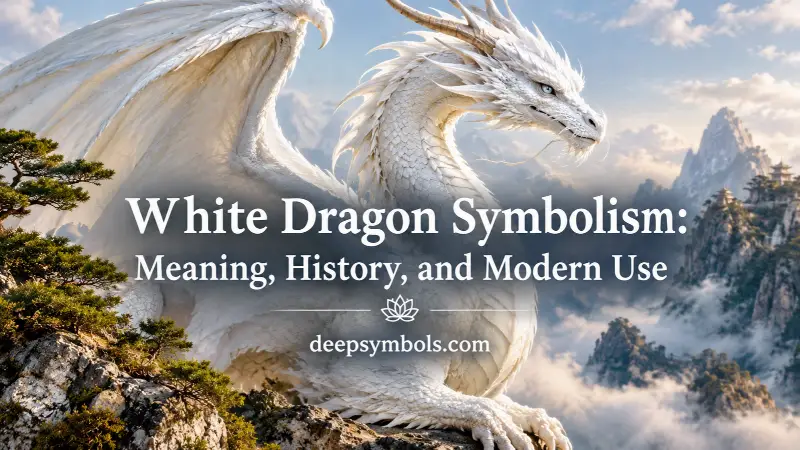
White dragon symbolism often reflects a combination of the dragon’s traditional qualities—strength, protection, authority, and transformation—with the meanings people attach to the color white. In modern American culture, that combination can suggest disciplined power, personal renewal, wisdom, or a protective presence.
The image is especially interesting because a white dragon does not have one fixed meaning. A Chinese religious image, a medieval European legend, a Japanese-inspired tattoo, and a fantasy-game creature can all look similar while carrying very different ideas.
That difference matters. Dragon symbolism developed in several cultures independently and through centuries of storytelling, religious practice, political imagery, decorative art, literature, and popular entertainment. Understanding the context usually tells you more than the color alone.
Quick Answer
In modern American culture, white dragon symbolism commonly represents strength guided by purity, transformation, protection, wisdom, or self-control. Historically, dragons carried very different meanings across cultures, including rain, fertility, imperial authority, local protection, and political power.
TL;DR
- White dragons often combine strength with ideas of purity or renewal.
- Chinese dragon traditions emphasize water, protection, fertility, and authority.
- White has also represented mourning, autumn, the West, and ritual symbolism.
- Medieval European literature used a white dragon as a political allegory.
- American tattoos often turn the image into a personal statement.
- Fantasy games frequently connect white dragons with ice, danger, and isolation.
What a White Dragon Looks Like and Where It Appears
A white dragon may be portrayed as a long, serpentine creature covered in pale scales, or as a winged reptile resembling the dragons of European fantasy. Its design can include horns, claws, whiskers, flowing facial hair, wings, clouds, snow, water, flames, or a pearl-like orb.
The appearance often reveals the intended cultural setting.
A long-bodied dragon surrounded by clouds and waves usually draws from East Asian visual traditions. A heavy-bodied dragon with wings, horns, and icy breath belongs more comfortably to Western fantasy. A minimalist white dragon tattoo may use the creature simply as a personal emblem rather than claiming a particular historical tradition.
Today, the image appears in tattoo art, fantasy illustrations, games, clothing, collectibles, jewelry, wall art, and digital avatars. That wide range is one reason the symbol can feel familiar while still carrying different meanings.
What It Commonly Means in the United States
There is no official American definition of a white dragon. Instead, contemporary U.S. interpretations tend to come from the combination of familiar dragon symbolism and the cultural associations of white.
The dragon itself commonly communicates strength, courage, protection, independence, and command. In East Asian traditions, dragons may also suggest water, rain, fertility, benevolent power, or good fortune. Chinese art, for example, frequently connects dragons with water and includes them among symbols associated with protection, happiness, fertility, and imperial authority.
White adds another layer. In contemporary American design, it can suggest clarity, innocence, cleanliness, peace, or a fresh beginning. But white can also imply coldness, distance, mourning, or something otherworldly.
That gives the image a useful tension: a white dragon can represent power without aggression, strength with restraint, or authority joined to renewal.
Why White Changes the Meaning of a Dragon
Color matters because people rarely interpret a mythical creature separately from its visual presentation.
A red dragon tends to look fiery and aggressive. A black dragon can appear secretive, dangerous, or formidable. A gold dragon can suggest wealth, status, or royalty. White changes the emotional register.
The color may make the dragon appear cleaner, calmer, more celestial, or more refined. In a personal context, someone might choose a white dragon to represent becoming stronger without becoming harder.
Yet the color should not automatically be treated as a universal sign of goodness. White has conflicting cultural associations. In China, for example, white has longstanding connections with the West and mourning, while ritual traditions also place white in larger cosmological systems.
So the most accurate interpretation is not simply “white equals purity.” It is more useful to ask what the white color is doing in a particular design.
Ancient Chinese Roots and a Common Misconception
The Chinese dragon is one of the oldest and most influential dragon traditions, with dragon imagery appearing in ancient Chinese material culture long before modern fantasy created today’s familiar Western dragon. A carved dragon object in the British Museum, for example, dates to the Shang period, roughly the second millennium BCE.
Chinese dragons are also fundamentally different from the standard European dragon. They are often associated with clouds, rivers, rain, agricultural fertility, and benevolent supernatural authority rather than being defined primarily as treasure-hoarding monsters.
One common modern mistake is to assume that an ancient Chinese system simply had a “white dragon of the West” in the same way it had the Green Dragon of the East. Classical Chinese cosmology instead identifies the Azure or Green Dragon with the East and the White Tiger with the West. These directional associations became established centuries before the Common Era.
That distinction is important. It prevents a modern color chart from being mistaken for an ancient universal rule.
White Dragons in Chinese Religious and Local Traditions
Although white is not simply the standard color of the Chinese directional dragon, specific white dragons do appear in Chinese religious and local traditions.
A striking example comes from the history of dragon worship in China. Historical scholarship describes a White Dragon associated with Mount Yan that became an important local rain deity. Communities regarded the deity as effective in protecting local welfare and appealing for rain, and a shrine developed around its worship.
This reveals something essential about dragon symbolism: meaning could be attached to a particular dragon because of its local story, shrine, reputation, or relationship with natural forces.
In that setting, a white dragon was not merely a decorative version of a standard dragon. It was a specific religious figure with a particular regional identity.
White itself could also carry multiple meanings in Chinese tradition. It could relate to mourning, the West, space, and ritual symbolism, while other religious contexts associated white with the moon or other cosmological ideas.
Japanese Traditions and White Dragon Imagery
Japanese dragon imagery developed through interactions with Chinese traditions as well as local religious and artistic traditions. Dragons became closely associated with water, clouds, rivers, and supernatural protection, and dragon motifs became important in painting, religious art, architecture, and tattooing.
A white dragon in Japanese-inspired artwork is often given a serene or elevated appearance, particularly when surrounded by clouds, moonlight, water, or blossoms. Modern artists may use the color to suggest wisdom, purity, spiritual discipline, or transition.
Still, it is better not to describe every white dragon in Japan as having one traditional definition. Japanese dragon imagery varies by story, shrine, artistic school, and modern interpretation. Contemporary tattoo culture has also added meanings that are more personal than historical.
The visual language may be Japanese-inspired even when the meaning has been created by a present-day American tattoo wearer.
The Medieval European White Dragon and Political Allegory
The white dragon also has a very different history in medieval European literature.
In the Arthurian tradition surrounding Merlin and King Vortigern, two dragons—one red and one white—fight beneath a hill. Merlin interprets the white dragon as representing the Saxons and the red dragon as representing the Britons. The story therefore turns the creatures into political symbols rather than simple monsters.
This is one of the clearest historical examples showing why color cannot be interpreted in isolation.
The white dragon did not mean “purity” in this story. It represented a people and the political struggle between groups in Britain. The meaning came from the narrative and its historical imagination.
This is also a useful reminder that modern fantasy often inherits visual symbols without preserving their original context.
How Dragon Symbolism Changes Across Cultures
| Context | Meaning in the USA | Common Associations | Notes |
|---|---|---|---|
| Personal symbolism | Strength with restraint | Courage, renewal, protection | Often chosen for individual reasons |
| Chinese-inspired imagery | Benevolent supernatural power | Water, rain, fertility, authority | White requires cultural context |
| Japanese-inspired art | Wisdom and disciplined strength | Clouds, water, spiritual imagery | Meanings vary by design and tradition |
| Medieval European literature | Political or territorial identity | Conflict, conquest, dynastic struggle | White and red can represent opposing peoples |
| Modern fantasy | Cold, danger, isolation, otherworldliness | Ice, snow, wilderness | Often unrelated to historical Asian symbolism |
The table shows why “what does a white dragon mean?” has no single answer. The surrounding imagery, cultural tradition, and purpose of the artwork all affect the interpretation.
Emotional and Psychological Meaning
On a personal level, a white dragon can work as a symbol of controlled strength.
People sometimes choose dragon imagery when they want to communicate resilience, independence, survival, or the ability to face difficult circumstances. Adding white can soften that message or redirect it toward clarity, growth, self-discipline, or a new chapter.
That makes the symbol particularly useful for life transitions. Someone might associate a white dragon with leaving an old identity behind, recovering from a difficult period, or becoming more confident without abandoning compassion.
There is also an interesting psychological contrast in the creature itself. Dragons are imagined as dangerous and immense, while white often creates a cleaner and calmer visual impression. The result can communicate strength that does not need constant aggression to prove itself.
That interpretation belongs to modern symbolic reading rather than a universal psychological rule.
Why It Appears in Tattoos and Personal Style
Dragon tattoos are unusually flexible because the body of the creature naturally works with large spaces such as the back, shoulder, chest, ribs, or thigh.
A white dragon tattoo may be chosen for its visual contrast, but the design can also communicate a specific life story. A person might use it to represent survival, transformation, protection, family, cultural heritage, or a personal sense of discipline.
The surrounding details often matter as much as the dragon. Clouds can emphasize the sky and spiritual dimension. Waves can emphasize movement and water. Snow can create an icy fantasy atmosphere. Flowers can shift the mood toward beauty or renewal.
Contemporary tattoo writing frequently associates white dragons with purity, transformation, wisdom, spirituality, and personal change, showing how these meanings have become established in modern tattoo culture even when they do not map neatly onto one ancient tradition.
White Dragons in Art, Decor, and Digital Culture
In American homes and creative spaces, dragon imagery often functions as a decorative statement rather than a religious emblem.
A white dragon sculpture may fit a modern room better than a brightly colored one because the pale form looks more restrained. White can also work well with silver, gray, glass, black, or natural wood, allowing the dragon to become a focal point without dominating the entire space.
Digital culture has expanded the symbol even further. White dragons appear in game art, fantasy illustrations, avatars, character designs, trading cards, and online communities built around mythology and speculative fiction.
In the case of Yu-Gi-Oh!, the Blue-Eyes White Dragon became one of the best-known dragon identities in global trading-card culture, demonstrating how a “white dragon” can become a recognizable character brand rather than a traditional cultural symbol.
White Dragons in Fantasy: Ice, Danger, and Isolation
Modern fantasy has given white dragons another highly recognizable meaning: cold.
One of the strongest examples is Dungeons & Dragons. Its current rules classify white dragons as chromatic dragons with a chaotic evil alignment, cold immunity, ice-walking abilities, and cold-based attacks. Their fictional habitats are closely associated with arctic environments.
This has influenced the expectations of many American fantasy audiences. A white dragon in a game or fantasy novel may therefore suggest winter, frozen landscapes, isolation, predation, or survival rather than purity or spiritual growth.
That is not a contradiction. It is a separate symbolic tradition created by modern storytelling.
Positive vs. Negative Symbolism
The white dragon can carry both positive and threatening meanings.
Its positive side includes courage, protection, wisdom, discipline, renewal, and the determination to survive change. These interpretations are particularly common in personal tattoos and inspirational artwork.
Its darker side can include emotional distance, dangerous power, coldness, conquest, death, or isolation. In some settings, white makes the creature feel less warm rather than more virtuous.
Fantasy can intensify this contrast. A beautiful white dragon standing in moonlight may appear noble, while the same creature emerging from an icy cave can look predatory.
The image is therefore flexible enough to express both serenity and menace.
Common Misunderstandings About the Symbol
The most common mistake is treating “white dragon” as though it has one ancient definition shared everywhere.
It does not.
Another mistake is assuming that white automatically means purity in every Asian tradition. Chinese symbolism demonstrates why that is too simple: white has meaningful associations with mourning and cosmological direction as well as other ritual meanings.
A third misunderstanding is confusing Chinese and Western dragons. Chinese dragons are strongly associated with water, rain, fertility, and benevolent authority, while European dragon traditions often emphasize threat, treasure, conflict, and heroic combat.
Finally, modern fantasy symbolism should not be presented as ancient folklore. An icy white dragon from a role-playing game may owe more to twentieth-century fantasy conventions than to Chinese religious tradition.
How the Meaning Has Evolved
The changing meaning of the white dragon reflects a broader shift in how Americans use symbols.
Older traditions generally embedded mythical creatures in specific religious, political, or cosmological systems. A dragon might govern rain, represent imperial power, protect a community, or symbolize an opposing people in a political legend.
Modern culture is more likely to combine traditions.
A contemporary artist may borrow the body shape of a Chinese dragon, the color palette of Japanese tattoo art, the icy atmosphere of Western fantasy, and the personal idea of rebirth. The final image can still feel coherent even though its ingredients come from different periods and cultures.
That blending is now normal in American popular culture, but it is worth distinguishing historical meanings from modern creative adaptations.
White Dragon Symbolism in Modern American Life
In the United States today, the white dragon works best as a flexible personal or artistic symbol rather than a single inherited code.
For one person, it may represent surviving a difficult period. For another, it may stand for wisdom, self-control, independence, or a new beginning. In fantasy fandom, it may simply evoke ice and danger. In Asian-inspired art, it may reflect admiration for a visual tradition involving clouds, water, or supernatural guardianship.
The most useful interpretation therefore comes from context.
Look at the dragon’s posture, color, environment, companion symbols, artistic style, and intended audience. A white dragon beneath a moon means something different from a white dragon breathing frost, and both differ from a dragon carved into a temple-inspired design.
That is why the symbol remains so adaptable in American culture: it allows people to combine strength with a quieter visual language.
FAQs
What does a white dragon symbolize spiritually?
In modern spiritual and personal symbolism, a white dragon may represent purification, wisdom, protection, transformation, or a new stage of life. These meanings are contemporary interpretations and should not be assumed to apply uniformly across historical religions.
What does a white dragon tattoo mean?
A white dragon tattoo can represent strength, resilience, renewal, self-mastery, or personal transformation. The meaning often changes according to added details such as flowers, clouds, water, snow, pearls, or weapons.
Is a white dragon a symbol of purity?
Purity is a common modern interpretation because white is often associated with cleanliness, clarity, and renewal. Historically, however, white has carried other meanings, including mourning and cosmological associations in Chinese traditions.
Is the white dragon good or evil?
There is no universal answer. Some traditions present dragons as protective or beneficial beings, while modern fantasy can portray white dragons as dangerous or openly evil, especially when they are connected with ice and arctic environments.
What did the white dragon mean in medieval Britain?
In the Merlin tradition associated with Geoffrey of Monmouth, the white dragon represented the Saxons while the red dragon represented the Britons. It was therefore a political allegory tied to conflict and conquest, not a general symbol of purity.
Why are white dragons associated with ice in fantasy?
Modern fantasy helped establish that connection through fictional settings such as Dungeons & Dragons, where white dragons are arctic creatures with cold-based abilities. That association belongs to fantasy literature and gaming rather than ancient dragon mythology.
Conclusion
White dragon symbolism combines the dragon’s traditional associations with immense power and the color white’s more varied meanings of clarity, renewal, restraint, coldness, or mourning. Its historical significance, however, depends heavily on the tradition in which the image appears. Chinese dragons have long been associated with water, fertility, protection, and authority, while medieval British literature used the white dragon in a specific prophetic story to represent the Saxons in opposition to the Britons. Victoria Flood’s academic study of medieval Merlin prophecy provides useful context for that political tradition.
In modern America, the image is far more flexible. A white dragon may suggest calm strength, transformation, spiritual aspiration, survival, purity, or simply the dramatic appeal of fantasy art.
Ultimately, white dragon symbolism cannot be reduced to the color white or the dragon alone. Its clearest meaning comes from the tradition, story, visual setting, and personal intention surrounding the image. That is precisely what allows the same creature to function as a historical political figure in one context and a deeply personal symbol in another.


