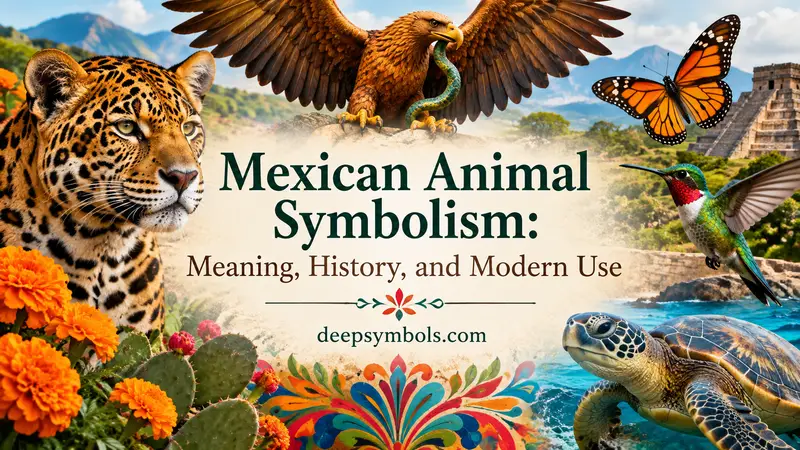
Mexican animal symbolism reflects a long history of people interpreting animals through religion, art, storytelling, political identity, and everyday life. In mexican animal symbolism, the jaguar, eagle, serpent, butterfly, dog, and other creatures can carry meanings connected to power, protection, transformation, death, fertility, courage, and the natural world.
One important point is that there is no single Mexican system of animal meanings. Mexico includes many Indigenous cultures, regional traditions, Catholic influences, modern Mexican popular culture, and Mexican American interpretations in the United States. A jaguar’s meaning in ancient Maya or Mexica art, for example, should not automatically be treated as a universal belief shared by every Mexican community.
The subject remains relevant today because animal imagery appears everywhere from Día de los Muertos artwork and Indigenous crafts to tattoos, jewelry, fashion, murals, home decor, sports identities, and digital art.
Quick Answer
Mexican animal symbolism commonly represents strength, protection, transformation, spiritual connection, and identity, depending on the animal and cultural setting. Historically, animals held major religious and political meanings in Mesoamerican societies, while modern Mexican and Mexican American culture continues to adapt these images through art, celebrations, identity, and personal expression.
TL;DR
- Jaguars traditionally suggest strength, authority, night, and sacred power.
- Eagles became associated with courage, warfare, sunlight, and Mexican national identity.
- Serpents represented renewal, fertility, water, sky, and sacred forces.
- Monarch butterflies connect remembrance, migration, and the dead in some traditions.
- Xoloitzcuintli dogs have long associations with companionship and the afterlife.
- Modern Mexican animal imagery blends Indigenous heritage with contemporary identity.
Why Animals Matter in Mexican Culture
Animals became important symbols partly because Mesoamerican societies closely observed the environments around them. Predators, birds, reptiles, insects, and domesticated animals offered visible qualities that could be interpreted through religion and social life.
The symbolism was not simply based on appearance. Animals could become associated with particular gods, rulers, warriors, places, natural forces, calendars, or stories. In some traditions, an animal could also serve as an intermediary between different realms or express a person’s relationship with supernatural forces.
Archaeological evidence makes this especially clear. Jaguar, serpent, eagle, bird, and other animal images occur throughout ancient Mexican art, including ceramics, sculpture, ornaments, murals, and manuscripts.
Ancient Roots and Mesoamerican Traditions
Much of the symbolism people now associate with Mexico has roots in several different Mesoamerican civilizations, including the Olmec, Maya, Teotihuacan, Mixtec, and Mexica.
These cultures were not interchangeable. Their languages, religions, political systems, and artistic traditions differed, and the meaning of an animal could change from one community to another.
The jaguar is an especially useful example. Archaeological evidence shows that jaguars were represented across Mesoamerica and could be connected with political authority, warfare, fertility, caves, night, and the world of the dead. In some traditions the animal was also associated with rulers and elite military organizations.
This is why it is more accurate to speak of related traditions rather than one fixed dictionary of Mexican animal meanings.
The Jaguar: Strength, Authority, and the Night
The jaguar is probably one of the most recognizable animals in ancient Mexican symbolism.
Its physical behavior helped shape its associations. It was a powerful predator capable of moving quietly through forests and hunting at night. Its connection to caves and darkness also encouraged links with the earth, the underworld, and hidden realms.
Among several Mesoamerican cultures, jaguar imagery was tied to political authority and military prestige. Mexica and other elite traditions used jaguar imagery to communicate status and martial identity.
In modern American culture, a Mexican-inspired jaguar often communicates courage, independence, toughness, cultural heritage, or connection with Indigenous history. A tattoo may emphasize personal strength rather than reproduce an ancient religious belief.
The Eagle: Courage and National Identity
The eagle has an especially visible place in modern Mexico because it appears in the country’s national emblem alongside a serpent.
Its symbolism also has deeper pre-Hispanic roots. Eagles were associated with celestial power, the sun, warfare, courage, and high-ranking warriors. Feathers from important birds were valuable symbols of elevated status and divine or heavenly association.
Today, the eagle can therefore communicate several ideas at once: bravery, Mexican identity, heritage, independence, and national pride.
For Mexican Americans in the United States, eagle imagery may carry an additional layer. It can express connection to Mexican heritage while also functioning within a broader American visual vocabulary of freedom, strength, and patriotism.
The Serpent: Renewal, Water, and Sacred Power
Serpents are often misunderstood when viewed only through European or Christian symbolism.
In several pre-Hispanic Mexican traditions, snakes were not simply symbols of evil. They could be associated with water, fertility, the earth, wind, lightning, renewal, and divine forces. Shedding the skin naturally offered a visual metaphor for cyclical renewal.
The feathered serpent is particularly significant. Quetzalcoatl-related traditions brought together the serpent and bird imagery, connecting earthly and celestial characteristics.
That combination helps explain why feathered-serpent imagery remains so recognizable today. Modern tattoos, murals, jewelry, and graphic art may use it to represent transformation, knowledge, cultural ancestry, or Mexican Indigenous heritage, although contemporary meanings are not necessarily identical to ancient religious ones.
The Monarch Butterfly: Migration and Remembering the Dead
The monarch butterfly has become one of the clearest examples of how animal symbolism can connect Mexican cultural tradition with the natural world.
Each autumn, monarch butterflies migrate to central Mexico, and their arrival occurs around the time of Día de los Muertos. Among Purépecha traditions, monarchs have been associated with the souls of deceased people returning to visit the living.
That connection is especially meaningful because the butterfly is already an obvious image of change. Its transformation from caterpillar to flying insect provides a natural metaphor for transition.
In Mexican American communities, monarch imagery can therefore suggest remembrance, ancestry, migration, family continuity, and the continuing relationship between generations. It can also carry an environmental meaning because monarch conservation has become closely connected with cultural awareness.
The Xoloitzcuintli: Loyalty and the Journey Beyond Life
The Xoloitzcuintli, commonly called the Mexican hairless dog or Xolo, has an unusually strong connection with ancient Mexican culture.
Dogs appear in pre-Hispanic art and traditions associated with death and the journey into the afterlife. Archaeological examples show dogs used in imagery and ritual contexts, while the Xolo later became a distinctive symbol of Mexican heritage.
Unlike the modern stereotype of the dog as merely a household companion, the Xolo can represent loyalty, guardianship, ancestry, and companionship across the boundary between life and death.
Today, Xolo imagery is frequently used to express Mexican identity. It can appear in tattoos, illustrations, sculptures, jewelry, and Día de los Muertos-inspired artwork.
The Hummingbird: War, Sunlight, and Vitality
The hummingbird carries several layers of meaning in ancient Mexican traditions.
Because of its movement, bright coloring, and aggressive territorial behavior, the bird could be connected with warriors and the sun. An INAH collection account also describes hummingbird associations with nobility, fertility, sunlight, seasonal cycles, and the movement between life and death.
Modern viewers often add their own meanings: energy, persistence, beauty, survival, and movement.
A hummingbird tattoo may therefore be personal rather than strictly historical. It might commemorate someone, represent resilience, or express cultural heritage without claiming a specific pre-Hispanic interpretation.
Other Animals and Their Associations
Mexican traditions contain far more animal imagery than the best-known jaguar, eagle, serpent, and butterfly.
Coyotes, monkeys, birds, crocodilian or amphibious earth creatures, opossums, and other animals appear in different regional and historical traditions. Their meanings depend heavily on the particular culture and artistic setting.
For example, the spider monkey appears in Mexica art and was connected with the Wind God through ritual imagery. It also had a place in calendar symbolism.
The opossum is another reminder that less glamorous animals could also possess symbolic importance. It appears in Mixtec material culture alongside other animals associated with supernatural and sacred imagery.
A Quick Comparison of Major Meanings
| Animal | Meaning in the USA | Common Associations | Cultural Note |
|---|---|---|---|
| Jaguar | Strength and authority | Courage, power, night | Widely represented across Mesoamerican cultures |
| Eagle | Mexican identity and bravery | Sun, warriors, national pride | Central to Mexico’s national emblem |
| Serpent | Transformation and sacred knowledge | Renewal, water, fertility | Meanings varied greatly by tradition |
| Monarch butterfly | Remembrance and ancestry | Migration, death, return | Especially associated with Día de los Muertos contexts |
| Xoloitzcuintli | Heritage and companionship | Loyalty, ancestry, afterlife | Distinctive Mexican cultural symbol |
| Hummingbird | Vitality and resilience | Sun, warriors, fertility | Ancient and modern meanings overlap but are not identical |
Animals in Día de los Muertos Traditions
Animal imagery has an important place in contemporary Día de los Muertos art, but it should not be reduced to a single collection of fixed symbols.
The monarch butterfly is especially relevant in some Mexican traditions because its migration coincides with the annual remembrance period. More broadly, Día de los Muertos combines Indigenous and Spanish Catholic influences and has developed into a major cultural tradition in Mexico and among Mexican Americans in the United States.
Today, animal imagery may appear on ofrendas, paintings, papel picado, clothing, masks, ceramics, and commercial designs. The meaning can range from remembrance and family heritage to artistic decoration.
That distinction matters because not every animal appearing beside a sugar skull automatically has an ancient religious meaning.
Mexican Animal Imagery in Tattoos and Personal Style
Tattoos are one of the most visible places where Mexican animal symbolism is reinterpreted today.
A jaguar can represent personal strength. A monarch butterfly can commemorate a relative. A Xolo can express family heritage. A feathered serpent can symbolize transformation or cultural ancestry.
The design itself also changes the meaning. A realistic animal may emphasize nature and personal identity, while a highly stylized image borrowing from pre-Hispanic art may communicate historical interest or Indigenous-inspired aesthetics.
People should also distinguish appreciation from imitation. Using an image from a living Indigenous tradition without understanding its context can flatten a complex cultural history into a decorative motif.
Psychological and Emotional Meanings
Animals work particularly well as personal symbols because people can recognize their traits quickly.
A jaguar can externalize confidence. A butterfly can give visual form to change. A dog can represent loyalty and family. A serpent can express renewal after a difficult period.
These meanings do not need to be ancient to be meaningful.
Modern symbolism is often a conversation between inherited cultural imagery and an individual’s own experiences. Someone may choose a hummingbird because it reminds them of a loved one, even if their personal interpretation differs from historical symbolism.
Mexican American Interpretations in the United States
Mexican animal imagery takes on additional meanings in the United States because it often functions as a marker of heritage.
For some Mexican Americans, an eagle, jaguar, butterfly, or Xolo can represent family history and cultural belonging. For others, the image may simply reflect appreciation for Mexican art.
Día de los Muertos provides a particularly clear example. The tradition has become increasingly visible in American cities, schools, museums, cultural organizations, and Latino communities while retaining its central emphasis on honoring deceased loved ones.
This broader American setting can also change how symbols are interpreted. An image that originally carried religious or political associations might become a family emblem, tattoo design, decorative motif, or statement of cultural pride.
Animals in Mexican Folk Art and Contemporary Design
Animal imagery remains important outside archaeological or religious contexts.
Contemporary Mexican artists and craftspeople use animals in ceramics, textiles, wood carving, painting, masks, sculpture, and popular visual culture. Stylized creatures can combine recognizable animals with imaginative forms, producing designs that are cultural, decorative, humorous, spiritual, or personal at the same time.
This is particularly important when discussing modern Mexican animal imagery because not every colorful animal design is a surviving ancient symbol. Some are contemporary creations influenced by older traditions.
The result is a living visual language rather than a museum piece frozen in the past.
When Mexican Animal Symbolism Is Misrepresented
One of the most common mistakes is treating Mexican culture as if it had a single universal set of animal meanings.
Another is calling every Mesoamerican symbol “Aztec.” The Mexica were one major society, but ancient Mexico included many other cultures with their own beliefs and artistic systems.
Modern internet posts can also turn complicated traditions into simple statements such as “the jaguar always means X” or “the butterfly always means Y.” Historical evidence rarely supports that level of certainty.
A better approach is to ask three questions: Which culture? Which period? Which context? The answer can change substantially depending on those details.
How These Meanings Have Changed
Animal meanings changed because cultures changed.
Pre-Hispanic societies used animal imagery within religious and political systems that no longer exist in their original form. Colonial Mexico introduced Catholic traditions and new artistic conventions. Later, nationalism gave particular animals additional importance, while the modern Mexican diaspora created new uses for familiar cultural imagery.
In the United States, Mexican animal symbols now appear in a multicultural environment shaped by Mexican American identity, contemporary art, tourism, fashion, tattoo culture, environmental movements, and social media.
The meaning of an animal can therefore be inherited, adapted, or personally reinvented.
What These Animals Communicate Today
In modern American culture, Mexican animal imagery often works on several levels simultaneously.
A person might choose a jaguar because it looks powerful, while also appreciating its connection to ancient Mesoamerican civilizations. Someone else may wear a monarch butterfly because it represents a deceased family member. A Xolo may serve as a visual connection to Mexican ancestry.
The most meaningful interpretation is usually the one supported by context rather than a universal symbolic dictionary.
That is especially important for living cultural traditions. Historical symbolism can inform modern use, but contemporary communities should not be treated merely as extensions of the ancient past.
FAQs
What is the most important animal symbol in Mexican culture?
There is no single answer for every Mexican community or historical period. The jaguar, eagle, serpent, hummingbird, monarch butterfly, and Xoloitzcuintli are among the most recognizable animals associated with different Mexican traditions.
What does a jaguar symbolize in Mexican culture?
The jaguar has been associated with strength, political authority, warfare, night, caves, and supernatural power in several Mesoamerican traditions. Its meaning was not identical everywhere, but its association with elite status and power is especially well documented.
Why are butterflies associated with the Day of the Dead?
In some Indigenous traditions, including Purépecha traditions, migrating monarch butterflies have been understood as connected with deceased ancestors returning around Día de los Muertos. Their seasonal arrival also makes migration and remembrance natural parts of the symbolism.
What does a Mexican eagle symbolize?
The eagle can represent courage, warfare, sunlight, elevated status, and national identity. Its strongest modern association comes from its role in Mexico’s national emblem, where it appears with the serpent.
Is the serpent a negative symbol in Mexican culture?
Not necessarily. Several pre-Hispanic Mexican traditions associated serpents with water, fertility, renewal, wind, lightning, and deities, so the animal cannot be reduced to an evil or negative meaning.
What does a Mexican animal tattoo mean?
The meaning depends on the animal, design, and reason for choosing it. Mexican-inspired animal tattoos can represent heritage, strength, remembrance, transformation, spirituality, family, or admiration for Mesoamerican art.
Conclusion
Mexican animal symbolism is best understood as a collection of traditions rather than a single symbolic code. Jaguars, eagles, serpents, hummingbirds, butterflies, and Xoloitzcuintli dogs developed different meanings through particular historical, religious, ecological, and social contexts. The National Museum of Anthropology’s collection and research provides useful context for the symbolic roles of animals such as the jaguar, eagle, serpent, and hummingbird in pre-Hispanic Mexico.
In the United States, those meanings continue to evolve. Mexican Americans and other artists may use the same animal to express ancestry, grief, strength, transformation, national pride, or personal identity. Understanding the historical context makes modern uses more meaningful because it helps distinguish ancient traditions from living culture and individual interpretation.
Ultimately, the most useful way to understand mexican animal symbolism is not to ask what an animal always means, but what it means in the culture, period, artwork, and personal context where it appears. That approach respects the history of the symbol while leaving room for the meanings people continue to create today.