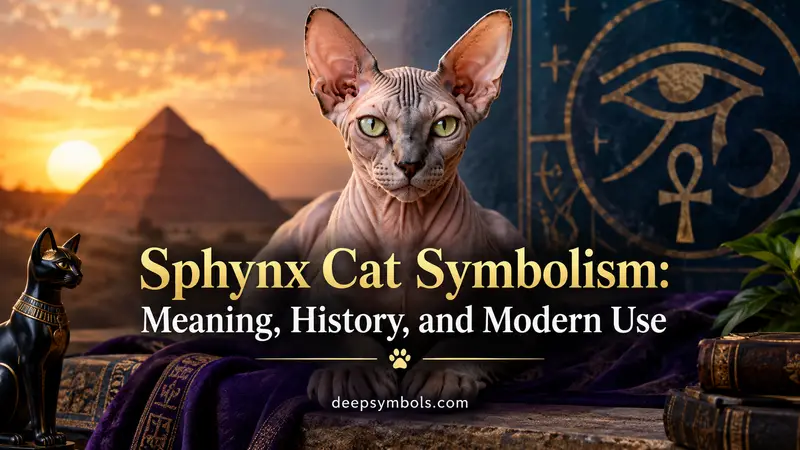
The sphynx cat symbolism people recognize today comes largely from the breed’s unusual appearance and affectionate personality. Its nearly hairless body, oversized ears, expressive eyes, and warm skin often suggest individuality, curiosity, vulnerability, confidence, and an unconventional sense of beauty.
Unlike symbols with thousands of years of continuous religious tradition, the Sphynx cat is a relatively modern breed. Its name connects it visually and culturally with the Egyptian Sphinx, while the actual breed developed from naturally occurring hairless cats in Canada and the United States during the late twentieth century.
That distinction matters because some modern interpretations treat the Sphynx as an ancient Egyptian cat. The historical record supports something more specific: the breed is modern, while its name and appearance draw on imagery associated with ancient Egypt.
Quick Answer
Sphynx cat symbolism commonly represents individuality, curiosity, affection, vulnerability, and unconventional beauty in modern American culture. Its Egyptian-sounding name adds associations with mystery and ancient imagery, while the breed’s actual history and friendly temperament support newer meanings centered on uniqueness, companionship, and confidence.
TL;DR
- Sphynx cats often symbolize individuality and unconventional beauty.
- Their hairless appearance encourages associations with vulnerability and openness.
- The breed originated from modern natural mutations, not ancient Egypt.
- Their name refers to the Egyptian Sphinx.
- Affectionate behavior contributes to meanings of companionship and warmth.
- Modern Americans often see them as distinctive companion animals.
What Makes the Sphynx Cat Symbolically Distinct?
The Sphynx is visually unlike the average domestic cat. Although commonly called hairless, it usually has a fine layer of down that gives the skin a soft, suede-like texture. Large ears, prominent cheekbones, lemon-shaped eyes, wrinkles, muscular proportions, and a rounded abdomen create a silhouette that can look almost sculptural.
Physical difference is central to its symbolism.
A person choosing a Sphynx may be attracted to precisely what makes the breed unusual. Instead of hiding individuality behind conventional beauty standards, the cat makes its differences immediately visible. That makes it a natural modern symbol of standing apart without necessarily rejecting affection, family, or social connection.
Its appearance can also create contrasting impressions. Some people see elegance and refinement, while others notice the wrinkles, exposed skin, and unusual proportions first. The same animal can therefore symbolize confidence to one person and vulnerability to another.
The Most Common Meanings of Sphynx Cats
There is no universal symbolic dictionary for the Sphynx. Meanings develop through appearance, behavior, naming, popular culture, and personal experience.
Several ideas appear repeatedly in modern interpretations.
Individuality is perhaps the clearest. The breed looks different from most cats, making it an easy representation of originality and personal identity.
Curiosity also fits naturally because Sphynx cats are widely described as active, inquisitive, intelligent, and highly engaged with their surroundings. They often investigate people, objects, cupboards, and new environments rather than remaining distant.
Affection is another important association. Sphynx cats are notably people-oriented and are often described as seeking constant physical closeness.
Finally, the breed can symbolize unconventional beauty. Its appeal challenges the assumption that a beautiful cat must have a thick, luxurious coat.
Why Hairlessness Represents Vulnerability
The Sphynx’s exposed-looking skin gives it a symbolic quality that ordinary coated cats do not have.
Fur normally acts as a visual and physical barrier between an animal and its surroundings. With the Sphynx, that barrier appears reduced. The result can suggest openness, sensitivity, exposure, and vulnerability.
This interpretation is especially noticeable in photographs and artwork. Wrinkles and visible skin create an impression of age or fragility even though the breed itself is muscular and active. TICA describes the Sphynx as sturdy, athletic, intelligent, affectionate, and highly active rather than delicate.
That contrast gives the symbolism more depth without requiring supernatural explanations.
A Sphynx can represent the idea that appearing exposed does not necessarily mean being weak. Its unusual body can instead suggest resilience, adaptability, and comfort with being visibly different.
The Egyptian Connection—and What It Really Means
The name is responsible for much of the Sphynx cat’s ancient image.
The breed was named after the Sphinx, the famous Egyptian monument and mythological figure associated with a human head and lion’s body. The resemblance is primarily visual and conceptual rather than genealogical.
This distinction is often blurred online.
Modern Sphynx cats are not an ancient Egyptian breed preserved unchanged into the present. Their documented breeding history begins in Canada during the 1960s, followed by later breeding work involving cats in Canada and Minnesota.
The Egyptian connection is therefore best understood as borrowed imagery. It gives the breed an atmosphere of antiquity, sculpture, grandeur, and enigma, but it should not be presented as proof that modern Sphynx cats descended directly from cats worshiped in ancient Egypt.
Ancient Egyptian Cat Symbolism Behind the Name
Ancient Egypt does provide an important cultural background for understanding why the Sphynx name feels symbolic.
Cats held major cultural and religious importance in ancient Egypt. The goddess Bastet, for example, became strongly associated with feline imagery and was represented in both lioness and cat forms. Her associations included protection, motherhood, and the home.
The Great Sphinx, meanwhile, belongs to a different symbolic tradition. Its combination of human and animal features has long made it an emblematic monument of ancient Egyptian civilization.
The modern Sphynx combines these familiar visual associations in the popular imagination: a cat-like creature with an Egyptian name and an almost sculptural appearance.
That combination should not be mistaken for a direct religious tradition. It is better described as modern cultural borrowing from ancient Egyptian imagery.
How the Sphynx Breed Actually Developed
The modern breed has a relatively recent history.
In 1966, a domestic cat in Toronto gave birth to a hairless kitten named Prune. Breeders began experimenting with the natural recessive hairlessness trait, and later hairless kittens in Toronto and Minnesota became important to the development of the breed. Devon Rex and other cats were incorporated into breeding programs to broaden the gene pool.
CFA identifies the Sphynx as having developed from a spontaneous mutation and notes that breeding programs continued for decades before the breed achieved formal recognition. CFA accepted the breed for registration in 1998 and granted Championship status in 2002.
This history adds another layer to the symbolism: the Sphynx is not simply an ancient-looking animal. It is a modern example of how a naturally occurring genetic variation became a recognizable breed through careful human breeding.
Sphynx Cat Symbolism in the United States
In the United States, Sphynx cats are commonly understood more as distinctive pets than as religious symbols.
Their appearance makes them especially recognizable in photographs, advertisements, pet media, and social platforms. Their expressive faces and unusual bodies photograph differently from conventional long-haired or short-haired cats.
For many Americans, the breed communicates personality before pedigree.
A Sphynx may be chosen because it feels playful, social, unusual, affectionate, or visually striking. Breed organizations emphasize its outgoing behavior and strong desire for human interaction, which reinforces the image of a cat that actively participates in household life rather than remaining aloof.
The symbolism is therefore strongly connected to contemporary ideas about individuality and companion-animal identity.
Sphynx Cat Symbolism and Personality
Behavior changes the way people interpret unusual appearance.
A cat that looked strange but behaved defensively might symbolize distance or otherness. The Sphynx often creates the opposite impression because it is recognized for friendliness and attachment to people.
TICA describes the breed as affectionate, loyal, intelligent, playful, and highly social. It also notes that Sphynx cats commonly seek close physical contact and may follow their owners throughout the home.
That produces a useful symbolic contrast:
| Context | Meaning in the USA | Common Associations | Notes |
|---|---|---|---|
| Appearance | Individuality | Originality, difference | Nearly hairless appearance is immediately recognizable |
| Personality | Affection | Companionship, loyalty | Breed is notably people-oriented |
| Egyptian name | Mystery and antiquity | Sphinx imagery, sculpture | Historical connection is symbolic rather than genealogical |
| Skin and wrinkles | Vulnerability | Openness, sensitivity | Visual impression does not mean physical weakness |
| Curiosity | Exploration | Intelligence, playfulness | Behavior strongly shapes modern interpretation |
The breed’s symbolism becomes more balanced when appearance and temperament are considered together.
Emotional and Psychological Associations
People often use animals to express qualities they recognize in themselves.
A Sphynx can represent the willingness to be visibly different. Someone who feels unconventional may identify with an animal that does not fit the standard visual expectations of its category.
The cat can also symbolize comfort with vulnerability. The apparent lack of a conventional coat makes the animal look exposed, yet its personality is often described as outgoing and confident.
Another association is attachment. Because Sphynx cats frequently seek warmth and physical contact, they can represent the emotional importance of closeness, companionship, and belonging.
These interpretations are personal rather than scientific personality tests. A cat does not possess a fixed psychological message simply because it belongs to one breed.
Why Sphynx Cats Appear in Tattoos and Personal Art
A Sphynx tattoo can carry several meanings at once.
For one person, the image may represent a beloved companion. For another, it may express unconventional beauty or individuality. Someone drawn to Egyptian aesthetics might emphasize the name and visual resemblance to ancient sculpture instead.
Minimalist designs often focus on the distinctive head shape, large ears, and eyes. More elaborate tattoos may combine the cat with pyramids, geometric motifs, celestial elements, jewelry, crowns, or ornamental Egyptian-inspired imagery.
The surrounding design usually determines which meaning becomes most important.
An isolated Sphynx face may emphasize identity. A cat paired with Egyptian architecture may emphasize antiquity and mystery. A realistic portrait may function primarily as a memorial or tribute to an individual pet.
Sphynx Symbolism in Art, Decor, and Digital Culture
The Sphynx’s unusual appearance makes it especially suited to visual media.
In home decor, artwork featuring a Sphynx can communicate eccentricity, modern design, humor, or appreciation for unconventional animals. Its smooth body and strong facial structure also lend themselves to graphic illustration.
Online, the breed often becomes part of personality-driven pet culture. Photos and videos emphasize expressive behavior, unusual poses, affection toward owners, and comic reactions to the cat’s appearance.
This contributes to an important modern interpretation: the Sphynx is often treated as a character, not merely as a pet.
Its recognizable silhouette lets artists and content creators communicate individuality quickly.
Positive and Negative Interpretations
Sphynx symbolism is not universally positive.
Its appearance can be described as elegant, alien-like, strange, delicate, humorous, or unsettling depending on the viewer. Those reactions demonstrate how strongly symbolism depends on cultural expectations about what an animal is supposed to look like.
Wrinkles, exposed skin, and large ears may encourage associations with age or otherness. At the same time, affectionate behavior can quickly replace those first impressions with associations of warmth and companionship.
This tension is part of the breed’s cultural identity. It challenges the assumption that unusual appearance has a single emotional meaning.
Common Misunderstandings About Sphynx Symbolism
One common misunderstanding is that the Sphynx is literally an ancient Egyptian cat. The breed is modern, with documented development beginning in twentieth-century Canada and later involving cats from Minnesota and other breeding lines.
Another misunderstanding is that every hairless cat is a Sphynx. Several hairless breeds exist, including the Donskoy and Peterbald, which developed through separate breeding histories and genetic backgrounds.
It is also inaccurate to assume that Sphynx cats are completely hairless. Fine down and small amounts of hair can occur on different parts of the body, and coat variation is normal.
These distinctions matter because accurate symbolism begins with accurate description.
What the Sphynx Can Symbolize in Different Contexts
The same cat can communicate different ideas depending on where it appears.
In a home, it may suggest affection, companionship, and an appreciation for unusual beauty.
In a tattoo, it can represent identity, individuality, a beloved pet, or an interest in Egyptian imagery.
In art, the breed can represent eccentricity, elegance, vulnerability, or modernity.
In social media, it often communicates humor, curiosity, personality, and distinctive personal style.
In a memorial portrait, the symbolic meaning becomes more intimate, representing attachment and remembrance rather than the breed’s general cultural associations.
Context turns a general symbol into a personal one.
How Sphynx Meaning Has Changed Over Time
The symbolism of the Sphynx has evolved alongside the breed itself.
Before the modern breed existed, the Egyptian Sphinx already carried associations of monumental art and ancient civilization. Once breeders developed the modern Sphynx, its unusual physical appearance created a new layer of meaning.
Over time, popular culture added further associations with individuality, eccentricity, affection, and unconventional beauty.
The result is a hybrid cultural image: partly ancient in name, modern in origin, and contemporary in emotional interpretation.
That makes the Sphynx particularly interesting as a symbol. Its meaning is not inherited from one ancient tradition. It has been assembled from appearance, history, behavior, popular culture, and personal experience.
FAQs
What does a Sphynx cat symbolize?
A Sphynx cat commonly symbolizes individuality, unconventional beauty, curiosity, affection, and openness. Its Egyptian-inspired name can also add associations with antiquity and mystery.
What does a Sphynx cat tattoo mean?
A Sphynx tattoo can represent individuality, a love of the breed, companionship, or appreciation for Egyptian-inspired imagery. The surrounding tattoo elements often determine the specific interpretation.
Are Sphynx cats actually from ancient Egypt?
No. The modern Sphynx breed developed from naturally occurring hairless cats in Canada and the United States during the twentieth century. Its name was inspired by the Egyptian Sphinx rather than by direct ancient Egyptian ancestry.
Why are Sphynx cats associated with mystery?
Their unusual appearance and Egyptian-derived name encourage that association. The connection is primarily visual and cultural rather than evidence of an ancient mystical tradition.
Does a Sphynx cat symbolize vulnerability?
It can. The visible skin and lack of a conventional coat can suggest openness or exposure, although the breed itself is muscular, active, and not inherently fragile.
What does a Sphynx cat symbolize spiritually?
There is no single established religious meaning for the modern Sphynx breed. Spiritual interpretations are generally personal and may draw from broader cat symbolism, Egyptian imagery, or ideas about individuality and transformation.
Why do Sphynx cats symbolize individuality?
Their appearance immediately distinguishes them from most domestic cats, while their outgoing personalities make them socially engaging rather than simply unusual. This combination makes the breed a natural modern image of being different without being isolated.
Conclusion
Sphynx cat symbolism is best understood as a modern combination of individuality, unconventional beauty, curiosity, vulnerability, affection, and distinctive identity. Although the breed’s name evokes ancient Egypt, the modern Sphynx developed much more recently from a spontaneous hairless mutation in Toronto and subsequent breeding programs. The Cat Fanciers’ Association’s Sphynx breed history provides useful context for that distinction.
The breed’s unusual appearance can suggest vulnerability or difference, while its muscular build and well-documented curious, outgoing, affectionate personality can suggest confidence, intelligence, and connection with others.
Ultimately, Sphynx cat symbolism works because the cat brings contrasting qualities together. It looks radically different from a typical cat, yet its sociable and affectionate nature emphasizes that individuality does not have to mean isolation.