
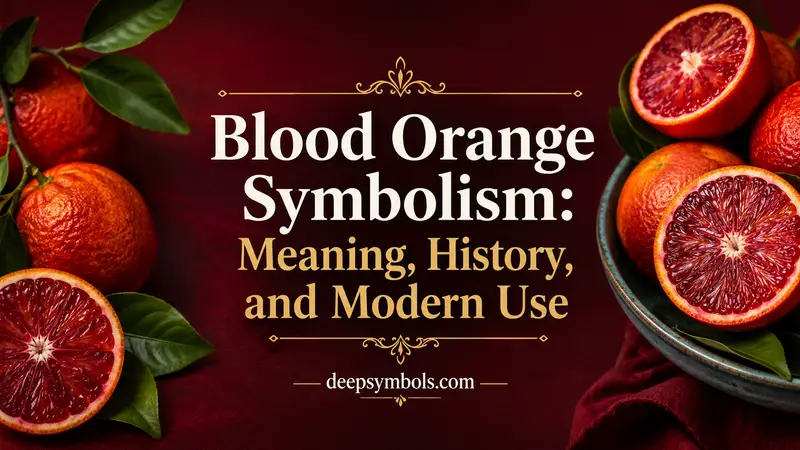
Cut a blood orange in half and the surprise is immediate — instead of the familiar pale orange flesh, there’s a deep crimson interior that looks almost like it doesn’t belong to a citrus fruit at all. That visual jolt is the real starting point for blood orange symbolism: a fruit whose meaning comes less from ancient myth and more from the simple, striking fact that its appearance contradicts what people expect.
Regular oranges already carry centuries of symbolic weight tied to prosperity, celebration, and good fortune across several cultures. Blood oranges inherit all of that and add something sharper on top — the color itself, which pulls the fruit toward associations with passion, vitality, intensity, and even mortality in a way a standard orange never quite manages. That combination of borrowed citrus symbolism and its own distinct color language is what makes blood orange worth looking at as its own subject rather than a footnote to “orange” in general.
In the United States today, the fruit shows up far more often in kitchens, cocktail menus, and design work than in any formal symbolic tradition — but the meanings people do attach to it draw on a surprisingly specific and traceable history, from Sicilian citrus groves to Renaissance painting to modern color psychology.
Quick Answer
Blood orange symbolism commonly represents vitality, passion, and intensity in modern American culture, largely because of its unexpected crimson color, and it appears most often in food culture, design, and seasonal imagery rather than formal tradition. Historically, oranges more broadly carried associations with prosperity and celebration across Chinese, Japanese, and European culture, while the blood orange’s specific red coloring has been connected to status, abundance, and the Sicilian identity of the fruit itself.
TL;DR
- Blood orange symbolism borrows heavily from general orange meaning
- Its red flesh comes from anthocyanins, a pigment rare in citrus fruit
- Oranges broadly symbolize prosperity and good fortune across cultures
- The color adds associations with passion, vitality, and intensity
- Sicily’s blood orange groves tie the fruit to regional identity and pride
- American use is mostly culinary and visual rather than ceremonial
What Makes a Blood Orange Look the Way It Does
Before getting into meaning, it’s worth understanding why the fruit looks the way it does, since the biology is doing a lot of the symbolic work here. Blood oranges get their deep red color from anthocyanins, the same family of pigments responsible for the color of blackberries, red grapes, and countless flowers.
Anthocyanins are actually uncommon in citrus fruit generally, which is part of why the effect feels so unusual even to people who eat oranges regularly. The dramatic contrast between the familiar orange exterior and deep red interior naturally makes the fruit visually distinctive.
That pigment doesn’t develop automatically. It requires a specific combination of conditions, most notably a sharp temperature swing between warm days and cold nights during the growing season.
Blood oranges most famously come from groves around Mount Etna in Sicily, along with regions in Spain. Volcanic soil and dramatic day-to-night temperature shifts in these areas create conditions that can encourage the fruit to develop its characteristic color.
Varieties like Tarocco, Moro, and Sanguinello each developed somewhat independently across Italy and Spain. The fruit itself is understood to have emerged as a mutation of the ordinary sweet orange sometime around the eighteenth century in the Mediterranean.
None of this is folklore — it’s observable horticulture. But it’s exactly the kind of striking, hard-to-miss natural process that tends to generate symbolic meaning on its own.
The same pattern appears throughout symbolism: an unusually colored flower, an oddly behaving animal, or a rare natural phenomenon can attract human attention before people begin attaching stories and meanings to it.
In the case of the blood orange, its unusual color has therefore become part of what makes the fruit symbolically interesting. Its biology provides the visual foundation, while cultural interpretation builds additional layers of meaning around it.
Orange as a Fruit of Prosperity: The Foundation
Blood orange symbolism doesn’t start from zero — it inherits a long-established set of meanings already attached to oranges generally. It’s worth being clear about that foundation before looking at what the blood orange adds on top of it.
In Chinese and Japanese tradition, oranges have long been associated with good fortune, wealth, and happiness. They are often exchanged around Lunar New Year celebrations as a wish for prosperity in the year ahead.
That association isn’t incidental. It’s tied partly to how the fruit’s color and round shape can read visually as symbols of gold and completeness, and partly to language itself, since in some Chinese dialects the word for orange sounds close to words associated with luck or wealth.
European tradition developed its own layer of orange symbolism, somewhat independently. Renaissance and Baroque painters featured citrus fruit in portraits and still-life compositions as a marker of prosperity.
Oranges were expensive and difficult-to-grow imports in much of Europe for centuries. Owning or displaying them could therefore signal real wealth.
Sandro Botticelli’s Primavera, painted in the late fifteenth century, places its central figures inside an orange grove. This detail is widely read as connecting the fruit to abundance, fertility, and springtime renewal.
This gives the blood orange a dual symbolic foundation. It inherits East Asian associations with prosperity and good fortune alongside European associations with luxury, abundance, and fertility.
The blood orange’s distinctive color can then add another layer to these established meanings. Its deep red interior naturally invites associations with vitality, passion, intensity, and transformation, although those meanings are interpretations rather than universal historical rules.
Taken together, these traditions provide the cultural foundation for understanding blood orange symbolism today. The fruit carries older meanings associated with oranges while its unusual appearance encourages newer interpretations of its own.
Why the Red Color Changes the Meaning
Color does real symbolic work on top of the fruit’s borrowed orange-family meaning, and it’s worth taking the two colors separately before combining them.
Orange as a color sits between red and yellow, and it typically reads as warm, energetic, and enthusiastic. It can be associated with vitality, sociability, and a kind of approachable confidence that doesn’t carry red’s more intense emotional charge.
Red changes that considerably. Across a wide range of traditions, red carries associations with passion, urgency, blood, life force, and sometimes danger or warning — a far more intense emotional register than orange alone.
When a blood orange’s flesh reads as genuinely red rather than orange, it pulls the fruit’s symbolism toward that more intense end of the spectrum. It’s not simply pleasant and warm, but vivid, dramatic, and even a little unsettling given how closely the color resembles blood itself, which is very likely part of how the fruit got its common name.
That tension between a cheerful citrus fruit and a color usually associated with something far more visceral is exactly what makes blood orange symbolism distinct from ordinary orange symbolism rather than just a more saturated version of it.
Sicily, Regional Identity, and the Blood Orange as a Cultural Marker
Nowhere is the blood orange more deeply tied to identity than in Sicily, where the fruit functions as something closer to a regional emblem than an ordinary crop.
Sicilian literature has used citrus groves specifically as a symbol of prosperity and the deep relationship between people and their land. Giovanni Verga, one of the major figures of Italian literary realism, described citrus orchards in these terms in his writing about the Sicilian countryside, using the fruit to represent both material wealth and generational labor at once.
That symbolic weight has carried into contemporary Sicilian identity and export culture, where blood oranges — particularly the Tarocco variety grown around Mount Etna — are marketed and understood as a point of regional pride, distinct from oranges grown elsewhere.
This is a case where symbolism and practical economics reinforce each other directly. The specific volcanic soil and climate around Etna genuinely produce a fruit with distinctive characteristics, giving the “Sicilian blood orange” label real substance behind the pride attached to it rather than making it purely a marketing construction.
Blood Orange, Status, and Historical Claims Worth Reading Carefully
Some sources describe blood oranges as a symbol of status and power in medieval Europe, tied to the broader pattern of citrus fruit functioning as a luxury import for centuries.
This claim appears frequently enough in modern writing about the fruit that it’s worth mentioning, but it deserves a note of caution. Detailed, well-documented primary sources specifically about blood oranges — as opposed to citrus fruit generally — in medieval Europe are thin, and much of what circulates online repeats the same claim without a clearly traceable original source.
The more solidly grounded version of this history is the broader one: citrus fruit as a category was genuinely a luxury item across much of medieval and early modern Europe. Citrus was difficult to grow outside Mediterranean climates and expensive to transport, which made any orange a reasonable marker of wealth for a European household that could obtain one.
Whether blood oranges specifically carried extra status beyond ordinary oranges during this period is plausible but less firmly documented than the general citrus-as-luxury pattern. Readers should therefore treat the more specific claim as a popular assertion rather than settled history.
An Unexpected Etymological Connection: Tarocco and Tarot
One of the more interesting, if unusual, historical threads connects a specific blood orange cultivar to a completely different area of symbolism entirely. The Tarocco variety — one of the most widely grown blood oranges, native to Italy — has, in some accounts, been suggested as a possible influence on the naming of the Tarot card deck, which emerged in fifteenth-century Italy under the Italian name tarocchi.
This connection is intriguing but should be treated as an interesting historical footnote rather than an established etymological fact — the actual origin of the word tarocchi is genuinely debated among scholars, and a direct, documented link to the citrus cultivar isn’t something linguists broadly agree on. It’s included here because it circulates fairly often in discussions of orange symbolism, not because it’s a confirmed piece of history. Worth knowing, worth holding loosely.
Blood Orange Symbolism in the United States Today
American engagement with blood orange symbolism is considerably less formal than the historical threads above, and it’s shaped much more by contemporary food and design culture than by any inherited tradition. The fruit has a specific, narrow growing season — typically winter into early spring — which has given it a modern American association with seasonal abundance in the middle of an otherwise fruit-scarce time of year, similar to how citrus generally reads as a small bright spot during colder months.
| Context | Meaning in the USA | Common Associations | Notes |
| Food and cocktail culture | Vibrancy, seasonal indulgence | Winter citrus, brunch, mixology | Its color drives most of the appeal |
| Design and photography | Boldness, energy, drama | Branding, editorial color palettes | Borrows more from color than fruit symbolism |
| Wellness and spiritual content | Vitality, healing, personal power | Color therapy, journaling prompts | Largely a recent, informal tradition |
| Gifting and hosting | Warmth, generosity, abundance | Holiday tables, winter gatherings | Echoes older orange-as-luck symbolism |
| Sicilian and Italian-American identity | Heritage, regional pride | Family recipes, cultural memory | Tied directly to Sicily’s citrus history |
Much of the fruit’s visibility in American culture right now comes from its usefulness as a visual subject rather than a symbol with settled meaning — it photographs dramatically, works as a striking ingredient on a menu, and reads as premium or artisanal in a way a standard navel orange doesn’t, largely because of its rarity and short season relative to other citrus.
Emotional and Psychological Associations
Psychologically, the blood orange tends to evoke a combination that few other fruits manage at once: comfort and intensity held together. The citrus flavor and bright color read as approachable and cheerful, the same way any orange does, but the unexpected red interior adds a layer of drama that a plain orange doesn’t carry — something closer to surprise or even mild unease before it resolves into simple visual pleasure.
That combination is likely why the fruit shows up so often in modern wellness and self-expression content specifically, where it gets framed as a symbol of embracing complexity or “finding strength in what looks different.” This is a fairly recent, informal reading rather than something with deep historical roots, and it’s worth naming plainly as modern personal interpretation rather than inherited tradition — but it’s a genuinely coherent reading given what the fruit actually does visually: something ordinary on the outside turns out to be more vivid and intense once you look closer.
Blood Orange in Art, Literature, and Popular Culture
Beyond Verga’s use of Sicilian citrus groves as a symbol of land and labor, oranges generally have a long history in visual art as still-life subjects, valued for their bright color and the visual contrast they create against darker backgrounds — a tradition blood oranges fit into easily, with their color offering painters and photographers even more contrast to work with than a standard orange.
The name “Blood Orange” has also been adopted well outside any culinary or botanical context, most notably as the stage name of English musician Dev Hynes, and as the title of multiple films and other creative works. In these cases, the name is typically chosen for its evocative, slightly unsettling contrast — the pairing of “blood,” with its associations of violence or intensity, against “orange,” a warm and ordinary fruit — rather than for any direct reference to the fruit’s own symbolic history. That pattern is worth noting on its own: the name itself has become a kind of transferable symbol, valued for its verbal tension independent of the actual citrus.
Common Misunderstandings About Blood Orange Symbolism
The most common overreach is treating blood orange symbolism as an ancient or universally established tradition on par with symbols that genuinely do have that kind of depth, like the rose or the lotus. It doesn’t have that. Most of what gets described as blood orange symbolism today is either borrowed directly from general orange symbolism, built from modern color psychology, or assembled fairly recently by wellness and lifestyle content — not inherited from a long, continuous, documented tradition specific to this fruit.
A second issue is treating specific historical claims — like the medieval status symbolism mentioned earlier, or the Tarocco-to-Tarot etymology — as more settled than they actually are. Both circulate widely enough to be worth mentioning, but neither is backed by the kind of clear documentation that would make them reliable historical fact rather than popular claim. Finally, it’s worth being careful not to conflate the fruit’s genuine, well-documented horticultural story — the anthocyanins, the Sicilian growing conditions, the specific cultivars — with its far less documented symbolic one. The biology is solid. Much of the symbolism sitting on top of it is considerably newer and looser than it’s often presented.
How Blood Orange Symbolism Has Developed
The clearest way to trace this is as a layering process rather than one continuous tradition. Ordinary oranges picked up prosperity and good-fortune symbolism independently across Chinese, Japanese, and European cultures, for different reasons in each place.
In East Asia, those associations developed partly through language and gift-giving customs. In Europe, oranges became connected with luxury and rarity because they were once expensive and difficult to obtain.
Blood oranges emerged later, as an eighteenth-century Mediterranean mutation. They inherited much of that existing orange symbolism by default simply by being a variety of orange.
Sicily then added a distinct regional layer, turning the fruit into a marker of specific cultural and agricultural identity rather than generic citrus abundance.
Color symbolism added another, more universal layer on top of all of that. Red’s association with passion and intensity could be placed directly over orange’s existing warmth and associations with abundance.
In the last couple of decades, food culture, design, and wellness content have added the newest and least historically grounded layer. These modern interpretations often emphasize vitality, boldness, and “finding intensity beneath an ordinary surface.”
That final reading says more about contemporary taste than about any single inherited tradition. The symbolism of the blood orange is therefore best understood as a combination of older cultural associations, regional identity, visual qualities, and newer interpretations.
FAQs
What does a blood orange symbolize?
Blood orange symbolism commonly represents vitality, passion, and intensity, drawing on both general orange symbolism around prosperity and the more emotionally charged associations of the color red. Much of this meaning is modern rather than ancient, shaped by food culture and design as much as by history.
Why is it called a “blood” orange?
The name comes directly from its deep red flesh, caused by anthocyanin pigments that are unusual in citrus fruit and develop in response to cold nights during the growing season. The name is descriptive rather than tied to any specific ritual or ceremonial origin.
Is there a connection between blood oranges and the Tarot?
Some sources suggest the Tarocco blood orange cultivar may have influenced the naming of the Tarot deck in fifteenth-century Italy, but this connection is debated and not firmly established by linguists. It’s best treated as an interesting possibility rather than confirmed history.
Do blood oranges symbolize good luck?
They can, mainly by inheriting the broader association between oranges and good fortune found in Chinese and Japanese tradition, where oranges are exchanged during celebrations like Lunar New Year. This meaning applies to oranges generally rather than being unique to the blood orange variety.
What does blood orange symbolize in Sicilian culture?
In Sicily, blood oranges represent regional identity, agricultural pride, and a connection to the land, particularly among groves grown around Mount Etna. This meaning is closely tied to the fruit’s specific growing conditions, which can’t easily be replicated elsewhere.
Is blood orange color symbolism the same as the fruit’s symbolism?
Not exactly, though they overlap heavily. The color blood orange draws primarily from red and orange’s separate psychological associations — passion, energy, warmth — while the fruit itself carries additional meaning tied to prosperity, seasonality, and regional identity that the color alone doesn’t carry.
Why do blood oranges appear so often in modern design and food photography?
Their unexpected, vivid color creates strong visual contrast and reads as premium or distinctive compared to a standard orange. This is largely an aesthetic and commercial pattern rather than a symbolic or ceremonial one.
Conclusion
Blood orange symbolism does not come from one ancient tradition or a single fixed meaning. Instead, its significance has developed through several layers: the broader symbolism of oranges as signs of prosperity and abundance, the fruit’s naturally dramatic red flesh, Sicily’s strong regional identity, and the newer meanings created by modern food, design, and wellness culture. The fruit’s connection to Sicily is especially grounded in reality; the European Union’s official specification for Arancia Rossa di Sicilia PGI documents how the region around Mount Etna and its distinctive growing conditions contribute to the fruit’s characteristic pigmentation.
That combination makes the blood orange especially interesting as a symbol. It can suggest prosperity, vitality, passion, regional pride, celebration, or simply the beauty of something unexpected inside an ordinary-looking fruit. Its meanings have changed and expanded over time rather than being inherited as one unchanging tradition.
Ultimately, blood orange symbolism works because the fruit itself invites interpretation: familiar on the outside, vivid and surprising within. Whether used in food, art, design, celebrations, or personal expression, it continues to carry meanings of richness, intensity, transformation, and distinctive identity.t together is the same thing that likely started the whole tradition in the first place: cutting into something familiar and finding a color you didn’t expect.


