
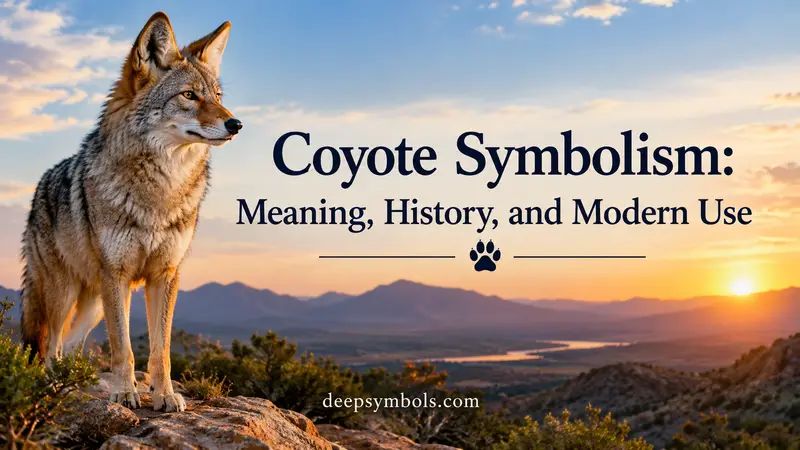
Coyote symbolism often represents cleverness, adaptability, independence, and the ability to survive by using opportunities others overlook. Known for its alert behavior, varied diet, and remarkable ability to live in different environments, the coyote has become a familiar figure in North American wildlife and storytelling. Its reputation is more complicated than simple cleverness, however: coyotes can also represent mischief, deception, unpredictability, and the consequences of acting without thinking.
In the United States, coyotes occupy a distinctive place in both nature and popular culture. They live in deserts, grasslands, forests, and increasingly urban and suburban environments. They also appear in cartoons, literature, folklore, and discussions about how people share landscapes with wild animals. Their ability to adapt to changing conditions makes them a recognizable symbol of survival and resourcefulness.
Coyote stories hold particular importance in many Indigenous traditions of North America. In some communities, Coyote is a trickster figure who challenges established expectations, creates disorder, exposes human weaknesses, or helps explain how the world works. Yet these stories differ significantly among Nations, and the character may have creative, destructive, humorous, or instructive roles depending on the tradition.
Understanding coyote symbolism requires looking beyond the familiar image of a crafty animal. Its meaning emerges from natural behavior, culturally specific stories, and modern experiences of living alongside wildlife.
Quick Answer
Coyote symbolism commonly represents cleverness, adaptability, resourcefulness, and the ability to find opportunities in difficult circumstances. In many Indigenous North American traditions, Coyote also appears as a trickster or culture hero whose actions reveal lessons about creation, human behavior, responsibility, and the consequences of challenging established rules.
TL;DR
- Coyotes symbolize adaptability, cleverness, independence, and survival.
- Indigenous Coyote stories vary by Nation, community, and tradition.
- Trickster stories can teach lessons through humor, mistakes, and unexpected consequences.
- Diné traditions include Coyote in important emergence and creation narratives.
- Modern American culture often portrays coyotes as crafty, mischievous characters.
- A coyote sighting does not automatically predict good or bad fortune.
What Makes the Coyote a Distinctive Symbol?
The coyote (Canis latrans) is a member of the dog family native to North America. It resembles a small wolf, with pointed ears, a narrow muzzle, a bushy tail, and fur that can range from gray and brown to reddish or yellowish tones.
Its appearance contributes to an image of alertness and independence. Coyotes frequently pause to listen, watch their surroundings, and assess potential threats. They may hunt alone, travel in pairs, or live in family groups, depending on circumstances.
Their adaptability is even more significant. Coyotes eat a varied diet that can include rodents, rabbits, insects, fruit, carrion, and other available food. They occupy a wide range of habitats and have persisted despite extensive historical efforts to eliminate them from many parts of North America.
These characteristics help explain the animal’s modern symbolic associations.
Its intelligence and ability to exploit opportunities suggest resourcefulness. Its survival in changing environments suggests resilience. Its willingness to approach a situation indirectly rather than relying on size or strength suggests clever problem-solving.
At the same time, a coyote’s opportunistic behavior can inspire less favorable interpretations, including manipulation, selfishness, or taking advantage of others.
The animal therefore makes a more complicated symbol than an uncomplicated emblem of bravery. It represents the advantages of adaptability while raising questions about how intelligence and opportunity are used.
The Main Meanings of Coyote Symbolism
Several meanings commonly appear in contemporary interpretations of the coyote, although their importance depends on cultural context.
Cleverness is among the most recognizable associations. Coyotes are alert, adaptable animals, and their portrayal in stories frequently emphasizes the ability to find unexpected solutions.
Adaptability reflects their success in a wide range of environments. The coyote can suggest adjusting to changing circumstances instead of relying on one familiar method.
Resourcefulness is closely related. The animal’s varied diet and flexible behavior illustrate how survival can depend on making effective use of available opportunities.
Independence comes partly from the coyote’s reputation as a solitary traveler. Although coyotes have important family and social relationships, their image in modern culture often emphasizes self-reliance.
Mischief and deception are especially prominent in trickster stories. Coyote may use disguises, exaggeration, cunning, or manipulation to achieve a goal, but those actions can also lead to embarrassment or failure.
Finally, the coyote can represent change and unpredictability. Trickster stories frequently disrupt familiar expectations, revealing that rules and assumptions are not always as secure as they appear.
These meanings should not be treated as one fixed spiritual definition. Some emerge from animal behavior, some from particular traditional narratives, and others from modern cultural interpretations.
Coyote as a Trickster in Indigenous North American Traditions
Coyote is a well-known trickster figure in numerous Indigenous traditions of western and southwestern North America, as well as in other regions. However, the stories differ considerably among individual Nations, and not every Indigenous community gives Coyote the same role.
A trickster is a character who crosses boundaries, unsettles expectations, and creates situations in which ordinary rules no longer work as expected. Tricksters can be intelligent, foolish, generous, selfish, creative, destructive, or several of these things at once.
In many Coyote narratives, the character attempts to satisfy a desire, gain an advantage, challenge another being, or change an existing situation. The plan may succeed temporarily before producing consequences that Coyote did not anticipate.
This is part of what makes the trickster an effective storyteller’s character. Instead of presenting an abstract lesson, a story allows listeners to observe a decision, its immediate reward, and its eventual consequences.
Coyote may expose arrogance by boasting too much, greed by taking more than is appropriate, or foolishness by refusing to recognize obvious limits. In other stories, the character’s unconventional actions contribute to creation or bring about changes that become part of the world.
It would be misleading to reduce every story to a simple moral such as “do not lie” or “be clever.” Indigenous oral traditions carry cultural knowledge, relationships, histories, and teachings that cannot always be separated into a single lesson.
The most important point is that Coyote is often a complicated character. Trickery can produce useful change, but cleverness does not guarantee wisdom, and challenging established rules can have both beneficial and harmful consequences.
Coyote in Diné (Navajo) Traditions
Among the Diné, commonly known in the United States as the Navajo, Coyote is known as Mąʼii and occupies an important place in traditional stories and teachings.
In documented Diné traditions, Coyote appears in early emergence narratives alongside figures such as First Man and First Woman. His role extends beyond that of a mischievous animal: he participates in accounts concerning the origins and ordering of the world.
Coyote’s character can include both constructive and disruptive qualities. His actions may bring innovation, challenge an existing arrangement, or create a situation that requires other beings to respond. At other times, his foolishness and selfishness produce consequences that become instructive within the narrative.
This combination gives Coyote a distinctive role. He is not simply a villain whose actions should always be rejected, nor is he a hero whose behavior should always be admired. His stories can reveal the complexity of change, the limits of cleverness, and the consequences of acting without sufficient judgment.
Diné Coyote stories also exist within cultural practices governing how certain narratives are shared. Some traditional accounts are associated with winter storytelling, and the appropriate timing and manner of telling may depend on community teachings.
This is an important reminder that these stories are not merely entertaining examples of universal trickster folklore. They belong to a living cultural tradition with its own context and protocols.
Modern interpretations of Coyote as a symbol of adaptability or transformation may draw inspiration from these stories, but personal symbolism should not be confused with a complete account of Diné beliefs.
How Coyote Stories Teach Through Humor and Consequences
Humor is one of the most recognizable features of many trickster narratives.
Coyote may devise an elaborate plan only to be defeated by a simple mistake. The character may try to outsmart another being, exaggerate his abilities, or act on a desire without considering the outcome.
These reversals create comedy, but the stories can also communicate more complicated ideas.
A trickster’s failure may demonstrate that intelligence without judgment is unreliable. A successful deception may raise questions about fairness and responsibility. A seemingly foolish act may produce an unexpected benefit, showing that outcomes do not always match intentions.
Coyote stories can therefore resist simplistic distinctions between clever and foolish behavior. A character may possess genuine intelligence while repeatedly failing to use it wisely.
For contemporary readers, this can provide a useful way to reflect on familiar experiences. A person who relies on shortcuts may succeed for a while but eventually face consequences. Someone who questions a rule may reveal a genuine problem, even if the way they challenge it creates additional difficulties.
These comparisons are modern interpretations, not substitutes for the original cultural context of a story.
The important distinction is that a trickster narrative often makes its point through the whole sequence of events. Understanding the character requires examining what happened, why it happened, and what the consequences reveal.
Cleverness, Resourcefulness, and Survival
The coyote’s natural behavior provides a strong basis for its modern association with resourcefulness.
Coyotes adapt their feeding habits to local conditions. An animal living near a desert settlement may encounter different food opportunities from one living in a northern forest or an urban neighborhood. Their survival depends partly on responding to what is available rather than specializing in a single food source.
Their success also illustrates the limitations of judging ability by physical size. A coyote is smaller than a wolf, but its adaptable behavior has helped it occupy an extensive geographic range.
As a personal symbol, the coyote can represent finding a practical route through a difficult situation. It may appeal to someone learning to work with limited resources, adjusting to an unexpected change, or solving a problem that cannot be overcome through force alone.
This meaning emphasizes flexible thinking rather than constant struggle.
The coyote also suggests that resourcefulness requires awareness. The animal benefits from noticing opportunities and responding to its surroundings. Applied to human experience, this can mean gathering information, learning from mistakes, and recognizing when an original approach is no longer useful.
The symbol is most constructive when cleverness is joined with judgment. Being resourceful does not mean taking advantage of others; it means finding workable solutions while recognizing the consequences of one’s actions.
Independence and the Balance Between Solitude and Community
Coyotes often travel alone or in pairs, although family groups are also important to their social lives. Their behavior does not fit the popular image of a permanently solitary animal that never depends on others.
This creates an interesting distinction between the coyote’s biological life and its symbolic reputation.
In modern personal interpretation, a coyote may represent independence, self-direction, and comfort with an unconventional path. Someone who has moved to a new city, changed careers, or chosen a different lifestyle might identify with the animal’s ability to navigate unfamiliar circumstances.
Yet the coyote’s social behavior provides a necessary qualification. Coyotes form family bonds, raise pups, and may cooperate in defending territory or obtaining food. Independence does not eliminate the need for relationships.
As a symbol, the coyote can therefore represent the balance between relying on oneself and remaining connected to others.
This interpretation is especially useful when independence becomes confused with isolation. A person can make personal decisions without rejecting help, friendship, or shared responsibility.
The coyote’s meaning is not simply “walk alone.” It can instead suggest knowing when to act independently, when cooperation is useful, and how to adapt when circumstances change.
Coyote Symbolism in Modern American Culture
In the United States, the coyote occupies two very different cultural roles: it is a real wild animal that people increasingly encounter near human settlements, and it is a familiar character in popular entertainment.
Modern wildlife accounts often describe coyotes as intelligent, opportunistic, and adaptable. Their presence in cities and suburbs demonstrates their ability to find food and shelter in environments shaped by people.
At the same time, American popular culture frequently portrays coyotes as mischievous or comically persistent characters. This image is particularly familiar through Wile E. Coyote from the Looney Tunes cartoons, whose elaborate attempts to catch the Road Runner repeatedly fail.
The cartoon reinforces associations with planning, persistence, and overconfidence. Wile E. Coyote can develop complicated schemes, but his failure to recognize their weaknesses usually creates the joke.
This portrayal is separate from the living cultural significance of Coyote in Indigenous traditions. Although both involve cleverness and trickery, a modern cartoon should not be treated as a faithful explanation of Indigenous storytelling.
The difference matters because popular entertainment can flatten a complex character into a simple joke. In traditional narratives, Coyote’s actions may involve creation, social relationships, spiritual context, or lessons specific to a community.
In contemporary American life, the animal’s meaning depends on where it appears. A wildlife photograph may suggest resilience, a cartoon may suggest comic failure, and an Indigenous artwork may communicate a cultural meaning that requires knowledge of the artist and tradition.
Coyote Symbolism in Tattoos, Art, and Personal Identity
Coyote imagery appears in tattoos, illustrations, jewelry, clothing, and other forms of contemporary visual expression.
A person choosing a coyote tattoo may associate the animal with adaptability, independence, survival, or unconventional thinking. A coyote shown looking over its shoulder might emphasize alertness, while one depicted running through a desert may suggest freedom or movement through challenging conditions.
The design’s details affect its interpretation. A moonlit scene can emphasize the animal’s nocturnal associations, while a cartoon-like coyote can express humor or a willingness to laugh at one’s own mistakes.
Some people may choose coyote imagery because of a meaningful connection with the landscapes of the American Southwest or another region where the animal is common. Others may be drawn to the character because they appreciate trickster stories or have a personal memory involving coyotes.
Indigenous-inspired coyote designs require additional care. Certain patterns, clan emblems, ceremonial imagery, or culturally specific representations may carry meanings that go beyond an individual’s preference. The cultural origin of a design should be understood rather than assumed from the animal alone.
A personal coyote image does not automatically communicate an Indigenous identity or traditional spiritual status. Its meaning depends on the design, the maker, the wearer’s intentions, and the cultural context.
The Shadow Side: Deception, Arrogance, and Unwise Choices
The coyote’s symbolism is not entirely positive.
In many trickster narratives, Coyote’s cleverness becomes a problem when it is used selfishly or without considering the consequences. A plan may initially appear successful, only for the character to lose control of the situation.
This pattern creates associations with manipulation, greed, impulsiveness, and overconfidence.
The coyote can therefore serve as a warning against assuming that intelligence guarantees a good outcome. A person may be good at finding shortcuts but still make poor decisions if the desire to win overrides honesty or judgment.
This interpretation also explains why trickster stories often use humor rather than direct condemnation. The audience can recognize the character’s mistake and laugh at the result while considering how similar behavior appears in human relationships.
The lesson is not that cleverness is inherently dishonest. Strategic thinking and creativity can be valuable qualities. The problem arises when they are separated from responsibility.
In personal symbolism, the coyote’s shadow side can encourage someone to examine their motives, recognize patterns of self-deception, or question whether a seemingly clever solution will create greater problems later.
The animal’s complicated reputation gives it a wider range of meaning than symbols associated only with courage or success.
What Does It Mean to See a Coyote?
A coyote sighting can be meaningful to someone because of personal beliefs, memories, or cultural teachings. However, it does not have one universal spiritual interpretation, and there is no reliable evidence that seeing a coyote automatically predicts a particular event.
Someone who associates coyotes with adaptability might interpret an encounter as a reminder to respond flexibly to changing circumstances. Another person may connect it with a familiar landscape, a traditional story, or an experience of living near wildlife.
Those interpretations can be personally valuable without being presented as objective predictions.
The circumstances of the encounter also matter in practical terms. A coyote near a trail may simply be traveling or searching for food. Coyotes can be active during daylight as well as nighttime, so seeing one does not necessarily indicate unusual behavior.
If you encounter a coyote, maintain a safe distance and do not approach or feed it. Keep pets under control, particularly in areas where coyotes are present.
The symbolic interpretation is a separate question from the animal’s real behavior. A sighting may prompt reflection, but the coyote’s presence is not evidence that good luck, danger, betrayal, or a major life change is approaching.
Coyote Symbolism at a Glance
| Context | Common Association | Important Distinction |
|---|---|---|
| Modern personal symbolism | Adaptability and resourcefulness | A contemporary interpretation inspired by animal behavior |
| Indigenous trickster stories | Cleverness, disruption, and consequences | Stories vary across Nations and communities |
| Diné traditions | Creation, innovation, and complex moral lessons | Coyote has a culturally specific role in Diné narratives |
| American popular culture | Mischief and comic persistence | Cartoon portrayals are not equivalent to Indigenous traditions |
| Tattoos and visual art | Independence and unconventional thinking | Meaning depends on design and cultural context |
| Wildlife encounters | Awareness and coexistence | Seeing a coyote is not a universal omen |
Common Misunderstandings About Coyote Symbolism
One common misunderstanding is that every Indigenous Nation regards Coyote as the same trickster character. Although Coyote appears in many Indigenous storytelling traditions, the character’s role differs by Nation, region, and narrative.
Another mistake is treating the trickster as automatically evil. Coyote may create difficulties, act selfishly, bring about change, or contribute to the formation of the world. The character’s meaning depends on the story rather than on a simple division between good and bad.
A third misunderstanding is equating Indigenous Coyote traditions with modern cartoons. Popular entertainment may borrow the idea of the crafty coyote, but its purpose and cultural context are different from those of Indigenous oral narratives.
It is also misleading to assume that seeing a coyote carries a fixed spiritual message. Personal reflection can make an encounter meaningful, but the animal’s appearance does not establish that an event has been foretold.
Finally, cleverness should not be confused with wisdom. Trickster stories often make this distinction central: knowing how to get what one wants is not the same as understanding whether the goal or method is appropriate.
Recognizing these differences allows the coyote to be understood as a complicated animal and cultural figure rather than a symbol with one simplified definition.
How Coyote Symbolism Has Evolved
Coyote symbolism has developed through the relationship between the animal’s real behavior, Indigenous oral traditions, changing landscapes, and modern media.
For Indigenous communities, Coyote stories have long held culturally specific roles. Depending on the tradition, Coyote may participate in creation narratives, challenge expectations, teach through mistakes, or reveal the consequences of human-like desires and decisions.
As American popular culture expanded, the animal became familiar through cartoons, children’s books, and general wildlife imagery. These portrayals often emphasized cleverness, mischief, and comic failure.
Meanwhile, coyotes adapted to changing North American environments. Their ability to survive across deserts, forests, agricultural areas, and cities has reinforced their modern reputation for flexibility and resilience.
Contemporary symbolism brings these strands together but should not confuse them. A modern tattoo inspired by independence is a personal interpretation; a Diné Coyote story belongs to a particular cultural tradition; and a wildlife photograph reflects the actual animal.
Each can be meaningful in its own setting.
The coyote remains a compelling symbol because it challenges easy judgments. It can be clever without being wise, disruptive without being purely destructive, and independent while still depending on family relationships. Its story is ultimately about the complicated relationship between opportunity, judgment, and consequence.
FAQs
What does the coyote symbolize spiritually?
In contemporary spiritual interpretation, the coyote may represent adaptability, resourcefulness, transformation, and learning through unexpected experiences. Indigenous traditions have their own distinct teachings about Coyote, so modern spiritual meanings should not be presented as universal Indigenous beliefs.
Why is Coyote considered a trickster in Native American traditions?
In many Indigenous narratives, Coyote challenges expectations through cleverness, mischief, or unusual behavior. The character’s actions can create change, reveal weaknesses, or teach lessons through the consequences of mistakes, although the role differs among cultural traditions.
What does a coyote symbolize in Diné culture?
In Diné traditions, Mąʼii appears in significant emergence and creation narratives and can have both constructive and disruptive roles. His stories may explore creation, innovation, judgment, and the consequences of behavior within a specific cultural context.
Is the coyote a positive or negative symbol?
The coyote can represent both positive and negative qualities. Resourcefulness and adaptability are constructive associations, while trickery, arrogance, and impulsive decisions reflect the animal’s more cautionary symbolic side.
What does a coyote tattoo mean?
A coyote tattoo may express independence, cleverness, resilience, or an unconventional approach to life. The meaning depends on the artwork, the wearer’s experiences, and whether the design refers to a particular cultural tradition.
Does seeing a coyote mean good luck?
There is no universal tradition establishing that a coyote sighting predicts good luck. Someone may attach personal significance to an encounter, but the animal’s appearance is not reliable evidence of a future event.
Conclusion
Coyote symbolism brings together cleverness, adaptability, independence, and the complicated lessons that emerge when intelligence is used without judgment. In Diné traditions, Coyote appears in creation and emergence narratives as a powerful figure whose actions can produce both innovation and disruption. The Natural History Museum of Utah’s explanation of Diné Coyote symbolism provides useful cultural context for understanding how Coyote’s adventures can teach lessons about possibilities, limitations, and consequences.
In modern American culture, the coyote may represent comic mischief, unconventional thinking, resourcefulness, or survival. These interpretations are most meaningful when they remain distinct from the specific teachings of individual Indigenous Nations rather than being treated as one universal Native American tradition.
Ultimately, coyote symbolism reminds us that cleverness alone does not guarantee wisdom. Finding an unexpected path can be a remarkable strength, but sound judgment means understanding where that path leads and who may be affected along the way.


