
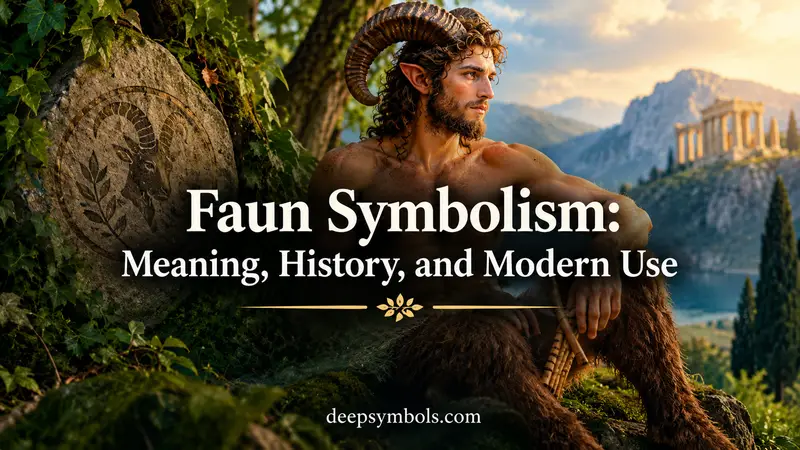
Faun symbolism centers on nature, freedom, instinct, playfulness, and the connection between human life and the untamed world. A faun is a mythical creature traditionally depicted with a human upper body and the legs, horns, or ears of a goat. Rooted in Roman mythology, fauns were associated with rural landscapes, woodland spirits, fertility, and the rhythms of life beyond settled communities.
In modern American culture, fauns appear in fantasy novels, films, sculptures, video games, tattoos, and decorative art. Their half-human, half-animal appearance makes them natural symbols of the boundary between civilization and wilderness. Depending on the story, a faun may represent cheerful freedom and creativity or temptation, recklessness, and the unpredictable side of human nature.
The creature’s history is more complicated than its familiar fantasy appearance suggests. Ancient Roman fauns were connected with the countryside and the rustic deity Faunus, while Greek satyrs influenced the way fauns were later depicted in art. Over time, the two traditions became increasingly intertwined, creating the goat-legged woodland figure recognized today.
Understanding faun symbolism means looking at this evolution carefully. The creature’s meaning can involve a celebration of nature, a warning about unchecked impulses, or a reminder that human beings remain connected to the natural world.
Quick Answer
Faun symbolism commonly represents nature, freedom, fertility, playfulness, and untamed instinct in modern American culture. Historically, fauns were associated with Roman rural religion and the countryside, while their later resemblance to Greek satyrs added connections with music, revelry, sensuality, and unpredictable behavior.
TL;DR
- Fauns symbolize nature, freedom, instinct, and the untamed world.
- Roman traditions connected fauns with rural life and fertility.
- Greek satyrs influenced the familiar goat-legged appearance of modern fauns.
- Flutes, forests, and dancing often suggest creativity and carefree living.
- Darker interpretations connect fauns with temptation and uncontrolled desires.
- Modern fantasy uses fauns to explore the boundary between civilization and nature.
What Is a Faun and What Does It Represent?
A faun is a mythical being associated primarily with Roman mythology. In modern illustrations, it usually has a human torso, arms, and face combined with goat-like legs, hooves, horns, and pointed ears. Some depictions include a short tail, furry lower body, or small horns that blend into the creature’s hairstyle.
The familiar image is partly the result of centuries of artistic development. Early Roman ideas about fauns did not always involve the half-goat appearance seen in modern fantasy. As Roman artists and writers adopted features associated with Greek satyrs and the god Pan, the figures increasingly resembled one another.
The creature’s unusual body provides a natural basis for its symbolic meaning. The human features suggest thought, speech, and social relationships, while the animal features connect it with instinct, movement, and the natural environment.
This combination makes the faun a useful symbol of two worlds meeting. It can represent the part of human nature shaped by culture and reason alongside the impulses associated with freedom, desire, and the outdoors.
Its meaning depends on how the creature behaves in a particular story. A faun playing music in a peaceful grove may suggest creativity and harmony, while a more sinister faun leading a traveler away from safety may represent temptation or uncertainty.
The faun is therefore not automatically good or evil. It is a flexible mythological figure whose meaning emerges from the relationship between humanity, nature, and instinct.
The Main Meanings of Faun Symbolism
Several themes recur in contemporary interpretations of fauns, although they do not all originate in the same historical tradition.
Connection with nature is the most fundamental association. Fauns belong to forests, fields, groves, and other rural environments rather than to crowded cities or formal institutions. They can represent a desire to reconnect with the living world.
Freedom and spontaneity arise from their playful portrayal in later art and literature. A faun may dance, play a flute, wander through a woodland, or ignore the expectations imposed by civilized society.
Fertility and vitality reflect the connection between Roman rural deities and the productivity of fields, flocks, and living creatures. These associations emphasize the natural processes that sustain life.
Creativity and music come from depictions of fauns and related woodland beings playing pipes or dancing. The creature can suggest artistic expression that feels instinctive rather than carefully controlled.
Instinct and desire represent a more complicated side of the symbol. Fauns may embody impulses that civilized society attempts to regulate, including appetite, attraction, excitement, and the pursuit of pleasure.
Finally, fauns can represent the boundary between human and animal nature. Their mixed appearance raises questions about identity, self-control, and whether civilization fully separates people from their instincts.
These meanings can coexist. A faun may express the joy of living freely while also reminding a reader that freedom without judgment can become dangerous.
Ancient Roman Origins: Fauns and the God Faunus
The roots of the faun lie in ancient Roman religion, particularly in traditions associated with Faunus, a rustic deity connected with forests, fields, flocks, and fertility.
Faunus was also associated with prophecy. In Roman accounts, his communications could come through mysterious sounds or visions received in sacred places. This gave him a role beyond that of a simple woodland god: he could be connected with knowledge of events that remained hidden from ordinary people.
The Roman countryside provided the setting for these beliefs. Agriculture and animal husbandry were central to everyday life, and communities depended on healthy crops, fertile livestock, and favorable environmental conditions.
Faunus and related rural spirits belonged to a religious world in which natural places could have divine significance. A grove, pasture, or cultivated field was not merely a backdrop for human activity; it was part of a landscape in which people recognized powers affecting their survival.
Over time, Roman literature and art increasingly connected fauns with the rustic figure of Faunus and with Greek pastoral mythology. The image of a horned or goat-legged woodland being became more familiar, and the distinction between a faun and a satyr gradually weakened.
This history matters because modern fantasy often treats fauns as a standardized species with a fixed personality. Their historical origins were more varied, involving rural religion, place-based spirits, fertility, and prophetic associations.
The faun’s original connection with the countryside remains the strongest foundation for interpreting its symbolism.
Nature, Forests, and the Untamed World
Fauns are among the mythological figures most closely associated with the natural landscape.
Unlike characters whose power depends on kingdoms, armies, or elaborate institutions, fauns are generally imagined among trees, streams, meadows, and mountain paths. Their environment helps define who they are.
This association makes the faun a symbol of a life that remains closely connected with nature. It can represent the desire to spend time outdoors, appreciate wildlife, or escape the pressures of a tightly organized social world.
In contemporary interpretation, a faun standing beneath old trees may suggest a place where unfamiliar possibilities exist beyond the boundaries of everyday routine. The forest can become a space for discovery, solitude, creativity, or encounters with forces that cannot be easily controlled.
The same setting can also feel threatening. A forest path may lead someone away from familiar surroundings, creating uncertainty about where the journey will end. In stories, a faun who lives in such a place may be a helpful guide or a character whose intentions remain unclear.
The creature therefore reflects both the attraction and the uncertainty of wilderness.
Its symbolism is especially relevant to modern nature-oriented art and fantasy, where the natural world can represent freedom from social expectations while retaining its own dangers and rules.
Freedom, Playfulness, and the Joy of Living
Modern depictions often portray fauns as energetic, sociable, and interested in music, dancing, feasting, or exploring the countryside.
These characteristics support their association with freedom and spontaneous enjoyment. A faun may act without the formal manners expected in a human court or the discipline associated with a strict institution.
As a symbol, this behavior can suggest the importance of play, curiosity, and experiences that have no immediate practical purpose. It offers a contrast to a life organized entirely around obligations, productivity, or external approval.
For someone drawn to the image, a faun might represent a wish to recover a more spontaneous part of themselves. Music, movement, humor, and outdoor exploration may become ways to reconnect with that feeling.
However, the historical distinction between Roman fauns and Greek satyrs matters here. The exaggerated revelry and uninhibited appetites commonly associated with modern fauns often reflect the influence of satyr imagery, especially through later classical art and literature.
Not every faun in historical sources was a carefree partygoer. The association with playfulness grew through the blending of different mythological traditions.
In contemporary symbolism, freedom is therefore best understood as one possible interpretation rather than a defining characteristic of every faun.
Fertility, Vitality, and the Cycles of Nature
Fauns are connected through Roman rural traditions with a world in which fertility meant much more than human reproduction.
Healthy crops, productive livestock, abundant food, and the continuation of living communities all depended on natural processes that people could influence but never fully control.
The rustic deity Faunus was associated with the welfare and fertility of fields and flocks. This background helps explain why fauns and related woodland figures became linked with vitality and the flourishing of life.
In modern art, the association may appear through images of fauns surrounded by fruit, flowers, vines, or lush vegetation. These details can suggest abundance, growth, and the natural cycle of renewal.
The meaning need not be limited to literal fertility. A faun may also represent creative productivity, the development of new ideas, or the energy required to begin a project.
At the same time, fertility in historical traditions should not be confused with one universal spiritual message. Roman rural religion, Greek pastoral mythology, and modern fantasy developed different interpretations of the relationship between supernatural beings and living things.
The broad connection remains useful: the faun represents a world in which life is continually growing, reproducing, changing, and responding to its environment.
Music, Creativity, and Artistic Inspiration
Fauns are frequently portrayed with simple musical instruments, particularly pipes or flutes, and are often shown dancing or performing in outdoor settings.
These images developed partly through the creature’s relationship with Greek satyrs and the rustic god Pan, who was associated with shepherds, pastoral music, and wild landscapes.
Music gives the faun an additional symbolic dimension. It suggests expression that comes from instinct and feeling rather than from strict rules.
In contemporary interpretation, a faun playing a flute can represent creativity, artistic freedom, or the pleasure of making something for its own sake. The instrument’s association with nature may also suggest a connection between human creativity and the surrounding environment.
The meaning changes depending on the mood of the image. A joyful faun playing among flowers may represent uncomplicated pleasure, while a lonely figure making music beneath dark trees may evoke nostalgia or longing.
For writers and artists, the faun can serve as a figure for creativity that resists rigid expectations. It represents the possibility that original ideas sometimes emerge through experimentation, play, and a willingness to explore unfamiliar territory.
This association is a modern extension of the creature’s pastoral imagery rather than a universal ancient belief about artistic inspiration.
Faun vs. Satyr: Why the Difference Matters
Fauns and satyrs are often treated as interchangeable in modern books, films, and fantasy games, but their historical origins differ.
The faun belongs to Roman mythology and is associated with the countryside, woodland spirits, and the rustic deity Faunus. Early Roman traditions were not always consistent about the appearance or number of these beings.
The satyr comes from Greek mythology and is strongly associated with Dionysus, the god of wine, theater, and revelry. Satyrs were frequently portrayed as unruly companions whose appetites and mischievous behavior contrasted with the expectations of respectable society.
Their physical appearances also changed over time. Early Greek satyrs often displayed horse-like ears and tails, while later art increasingly portrayed them with goat-like features. As Roman culture adopted Greek artistic conventions, the distinction between fauns and satyrs became less clear.
Modern fantasy generally uses faun for a human-goat hybrid, but contemporary depictions may borrow freely from both traditions.
This matters when interpreting the symbol. A gentle woodland guide may draw more heavily on the pastoral associations of Roman fauns, whereas an unruly creature pursuing pleasure may reflect the satyr tradition.
Neither character has one universal personality, but recognizing their different origins makes the symbolism more historically accurate.
Faun Symbolism in Literature and Modern Fantasy
Modern literature often uses fauns as figures that stand between the familiar human world and a more unpredictable realm of nature or magic.
One of the best-known examples appears in C. S. Lewis’s The Lion, the Witch and the Wardrobe. Mr. Tumnus is a faun who lives in Narnia and initially appears to be a charming, music-loving woodland resident. His relationship with Lucy introduces the tension between personal conscience and obedience to an oppressive ruler.
The character’s mixed identity also helps establish Narnia as a world where ordinary boundaries between human society, animal life, and mythological beings do not operate in the usual way.
Another notable modern example is Guillermo del Toro’s film Pan’s Labyrinth, released in 2006. Its ambiguous woodland figure belongs to a darker fantasy atmosphere in which questions of trust, authority, imagination, and danger remain unsettled.
Although the film’s English title emphasizes Pan, its Spanish title, El laberinto del fauno, refers to the faun. The creature’s appearance and role deliberately leave room for uncertainty about its motives.
These examples show the faun’s versatility. In one story, it may help a character find courage and compassion. In another, it may become part of a world where appearances cannot be trusted.
Modern fantasy uses this ambiguity to explore the relationship between innocence, instinct, and moral responsibility.
The Shadow Side: Temptation, Impulses, and Loss of Control
The faun’s association with nature and freedom can also create darker interpretations.
In traditions influenced by satyrs, fauns may embody appetite, sensuality, intoxication, or the pursuit of pleasure without sufficient regard for consequences. These traits can make the creature appealing and unsettling at the same time.
Symbolically, the faun can represent the part of human nature that resists rules and seeks immediate satisfaction. In a story, this may lead to liberation from an oppressive system, but it can also result in recklessness or harm to others.
The forest setting reinforces the ambiguity. Leaving a controlled social environment can create space for discovery, yet the wilderness can also make a traveler vulnerable to confusion or danger.
A faun offering music or an invitation into the woods may therefore act as a symbol of temptation. The invitation might lead to pleasure and discovery, or it might draw someone away from responsibilities and familiar safeguards.
This darker reading does not mean that fauns are inherently evil. Their meaning depends on how their freedom is used and what consequences follow.
The creature can therefore serve as a reminder that instinct is part of human nature, but acting on every impulse is not the same as living freely or wisely.
Faun Symbolism in American Art, Tattoos, and Personal Identity
In the United States, fauns appear mainly through classical art, fantasy entertainment, decorative illustration, and personal creative expression.
A faun tattoo might represent a connection with nature, artistic independence, playful energy, or a fascination with mythology. Some people may identify with its half-human appearance because it expresses the tension between social expectations and personal instinct.
The design’s details influence the message. A faun surrounded by flowers and trees may emphasize harmony with nature. A flute-playing figure can evoke creativity and freedom, while a darker faun standing at a forest entrance may suggest mystery or temptation.
In home decor, fauns appear in garden statues, sculptures, fantasy artwork, and classical-inspired designs. These images may lend a space a pastoral or mythological atmosphere.
However, the symbol’s meaning is rarely standardized in modern America. Unlike a common sign with an established public definition, a faun may simply communicate that the owner enjoys mythology, fantasy, or woodland imagery.
It is therefore useful to distinguish the historical associations of the creature from personal interpretations developed by artists and audiences.
A faun can function as a personal emblem without requiring the wearer or owner to follow a particular religious tradition.
Faun Symbolism in Nature-Inspired Design and Decor
Fauns fit naturally into garden and woodland-inspired design because their traditional setting is the countryside.
A small statue of a flute-playing faun beside a fountain or among plants can evoke an idealized rural landscape. The figure may suggest playfulness, creativity, or a sense of connection with nature that differs from the formality of modern architecture.
In indoor spaces, faun imagery often contributes to a classical or fantasy-inspired aesthetic. Sculptures may resemble figures found in Roman gardens, while illustrations may depict fauns among ferns, mushrooms, flowers, and trees.
These visual choices can create associations with tranquility and escape from ordinary routines. The faun becomes a reminder of a world where music, movement, and the natural environment are central.
Its meaning changes with the setting. A traditional sculpture might reference classical art, while a contemporary illustration may emphasize magic or personal imagination.
Not every faun decoration is intended as a spiritual symbol. It may simply express an appreciation for mythology, sculpture, or the visual contrast between human and animal forms.
The most meaningful interpretation considers the object’s artistic origin and the reason it was chosen.
Common Misunderstandings About Faun Symbolism
One common misunderstanding is that fauns and satyrs are originally the same creature. The traditions eventually blended, but fauns emerged from Roman religious and rural contexts, whereas satyrs belonged to Greek mythology.
Another mistake is assuming that fauns were always gentle, friendly woodland beings. Modern children’s fantasy often presents them as approachable, but ancient and later portrayals vary considerably. Some emphasize prophecy and rural protection, while others draw on the unruly behavior associated with satyrs.
A third misconception is that fauns have one fixed spiritual meaning. Nature, freedom, fertility, creativity, and temptation are possible associations, not universal definitions.
It is also important to distinguish a faun from a fawn. The words sound alike in English, but a fawn is a young deer, while a faun is a mythological human-animal hybrid.
Finally, modern fantasy imagery should not automatically be treated as accurate ancient mythology. Contemporary authors and artists often combine Roman fauns, Greek satyrs, the god Pan, and new inventions into a single character type.
Recognizing these differences helps explain why fauns can represent several seemingly contradictory ideas without reducing their history to one simplistic meaning.
Faun Symbolism at a Glance
| Context | Common Association | Important Distinction |
|---|---|---|
| Ancient Roman traditions | Rural life, nature, and fertility | Connected with Faunus and countryside religion |
| Greek-influenced imagery | Revelry, music, and instinct | Often reflects the influence of satyrs and Pan |
| Nature-inspired symbolism | Freedom and harmony with the natural world | A modern interpretation of the creature’s setting |
| Literature and fantasy | Mystery, guidance, temptation, or transformation | The character’s role depends on the story |
| Tattoos and personal art | Creativity, independence, and individuality | Personal meaning may differ from historical symbolism |
| Garden and home decor | Playfulness and classical beauty | Often primarily decorative rather than religious |
How Faun Symbolism Has Evolved
Faun symbolism has changed as Roman religious ideas, Greek artistic influence, European literature, and modern fantasy have shaped the creature’s appearance and character.
In ancient Rome, fauns were associated with rural settings, fields, flocks, and the deity Faunus. Their connection with the countryside reflected a world in which agriculture, livestock, and natural forces were central to human survival.
As Roman culture absorbed Greek mythology and artistic traditions, fauns increasingly resembled satyrs. Their imagery became more closely associated with goat-like bodies, music, dancing, and uninhibited behavior.
Renaissance and later European art popularized these hybrid forms, and literature continued to develop the faun as a creature inhabiting the boundary between humanity and nature.
Modern fantasy expanded the possibilities further. Fauns could become friendly guides, mysterious guardians, comic characters, or dangerous figures whose motives were difficult to judge.
Today, the creature often symbolizes freedom, creativity, individuality, or the desire to reconnect with the natural world. Darker portrayals preserve the themes of temptation and uncontrolled instinct.
These meanings coexist because the faun has never been limited to one role. Its continuing appeal comes from its ability to represent the benefits and dangers of stepping beyond familiar boundaries.
FAQs
What does a faun symbolize spiritually?
A faun may represent connection with nature, freedom, fertility, creativity, and instinct in contemporary spiritual interpretation. These associations draw on Roman mythology and later artistic traditions rather than one universally established spiritual definition.
Is a faun good or evil in mythology?
Fauns are not uniformly good or evil. Some portrayals emphasize rural nature and pastoral charm, while others, influenced by Greek satyrs, highlight mischief, temptation, and uncontrolled desires.
What is the difference between a faun and a satyr?
Fauns originated in Roman mythology and were associated with rural deities and the countryside, while satyrs originated in Greek mythology and were connected with Dionysus. Their appearance and symbolism blended over time, which is why modern fantasy often treats them as interchangeable.
What does a faun tattoo mean?
A faun tattoo may represent freedom, creativity, individuality, a love of nature, or an interest in classical mythology. The specific meaning depends on the design and the wearer’s personal connection with the creature.
Why are fauns associated with music?
Fauns are often depicted with pipes or flutes because later artistic traditions connected them with Greek satyrs and the pastoral god Pan. Music reinforces their associations with nature, spontaneity, and creative expression.
What is the difference between a faun and a fawn?
A faun is a mythological human-animal hybrid traditionally associated with Roman mythology. A fawn is a young deer, so the terms refer to entirely different things despite their similar pronunciation.
Conclusion
Faun symbolism brings together nature, freedom, fertility, creativity, and the unpredictable side of human instinct. Rooted in Roman rural traditions and reshaped through Greek mythology, classical art, and modern fantasy, the faun represents the meeting point between human culture and the untamed world. The Smithsonian American Art Museum’s discussion of its Faun sculpture offers a compelling example of this tension, presenting music as a way of bridging human culture and the natural world.
In modern American culture, fauns appear in literature, films, tattoos, sculptures, and nature-inspired design. Their meaning can range from playful creativity and freedom to temptation and the need for self-restraint. The interpretation depends on the story, artistic setting, and qualities emphasized in the image.
Ultimately, faun symbolism reminds us that nature and instinct are neither forces to suppress entirely nor ideals to romanticize without question. They are parts of human experience that deserve curiosity, understanding, and thoughtful judgment. The faun’s lasting appeal lies in its dual nature: partly human and partly wild, it invites us to explore how creativity, freedom, and instinct can coexist with responsibility.


