
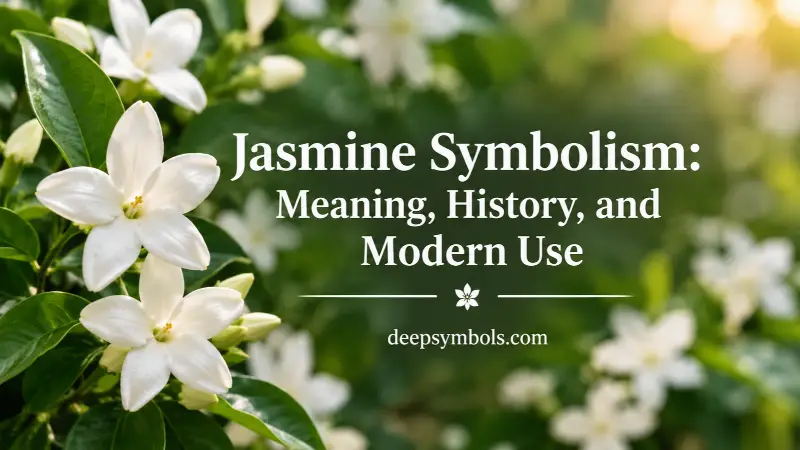
Jasmine symbolism brings together several ideas that seem different at first: love, purity, beauty, hospitality, sensuality, spirituality, and remembrance. The small flowers are visually modest, but their fragrance can fill an entire room, garden, or evening air. That contrast is one reason jasmine has acquired such a wide range of meanings.
Jasmine matters because people rarely experience it as decoration alone. A jasmine vine may remind someone of a family garden, a wedding ceremony, a religious offering, a favorite perfume, or a summer evening. In the United States, those associations increasingly overlap with traditions brought by Asian, Middle Eastern, Mediterranean, Caribbean, and other immigrant communities.
There is also an important historical point: jasmine does not have one universal meaning. Different species, regions, religions, and periods gave the flower different roles. Understanding those differences makes its symbolism more useful—and much more accurate.
Quick Answer
Jasmine symbolism commonly represents love, grace, purity, and affectionate warmth in modern American culture, especially in weddings, fragrance, gardens, and personal gifts. Historically, jasmine has also been associated with religious devotion, sensual beauty, hospitality, and sacred gardens across South and East Asia, Persia, the Islamic world, and Europe.
TL;DR
- Jasmine commonly represents love, grace, purity, and warm affection.
- Fragrance helped connect jasmine with romance, hospitality, and sensuality.
- Hindu and Buddhist traditions use jasmine in worship and offerings.
- Islamic gardens associated jasmine with beauty, fragrance, and paradise imagery.
- American meanings combine floral tradition with perfume, weddings, gardens, and cultural identity.
- Victorian flower language gave jasmine meanings that were not always consistent.
What Jasmine Looks Like and Why Its Appearance Matters
Jasmine is not one single plant but a large genus of flowering plants in the olive family, Oleaceae. Different jasmine species can grow as shrubs, climbers, or scrambling vines, and their flowers may be white, yellow, or pink. Many varieties are cultivated because of their exceptionally noticeable fragrance.
Common jasmine, Jasminum officinale, is a climbing plant with small, pale flowers and a strong scent. Arabian jasmine, Jasminum sambac, is another culturally important species, particularly across South and Southeast Asia. These species are sometimes discussed simply as “jasmine,” even though their histories and uses are not identical.
Its physical qualities help explain much of its symbolism. The flowers look delicate, but their fragrance is unusually strong. That combination naturally lends itself to ideas such as understated beauty, emotional presence, attraction, and elegance.
Jasmine also tends to be experienced through several senses at once. Someone may see white flowers, smell their fragrance, wear them in the hair, encounter them in perfume, or drink tea scented with them. A symbol that repeatedly enters everyday sensory life can become associated with memory very quickly.
What Jasmine Commonly Means in the United States
In contemporary American culture, jasmine is most often interpreted as a flower of romantic affection, grace, beauty, and refined femininity. Its meaning is generally softer than the dramatic passion associated with red roses.
Jasmine can suggest love without necessarily implying a romantic relationship. A plant given as a gift can represent affection, welcome, appreciation, or the wish to create a pleasant home environment.
Purity is another common association, especially when jasmine is white. The symbolism does not mean that jasmine has one fixed religious definition of purity. Rather, white petals, a clean appearance, and pleasant fragrance have repeatedly encouraged associations with innocence, sincerity, beauty, and spiritual devotion in different cultures.
In American gardens, the meaning can become more personal. A jasmine-covered trellis may represent hospitality, a peaceful home, or memories of a particular place. For someone from a family where jasmine was used in ceremonies, however, the flower can carry a much more specific cultural meaning.
That distinction matters. American culture does not produce one single interpretation of jasmine. It often combines older European floral traditions with family practices and cultural traditions from South and East Asia, the Middle East, and elsewhere.
How Fragrance Shaped Jasmine’s Symbolism
The strongest key to understanding jasmine is its scent.
Many flowers are beautiful when viewed from a distance. Jasmine is different because its presence can be recognized before the flower is even seen. Its fragrance has therefore played an important role in its use in gardens, body adornment, religious practice, and perfume. Kew notes that jasmine has been cultivated for at least two thousand years and was likely among the early plants intentionally cultivated for perfume.
That sensory quality helps explain why jasmine often represents attraction and sensuality.
The flower’s symbolism does not come only from its appearance. It comes from the experience of entering a space and suddenly noticing its scent. Historically, jasmine was planted around courtyards and gardens precisely because fragrance could transform an environment.
This is why jasmine can symbolize both beauty and presence. The flower may be small, but its effect extends beyond its physical size.
The same quality also explains its place in perfumery. Jasmine remains an important fragrance ingredient, and its association with elegance has continued into modern cosmetics, personal fragrance, and fashion.
Ancient Roots and the Early History of Jasmine
Jasmine has a long history of cultivation across Asia. Common jasmine’s native range extends across parts of Central and South Asia into China, while Jasminum sambac is native to the Indian subcontinent. The plant later spread through trade, cultivation, gardening, and cultural exchange.
Jasmine became particularly important in India, China, Persia, and other regions where flowers had practical as well as symbolic roles. People cultivated jasmine for fragrance, used it in personal adornment, incorporated it into ceremonies, and placed it in gardens.
Its European history developed through contact with the Islamic world and Mediterranean gardening traditions. Plant Humanities researchers note that jasmine was cultivated in medieval Islamic gardens and became established in Europe during the late medieval and early modern periods. By the fifteenth and sixteenth centuries, its popularity had expanded considerably in Europe.
This history shows why it is misleading to describe jasmine symbolism as originating from one ancient legend. Its meanings accumulated gradually as different societies used the plant for different purposes.
Jasmine in Hindu and Buddhist Traditions
South Asian traditions provide some of the clearest examples of jasmine functioning as more than decorative symbolism.
In Hindu worship, fragrant flowers such as jasmine are used as offerings during puja. Their beauty and scent help create an atmosphere appropriate for devotion, while jasmine itself can be associated with particular deities and religious imagery. White jasmine, for example, has associations with Krishna, and jasmine appears in literary and devotional descriptions of beauty and love.
Jasmine is also important in Buddhist practice, particularly in Sri Lanka and other parts of South and Southeast Asia. Jasmine flowers may be offered at shrines as reminders of life’s temporary nature. Their beauty fades, which can reinforce reflections on impermanence rather than simply celebrating physical attractiveness.
This creates an important contrast in jasmine symbolism. The same flower can represent beauty while simultaneously reminding people that beauty does not last forever.
South Indian traditions also use jasmine in personal adornment. Gajra, or jasmine garlands, are traditionally worn in the hair, particularly for ceremonies and weddings. Historical Tamil poetry describes women wearing jasmine in romantic settings, showing how closely the flower has connected beauty, fragrance, love, and adornment for centuries.
Jasmine in Islamic Gardens and Persian Culture
Jasmine also became important in Persian and Islamic garden traditions.
Persian gardens placed considerable emphasis on sensory experience, including fragrance, water, shade, and vegetation. Jasmine was especially well suited to this environment because its scent could transform an enclosed garden into a place associated with pleasure, freshness, and relief from extreme heat.
Islamic garden design has often been discussed in relation to paradise imagery. Fragrant plants, flowing water, shade, and abundant greenery created physical environments that could evoke descriptions of an ideal garden. Jasmine’s role was therefore not simply decorative. Its fragrance helped shape the sensory character of the garden itself.
This history contributes to later associations between jasmine and peace, hospitality, beauty, and spiritual comfort.
Jasmine, Love, and Personal Adornment
Jasmine’s connection with romantic love is particularly strong in South Asian literary and ceremonial traditions.
The symbolism makes sense on a practical level. Jasmine is highly fragrant, visually delicate, easy to arrange into garlands, and closely associated with hair adornment and evening settings. These qualities made it suitable for expressing attraction and affection without requiring words.
In South Indian culture, jasmine garlands have long been connected with weddings and other ceremonies. The flower can communicate beauty and affection while also participating in family and community traditions.
The romantic meaning therefore should not be reduced to “jasmine means love.” A more accurate interpretation is that jasmine often represents affection expressed through beauty, scent, closeness, and ritual.
That distinction is useful in American culture too. A jasmine tattoo or floral arrangement may represent romantic love, but it could just as easily represent family, cultural heritage, marriage, or memories of a particular person.
What Jasmine Means in Modern American Culture
Jasmine’s American symbolism comes from several overlapping traditions.
One comes from European flower symbolism and nineteenth-century floriography. During the Victorian period, flowers were used to communicate feelings indirectly, and the practice became popular in Britain and North America. However, flower dictionaries did not always agree with each other, so individual meanings should not be treated as universal laws.
Another American association comes from fragrance and commercial beauty culture. Jasmine became closely connected with perfume, cosmetics, soaps, and personal grooming because of its distinctive scent. That helped establish an image of elegance, romance, femininity, and luxury.
A third influence is immigration and cultural continuity. Americans with South Asian, Middle Eastern, East Asian, Caribbean, and other cultural backgrounds may encounter jasmine through religious observances, weddings, food, gardens, or family traditions. In those settings, the meaning may be much more specific than the generic “romantic flower” interpretation.
There is also a distinctly regional American association worth noting. South Carolina officially recognizes yellow jessamine as its state flower. Carolina jessamine, Gelsemium sempervirens, is botanically different from true jasmine in the genus Jasminum, but its common name creates an occasional source of confusion.
Jasmine meanings at a glance
| Context | Meaning in the USA | Common Associations | Notes |
|---|---|---|---|
| Weddings | Love and grace | Romance, beauty, commitment | Meaning may reflect cultural or family traditions |
| Gardens | Welcome and elegance | Hospitality, summer evenings, fragrance | Often experienced through scent rather than appearance |
| Perfume | Sensuality and refinement | Beauty, femininity, luxury | Strong scent drives much of the association |
| Religious or cultural ceremonies | Devotion and belonging | Family, offering, heritage | Meaning depends heavily on tradition |
| Tattoos | Personal love or memory | Identity, affection, remembrance | Usually individualized rather than universally defined |
Jasmine in Chinese Culture and Jasmine Tea
Jasmine’s story is not limited to religion and romance. China developed a major tradition of jasmine-scented tea, linking the flower to hospitality, refinement, and everyday social life.
Jasmine flowers have been used to scent tea in China for many centuries, with the practice becoming especially widespread during the Qing period as tea production and export expanded. The process depends on the flower’s fragrance transferring into tea leaves, making scent itself part of the drinking experience.
For Americans, jasmine tea provides another pathway into the flower’s symbolism. Here the plant may suggest calm, hospitality, refinement, or cultural appreciation rather than romance.
This is a useful reminder that symbols often change when they move between everyday contexts. A jasmine blossom in a wedding bouquet and jasmine fragrance in a cup of tea can carry related associations while communicating very different social messages.
Emotional and Psychological Meaning of Jasmine
Jasmine often creates a particular emotional combination: softness with presence.
Its flowers look delicate, yet the scent can be unmistakably strong. That contrast makes jasmine suitable for symbolism involving quiet confidence, subtle attraction, and emotional warmth.
Jasmine can also become a memory symbol. Because scent is closely connected to autobiographical memory, someone may associate the plant with a grandparent’s yard, a childhood home, a wedding, a specific country, or a familiar religious setting.
That personal dimension is particularly important for diaspora communities. A jasmine plant may represent a place that is geographically distant but emotionally close.
In this sense, jasmine can symbolize belonging. It does not have to mean belonging in an abstract spiritual sense; it can simply represent the experience of recognizing a familiar scent, tradition, or family custom in a different environment.
Why Jasmine Appears in Weddings, Tattoos, and Decor
Jasmine works well in weddings because its symbolism can move between romance and purity without becoming overly specific. It can complement larger flowers while providing fragrance and a sense of delicacy.
In tattoos, jasmine commonly represents love, beauty, femininity, cultural identity, or a meaningful memory. The white flower can emphasize purity or a new beginning, while the vine form may suggest growth, connection, or continuity. These meanings are personal choices rather than fixed rules.
In home decor, jasmine imagery often communicates calm elegance and natural beauty. Real jasmine plants can serve a similar function because their scent changes the atmosphere of a room, porch, or garden.
Fashion and fragrance use the flower differently. Here jasmine often represents sophistication, sensuality, and polished femininity. Modern branding frequently separates jasmine from its older ceremonial contexts, presenting it as an aesthetic fragrance note rather than a religious or cultural symbol. That interpretation is valid, but it is only one layer of the flower’s much longer history.
The Religious and Secular Meanings Can Overlap
One of the most interesting features of jasmine is that its sacred and secular meanings often coexist.
A flower can be romantic in a poem, devotional in a temple, decorative at a wedding, and luxurious in a perfume bottle without any of those uses canceling the others.
Historically, jasmine’s fragrance was one of the qualities that connected these settings. Beauty, scent, pleasure, devotion, and personal adornment were not always separated into the categories modern consumers might use today.
That is why it is better to describe jasmine as a flexible symbol than to assign it one fixed definition.
Common Misunderstandings About Jasmine Symbolism
The biggest misunderstanding is the idea that every flower has one ancient, universally accepted meaning.
Flower symbolism has never worked that neatly. Meanings can vary by country, religion, period, species, and even individual flower-language dictionary.
Victorian floriography is a good example. Modern sources often associate jasmine with love, amiability, or purity, but historical records show that meanings could differ. The Smithsonian’s National Museum of American History, for example, preserves jasmine collected by a Union soldier during the Civil War that was labeled with the meaning “separation.”
This does not make the modern associations wrong. It shows that symbolic meanings are cultural conventions rather than botanical facts.
Another common mistake is treating all jasmine species as interchangeable. Jasminum officinale, Jasminum sambac, yellow jessamine, and other plants may share common names or visual similarities while having completely different botanical identities and cultural histories.
How Jasmine Symbolism Has Changed Over Time
Jasmine’s symbolism has expanded rather than simply replacing one meaning with another.
In ancient and medieval Asian traditions, jasmine developed strong connections with worship, beauty, adornment, and gardens. Its movement into Persian and Islamic garden culture added associations with sensory pleasure, paradise-like environments, and hospitality. European adoption introduced additional religious, artistic, and literary interpretations.
Nineteenth-century flower language then turned individual flowers into a kind of social vocabulary. In modern America, that older system has largely become informal. People still associate flowers with emotions, but most are not consulting a Victorian dictionary before choosing a bouquet.
Today jasmine’s meaning is more personal and flexible. It can represent romance, cultural heritage, hospitality, beauty, spiritual devotion, self-expression, or simply a favorite scent.
That flexibility explains its continued relevance. Jasmine has survived changes in fashion because its symbolism grows from actual human experiences—smelling, wearing, cultivating, gifting, tasting, and remembering.
FAQs
What does jasmine symbolize in love?
Jasmine commonly represents affectionate love, attraction, beauty, and emotional closeness. In many traditions, its fragrance and use in personal adornment strengthened the connection between the flower and romantic relationships.
What does a jasmine tattoo mean?
A jasmine tattoo can symbolize love, beauty, femininity, cultural heritage, remembrance, or personal growth. The specific meaning usually comes from the person’s own experience rather than a universal tattoo code.
What does white jasmine symbolize?
White jasmine is often associated with purity, grace, beauty, devotion, and sincere affection. These associations partly come from the flower’s color and partly from religious, literary, and cultural traditions.
Is jasmine a religious symbol?
Yes, jasmine has religious roles in several traditions, including Hindu and Buddhist practices, and it has also appeared in Islamic and Christian artistic contexts. The specific meaning differs between traditions, so it should not be treated as a single religious symbol.
Does jasmine symbolize femininity?
Jasmine is often connected with femininity because of its use in hair adornment, perfume, beauty products, weddings, and romantic imagery. That association is cultural rather than an inherent characteristic of the flower.
Does jasmine have a negative meaning?
Jasmine is overwhelmingly associated with positive ideas today, but historical flower symbolism was not completely consistent. Some nineteenth-century examples gave jasmine-related flowers meanings such as separation, showing that its symbolism has never been universally fixed.
Conclusion
Jasmine symbolism is best understood as a combination of fragrance, cultural tradition, and personal experience. Its white flowers and powerful scent have encouraged associations with love, grace, purity, devotion, beauty, and memory, while American flower traditions have added their own interpretations. The Smithsonian’s history of the language of flowers provides useful historical context for how jasmine entered American symbolic traditions.
In modern American life, jasmine may appear in weddings, gardens, perfumes, religious practices, artwork, or personal rituals. Its meaning is therefore flexible rather than universal, shaped by the setting and the memories attached to the flower.
Ultimately, jasmine symbolism endures because its meaning is experienced as much as it is seen. A small flower can quietly transform an entire space through fragrance, turning beauty into memory and presence into emotion. That is what makes jasmine more than a symbol of love or purity: it becomes a lasting reminder that the most powerful forms of meaning are sometimes the ones we feel before we put them into words.


