
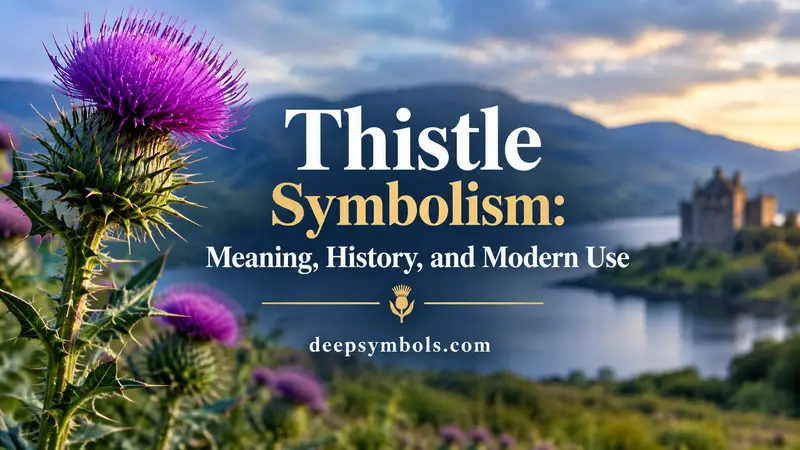
The thistle symbolism people recognize today is closely tied to resilience, protection, defiance, and Scottish identity. Its prickly leaves and hardy growth make it an unusual flower to celebrate, yet that very toughness helped turn the thistle into one of Scotland’s best-known national symbols—and gave it a wider meaning in modern American culture.
Thistles are not a single plant but a group of prickly flowering plants, mostly in the sunflower family. Depending on the species, they can have purple, pink, white, or yellow flower heads surrounded by spiny bracts. Some are valued as native wild plants, while others are considered invasive weeds in parts of the United States.
That contrast is part of what makes the thistle interesting as a symbol. It can represent beauty with boundaries, survival under pressure, national pride, or an unwillingness to be easily pushed aside. Its meaning depends heavily on cultural context.
Quick Answer
Thistle symbolism commonly represents resilience, protection, defiance, and Scottish heritage in modern American culture, especially in tattoos, family-history designs, flags, jewelry, and decorative art. Historically, the thistle became Scotland’s national emblem and later carried associations with vigilance, honor, and resistance.
TL;DR
- Thistles often symbolize resilience, protection, and self-defense.
- Scotland adopted the thistle as a major national emblem.
- A famous invasion story explains its protective symbolism.
- Americans often connect thistles with Scottish ancestry and heritage.
- Religious traditions can give thorns more difficult meanings.
- Modern tattoos use thistles for strength, survival, and identity.
What Does a Thistle Look Like?
A typical thistle is easy to recognize. It has a sturdy stem, deeply lobed leaves with sharp spines, and a rounded flower head surrounded by pointed bracts. Many familiar thistles produce purple or reddish-purple blooms, while others may be pink, white, or yellow.
The word “thistle” covers numerous species, so appearance varies considerably. The U.S. Forest Service notes that the term applies broadly to prickly plants and that true thistles belong to the tribe Cardueae within the sunflower family. It also distinguishes true thistles from plants such as sow thistle, Russian thistle, and yellow starthistle, which are not true thistles taxonomically.
This physical character matters symbolically. The flower is not delicate in the usual sense. Its beauty comes with built-in defenses. A thistle can therefore suggest the idea that something attractive does not have to be fragile or accessible to everyone.
The Core Meanings of the Thistle
The most common symbolic readings of the thistle grow directly from its appearance and cultural history.
Resilience is perhaps the broadest meaning. Thistles are associated with persistence because many species tolerate difficult or disturbed environments, and some can spread vigorously through roots or seed. In symbolic language, that translates naturally into endurance after hardship.
Protection comes from the plant’s spines. A thistle warns before it is touched. Unlike symbols of protection that depend on walls, armor, or weapons, the thistle represents defense built into the living thing itself.
Defiance is especially strong in Scottish symbolism. The plant’s prickles became a natural image for refusing intrusion or resisting an aggressor.
Heritage and national identity are particularly important when the thistle appears alongside Scottish tartan, the Saltire, bagpipes, castles, clan imagery, or other Scottish references.
There is also a quieter meaning: boundaries. A person may use a thistle to communicate, “I am kind, but I am not defenseless.” That interpretation is common in contemporary personal symbolism because the image combines beauty with limits.
How Scotland Turned the Thistle Into a National Symbol
The Scottish thistle is the clearest example of a plant becoming a national emblem through a combination of history, heraldry, and storytelling.
The National Trust for Scotland describes the thistle as Scotland’s national flower and notes that its use as a national emblem dates back to the period associated with King Alexander III. The historical record becomes much clearer in the late fifteenth century, when thistle imagery appeared on Scottish silver coinage during the reign of James III.
The plant later became part of royal and military symbolism. Thistles appeared in Scottish decorative arts, royal clothing, heraldic designs, and other public imagery. By the seventeenth century, the symbol had become recognizable as a specifically Scottish national emblem.
This history is important because the Scottish meaning of the flower was not created solely by folklore. The emblem developed through repeated official and public use. Over time, the plant became a visual shorthand for Scotland itself.
The Famous Legend of the Thistle and the Norse Invasion
The most famous explanation for the thistle’s Scottish meaning is a dramatic story involving an attempted nighttime attack.
According to the legend, invading Norsemen tried to approach a Scottish camp quietly and removed their footwear. One of the attackers stepped on a prickly thistle and cried out in pain. The noise alerted the Scots, who were able to respond to the approaching enemy. The plant was then remembered as an unlikely guardian.
The story is closely associated with the Battle of Largs in 1263, but historians caution that there is no firm contemporary evidence proving this was the actual origin of the national emblem. Later writers preserved and popularized the account, and the legend endured because it perfectly expresses the thistle’s defensive character.
That distinction matters. The invasion story is best understood as a national legend rather than a documented historical explanation. Its symbolic importance, however, is very real.
The underlying message is simple: something small and easily overlooked can provide protection at a critical moment.
Why the Thistle Means Protection and Defiance
The thistle’s protective meaning is unusually easy to understand because it comes from the plant itself.
A rose may have thorns, but the thistle appears almost designed around defense. Its spines extend from the leaves and bracts, making careless contact painful. Historically, those defenses also affect grazing animals and human movement.
Scotland’s heraldic use of the plant strengthened this association. The Order of the Thistle, established in statutory form by James VII in 1687, made the flower part of one of Scotland’s highest traditions of honor. Its motto, Nemo me impune lacessit, is commonly translated as “No one provokes me with impunity.”
The connection between the motto and the plant is almost visual: approach carelessly, and you will encounter resistance.
For modern readers, this can translate into a personal message about maintaining boundaries. A thistle tattoo, emblem, or piece of jewelry may communicate strength without suggesting aggression.
Thistle Symbolism in the United States
In the United States, the thistle does not carry one universal national meaning. Unlike the bald eagle, which is specifically associated with American national identity, the thistle is usually interpreted through family history, gardening, folklore, religion, or personal symbolism.
The strongest U.S. association is Scottish heritage. Scottish-American families may use thistle imagery on clan displays, wedding stationery, memorial pieces, tartans, home décor, jewelry, and genealogy projects.
The flower also has an interesting place in early American national symbolism. In an eighteenth-century proposal for the Great Seal, Pierre Eugene du Simitière suggested including several European symbols, including the Scottish thistle, alongside an English rose, Irish harp, French fleur-de-lis, Dutch lion, and German eagle. Congress ultimately chose the bald eagle instead, but the proposal shows that the thistle was already recognizable as a marker of Scottish identity in the early United States.
So in American culture, the thistle often communicates heritage rather than patriotism. Its meaning becomes strongest when the surrounding design identifies a Scottish connection.
Thistle Meanings in Other Cultural and Religious Traditions
The Scottish interpretation is only one chapter in the plant’s wider symbolic history.
In Christian symbolism, thistles can inherit some of the meanings associated with thorns. Genesis describes the ground producing “thorns and thistles” after the Fall, linking prickly vegetation with hardship, toil, and the consequences of human disobedience.
Christian traditions also connect thorns with the Passion of Christ. Because the Gospels describe Jesus being crowned with thorns before the Crucifixion, thorny plants became associated with suffering, humiliation, sin, and redemption. Some later Christian symbolic traditions specifically treated the thistle as a reminder of Christ’s Passion because of its prickly nature.
This means a thistle can carry an apparent contradiction. In Scottish heraldry, the thorniness is protective and honorable. In some Christian contexts, thorniness can suggest suffering or the fallen condition of the world.
Neither interpretation automatically cancels the other. Symbolism changes with context.
A Quick Comparison of Thistle Meanings
| Context | Meaning in the USA | Common Associations | Notes |
|---|---|---|---|
| Scottish heritage | Resilience and national identity | Scotland, clans, tartan | Usually the clearest cultural association |
| Personal symbolism | Strength and boundaries | Survival, independence | Common in tattoos and jewelry |
| Christian imagery | Suffering or endurance | Thorns, Passion of Christ | Meaning depends on religious context |
| Floral design | Rustic beauty and toughness | Wildflowers, countryside | Often chosen for its distinctive shape |
| Historical heraldry | Honor and defense | Royal badges, orders | Closely connected to Scotland |
The Emotional Meaning of a Thistle
The emotional appeal of the thistle comes from the tension between vulnerability and defense.
A flower usually suggests openness, beauty, affection, or growth. The thistle complicates that image. It blooms, but it also resists being handled carelessly.
For some people, that makes it a good symbol of survival without surrender. Someone recovering from a difficult period may identify with a plant that can look rough and uncompromising while still producing a striking flower.
It can also represent self-respect. A thistle does not need to become soft in order to be beautiful. Its boundaries are part of its identity.
That interpretation is especially useful in personal symbolism because it does not require the symbol to represent victory. Sometimes the message is simply, “I made it through, and I still have my edges.”
Why Thistles Appear in Tattoos
Thistle tattoos are especially common among people with Scottish ancestry, but heritage is not their only appeal.
A Scottish thistle tattoo may honor family origins, a clan connection, a parent or grandparent, or an emotional connection to Scotland. Designs often combine the flower with tartan patterns, Celtic-inspired elements, the Scottish flag, names, dates, or other family imagery.
Other tattoos use the thistle more broadly as a symbol of resilience. In that context, the wearer may be using the flower to mark survival, independence, personal boundaries, or recovery after hardship.
The visual design also makes the flower practical for tattoo art. Its silhouette is recognizable even when simplified, and its leaves and flower head provide strong shapes for black-and-gray or color work.
A tattoo showing only the plant may therefore be intentionally ambiguous. To one viewer, it means Scotland. To another, it means toughness. The owner’s personal story determines which interpretation matters most.
Thistle Symbolism in Weddings, Memorials, and Décor
The thistle can work well in ceremonial settings because it communicates more than beauty alone.
At weddings, Scottish couples or families may use thistles in bouquets, boutonnieres, table settings, stationery, or reception décor. In that setting, the flower can represent heritage, family continuity, loyalty, and enduring partnership.
Memorial use can be more personal. A thistle may symbolize a person’s Scottish ancestry or represent the idea of remaining strong after loss. Its defensive form can also suit memorial designs focused on dignity and perseverance.
In home décor, the flower often signals rustic character, Celtic or Scottish heritage, or an appreciation for natural forms that are less conventionally delicate than roses or lilies.
The Positive and Negative Sides of Thistle Meaning
The thistle is not automatically positive.
Its negative associations usually arise from the same qualities that create its strengths. Spines can represent hostility, exclusion, stubbornness, or emotional defensiveness. A thistle growing over neglected land can also evoke abandonment or hardship.
The plant’s status in American ecology adds another layer. Some thistle species are native and ecologically useful, while others introduced to the United States have become invasive and difficult to control. The U.S. Forest Service documents numerous nonnative thistles that can reduce forage, displace native plants, or spread aggressively in disturbed habitats.
That ecological reality is worth separating from symbolism. Calling a person “a thistle” can be a compliment when it means resilient and difficult to defeat, but it could be an insult when it means prickly, unwelcome, or hard to live with.
Symbolic meaning is not fixed simply because a plant has a famous history.
Common Misunderstandings About the Thistle
One common mistake is assuming that every plant called a thistle has the same cultural meaning. The word covers many different species, including plants that are native to North America and species introduced from elsewhere.
Another misconception is that the Battle of Largs story is proven history. The story is famous and culturally important, but the precise origin of Scotland’s thistle emblem remains uncertain. Historical evidence for thistle use as an official Scottish symbol is much stronger by the late fifteenth century than it is for the legendary battlefield episode centuries earlier.
It is also a mistake to assume that the thistle has an exclusively positive meaning. Religious, ecological, and literary contexts can emphasize suffering, neglect, aggression, or unwanted growth instead.
The safest interpretation is always contextual: look at who is using the thistle, what other symbols appear beside it, and what story surrounds it.
How Thistle Meaning Has Changed Over Time
The thistle’s symbolic evolution is a good example of how meanings accumulate rather than simply replace one another.
Its physical identity came first: a prickly plant with a distinctive flower. Folklore then turned that physical defense into stories of warning and protection. Scottish royal symbolism transformed the plant into a national emblem. Heraldry and the Order of the Thistle added associations with honor and public distinction.
Later, the symbol traveled through migration and cultural memory into the United States. For Scottish Americans, it could represent ancestry and belonging. In personal art, it became easier to interpret more broadly as resilience and boundaries.
Modern symbolism has therefore widened the meaning without erasing the historical core. A thistle may still say “Scotland,” but it can also say “I endured,” “I protect what matters,” or “I have boundaries.”
What Thistle Symbolism Says About Identity Today
In modern American culture, plant symbols often become shorthand for identity. People choose flowers not only because they look attractive but because they can carry a personal narrative.
The thistle is especially suited to that purpose because its symbolism is specific without being overly narrow. Someone with Scottish ancestry can use it literally as a heritage emblem. Someone else can choose it for the more personal message of resilience.
That flexibility helps explain its continued presence in tattoos, jewelry, artwork, family keepsakes, and social-media imagery. A thistle does not require the owner to explain an entire life story. Its visual language already suggests toughness, caution, and persistence.
At the same time, its meaning remains strongest when context is respected. A Scottish national emblem should be understood as part of Scottish history rather than reduced to a generic “strong flower” aesthetic.
FAQs
What does a thistle symbolize spiritually?
Spiritually, a thistle can represent endurance, protection, and surviving hardship. In Christian contexts, its thorniness may also connect it with suffering, sin, the Passion of Christ, and the biblical imagery of thorns and thistles.
What does a thistle tattoo mean?
A thistle tattoo commonly represents Scottish heritage, resilience, self-protection, or personal strength. The intended meaning usually becomes clearer when the design includes tartan, a clan reference, dates, names, or other symbols.
Why is the thistle Scotland’s national flower?
The exact origin is uncertain, but a famous legend says a barefoot Norse attacker stepped on a thistle and alerted the Scots to an attempted surprise attack. Historical evidence shows that thistle imagery was firmly established in Scottish royal symbolism and coinage by the late fifteenth century.
Is a thistle a positive or negative symbol?
It can be either. Positive meanings include resilience, protection, courage, heritage, and strong boundaries, while negative interpretations can include defensiveness, hostility, neglect, or unwanted growth.
Does the thistle have a meaning in Christianity?
Yes, particularly through the broader symbolism of thorns. Christian traditions associate thorns with the Fall, suffering, and Christ’s crown of thorns, so a thorny plant such as a thistle may be interpreted within that framework.
What does the thistle symbolize in American culture?
In the United States, the thistle most often points to Scottish heritage, family ancestry, or personal resilience rather than a single national meaning. Its use in early American heraldic proposals also shows that it was recognized as a Scottish cultural emblem during the nation’s formative years.
Conclusion
The thistle symbolism most familiar today comes from the meeting of physical defenses and cultural history. Its sharp prickles naturally lend themselves to ideas of protection and resilience, while its long association with Scotland has given the flower an additional meaning of identity and national pride. The National Trust for Scotland’s history of the thistle provides useful context for how the plant became such a recognizable Scottish symbol.
That layered meaning also explains why the thistle can work in deeply personal ways. It may represent ancestry, survival, independence, strong boundaries, or the ability to remain distinctive in difficult circumstances.
A thistle does not symbolize strength because it appears invulnerable. Its symbolism is more interesting than that: beauty and protection exist together, reminding us that resilience can mean knowing when—and how—to defend yourself.


