
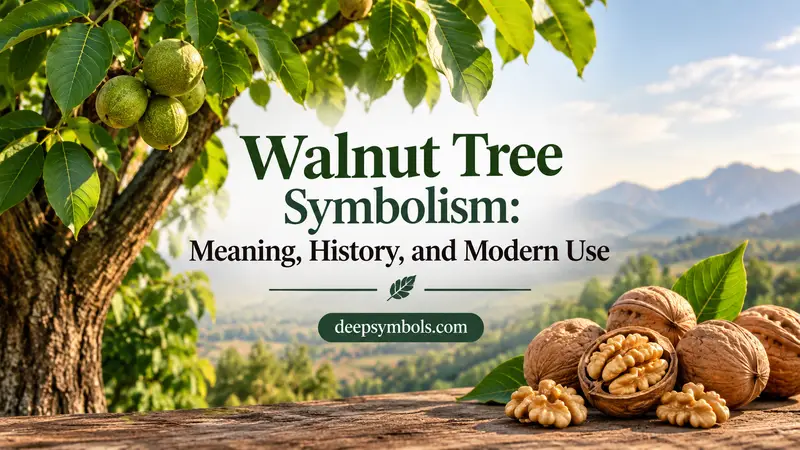
A walnut tree can symbolize prosperity, fertility, resilience, wisdom, protection, and long-term legacy, depending on the cultural setting. In the United States, its symbolism often grows from the tree’s practical value as a source of food, durable timber, shade, and something that can outlive the people who plant it.
Walnut trees also carry older associations that came from Greek and Roman traditions. European folklore sometimes gave them darker meanings, while American history connected black walnut especially with settlement, craftsmanship, land stewardship, and family inheritance.
Quick Answer
Walnut tree symbolism commonly represents prosperity, family continuity, resilience, and fruitful growth in modern American culture, especially when the tree is connected with a home, property, garden, or family history. Historically, walnuts were also associated with fertility and marriage, while some European traditions linked walnut trees with supernatural beliefs and witchcraft.
TL;DR
- Walnut trees symbolize prosperity, fertility, resilience, and lasting family roots.
- Greek and Roman traditions connected walnuts with fertility and marriage.
- Black walnut became important to Native communities and American settlers.
- Dark folklore sometimes associated walnut trees with witches and harmful shade.
- Modern Americans often view walnut as a symbol of craftsmanship and legacy.
- Walnut imagery works well for homes, family trees, tattoos, and heirlooms.
What a Walnut Tree Represents
Walnut trees are large deciduous trees with broad canopies, compound leaves, and hard-shelled fruits enclosed in green husks. In North America, one of the most culturally important species is the eastern black walnut, Juglans nigra, known for its dark, valuable wood and edible nuts.
The physical character of the tree helps explain much of its symbolism. A mature walnut can become substantial, visually imposing, and long-lived. Its nuts require effort to harvest and crack, while its wood is valued for furniture, paneling, veneer, and other durable products. Those qualities naturally lend themselves to ideas of strength, usefulness, patience, abundance, and endurance.
Unlike a flower whose symbolism may depend heavily on color or appearance, the walnut tree derives much of its meaning from what it produces and how it functions. It feeds people, provides valuable wood, creates shade, and can become part of a landscape’s history.
That makes walnut especially suited to symbolism involving things that are built slowly and intended to last.
Ancient Roots and Early Walnut Symbolism
The walnut has an unusually old symbolic history around the Mediterranean world. The botanical name Juglans is traditionally interpreted as meaning “Jupiter’s nut,” while regia means “royal,” reflecting the high status attached to the cultivated walnut. Ancient accounts treated walnuts as food associated with the gods and with exceptional value.
Greek tradition also connected the walnut with Artemis. At Karyai in Laconia, the nut tree was associated with the goddess, and the priestesses known as Karyatides took their name from the Greek word for the nut tree. Another myth tells of Karya, a mortal woman loved by Dionysus who was transformed into a walnut tree.
These stories helped associate the walnut with divinity, transformation, femininity, fertility, and sacred place. The mythology is important because it shows that the tree was not valued merely as a food source. It could also become a vehicle for explaining relationships between humans, gods, nature, and transformation.
Walnut Symbolism in Marriage and Fertility
One of the clearest historical meanings of the walnut is fertility.
Greeks and Romans associated walnuts with fruitfulness, and Roman wedding customs included scattering nuts during the bridal celebration. Ancient writers and later classical scholarship connect this practice with hopes for a fruitful marriage and household prosperity.
The symbolism is easy to understand when viewed through the structure of the nut itself. The walnut contains a seed protected within a hard exterior, making it a natural image of potential, reproduction, nourishment, and life contained within a protective shell.
For modern readers, that historical symbolism does not necessarily mean that a walnut tree has to represent literal fertility. It can more broadly stand for:
- a productive household
- a growing family
- a successful partnership
- new beginnings
- abundance created over time
In wedding or anniversary symbolism, a walnut tree can therefore suggest a relationship that becomes stronger and more productive as it matures.
Why Walnut Symbolizes Prosperity
Prosperity is one of the most practical meanings attached to walnut.
The tree produces food, provides useful timber, and can represent an asset that increases in value as it matures. Black walnut in particular has long been prized as a valuable hardwood in the United States. Its nuts also have established culinary and commercial uses.
This creates a different kind of abundance from the symbolism of gold or luxury. Walnut prosperity is productive prosperity.
It suggests something that provides benefits repeatedly rather than something gained all at once. A planted tree may require years before reaching maturity, which makes it a fitting symbol for saving, investing, building a family business, cultivating land, or creating something future generations can use.
That is why walnut imagery often feels appropriate for themes of financial stability, craftsmanship, agriculture, family property, and generational wealth.
Strength, Resilience, and Endurance
Walnut wood has an important place in American material culture because of its durability and attractive grain. Black walnut became especially valued for furniture, interior woodwork, veneer, and other products requiring high-quality hardwood.
As symbolism, this supports the idea of walnut as a representation of strength that has practical value.
The tree’s hard fruit reinforces the same impression. The nut is protected by layers that have to be broken before the edible kernel can be reached. Symbolically, that can suggest a person who is guarded on the outside but valuable, generous, or resilient within.
A walnut tree can therefore represent:
Outer strength: protection and toughness.
Inner value: knowledge, character, or resources hidden beneath the surface.
Endurance: the ability to remain useful through changing circumstances.
This symbolism is particularly fitting for stories of perseverance because it avoids portraying strength as aggression. Walnut strength is usually associated with staying power.
Walnut Trees and Wisdom
Wisdom is a common modern interpretation of many old trees, but walnut has a particular visual reason for attracting that association.
The tree can grow large and mature over many years, becoming a prominent part of a landscape. Its wood has long been transformed into objects associated with learning, craftsmanship, offices, libraries, and formal interiors.
The symbolism of wisdom is therefore less about an ancient universal doctrine and more about age, accumulated value, and preserved knowledge.
A walnut tree in a symbolic setting can represent a person who has experienced enough life to become a source of guidance. It can also symbolize knowledge that is inherited rather than discovered all at once.
The idea works especially well in family symbolism: grandparents, ancestral homes, old furniture, handwritten records, and mature trees all share the suggestion of something preserved across generations.
Walnut Tree Symbolism in the United States
In the United States, walnut symbolism is strongly tied to the history of black walnut.
Eastern black walnut is native to the central and eastern parts of the country. Historical research from the U.S. Forest Service describes the tree as an important resource for Native Americans and later European settlers, providing food, useful materials, and economic value.
That history gives walnut a distinctly American symbolic layer: resourcefulness.
The tree was not simply admired; it was useful. Nuts could be eaten, wood could be worked, and other parts of the tree had practical applications. Native communities used black walnut nuts as food and obtained dye from the roots, while later settlers valued the timber and nuts.
For an American audience, walnut can therefore suggest self-reliance, responsible use of land, practical prosperity, and making something lasting from available resources.
Walnut Meanings Across Contexts
| Context | Meaning in the USA | Common Associations | Notes |
|---|---|---|---|
| Family property | Family roots and continuity | Home, land, ancestry | Especially fitting for old trees |
| Furniture and woodcraft | Skill and lasting quality | Craftsmanship, durability | Strong connection to black walnut |
| Marriage | Fertility and household prosperity | Partnership, family, abundance | Comes largely from older classical tradition |
| Personal symbolism | Resilience and guarded inner value | Strength, patience, character | Often used metaphorically |
| Historical landscape | Legacy and endurance | Generations, memory, stewardship | Trees can outlive their planters |
Walnut Trees as Symbols of Family and Legacy
Few tree symbols fit the idea of family legacy as naturally as the walnut.
A walnut planted near a house can become a living marker of the people who cared for the property before the current generation. Even when the original planter is gone, the tree can remain.
That association is especially visible in the American tradition of historic trees. One notable black walnut at Adams National Historical Park is described by the National Park Service as a witness tree connected with John Quincy Adams and several generations of the Adams family.
The symbolic lesson is straightforward: a tree can become a physical record of time.
For that reason, walnut can represent inheritance without being limited to money. It may symbolize inherited values, family stories, land, craftsmanship, responsibility, or memories.
In this context, the walnut tree is less a symbol of the past than a bridge between generations.
Protection and the Meaning of the Walnut Shell
The walnut’s shell offers one of its strongest symbolic images.
The edible center is protected by a tough exterior, which makes the nut an intuitive metaphor for boundaries, privacy, emotional protection, and hidden worth.
A walnut can symbolize someone who does not reveal everything immediately. The hard shell may stand for caution or experience, while the kernel represents the person’s inner character.
This symbolism can be positive or negative depending on context.
In a positive interpretation, the shell means healthy boundaries and self-protection.
In a negative interpretation, it can suggest emotional distance, stubbornness, or difficulty opening up.
The symbolism therefore works especially well when describing people who have developed resilience because of experience rather than because life was always easy.
Dark Walnut Folklore and Superstitions
Walnut symbolism has not always been positive.
European folklore developed several uneasy associations with walnut trees. A famous seventeenth-century Italian tradition connected a walnut at Benevento with gatherings of witches. Earlier writings also preserved fears about walnut shade, including the ancient claim that sitting beneath such a tree could affect the mind.
These stories should be treated as folklore rather than evidence of any supernatural property of walnut trees.
The darker associations probably reflect a mixture of observation, superstition, and the natural characteristics of the plant. Walnut trees produce chemical compounds that can inhibit some nearby plants, and their large canopies can create dense shade. Such noticeable ecological effects may have encouraged older explanations involving harmful or uncanny qualities.
Modern readers sometimes encounter claims that walnut trees are universally signs of witchcraft or bad luck. That is misleading. The witchcraft association belongs to particular European folk traditions, not to a universal meaning of the tree.
Walnut Symbolism in Religion
Walnut trees do not have one universally established biblical meaning.
This is important because modern symbolic lists sometimes assign every familiar plant a fixed Christian definition. The walnut does not have that kind of straightforward, universally accepted biblical status.
Its older symbolic associations are more strongly documented in classical mythology and European folklore. Within broader religious symbolism, however, people may still use a walnut tree to represent creation, provision, fertility, or stewardship because those ideas arise naturally from the tree’s fruitfulness and longevity.
That is a personal or artistic interpretation rather than a universally prescribed religious doctrine.
Emotional and Psychological Meaning
Walnut symbolism often appeals to people because it combines protection with generosity.
The tree does not look delicate, yet it produces something nourishing. Its fruit is enclosed in a hard covering, while its mature canopy can provide shelter and shade.
Psychologically, that combination can represent a person who has developed strong defenses without losing the ability to care for others.
A walnut tree may therefore symbolize:
- emotional resilience
- maturity
- patience
- guardedness
- generosity
- responsibility
- self-protection
- confidence built through experience
The meaning changes according to the story surrounding the tree. A walnut planted after hardship can symbolize recovery. One inherited with a family home can represent continuity. A walnut used in artwork may simply communicate solidity and natural elegance.
Walnut Tree Symbolism in Tattoos
Walnut tree tattoos are less common than oak, pine, or olive tree designs, which can make the symbolism feel more personal.
A tattoo featuring a walnut tree can represent family heritage, resilience, prosperity, personal growth, or a life built over many years.
Some people may emphasize the nut rather than the full tree. In that case, the design can focus on protection, hidden value, or the contrast between a hard exterior and a valuable interior.
A tree with visible roots can strengthen the family and ancestry theme, while fruit can highlight productivity and abundance.
Because walnut does not have one universally fixed tattoo meaning, the personal story behind the design matters more than any online symbolism dictionary.
Walnut Symbolism in Home Decor and Design
Walnut has a particularly strong place in American interior design because actual walnut wood is associated with quality furniture and fine woodworking.
A walnut table, cabinet, desk, or wall detail can communicate warmth, stability, craftsmanship, and permanence without displaying an obvious symbolic image.
This is an important distinction: sometimes symbolism is carried by the material itself.
The dark grain of walnut can make a room feel established and traditional, while still fitting contemporary interiors. In a family home, walnut furniture may also become an heirloom, strengthening the association with continuity and inherited value.
The symbolic message is subtle: well-made things are meant to remain useful.
How Walnut Symbolism Has Changed Over Time
Walnut symbolism has moved from sacred mythology and fertility traditions toward more practical ideas of legacy and endurance.
In classical cultures, the emphasis included fertility, marriage, divine association, and transformation. In parts of European folklore, the tree acquired more ominous associations involving witches and harmful shade.
In America, especially through the history of black walnut, the practical qualities of food, timber, land use, and economic value became more prominent. The tree became connected with settlement, agriculture, craftsmanship, and long-term ownership.
Today, symbolic interpretations tend to blend these layers rather than replacing one with another.
A walnut can simultaneously suggest family, prosperity, protection, craftsmanship, and endurance. The interpretation depends heavily on where the symbol appears and what story accompanies it.
Common Misunderstandings About Walnut Symbolism
The biggest mistake is treating walnut symbolism as a universal code with one fixed definition.
There is no single meaning shared by every culture, religious tradition, and historical period. Classical fertility symbolism, European witch folklore, and modern American ideas of family legacy come from different contexts.
Another misunderstanding is assuming that the presence of a walnut tree automatically represents good luck or bad luck. Neither interpretation is universal.
It is also misleading to treat Native American relationships with black walnut as one shared belief system. Indigenous nations had different languages, traditions, environments, and practices. Historical evidence shows practical uses of black walnut and references to its place in some Native traditions, but that should not be turned into a single generalized “Native American symbolism.”
The most accurate interpretation always considers culture, place, history, and personal meaning.
Why the Walnut Tree Still Matters Today
In modern America, walnut symbolism works because the tree represents things that remain important even when the symbolic language changes.
People still value family continuity. They still want homes built to last. They still associate mature trees with land, memory, and time. Quality wood still represents craftsmanship, while fruit still represents productivity and provision.
The walnut therefore has a practical modern relevance that many purely mythological symbols do not.
It can appear in a memorial garden, a family property, a wedding illustration, a tattoo, a woodworking project, or a piece of furniture passed from one generation to another.
In each case, its meaning is strongest when connected to something concrete.
FAQs
What does a walnut tree symbolize spiritually?
A walnut tree may symbolize growth, provision, protection, maturity, and continuity in spiritual or personal interpretation. There is no single universal spiritual meaning, so the symbolism depends on the tradition and context.
What does a walnut tree symbolize in the United States?
In the United States, walnut often suggests resilience, family roots, craftsmanship, prosperity, and long-term legacy. These meanings are strongly influenced by the historical value of black walnut as a food source and prized hardwood.
What does a walnut symbolize in a relationship?
Historically, walnuts were connected with fertility and marriage, particularly in Greek and Roman traditions. In modern symbolism, a walnut can represent a relationship that is protected, productive, mature, and capable of lasting across time.
Is the walnut tree a symbol of wisdom?
It can be interpreted that way, especially because mature trees suggest age, experience, and accumulated knowledge. However, wisdom is a modern symbolic association rather than a universally fixed historical meaning of the walnut.
Does a walnut tree symbolize bad luck?
Not universally. Some European folklore connected walnut trees with witches or dangerous supernatural activity, but those beliefs were regional and historical rather than a general meaning shared across cultures.
What does a walnut tree tattoo mean?
A walnut tree tattoo can represent resilience, family heritage, protection, prosperity, personal growth, or long-term endurance. The roots, nuts, branches, and overall style can shift the emphasis toward ancestry, abundance, or inner strength.
Why is black walnut important to American symbolism?
Black walnut became important because it served practical needs for food, dye, timber, furniture, and other products while remaining a valuable native hardwood. Its history links the tree with resourcefulness, land stewardship, craftsmanship, and economic value
Conclusion
The symbolism of a walnut tree grows naturally from its physical qualities. It produces food, protects its seed, offers useful wood and shade, and can remain part of a landscape for generations. The Arnold Arboretum’s history of the walnut family provides useful botanical and historical context for understanding why walnuts have long been valued by people.
For modern Americans, walnut tree symbolism is especially meaningful as an image of gradual growth and lasting value. A walnut may appear in family history, furniture, gardens, landscapes, art, or personal symbolism, where its meaning often centers on prosperity, protection, maturity, and continuity.
Ultimately, a walnut tree does not need a supernatural explanation to become symbolic. Its ordinary qualities already tell a compelling human story: grow slowly, become useful, protect what matters, and leave something valuable behind.


