
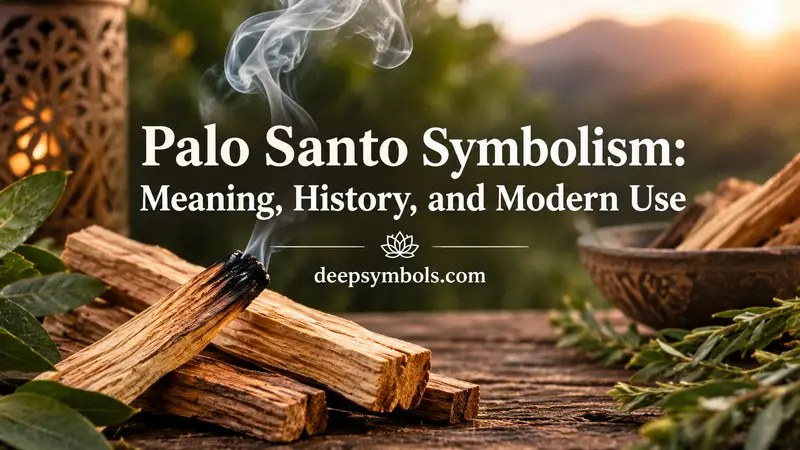
Palo santo symbolism centers on purification, spiritual reflection, renewal, and the creation of a peaceful atmosphere. The name palo santo means “holy wood” in Spanish and commonly refers to aromatic trees whose wood has been used in parts of South America for traditional, ceremonial, and practical purposes. Today, palo santo is widely recognized in the United States through incense, wellness rituals, meditation spaces, and home fragrance.
The appeal of palo santo goes beyond its distinctive scent. For some people, lighting a small piece of its wood marks a transition from a busy day to a quieter evening. Others use its fragrance during prayer, meditation, or personal reflection. In these settings, the smoke can represent a deliberate pause, a fresh beginning, or an effort to make a space feel calm and welcoming.
Yet its meaning is not identical across cultures. Palo santo has connections to particular South American traditions, while its modern American image has been shaped by wellness marketing, spiritual practices, interior design, and social media. Understanding its symbolism means recognizing both its contemporary uses and the cultural history behind them.
Quick Answer
Palo santo symbolism commonly represents purification, peace, renewal, and spiritual intention in modern American culture, especially during meditation, personal reflection, and home rituals. Historically, aromatic palo santo wood has been used in parts of South America for traditional ceremonial and practical purposes, with meanings that vary by community and context.
TL;DR
- Purification: The fragrant smoke represents clearing a space or marking a fresh start.
- Peace: Its warm, woody scent is associated with calm and relaxation.
- Renewal: Lighting the wood can mark a transition or a new intention.
- Spirituality: Some people incorporate it into prayer, meditation, and reflection.
- Cultural heritage: Its traditional uses are connected to specific South American communities.
- Responsible use: Ethical sourcing matters because the wood comes from living ecosystems and culturally meaningful traditions.
What Palo Santo Looks Like and Where It Comes From


8
Palo santo usually appears in the American marketplace as small pieces of pale tan or golden-brown wood, often cut into short sticks. When burned, the wood releases a distinctive fragrance that many people describe as woody, citrus-like, resinous, or slightly sweet. Essential oils and fragrance products made from the wood are also common.
The name generally refers to Bursera graveolens, a tree native to parts of Central and South America, including Ecuador and Peru. However, the common name palo santo can refer to different tree species in different regions, so the name alone does not establish a product’s botanical identity.
The tree grows in seasonally dry tropical environments. Its aromatic wood is valued for its fragrance, and naturally fallen or dead wood is often collected for traditional uses and commercial products.
This physical character helps explain its modern symbolism. The wood comes from a living landscape, carries a recognizable scent, and produces smoke when burned. These qualities make it a natural focus for rituals involving nature, transition, and reflection.
The Core Meanings of Palo Santo
Palo santo does not have one universal symbolic definition. Its meaning depends on the community, the ritual, and the intention of the person using it. Nevertheless, several associations appear frequently in contemporary American wellness culture.
- Purification: Burning the wood can mark the intention to clear a space or prepare for a new activity.
- Peace: Its fragrance can help establish a quiet atmosphere for rest or contemplation.
- Renewal: Lighting a fresh stick can serve as a symbolic beginning after a difficult period or major change.
- Spiritual connection: In some traditional and contemporary practices, aromatic smoke forms part of prayer or ceremony.
- Protection: Some people associate its use with creating a protected, intentional environment.
- Mindfulness: The act of lighting the wood and attending to its scent can encourage a slower, more deliberate pace.
These associations overlap, but they are not interchangeable. Purification suggests removing or releasing something unwanted; renewal focuses on beginning again. Peace describes a desired state, while protection expresses an intention to preserve that state.
The symbolism is most meaningful when the user understands what the ritual represents to them rather than assuming that the wood has an identical meaning for everyone.
Ancient Roots and Traditional South American Uses

Palo santo’s traditional significance developed in the regions where the tree grows, especially in parts of western South America. Communities have used aromatic wood and other plant materials for practical, medicinal, household, and ceremonial purposes. The precise practices and beliefs differ by region and community.
Burning aromatic wood can serve several functions at once. It releases a fragrance, changes the atmosphere of a place, and creates a visible sign that an activity has begun. In a ceremonial setting, smoke may also form part of an offering or a practice intended to address spiritual concerns.
It is important, however, not to treat all Indigenous South American communities as if they share a single spiritual system. Traditional knowledge is diverse, and particular meanings may belong to specific families, communities, or ritual specialists.
Nor is there a single documented origin story that accounts for every use of palo santo. Its history is better understood through the different relationships people have developed with local plants, forests, healing practices, and ceremonial life.
For contemporary readers, this distinction matters: the wood’s cultural background is more specific than the broad, universal spiritual language sometimes used to sell it.
Why the Name “Holy Wood” Matters
The Spanish name palo santo translates to “holy wood” or “sacred wood.” That translation contributes strongly to the material’s modern reputation, particularly among American consumers who encounter it through spiritual shops and wellness brands.
Words associated with holiness suggest that an object deserves special attention. They can imply reverence, ritual importance, or a connection to something beyond ordinary daily activity. When people hear the name, they may naturally associate the wood with prayer, cleansing, or sacred space.
However, the Spanish name does not mean that every culture has always regarded the tree as holy in the same way. Common names can reflect local histories, religious encounters, and changing patterns of use.
The name also does not automatically make burning palo santo a religious act. Someone may use it simply because they enjoy the fragrance, while another person may approach it with a carefully defined spiritual intention.
Its name is therefore an important part of its symbolism, but context determines how that symbolism is understood.
What Palo Santo Symbolizes in the United States
In the United States, palo santo is especially visible in wellness settings, yoga studios, meditation spaces, spiritual boutiques, and homes designed around relaxation. It often represents a conscious shift from ordinary activity toward a calmer or more reflective state.
A person might light a stick before journaling, meditating, or tidying a room. Another might use its scent to mark the end of a workday or the beginning of a personal ritual. In these situations, the wood functions as a sensory reminder to pause and pay attention.
Its American interpretation also reflects the broader popularity of aromatherapy, mindfulness, and home-based wellness practices. Consumers often seek objects that make an abstract intention tangible. A candle can mark a quiet evening; a journal can represent self-examination; palo santo can serve as a marker of transition.
| Context | Meaning in the United States | Common association | Important distinction |
|---|---|---|---|
| Meditation | Focus and intention | Quiet reflection | Personal practice varies |
| Home rituals | Freshness and renewal | A new beginning | Smoke does not physically purify every contaminant |
| Spiritual practice | Purification or protection | Sacred atmosphere | Beliefs differ by tradition |
| Interior design | Warmth and calm | Natural materials | Fragrance may be the primary appeal |
| Personal wellness | A pause in the day | Mindfulness | Symbolic comfort is not medical treatment |
The American meaning is therefore partly inherited from existing traditions and partly shaped by contemporary consumer culture. Both influences help explain why the wood has become recognizable far beyond its native range.
Purification, Cleansing, and the Idea of a Fresh Start
Purification is one of the most common modern associations with palo santo. In symbolic terms, cleansing means making a deliberate distinction between what came before and what should follow. It can involve releasing tension, preparing for a significant event, or setting an intention for a room.
Consider someone who has just moved into a new home. Lighting palo santo might represent the beginning of a new chapter, even if the person does not believe the smoke has supernatural properties. The ritual gives an emotional shape to a change that might otherwise feel abstract.
Others may use it after an argument, during a period of grief, or when establishing a new daily routine. In each case, the action can provide a clear starting point.
It is worth separating symbolic cleansing from physical sanitation. Burning palo santo does not guarantee that a room is free of harmful microorganisms, allergens, or chemical pollutants. Its smoke can irritate the respiratory system, particularly in people sensitive to airborne particles.
The symbolic value of a fresh start does not depend on making unsupported claims about what smoke can accomplish physically.
Protection and the Creation of Sacred Space
Palo santo is also associated with protection. For some users, burning it represents an intention to make a space feel safe, settled, or spiritually prepared.
This interpretation can be understood through the role of ritual boundaries. People often mark special places and occasions with recognizable actions: removing shoes before entering a home, lighting candles during prayer, or arranging objects before meditation. Such practices distinguish ordinary surroundings from spaces reserved for particular purposes.
Palo santo can serve a similar function. Lighting the wood may signal that the room is now a place for reflection rather than distraction. Its scent and smoke create a recognizable transition, while the user’s intention gives the act its personal meaning.
Some spiritual practitioners understand protection in explicitly religious or metaphysical terms. Others use the word more loosely to describe emotional reassurance and a sense of control over their surroundings.
These interpretations should not be confused with evidence that the wood can prevent physical danger or guarantee supernatural protection. The symbol can express a hope or belief without proving that the desired outcome will occur.
Peace, Grounding, and Emotional Meaning
The emotional appeal of palo santo often begins with its scent. Smell is closely connected with memory and emotion, which helps explain why familiar fragrances can evoke particular places, people, and experiences.
A warm, woody fragrance may remind someone of a forest, a quiet room, or a relaxing personal routine. Over time, repeatedly encountering that scent during peaceful moments can make it a cue for settling down.
This is one reason palo santo can symbolize grounding. Grounding, in this context, means returning attention to the present rather than becoming absorbed in worries about the past or future. Lighting the wood, noticing its fragrance, and taking a few deliberate breaths can become a simple mindfulness exercise.
The experience is personal rather than guaranteed. Some people find the scent comforting; others dislike smoke or find the aroma too strong. The ritual’s emotional effect depends on individual associations, expectations, and surroundings.
Its symbolism is therefore strongest when described as an invitation to pause, not as a universal remedy for stress or emotional distress.
Palo Santo in Spirituality and Religion
Palo santo appears in a variety of spiritual settings, but it should not be treated as a universal religious symbol. Its ceremonial significance is connected to particular South American histories and practices, while contemporary users may incorporate it into personal forms of spirituality.
Some people light the wood before prayer, meditation, or an act of gratitude. Others use it while reflecting on a loss, setting a personal intention, or preparing a quiet place for contemplation. In such situations, the smoke can serve as an outward expression of an inward commitment.
There is no single Christian, Buddhist, Hindu, or other major religious doctrine that gives palo santo one standard meaning across all followers. A person may incorporate it into an individual practice without it being a prescribed part of their religion.
This distinction is particularly important when comparing palo santo with incense used in established religious ceremonies. Incense has a long history in several religions, but similar physical actions do not mean that all materials have the same cultural meaning.
Respectful interpretation requires attention to the tradition involved rather than assuming that every aromatic wood is interchangeable.
Palo Santo Compared With Other Incense and Cleansing Plants
Palo santo is sometimes sold alongside white sage, cedar, copal, and other aromatic materials. Because these products may appear in the same shops, consumers can easily assume that they have identical histories or functions. They do not.


4
Palo santo is generally valued for its aromatic wood. White sage has particular significance in some Indigenous North American traditions, including specific ceremonial uses. Copal refers to aromatic resins associated with multiple Mesoamerican and other regional traditions. Cedar species have their own varied practical, cultural, and spiritual roles.
All of these materials may be used to create fragrant smoke, but their shared physical property does not erase their different origins.
Combining them into a generic “energy cleansing kit” can obscure the knowledge and cultural relationships behind each material. It can also encourage inaccurate claims that all traditions use the same plants for the same reasons.
For American consumers, the useful lesson is simple: learn the identity and background of a plant or wood rather than relying solely on the category of incense or cleansing products under which it is sold.
Modern Uses in Homes, Meditation, and Personal Rituals
In contemporary American homes, palo santo is often used as a fragrance product, a meditation aid, or an object associated with intentional living. It may be stored beside candles, journals, crystals, or other items that help a person establish a familiar routine.
The symbolic value often comes from repetition. Lighting the wood before a meditation session can help distinguish that activity from the rest of the day. Using it at the beginning of a weekly reflection can turn an ordinary habit into a recognizable personal ritual.
It also appears in wellness studios and retail environments, where its scent contributes to a particular atmosphere. In these spaces, the wood can communicate naturalness, simplicity, and an interest in holistic living.
Not every use needs a spiritual explanation. Someone may purchase palo santo because they enjoy its fragrance, appreciate its natural appearance, or associate it with a calming room.
The important distinction is between what a person chooses to express through the material and what can be established about its traditional meaning. Modern use can create new associations, but it does not replace the cultural history from which the material comes.
Palo Santo in Tattoos, Jewelry, and Personal Identity
Palo santo is less standardized as a tattoo or jewelry symbol than widely recognized images such as the lotus, moon, or tree of life. Nevertheless, it can appear in personal artwork, botanical illustrations, pendants, and designs inspired by aromatic wood or smoke.
When represented visually, its meaning often comes from the ideas associated with its use. A drawing of the wood surrounded by curling smoke may suggest purification, renewal, or an intentional connection with nature. A botanical illustration may emphasize ecological awareness or appreciation for South American plant life.
For someone who regularly uses palo santo during meditation, an image of the wood might represent a meaningful personal routine. For another person, it could simply reflect an interest in natural fragrances or botanical design.
There is no universally accepted tattoo meaning for palo santo, and it should not be assumed that everyone who displays it is making a religious statement.
Anyone considering a design inspired by a culturally significant plant can benefit from learning about its origins and avoiding imagery that falsely claims membership in a community or a ceremonial tradition.
Environmental Responsibility and Ethical Sourcing
The growing international market for palo santo has made sourcing an important part of its modern significance. The wood is not just a fragrance product; it comes from trees that form part of particular dry-forest ecosystems and support local livelihoods.
Some responsible harvesting systems focus on collecting naturally fallen or dead wood under managed conditions. However, practices vary, and a product labeled “natural,” “wildcrafted,” or “sustainable” should not automatically be considered responsibly sourced.
Buyers can look for clear information about the botanical species, the country and region of origin, the supplier, and the harvesting method. Credible traceability is more useful than vague claims about ethical production.
This issue has particular importance in Peru, where forest authorities and local communities have worked to improve oversight of palo santo harvesting. Illegal extraction and inadequate management can threaten forests and undermine the livelihoods of communities that depend on them.
Responsible purchasing also means recognizing the labor and knowledge involved in producing the wood. A culturally meaningful plant should not be treated as an unlimited commodity simply because international demand has increased.
In this context, palo santo can symbolize stewardship as well as purification: care for the environment is a practical way to respect the material’s origins.
Cultural Misunderstandings and Commercial Misuse
Palo santo’s popularity has encouraged simplified descriptions that sometimes blur the distinction between documented traditions and modern marketing claims. Products may be advertised as universally sacred, guaranteed to remove negative energy, or capable of producing specific spiritual outcomes.
Such claims are not reliable descriptions of a single shared cultural tradition. Beliefs about spiritual cleansing and protection vary, and they cannot be verified simply by burning a piece of wood.
Another problem arises when companies detach a traditional material from the people and places associated with it. Packaging may present palo santo as a generic mystical object while saying little about its South American origins, the tree species, or the people involved in harvesting it.
Cultural respect does not necessarily require that every use outside its region of origin be prohibited. It does require more than buying an object and assigning it a dramatic story. Learning its background, avoiding false claims, and supporting accountable suppliers are meaningful steps.
It is also important not to confuse palo santo with white sage or assume that practices from different Indigenous communities can be combined without distinction. Similar uses do not make their histories identical.
A thoughtful approach allows people to appreciate the material without exaggerating its powers or overlooking its cultural and ecological context.
How Palo Santo Symbolism Has Evolved
The symbolism of palo santo has changed as the material has moved between local settings and international markets. In its native regions, its importance is tied to the tree itself, its practical uses, and the customs of communities familiar with the surrounding landscape.
As palo santo became more widely marketed internationally, the emphasis increasingly included home fragrance, personal wellness, meditation, and a broad language of cleansing and intention. In the United States, this helped transform it into a recognizable lifestyle product.
That change has brought both opportunities and concerns. More consumers have become interested in the plant and its origins, while increased demand has raised questions about harvesting, traceability, and the simplification of cultural practices.
The modern meaning is therefore not simply a continuation of an unchanged ancient belief. It reflects an ongoing interaction between regional traditions, international commerce, individual spirituality, and contemporary wellness culture.
Understanding this evolution makes it easier to distinguish inherited cultural meanings from newer personal associations. Both can matter, but they should not be presented as though they have the same history.
FAQs
What does palo santo symbolize spiritually?
Palo santo commonly represents purification, peace, protection, and renewal in contemporary spiritual settings. Its precise meaning depends on the tradition and the intention behind its use.
Is palo santo considered sacred?
Palo santo has ceremonial and spiritual significance in some South American traditions, but it is not regarded identically by every community. The name “holy wood” alone does not establish a universal religious status.
What does burning palo santo symbolize?
Burning palo santo can represent a fresh beginning, preparation for meditation, or the intention to create a peaceful environment. For some practitioners, it also forms part of a traditional or personal spiritual ritual.
Is palo santo associated with Christianity?
Palo santo is not a universal symbol prescribed by Christian doctrine. Individual Christians may use aromatic wood as part of personal reflection, but that practice should be distinguished from established Christian rites involving incense.
What does palo santo mean in a home?
In a modern American home, palo santo often represents calm, intentional living, and a transition into a more reflective atmosphere. Some people value it mainly for its fragrance rather than for a spiritual purpose.
Is palo santo the same as white sage?
No. Palo santo generally refers to aromatic wood from trees such as Bursera graveolens, while white sage is a different plant with its own cultural and ecological history. Their uses may overlap in some modern retail settings, but they are not interchangeable symbols.
Is burning palo santo safe?
Burning palo santo produces smoke and airborne particles that can irritate the lungs, especially for people with asthma or other respiratory sensitivities. Use it sparingly in a well-ventilated area, keep it away from flammable materials, and consider an unburned wood piece or a non-smoke alternative if needed.
Conclusion
Palo santo symbolism brings together purification, peace, renewal, and spiritual intention. In contemporary American culture, the fragrant wood is often used during meditation, personal reflection, or rituals intended to create a calmer atmosphere. Its deeper significance, however, is connected to traditional practices in South America and the cultural knowledge passed down through communities.
Using palo santo thoughtfully means looking beyond its fragrance and modern wellness appeal. Understanding its cultural origins and choosing products with a verifiable, responsibly managed source helps preserve the connection between the material, the people, and the landscapes from which it comes. Peru’s forest oversight agency explains the importance of tracking palo santo’s origin to support legal sourcing and sustainable forest management.
Ultimately, palo santo symbolism is about more than cleansing a space or creating a peaceful atmosphere. It invites us to consider the intention behind a ritual, the cultural traditions that give it meaning, and our responsibility toward the natural world. When approached with respect and awareness, palo santo can serve as a reminder that genuine renewal begins not only with the desire for peace, but also with the care we show for the people, traditions, and environments connected to it.


