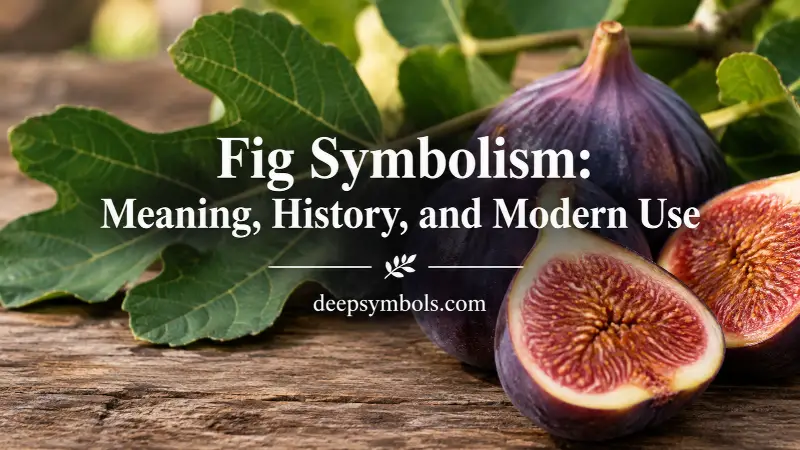
Few plants appear across as many unrelated ancient traditions as the fig. It covers the first humans in Genesis, shelters the infants Romulus and Remus in Roman legend, and shades Siddhartha Gautama at the exact moment he becomes the Buddha. Fig symbolism didn’t spread from one culture to the others — these traditions developed independently, which makes their shared attraction to the same tree genuinely interesting rather than coincidental.
Part of the explanation is practical. Figs were among the earliest fruits cultivated by humans, found across the Mediterranean, the Middle East, and South Asia, and a plant that feeds entire civilizations for thousands of years naturally accumulates meaning along the way. This guide traces those meanings separately by tradition, rather than blending them into one invented “ancient fig wisdom,” since the fig’s various associations with fertility, peace, knowledge, and judgment developed through genuinely different religious and cultural logics.
Quick Answer
The fig commonly symbolizes abundance, fertility, peace, and spiritual knowledge across multiple ancient traditions, though the specific meaning varies considerably by culture. In Judeo-Christian tradition, the fig appears in Genesis, in Hebrew Bible imagery of peace and prosperity, and in the Gospels’ account of Jesus cursing a barren fig tree; in Buddhism, a particular fig species is the tree under which the Buddha attained enlightenment; and in ancient Roman legend, a fig tree shelters the infants who would go on to found Rome.
TL;DR
- The fig leaf famously covers Adam and Eve’s nakedness in Genesis
- Sitting under one’s own vine and fig tree” is a Hebrew Bible symbol of peace and security
- Jesus’s cursing of a barren fig tree in the Gospels carries specific symbolic weight
- The Bodhi tree under which Buddha attained enlightenment is a species of sacred fig
- Roman legend places Romulus and Remus beneath a fig tree as infants
- The fig’s abundant seeds gave it a long-standing association with fertility across cultures
Why the Fig Became So Widely Symbolic
Before looking at specific traditions, it helps to understand what made the fig such fertile symbolic ground in the first place. Figs are counted among the oldest cultivated fruits in human history, with archaeological evidence of fig cultivation stretching back thousands of years across the Mediterranean and Near East. A tree that reliably fed communities across so many centuries and civilizations naturally became woven into daily life in a way few other plants managed — and daily necessity, repeated across generations, is exactly the kind of thing that turns into shared symbolism.
The fruit’s own physical characteristics contributed as well. A ripe fig is packed with hundreds of tiny seeds, giving it an obvious and nearly universal association with fertility and abundance. Its broad leaves provided practical shade and covering, which is part of why Genesis reaches for the fig leaf specifically rather than some other plant. And the fig tree’s tendency to produce fruit without an obviously showy flower beforehand gave it a reputation in some traditions for either quiet reliability or, conversely, deceptive appearance — a tree that looks the same whether or not it’s actually bearing fruit, a detail that becomes symbolically important in at least one biblical passage covered below.
The Fig Leaf in Genesis
The fig’s first and most famous appearance in Judeo-Christian tradition comes immediately after Adam and Eve eat the forbidden fruit in the Garden of Eden: becoming aware of their own nakedness, they sew fig leaves together to cover themselves. This is one of the most recognizable images in Western religious art and literature, and the fig leaf has since become a broader cultural shorthand for modesty, shame, or the covering of something considered inappropriate to display — the phrase “fig leaf” is still used idiomatically in English to describe a thin or inadequate cover for something embarrassing.
It’s worth noting that Genesis doesn’t specify what kind of fruit Adam and Eve actually ate — that detail isn’t in the text, and the popular image of an apple comes from much later European artistic and literary tradition rather than the biblical account itself. The fig’s role in the story is specifically about the leaf used for covering afterward, not the forbidden fruit itself, a distinction that’s easy to blur in popular retellings.
The Fig as a Symbol of Peace and Security
A separate and much more positive image appears repeatedly throughout the Hebrew Bible: the phrase describing a person sitting peacefully “under their own vine and fig tree,” used as a vivid picture of security, prosperity, and peace during a settled, untroubled era. This phrase appears in several books of the Hebrew Bible and became an enduring symbol of ordinary, contented life — not grand wealth, but the simple security of owning land productive enough to provide shade and fruit without fear of war or displacement.
This image later found an interesting afterlife in early American political rhetoric, where the phrase was invoked by several of the nation’s founders, including George Washington, as a symbol of the peaceful agrarian life they hoped the new republic would secure for its citizens. This represents a distinct, later adoption of the biblical image for a specific political and cultural purpose in early American history, separate from its original Hebrew Bible context.
The Barren Fig Tree in the Gospels
The New Testament includes an episode, found in the Gospels of Matthew and Mark, in which Jesus approaches a fig tree expecting fruit, finds none, and curses it, after which the tree withers. This passage has generated substantial theological commentary and interpretation across different Christian traditions, generally read as a symbolic message about the consequences of outward religious appearance without genuine spiritual substance — a tree that looks capable of bearing fruit but doesn’t, paralleling a warning about hollow religious observance.
Different Christian traditions and commentators have offered varying specific interpretations of this episode’s finer details, including questions about the actual fruiting season of fig trees in the region at the time of the events described, and it’s worth treating any single confident interpretation as one reading among several rather than a universally agreed conclusion. What’s consistent across most interpretations, though, is the general symbolic pairing of the fig tree with judgment about genuine versus superficial spiritual fruitfulness.
The Fig in Islamic Tradition
The fig holds a distinct place in Islamic scripture as well, most notably through Surah At-Tin (“The Fig”), a chapter of the Quran that opens by swearing an oath by the fig and the olive. Islamic scholarly tradition has offered various interpretations of why these two specific plants are invoked at the opening of the chapter, generally connecting them to themes of divine creation, human dignity, and moral accountability central to the surah’s broader message.
This represents its own distinct tradition, developed independently of the Hebrew Bible and Gospel references covered above, and it shouldn’t be treated as simply an extension of earlier biblical fig symbolism — the Quranic reference carries its own specific theological context within Islamic tradition.
The Bodhi Tree and Buddhist Enlightenment
Buddhism’s relationship with the fig centers on one of the most significant trees in all of religious history: the Bodhi tree, a sacred fig (Ficus religiosa) under which Siddhartha Gautama is said to have attained enlightenment, becoming the Buddha. The tree’s heart-shaped leaves have become a recognizable symbol in Buddhist art and iconography, closely associated with wisdom and spiritual awakening.
The original tree’s descendants have been propagated and venerated across Buddhist communities for over two thousand years — a sapling from the original tree was historically transplanted to Sri Lanka, where it’s maintained as a sacred site to this day, and cuttings from these trees have been planted at Buddhist sites throughout Asia. This gives the sacred fig a continuity of religious significance that very few other single trees or tree species can claim, developed entirely independently of the fig’s role in Mediterranean and Near Eastern traditions described above — a case of two completely separate ancient civilizations, with no direct historical contact, each attaching profound spiritual significance to different species within the same broader fig genus.
The Fig in Ancient Greek and Roman Tradition
Ancient Greek mythology connects the fig to Dionysus, the god of wine and fertility, through a story describing the transformation of a nymph named Syke into a fig tree — an origin myth tying the fruit directly to themes of fertility and abundance already associated with Dionysian worship more broadly. Figs held genuine economic and cultural importance in ancient Greek society as a significant food source, which likely reinforced these associations with abundance independent of the mythological narrative itself.
Roman tradition developed its own, separate fig symbolism centered on the Ficus Ruminalis, a specific wild fig tree of real religious and historical significance in ancient Rome, located near the Palatine Hill. According to Roman foundational legend, this was the tree beneath which the floating cradle carrying the infant twins Romulus and Remus came to rest after being abandoned, where a she-wolf is said to have nursed them until they were later discovered. This specific tree held ongoing ritual significance in Roman religious life for centuries afterward, connecting the fig directly to Roman national identity and the mythology of the city’s founding — a genuinely distinct tradition from the Greek Dionysian fig mythology, despite both cultures’ geographic proximity and cultural exchange.
Figs, Fertility, and Abundance Across Cultures
Running beneath several of these specific religious and mythological traditions is a more general, widely shared association between figs and fertility, drawn largely from the fruit’s own physical characteristics — its abundant seeds and its reliable, generous yield. This broader fertility symbolism appears independently in Mediterranean, Near Eastern, and South Asian contexts, and it’s genuinely difficult to trace to one single origin point, since it seems to have developed naturally and repeatedly wherever fig cultivation became an important part of a community’s food supply.
This is a useful reminder about how symbolism develops generally: sometimes a meaning spreads from one culture to another through contact and exchange, but sometimes, as appears to be largely the case with fig-and-fertility symbolism, different cultures independently arrive at a similar association because the same physical plant suggests the same obvious metaphor to anyone who looks closely at it.
A Quick Comparison of Fig Symbolism by Tradition
| Tradition | Key Reference | Primary Symbolism | Notes |
|---|---|---|---|
| Hebrew Bible | “Vine and fig tree” imagery | Peace, security, prosperity | Later invoked in early American political rhetoric |
| Genesis | Adam and Eve’s fig leaves | Modesty, covering, awareness | The forbidden fruit itself is not specified as a fig |
| The Gospels | The cursed barren fig tree | Judgment, false religious appearance | Interpretation varies across Christian traditions |
| The Quran | Surah At-Tin | Divine creation, human dignity | A distinct tradition from Hebrew Bible symbolism |
| Buddhism | The Bodhi tree | Wisdom, enlightenment, awakening | Ficus religiosa, developed independently of Mediterranean tradition |
| Greek mythology | The nymph Syke and Dionysus | Fertility, abundance | Connected to broader Dionysian symbolism |
| Roman legend | The Ficus Ruminalis | National founding, protection | Central to the Romulus and Remus story |
The Fig in Modern American Culture
Modern American engagement with fig symbolism is considerably more casual than any of the traditions above, largely detached from their specific religious or mythological weight. The dismissive idiom “I don’t give a fig,” meaning something is of little or no value or concern, descends from a long history of using the fig as a byword for something trivial or worthless in English and other European languages — a notably different and more deflating association than the fruit’s reverent treatment in Genesis, the Gospels, the Quran, or Buddhist tradition.
Commercially, the fig is perhaps best known in the United States through the Fig Newton, a mass-produced snack food whose name has made the fruit a familiar, if largely symbolically neutral, part of American food culture. Figs also appear in contemporary wellness and culinary culture as a fashionable, somewhat upscale fruit, associated loosely with Mediterranean cuisine and health-conscious eating — a modern, largely secular layer of meaning built on the fruit’s culinary appeal rather than any of its older religious symbolism.
Common Misunderstandings About Fig Symbolism
One common mistake is assuming the forbidden fruit in Genesis was specifically a fig, when the text itself doesn’t name the fruit — only the leaves used afterward for covering are explicitly identified as fig leaves. The popular association with an apple comes from later European art and literary tradition rather than the biblical account.
Another common error treats fig symbolism as though it originated in one place and spread to the others, when the Hebrew Bible and Gospel traditions, the Quranic reference, Buddhist Bodhi tree veneration, and Greek and Roman mythology each developed largely independently, reflecting different religious and cultural logics rather than one shared inherited tradition. It’s also worth being cautious about collapsing every fig reference into one generic “ancient wisdom” framing, a tendency common in casual online content about the subject — the barren fig tree in the Gospels and the Bodhi tree in Buddhism, for instance, carry essentially opposite emotional registers (judgment versus enlightenment) despite both involving the same general type of tree.
How Fig Symbolism Has Evolved
The fig’s symbolic trajectory moves through several genuinely separate historical threads rather than one continuous narrative. Ancient Near Eastern and Hebrew Bible tradition established early associations with modesty, peace, and prosperity, later developed further and reinterpreted within Christian Gospel tradition and, independently, within Quranic revelation. Entirely separately, Buddhist tradition in South Asia attached its own profound spiritual significance to a related but distinct fig species, centered on the Buddha’s enlightenment. Greek and Roman Mediterranean tradition developed yet another independent layer, tying the fig to fertility mythology and, in Rome’s case, the specific legend of the city’s founding.
Modern American culture has largely set aside these older religious and mythological layers in favor of either dismissive casual idiom or neutral culinary association, though the older meanings remain fully intact within their respective religious traditions and continue to shape religious art, scripture study, and pilgrimage practice today.
FAQs
What does the fig tree symbolize in the Bible?
The fig tree carries several distinct meanings across the Bible, including modesty and awareness in Genesis, peace and prosperity in the Hebrew Bible’s “vine and fig tree” imagery, and judgment against false religious appearance in the Gospels’ account of Jesus cursing a barren fig tree.
Why is the Bodhi tree significant in Buddhism?
The Bodhi tree is a sacred fig (Ficus religiosa) under which Siddhartha Gautama is said to have attained enlightenment, becoming the Buddha. Its heart-shaped leaves remain a recognizable symbol of wisdom and spiritual awakening in Buddhist art.
Was the forbidden fruit in Genesis a fig?
The Bible doesn’t specify what fruit Adam and Eve ate — only that they used fig leaves afterward to cover themselves. The popular image of an apple comes from later European artistic and literary tradition rather than the biblical text itself.
What does the fig symbolize in ancient Rome?
The fig is tied to Roman founding mythology through the Ficus Ruminalis, the wild fig tree beneath which the infants Romulus and Remus are said to have been nursed by a she-wolf after being abandoned.
What does the fig represent in the Quran?
Surah At-Tin, a chapter of the Quran, opens by swearing an oath by the fig and the olive, generally interpreted as connecting to themes of divine creation and human moral accountability within Islamic tradition.
Why is the fig associated with fertility?
The fig’s abundant internal seeds gave it a natural, widely shared association with fertility and abundance across many cultures, likely developing independently in different regions rather than spreading from one single source.
What does “I don’t give a fig” mean?
It’s an idiom meaning something is of little value or concern, descending from a long history of using the fig as a symbol of something trivial — a notably more dismissive association than the fruit’s treatment in most religious traditions.
Conclusion
Fig symbolism is best understood as a collection of meanings that developed in different religious and cultural settings. The fig appears in biblical traditions as a source of modesty and as an image associated with peace and prosperity, while later Christian, Buddhist, and Roman traditions gave the tree additional meanings. The Metropolitan Museum of Art’s discussion of figs and fig leaves provides useful historical context for the fig’s roles in biblical and Greco-Roman culture, including its associations with abundance, fertility, and Rome’s founding traditions.
What makes the fig especially interesting is that its symbolic history is tied to ordinary qualities that made the tree valuable: edible fruit, shade, cultivation, and longevity. Yet those practical qualities were interpreted differently by different communities, producing meanings that should not be collapsed into a single universal definition.
Ultimately, fig symbolism is most accurately understood through context. The same tree can represent modesty, peace, judgment, enlightenment, divine testimony, fertility, or cultural memory, depending on the tradition and story surrounding it. Its long symbolic life comes not from one shared ancient meaning, but from the many meanings people have built around a tree that has remained important to human life for thousands of years.