
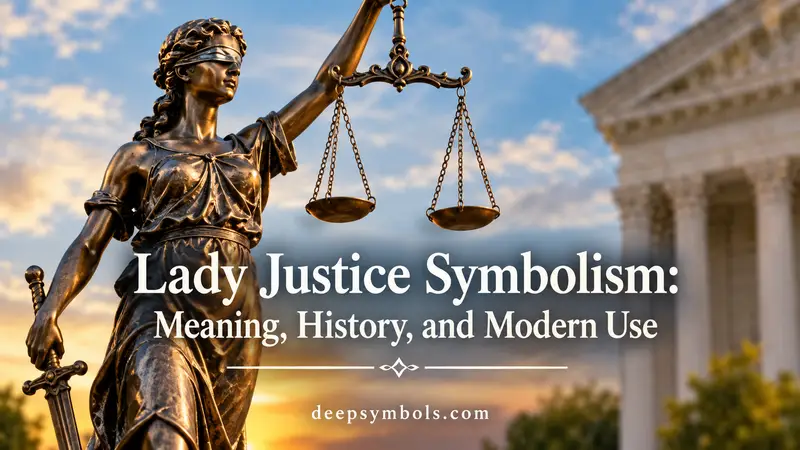
Lady Justice is one of the most recognizable figures associated with law, fairness, and the courts, and lady justice symbolism remains especially familiar in American public life. You see her outside courthouses, in courtroom artwork, on legal seals, in political cartoons, and in designs that represent fairness or accountability. Her familiar scales, sword, and sometimes blindfold turn an abstract idea—justice—into a human figure that people can immediately understand.
The image also has a more complicated history than the modern statue suggests. Lady Justice did not begin as a single fixed character with all three of her familiar attributes. Her visual language developed from Greek and Roman personifications of law and justice, changed during the Renaissance, and eventually became a standard symbol of the modern legal system.
In the United States, the figure carries both an idealistic and practical message. She represents the hope that disputes can be judged fairly, evidence can be weighed carefully, and legal authority can be exercised without favoritism. At the same time, her image can raise uncomfortable questions about whether real institutions always live up to the ideal she represents.
Quick Answer
Lady Justice commonly symbolizes fairness, impartial judgment, equality before the law, and accountability in modern American culture. Historically, her scales, sword, and later blindfold developed from classical personifications of justice and evolved into a visual language for balancing evidence, exercising legal authority, and judging without favoritism.
TL;DR
- Lady Justice represents fairness, equality, law, and impartial judgment.
- Her scales symbolize weighing evidence and competing claims.
- Her sword represents legal authority and the enforcement of judgments.
- The blindfold became associated with impartiality during the Renaissance.
- American courts use her image to express ideals of equal justice.
- Modern uses can emphasize fairness, protest, law, or personal identity.
What Lady Justice Looks Like and Where You See Her
The familiar figure is usually a woman in flowing classical robes, standing or seated with a dignified, deliberate posture. She often carries a set of balance scales in one hand and a sword in the other. In many modern representations, a cloth covers her eyes.
The details vary considerably. Some figures are blindfolded, while others look directly ahead. Some hold a sword upright, while others rest it at their side or leave it sheathed. A few carry a law book or another object instead of a sword.
In the United States, these images appear most often in courthouses and other government buildings. They can also appear on court seals, legal publications, jewelry, tattoos, illustrations, logos, political cartoons, and decorative objects associated with law.
Her widespread recognition comes partly from the fact that each object communicates a different part of the idea. The figure does not simply stand for “law.” She presents law as something that should involve judgment, balance, and authority.
The Ancient Roots Behind the Figure
The roots of Lady Justice reach into the visual traditions of ancient Greece and Rome. Greek culture included female figures associated with law, order, justice, and moral balance, including Themis and Dike. Roman culture later developed Justitia as a personification of justice.
These figures should not be treated as identical characters. Themis was associated with divine law, custom, and proper order, while Dike was connected with justice and right conduct. Justitia became a Roman personification of justice that helped establish the visual tradition later inherited by Europe.
The idea of representing an abstract virtue as a woman was useful artistically. A figure could make an invisible principle visible. Instead of presenting justice as a complicated legal theory, artists could show a composed woman holding the objects associated with fair judgment.
Older civilizations also used images connected with truth, order, judgment, and balance. Ancient Egyptian imagery surrounding Ma’at, for example, linked truth and cosmic order with the proper organization of society. That does not make Ma’at a direct historical version of Lady Justice, but it shows that the idea of representing justice and order through symbolic imagery is much older than the modern courthouse statue.
Why the Scales Represent Fair Judgment
The scales are probably the easiest part of the figure to understand. They represent balance: one side of a claim is weighed against another, and evidence must be considered before a judgment is reached.
In modern legal symbolism, the scales can suggest several related ideas. They can represent evidence versus counterevidence, competing arguments, competing interests, or the effort to reach a proportionate decision.
The important point is that the scales symbolize a process rather than a simple promise of a particular outcome. Justice is not represented by declaring one side automatically correct. Instead, the image suggests that claims should be examined and measured before a conclusion is reached.
That distinction matters in American culture. People often use the scales in discussions of due process and fair treatment because the symbol implies that a person should not be judged merely because of reputation, wealth, popularity, or social position.
The scales also communicate restraint. A legal system is supposed to deliberate rather than react purely from anger or emotion.
What the Sword Means
The sword adds a different idea to the image. If the scales represent judgment, the sword represents the authority to act on that judgment.
A sword can symbolize the power of law, the ability to impose consequences, and the government’s authority to enforce legal decisions. It also gives the figure a more active character. Justice is not only about thinking carefully; it also involves decisions that can affect real lives.
The sword is often shown upright, suggesting readiness, or lowered, suggesting controlled authority. In some representations it remains sheathed, which can imply that force should remain restrained unless necessary.
This makes the sword an important counterweight to the scales. Fairness without the ability to enforce a decision would have limited practical effect. At the same time, power without careful judgment would become arbitrary. Together, the two objects create a visual argument: authority should follow considered judgment.
Why Lady Justice Is Blindfolded
The blindfold is one of the most familiar features of the modern image, but it is not one of the oldest.
Ancient Greek and Roman personifications of justice were generally shown with their eyes uncovered. The blindfold became more prominent in European art during the late medieval and Renaissance periods. Early examples could carry a negative or satirical meaning, suggesting that justice was unable to see what was happening around her.
Over time, that interpretation changed. The blindfold increasingly became a positive symbol of impartiality. The idea was straightforward: justice should not favor a person because of wealth, beauty, social rank, political influence, or personal identity.
That interpretation eventually became dominant in popular culture. In the phrase “justice is blind,” the blindfold represents the ideal that the law should evaluate the case rather than the status of the people involved.
There is an interesting tension here. Blindness can suggest impartiality, but justice also requires careful attention to evidence. That is why some court buildings deliberately depict Justice without a blindfold. The uncovered eyes can emphasize vigilance, careful observation, and the responsibility to see the facts clearly.
Neither version is automatically more correct. The choice often reflects the artist’s historical model or the message the building wants to communicate.
Lady Justice in American Courts and Civic Life
The United States adopted classical imagery as part of its broader visual language of government and civic authority. Early American institutions often borrowed symbols from Greek and Roman traditions because those traditions were associated with republican government, law, civic virtue, and public responsibility.
Lady Justice fits naturally into that visual system. In American courthouses, she can be found in sculptures, murals, friezes, seals, mosaics, and architectural details. She appears not because the courts worship a goddess, but because an allegorical figure makes an institutional ideal visible.
The U.S. Supreme Court provides some of the most prominent examples. Its architecture includes multiple representations of Justice, including versions with a blindfold and another figure with uncovered eyes.
That variety is revealing. American legal culture does not depend on one rigid image. Instead, the figure is adapted to communicate related ideas such as fairness, reason, moral responsibility, legal authority, and the struggle between justice and wrongdoing.
Modern courthouse art continues to use these themes, showing that the figure remains useful even in contemporary public architecture.
How Americans Commonly Interpret the Symbol Today
In contemporary American culture, Lady Justice is usually understood in secular rather than religious terms. Most people encountering her in a courthouse do not interpret her as a literal supernatural being. She functions as an allegory for principles that institutions are expected to uphold.
Common associations include:
| Context | Meaning in the USA | Common Associations | Notes |
|---|---|---|---|
| Courthouse art | Equal and impartial justice | Law, fairness, judgment | Often appears in sculptures and murals |
| Legal seals | Authority of the judicial system | Courts, evidence, law | Scales and sword are common |
| Political cartoons | Public accountability | Government, rights, justice | Can be supportive or critical |
| Tattoos and jewelry | Personal commitment to fairness | Strength, principles, law | Meaning varies by wearer |
| Protest imagery | Demand for equal treatment | Rights, accountability, reform | Often used symbolically rather than formally |
Americans may also connect the image with constitutional rights, due process, civil rights, and the broader idea that government should be governed by law.
That makes the figure especially flexible. She can appear in a formal courthouse and in a protest poster without losing her basic symbolic identity.
The Emotional and Psychological Meaning
Although Lady Justice is primarily a civic and legal symbol, she can also carry a strong emotional meaning.
For some people, she represents reassurance. The image suggests that there is supposed to be a process for resolving disputes, protecting rights, and correcting wrongdoing. It can offer a visual expression of the belief that fairness should not depend entirely on personal power.
For others, the symbol evokes seriousness, authority, or accountability. The sword makes the figure less comforting than a purely peaceful emblem. Justice can protect, but it can also punish.
This creates a useful psychological contrast. The scales suggest patience and thought, while the sword suggests consequences. The blindfold suggests neutrality, while the human form makes the concept feel personal and recognizable.
For someone who chooses the image as personal art, the emotional meaning may therefore be less about courts and more about principles: standing up for fairness, refusing favoritism, demanding accountability, or believing that actions should have consequences.
What Lady Justice Can Mean in Tattoos and Personal Style
Lady Justice tattoos often carry a much more individual message than courthouse artwork does.
A person working in law may use the image as a professional symbol, but that is only one possible meaning. Someone else may choose it to represent fairness after a difficult experience, commitment to justice reform, a belief in personal accountability, or admiration for legal ideals.
The design itself can change the meaning. A blindfolded figure tends to emphasize impartiality. A visible sword may highlight strength or enforcement. Prominent scales can emphasize fairness and balance. A broken chain, rose, clock, quote, or other added element can shift the symbolism toward freedom, remembrance, resilience, or political commentary.
This is an important distinction: the traditional meaning belongs to the cultural symbol, while a tattoo’s personal meaning belongs to the person wearing it.
Jewelry and graphic design work similarly. A small scales pendant may communicate fairness without carrying the full dramatic imagery of a complete Lady Justice statue.
Lady Justice in Politics, Protest, and Popular Culture
The figure does not remain confined to courtrooms. Because she represents an ideal rather than a specific institution, she is frequently adapted for political and social commentary.
Artists may show Lady Justice standing, falling, removing her blindfold, carrying a broken sword, or struggling beneath an oversized burden. These alterations can question whether a legal system is impartial or whether institutions have failed to protect certain people.
Her image also appears in editorial cartoons and political graphics because viewers already understand the basic visual vocabulary. A damaged scale can suggest unequal treatment. A broken sword can imply weak enforcement. A blindfold removed from the figure can suggest transparency—or the discovery that justice was never truly impartial.
In popular culture, she can also be used in a much lighter way. Lawyers’ offices, educational materials, law-themed merchandise, and fictional courtroom stories frequently rely on the familiar silhouette.
Her ability to move between serious civic art, criticism, advertising, and personal style is one reason the image has remained so durable.
Religious and Cross-Cultural Interpretations
Lady Justice is sometimes misunderstood as a religious figure because her historical roots involve goddesses and classical mythology. In modern American legal settings, however, the figure is generally allegorical and secular.
Greek Themis, Dike, and Roman Justitia belong to ancient religious and mythological traditions, but the modern courtroom image is not simply a surviving form of worship. It is a cultural inheritance transformed into a civic symbol.
Other cultures also created visual traditions for justice, truth, or cosmic order. The Egyptian concept of Ma’at is one well-known example involving truth, balance, and proper order. Similar themes can appear in legal and moral imagery in different societies without implying that all these traditions share one direct origin.
The recurring use of balance is especially understandable. Human societies have long needed ways to express the idea that conflicts can be judged according to standards rather than personal revenge.
Common Misunderstandings About the Symbol
One common mistake is assuming that Lady Justice has always looked exactly as she does today. She has not. Her attributes developed at different times, and the blindfold in particular became important later than the original Greek and Roman personifications.
Another misunderstanding is that the blindfold literally means justice cannot see. Its modern symbolic use is nearly the opposite: she is not supposed to judge by appearance or social identity.
It is also misleading to treat every Lady Justice statue as a direct religious image of a Roman goddess. Modern courts generally use the figure as a personification of legal ideals.
Finally, the symbol should not be confused with a claim that legal systems are automatically fair. A courthouse may display Lady Justice while people still debate unequal outcomes, access to legal representation, discrimination, or institutional power. The symbol expresses an ideal; it does not prove that the ideal has always been achieved.
How the Meaning Has Changed Over Time
The history of Lady Justice is best understood as an accumulation of meanings.
The ancient foundation emphasized law, order, fairness, and the proper structure of society. The scales became associated with weighing competing claims, while the sword reinforced the authority of justice.
During the Renaissance, the blindfold introduced a new visual idea. What could initially mock Justice for failing to see gradually became an expression of neutrality. That shift is a good example of how symbols change when societies reinterpret them.
In the modern era, especially in the United States, the figure became closely tied to secular institutions, civic architecture, judicial authority, and the rule of law.
Today, she can mean fairness, legal power, accountability, equality, protest, professional identity, or personal principle depending on context. The central idea remains recognizable, but the surrounding message can change dramatically.
Why Lady Justice Still Matters in Modern America
Lady Justice continues to matter because Americans regularly debate what fairness should look like in practice. Questions about civil rights, equal treatment, constitutional protections, policing, sentencing, access to courts, and government authority all involve the same basic problem the symbol presents: how should society make judgments fairly?
Her continued presence in new courthouses shows that the imagery has not become obsolete. At the same time, modern artists often redesign her rather than copying older statues exactly. That allows the figure to reflect new conversations while preserving the recognizable elements of scales, sword, and sometimes the blindfold.
She works because the symbolism is easy to understand without being simplistic. Everyone can recognize a scale as a measuring device and a sword as an instrument of power. Together they create a compact picture of judgment backed by authority.
The figure also reminds people that justice is an ideal people argue about, not merely a decorative concept carved into stone.
FAQs
What does Lady Justice symbolize?
Lady Justice symbolizes fairness, impartial judgment, equality before the law, and legal authority. Her scales represent weighing evidence, while her sword represents the power to enforce a judgment.
Why is Lady Justice blindfolded?
The blindfold is generally understood today as a sign of impartiality. It suggests that justice should not favor people based on wealth, appearance, status, or personal identity.
Why does Lady Justice carry scales?
The scales represent the balancing and weighing of competing claims, facts, or evidence. They visually express the idea that judgment should follow careful consideration rather than impulse.
What does the sword represent?
The sword represents legal authority and the ability to enforce decisions. It also suggests that justice can involve consequences when laws are violated.
Is Lady Justice a religious symbol?
Her historical roots include ancient Greek and Roman goddesses associated with justice and law, but modern Lady Justice is generally used as a secular civic symbol. In American courts, she represents legal ideals rather than religious worship.
What does a Lady Justice tattoo mean?
A Lady Justice tattoo can represent fairness, accountability, legal ideals, personal principles, or a commitment to equality. The meaning often changes according to added elements such as scales, weapons, flowers, or broken chains.
Why are some Lady Justice statues blindfolded while others are not?
The difference reflects changing artistic traditions. Blindfolded versions emphasize impartiality, while figures with uncovered eyes can emphasize awareness, careful judgment, and the responsibility to see the facts clearly.
Conclusion
Lady Justice symbolism brings together fairness, authority, and impartiality in a single recognizable figure. Her scales suggest the careful weighing of evidence, her sword represents the power of law, and her blindfold has come to express the ideal of judging without favoritism. A U.S. federal court guide on judicial symbols provides useful context for the meanings attached to the scales and sword.
In the United States, Lady Justice remains visible because she represents an ideal that legal institutions are expected to pursue even when human systems fall short. Her presence in courthouses, public art, books, tattoos, and civic imagery keeps that ideal recognizable beyond the courtroom.
Ultimately, Lady Justice symbolism is not a claim that justice is always fair or impartial. It is a visual standard for what justice is supposed to be: evidence weighed carefully, authority exercised responsibly, and decisions made without favoritism. That tension between ideal and reality is what keeps her image rel


