
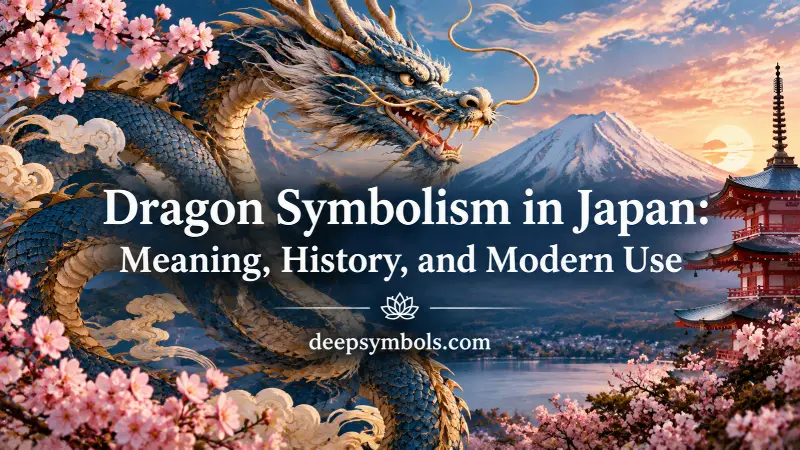
Dragon symbolism in Japan centers on water, protection, wisdom, strength, and the connection between the natural and spiritual worlds. Known as ryū or tatsu in Japanese, the dragon appears in mythology, Shinto traditions, Buddhist temples, paintings, festivals, and contemporary tattoo art. Unlike the fire-breathing monster familiar from many Western stories, the Japanese dragon is often associated with rain, rivers, oceans, and supernatural powers that can sustain life or threaten it.
In modern Japanese culture, dragons remain recognizable symbols of strength, good fortune, transformation, and spiritual protection. Their images appear on temple ceilings, in traditional woodblock prints, on clothing, and in popular entertainment. Some are depicted rising through clouds, while others coil around waves or guard sacred spaces.
The dragon’s history in Japan developed through interactions among indigenous beliefs, Chinese dragon traditions, and Buddhist ideas originating in India and spreading across Asia. Over time, these influences combined with local stories about water deities, serpents, mountains, and the sea. The result is a distinctive tradition in which dragons can be protectors, powerful deities, guardians of Buddhist teachings, or dangerous forces of nature.
Understanding the Japanese dragon requires looking beyond the image itself. Its meaning depends on the story, religious setting, artistic design, and cultural tradition in which it appears.
Quick Answer
Dragon symbolism in Japan commonly represents water, protection, wisdom, strength, and good fortune, reflecting the creature’s connections with rivers, rain, oceans, and supernatural power. Historically, Japanese dragons developed through Chinese and Buddhist influences alongside local serpent and water-deity traditions, becoming important figures in Shinto worship, Buddhist art, mythology, and modern Japanese culture.
TL;DR
- Japanese dragons commonly represent water, protection, wisdom, and supernatural power.
- Ryūjin is a dragon deity associated with the sea and water.
- Shinto traditions connect dragons with rainfall, agriculture, and natural forces.
- Buddhist dragons can protect sacred teachings and religious spaces.
- Traditional dragon paintings often combine strength with movement, water, and clouds.
- Modern Japanese dragon tattoos frequently express resilience, courage, and protection.
What Does a Japanese Dragon Look Like?
The Japanese dragon, called ryū or tatsu, is generally portrayed as a long, serpentine creature with scales, claws, whiskers, horns, and a flowing mane. Its body often twists through clouds, rain, or waves rather than occupying the ground like a typical European dragon.
Japanese dragons are commonly associated with water and the sky. Paintings may show them emerging from stormy seas, ascending toward clouds, or curling through the air with their claws extended. Their faces often appear fierce, with prominent eyes, sharp teeth, and elaborate facial details.
These visual features help communicate the dragon’s supernatural authority. A dragon surrounded by water may suggest control over rainfall or the sea, while one painted above a temple interior may suggest guardianship and spiritual strength.
The Japanese dragon developed within a broader East Asian artistic tradition, so it shares characteristics with Chinese and Korean dragons. There is no single physical design that defines every Japanese dragon, and historical depictions vary by period, region, and artistic purpose.
Its elongated body and association with weather distinguish it from the heavily winged, fire-breathing dragons familiar from much Western fantasy. The Japanese dragon is often closer in appearance to a supernatural serpent whose power extends across water, clouds, and the natural world.
The Main Meanings of Dragon Symbolism in Japan
Several meanings recur in Japanese dragon imagery, although the importance of each depends on its cultural and religious context.
Water and rainfall are among the most historically significant associations. Dragons are connected with rivers, lakes, springs, and the sea, as well as with the rain needed for agriculture.
Protection appears in religious art, temple traditions, and stories about dragon deities. A dragon may guard sacred teachings, protect a particular place, or represent the power that keeps dangerous forces under control.
Wisdom and spiritual authority arise particularly in Buddhist traditions, where dragon kings and other supernatural beings can be connected with Buddhist teachings and the protection of religious communities.
Strength and resilience reflect the dragon’s ability to move through storms, surge from the sea, and command powerful natural forces. These qualities also make the dragon a popular personal emblem.
Good fortune and prosperity are associated with certain dragon deities and artistic traditions, particularly where water, successful fishing, and agricultural abundance are involved.
Finally, transformation and ascent appear in imagery showing a dragon rising into the sky. Such pictures can suggest movement toward a new level of power or a change in one’s circumstances, although these are broad interpretations rather than a fixed meaning shared by every traditional dragon image.
Together, these associations present the dragon as a force that can sustain life, protect people, and command respect. Its power is not always gentle, but it is often connected with the forces on which communities depend.
Historical Origins: How Dragons Became Part of Japanese Culture
Japanese dragon imagery developed through cultural exchange as well as local religious traditions.
The Chinese dragon provided a major influence. Chinese dragon imagery and beliefs reached Japan through long-standing connections with the Korean peninsula and mainland Asia, alongside writing, political institutions, Buddhist teachings, and artistic practices.
Chinese dragons were closely associated with water, rainfall, auspicious power, and authority. As these ideas spread, dragon imagery became part of Japanese religious and artistic life.
Buddhism added another layer through its accounts of nāgas, supernatural serpent beings associated with water and, in some traditions, the protection of Buddhist teachings. These beings became connected with East Asian dragon kings and other dragon figures.
Japan also had older traditions involving serpents and water-related deities. As these traditions interacted with imported ideas, dragon worship developed in forms that reflected local landscapes and religious practices.
This history did not produce one uniform dragon mythology. Instead, it created overlapping traditions involving Shinto deities, Buddhist protectors, sea gods, local legends, and artistic symbols.
The dragon’s significance therefore reflects more than the borrowing of a mythical animal from another culture. Japanese communities reshaped dragon imagery to express concerns about water, agriculture, sacred places, and the relationship between human life and powerful natural forces.
Ryūjin: The Japanese Dragon God of the Sea
One of the best-known dragon figures in Japanese mythology is Ryūjin, often described as the dragon god or dragon deity of the sea. He is also associated with the name Watatsumi in Japanese mythological traditions, although the names have distinct histories and are not interchangeable in every context.
Ryūjin is connected with the ocean, tides, marine life, and the supernatural power of water. In many stories, his realm is the magnificent Dragon Palace beneath the sea, known as Ryūgū. This underwater palace is a place of extraordinary beauty and otherworldly wealth.
Ryūjin is especially significant because the sea could provide food and trade while also posing serious dangers to coastal communities. Fishing communities depended on marine resources and favorable conditions, yet storms and dangerous waters could threaten their livelihoods.
Dragon-deity worship developed around these practical and religious concerns. People prayed for favorable weather, abundant catches, and protection at sea. In agricultural settings, dragon deities were also associated with rainfall and the water needed to sustain crops.
The dragon thus represented a force that could nourish life and disrupt it. Water was essential, but excessive rain, flooding, and violent storms could be destructive.
In modern interpretation, Ryūjin can represent the relationship between strength and responsibility. His authority over the sea reflects not merely domination but the power of a natural world on which human survival depends.
Dragons in Shinto: Water, Rain, and Agricultural Life
Shinto traditions include many kami, or sacred beings, associated with particular places, natural features, and aspects of life. Dragon worship, known as ryūjin shinkō, became part of Japanese religious practice through a combination of continental influence and local water-deity traditions.
Dragons have been associated with springs, ponds, rivers, waterfalls, deep pools, and the sea. These bodies of water could be understood as places where dragon deities resided or exercised their power.
Rain was particularly important in an agricultural society dependent on the success of rice cultivation. Too little rain could damage crops, while too much water could destroy fields and settlements. Communities therefore performed rituals intended to seek rain or bring excessive rainfall to an end.
Dragon deities also had a role in coastal life. Fishermen could pray for calm seas and successful catches, reflecting the dragon’s relationship with the water that sustained their livelihoods.
This background helps explain why Japanese dragon symbolism often feels more connected with water than with fire. The dragon is not simply a supernatural monster; it is associated with the natural forces that communities depend upon and must respect.
It is important to remember that not every Japanese dragon tradition is exclusively Shinto. Dragon worship developed through overlapping religious practices, and dragon figures may appear in settings influenced by both Shinto and Buddhism.
The central association remains clear: dragons can embody the power, uncertainty, and life-giving importance of water.
Dragons in Buddhism: Wisdom and Protection of Sacred Teachings
Buddhism helped establish another important dimension of Japanese dragon symbolism.
In Buddhist traditions, dragon kings, often referred to as ryūō in Japanese, are connected with the broader Asian tradition of supernatural nāga beings. These figures can possess considerable power and appear in stories associated with the protection of Buddhist teachings and sacred communities.
One important example comes from the Lotus Sutra, which includes the Dragon King’s daughter in a famous account of attaining buddhahood. The story challenges assumptions about who can attain enlightenment and has been interpreted in discussions of Buddhist wisdom and spiritual potential.
Dragon kings also appear in Buddhist imagery and temple art. Dragons may be painted on ceilings, carved into architectural details, or represented in decorative objects associated with sacred spaces.
Such images can communicate protection, authority, and the presence of supernatural beings within the Buddhist cosmos. In some settings, dragons are connected with rainfall and water; in others, their significance lies primarily in Buddhist narratives and religious art.
These meanings should not be reduced to a claim that every Japanese dragon symbolizes enlightenment. The dragon’s religious role varies according to the story and setting.
Nevertheless, Buddhist traditions contributed significantly to the dragon’s association with spiritual protection and supernatural wisdom. The creature could be powerful without being a purely destructive force, and its strength could be directed toward preserving something considered sacred.
Japanese Dragon Mythology: Serpents, Storms, and Transformation
Japanese mythology contains several stories involving powerful serpents and dragon-like beings. One famous example is Yamata no Orochi, the eight-headed and eight-tailed serpent defeated by the storm deity Susanoo.
In the Kojiki and related mythological traditions, Susanoo encounters a family whose daughters have been threatened by the monstrous serpent. He devises a plan to defeat Orochi and rescues the remaining daughter, Kushinada-hime.
Orochi is most accurately described as a great serpent rather than treated as identical to the familiar Japanese dragon. Its place in the broader history of dragon imagery is nevertheless relevant because Japanese representations of dragons developed partly through interactions with local serpent beliefs and imported dragon traditions.
Stories of powerful serpents and dragons connect the creatures with dangerous natural forces, particularly water, storms, and places that lie beyond ordinary human control.
Other Japanese tales involve sea deities, underwater palaces, unusual transformations, and supernatural encounters at the boundary between the human world and the spirit world.
These narratives do not establish that all dragons are benevolent. A dragon or serpent may protect people in one story and become a dangerous adversary in another.
For modern readers, these myths reveal that Japanese dragon symbolism includes both reverence and fear. The creature’s power can sustain life, challenge human control, or demand courage from those who encounter it.
The Japanese Dragon and the Chinese Dragon: Key Differences
Japanese and Chinese dragon traditions share many features, but they developed within different histories and should not be treated as identical.
Both traditions portray dragons as powerful supernatural beings connected with water, clouds, rain, and auspicious authority. Chinese dragon imagery strongly influenced Japanese dragon art, and many visual characteristics overlap.
Japanese dragon depictions often emphasize the long, winding body, dramatic movement, and connection with waves and clouds. These characteristics make the creature well suited to paintings of storms, seas, and sacred spaces.
Chinese dragon traditions also include strong associations with imperial authority and cosmological order. Japanese traditions adopted some continental ideas while connecting dragon imagery with local deities, religious places, and stories about the sea.
There is no single rule that every Chinese dragon must have five claws or every Japanese dragon must have three. Claw counts and visual conventions vary with historical period, artistic context, and the image’s origins.
The cultural setting is more informative than one physical feature. A dragon in a Japanese temple painting, a dragon associated with Ryūjin, and an imperial dragon from China may resemble one another while communicating different histories and relationships.
For contemporary artists, understanding these distinctions helps avoid treating East Asian dragon imagery as one undifferentiated style.
What Dragon Colors Mean in Japanese Art
Color can change the impression created by a Japanese dragon, although no single color code applies to every historical image.
Blue and green dragons may be associated with water, vegetation, renewal, or the natural world in modern interpretation. In a painting dominated by waves and clouds, these colors can strengthen the connection between the dragon and its environment.
Gold dragons often appear prestigious or auspicious because gold is visually associated with wealth, honor, and ceremonial importance. Depending on the artwork, gold can also emphasize the dragon’s supernatural character.
Black dragons may look imposing, mysterious, or connected with deep water and storms. These impressions often come from modern color symbolism and the mood of the artwork rather than one universal Japanese religious meaning.
White dragons can appear serene, refined, or otherworldly in contemporary art. Again, these are possible interpretations rather than fixed traditional definitions.
The surrounding details often provide better clues than the color alone. A dragon coiling around a waterfall may emphasize water and natural power, while a dragon painted above a Buddhist altar may be associated with sacred protection.
The meaning of color should therefore be interpreted alongside the historical period, artist, religious setting, and purpose of the image.
The Dragon in Japanese Art, Temples, and Architecture
Dragons have been prominent in Japanese art for centuries. Their twisting bodies and dramatic movement make them effective subjects for paintings, sculpture, ceramics, textiles, and architectural decoration.
One familiar form is the dragon painted across a temple ceiling. These images may be intended to convey sacred protection, supernatural authority, or the presence of a powerful being within the religious space.
Dragon paintings in Zen Buddhist temples are particularly recognizable. Some were designed to create a strong visual impression, with the dragon’s open mouth, sharp claws, and spiraling body drawing the viewer’s attention upward.
Dragon imagery also appears in traditional woodblock prints, including dynamic compositions showing dragons rising from waves or moving through storm clouds. Such works reflect the imaginative possibilities of a creature associated with both sky and water.
In decorative arts, dragons can appear on armor, clothing, metalwork, vessels, and other objects. Their presence may emphasize strength, protection, prestige, or the artistic importance of the object.
Not every dragon image carries the same religious meaning. A dragon on a temple ceiling may have a sacred context, while a dragon decorating a garment may primarily serve an artistic or status-related purpose.
The image’s location and function help distinguish those meanings.
Japanese Dragon Symbolism in Tattoos and Modern Fashion
Japanese dragon tattoos are widely recognized for their flowing composition, intricate scales, powerful claws, and integration with waves, clouds, wind, or other motifs.
Within Japanese tattoo traditions, dragon imagery may communicate strength, protection, courage, wisdom, or good fortune. These associations are compatible with the dragon’s broader cultural importance, although the exact meaning depends on the design and the individual.
A dragon surrounded by waves may emphasize water and natural power. A dragon moving upward through clouds can suggest ascent, ambition, or transformation in modern interpretation. A coiled dragon may create an impression of contained strength and readiness.
Traditional Japanese tattoo art also uses combinations of motifs to create a cohesive visual narrative. The dragon’s posture, direction, accompanying elements, and placement on the body affect the design’s overall impression.
Outside Japan, dragon tattoos are often chosen as personal symbols of resilience, independence, overcoming adversity, or protecting loved ones. These modern meanings can be meaningful without being exact reproductions of Japanese religious tradition.
It is useful to distinguish appreciation for Japanese tattoo aesthetics from claims about specific cultural meanings. A design may draw on Japanese visual style without representing one ancient belief or making the wearer part of a particular religious tradition.
The most informed interpretation considers both the artwork’s cultural background and the reason someone chose it.
The Dragon in the Japanese Zodiac
The dragon is one of the twelve animals in the East Asian zodiac system used in Japan. The system was adopted from Chinese calendrical traditions and became integrated into Japanese cultural life.
In Japanese, the dragon is associated with the zodiac sign tatsu, represented by the character 辰. Because the dragon is a mythical creature rather than an ordinary animal, it has a distinctive place among the twelve signs.
In contemporary zodiac interpretation, the dragon is often connected with ambition, vitality, confidence, and strong personal drive. These associations are particularly prominent in modern popular descriptions of the dragon year and should not be mistaken for one fixed historical rule.
The zodiac dragon also reflects a broader cultural interest in auspicious beginnings and cyclical time. Zodiac animals can appear in New Year decorations, calendars, gifts, and other seasonal imagery.
However, the meaning of an individual dragon image is not automatically determined by the zodiac. A dragon painted in a Buddhist temple or associated with Ryūjin belongs to a different context from a dragon used to mark a birth year.
The zodiac is one part of the dragon’s cultural presence, not the explanation for all Japanese dragon symbolism.
Positive and Powerful Meanings: Protection, Prosperity, and Strength
Many contemporary interpretations emphasize the dragon’s protective or auspicious qualities.
This association has a historical basis in dragon-deity worship and Buddhist imagery. Dragons connected with water could be approached through prayers for rain, successful harvests, and safe or productive fishing. Their power was therefore closely related to community well-being.
In modern culture, the dragon may stand for safeguarding what matters, maintaining courage through uncertainty, or having the strength to confront difficult circumstances.
Its association with prosperity can also arise from the relationship between water and agricultural abundance. Rainfall was necessary for crops, so a dragon linked with water could represent the natural conditions that sustained livelihoods.
Yet the dragon’s power was never purely gentle. Too much rain could bring flooding, and the sea could become dangerous. Respect for the dragon therefore included recognition of forces people could not fully control.
This balance makes the dragon a particularly effective symbol. It represents the benefits of strength while acknowledging that power must be approached with care.
For someone using a Japanese dragon as a personal emblem, protection and resilience may be central meanings. The historical context, however, is broader than a general promise of good luck or invulnerability.
Common Misunderstandings About Japanese Dragon Symbolism
One common misunderstanding is that Japanese dragons are simply monsters from Western fantasy. Japanese dragons generally belong to a tradition strongly connected with water, supernatural authority, and religious protection, rather than being defined primarily as fire-breathing enemies.
Another misconception is that all Japanese dragons are benevolent. Although many are associated with protection and auspicious power, stories also include dangerous serpents, destructive forces, and beings that must be confronted.
A third mistake is treating Shinto and Buddhist dragon traditions as identical. Japan’s religious history includes extensive interaction between the two, but dragons appear in distinct stories and practices within each tradition.
It is also misleading to assign every color or claw count one permanent symbolic meaning. Artistic conventions vary by era, artist, and cultural source.
Finally, modern tattoo meanings should not automatically be presented as ancient Japanese beliefs. An upward-moving dragon may now suggest personal transformation, but that does not mean every historical Japanese artwork used the same visual element to communicate that idea.
The most reliable approach is to consider the image’s religious, historical, or artistic context before assigning a meaning.
Japanese Dragon Symbolism at a Glance
| Context | Common Association | Important Detail |
|---|---|---|
| Ryūjin and water-deity worship | Rain, sea, protection, and abundance | Connected with natural forces and community livelihoods |
| Shinto traditions | Water, rainfall, and agricultural life | Practices vary by region and shrine |
| Buddhist traditions | Protection of teachings and sacred spaces | Includes dragon kings influenced by Buddhist nāga traditions |
| Japanese mythology | Supernatural power and transformation | Stories include both protective and dangerous beings |
| Traditional art and architecture | Authority, protection, and dramatic natural power | Meaning depends on the setting and artistic purpose |
| Tattoos and modern fashion | Strength, resilience, courage, and personal identity | Contemporary meanings may differ from historical ones |
| Japanese zodiac | Vitality and ambition in modern interpretation | The dragon is one animal in an adopted calendrical system |
How Dragon Symbolism Has Evolved in Japan
Japanese dragon symbolism developed through centuries of exchange among Chinese artistic traditions, Buddhist teachings, local serpent beliefs, and water-related religious practices.
In early and medieval Japanese settings, dragons became connected with rainfall, rivers, oceans, and sacred places. Dragon deities could be approached through rituals involving the water needed for agriculture and fishing, while Buddhist traditions provided stories about powerful dragon kings and the protection of religious teachings.
Over time, dragon imagery spread through temple architecture, painting, decorative objects, clothing, and literature. During the Edo period, dragons appeared in a wide range of artistic forms, including woodblock prints and decorative designs.
Modern Japanese culture continues to use dragons in tattoos, entertainment, fashion, seasonal imagery, and personal expression. Some contemporary meanings emphasize strength, courage, prosperity, and transformation, while religious settings may preserve associations with water deities and sacred protection.
These layers do not replace one another. A dragon may be a religious figure in one setting, an artistic motif in another, and a personal emblem in a modern tattoo.
The dragon remains meaningful because its image can express both life-giving and dangerous power. It connects the human world with natural forces people depend upon but cannot fully control.
FAQs
What does a dragon symbolize in Japan?
A Japanese dragon commonly represents water, protection, wisdom, strength, and supernatural authority. Its exact meaning depends on whether it appears in Shinto traditions, Buddhist art, mythology, the zodiac, or modern design.
Is the Japanese dragon a good or evil symbol?
Japanese dragons are often protective or auspicious, particularly in traditions connected with water deities and Buddhist guardians. However, some stories feature dangerous or destructive serpentine beings, so the dragon is not universally benevolent.
Who is Ryūjin in Japanese mythology?
Ryūjin is a dragon deity associated with the sea and water. He is connected with the Dragon Palace beneath the sea and with traditional concerns about fishing, ocean conditions, and the power of water.
What does a Japanese dragon tattoo mean?
A Japanese dragon tattoo may express strength, protection, wisdom, courage, or resilience. The design’s accompanying elements, artistic tradition, and the wearer’s personal intentions help determine its specific meaning.
Why are dragons connected with water in Japan?
Japanese dragon traditions developed partly through Chinese influences and local beliefs involving serpents and water deities. Because rainfall, rivers, and the sea were essential to agriculture and fishing, dragons became connected with the forces that sustain or threaten life.
Are Japanese and Chinese dragons the same?
They share a common East Asian artistic heritage, and Chinese dragon traditions strongly influenced Japanese imagery. However, Japanese dragons developed their own associations with local deities, Buddhist practices, sacred places, and stories.
What does the dragon represent in the Japanese zodiac?
The dragon is one of the twelve zodiac animals used in Japan. Modern interpretations commonly associate it with vitality, ambition, and confidence, although these meanings are distinct from the symbolism of dragons in religious stories.
Conclusion
Dragon symbolism in Japan brings together water, protection, wisdom, strength, and the relationship between people and the natural world. Ryūjin, the dragon deity associated with water and the sea, reflects the importance of rainfall, fishing, and agricultural prosperity in Japanese traditions. Kokugakuin University’s Encyclopedia of Shinto entry on Ryūjin worship explains how these beliefs connect the dragon with rain, the sea, and the protection of livelihoods.
Buddhist traditions add another dimension through dragons associated with protecting religious teachings, while Japanese paintings, temple decorations, and modern tattoos continue to use the creature to express authority, courage, resilience, and spiritual significance. These interpretations vary according to the particular story, religious tradition, and artistic context.
Ultimately, Dragon Symbolism in Japan expresses a form of power that can sustain life while remaining beyond complete human control. Water nourishes crops, supports communities, and sustains the sea, yet it can also become dangerous and destructive. The Japanese dragon embodies that balance, reminding us that true respect for power involves recognizing both what it makes possible and what it demands of us.


