
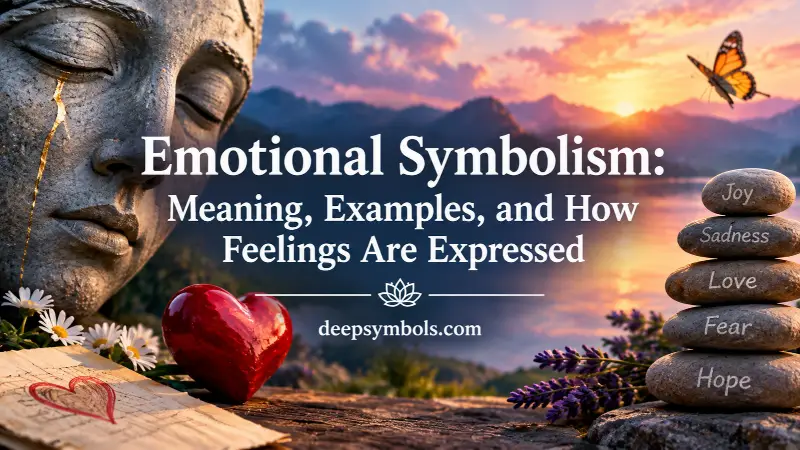
Emotional symbolism describes how objects, colors, animals, places, and images communicate feelings that may be difficult to express directly. A rainstorm can suggest grief, a warm light can evoke comfort, and an old photograph can represent love or longing. These symbols give visible form to emotions that otherwise exist mainly in memory, thought, and personal experience.
In modern American culture, emotional symbols appear everywhere, from films and poetry to tattoos, memorial jewelry, home decor, and social media. A broken heart communicates sadness or romantic loss, while a sunrise often suggests hope and a new beginning. These associations help people communicate complex feelings without explaining every detail.
Emotional symbols do not always have the same meaning for everyone. A particular song may remind one person of a happy childhood and another of a painful separation. A color associated with celebration in one cultural setting may be connected with mourning in another. Personal memories, cultural traditions, and the surrounding context all influence interpretation.
Understanding how emotional symbolism works can help readers appreciate literature, interpret visual art, recognize cultural differences, and understand their own emotional associations. The key is to look beyond an object’s appearance and consider the feelings, experiences, and ideas it represents in a particular situation.
Quick Answer
Emotional symbolism uses colors, objects, animals, places, and other familiar images to represent feelings such as love, grief, hope, fear, loneliness, and joy. Its meaning develops through cultural traditions, personal memories, artistic choices, and context, allowing people to communicate complex emotions without expressing them directly.
TL;DR
- Colors can communicate emotional associations that vary across cultures.
- Objects often represent memories, relationships, longing, or personal loss.
- Weather and landscapes can reflect emotional states in literature and art.
- Animal symbols communicate feelings through appearance, behavior, and cultural stories.
- Personal experiences can change the meaning of familiar symbols.
- Context matters more than memorizing a universal list of emotional meanings.
What Emotional Symbolism Means
A symbol is something recognizable that represents an idea beyond its literal form. Emotional symbolism applies this relationship to feelings and psychological experiences.
For example, a wilted flower is literally a plant that has lost its freshness. In a poem, it might also represent fading affection, disappointment, aging, or the end of a relationship. A locked door may serve a practical purpose within a story while also suggesting emotional distance, secrecy, or an opportunity that remains inaccessible.
The emotional meaning comes from the connection between the visible object and the feelings associated with it.
Writers and artists often use symbols when direct statements would be too simple or restrictive. Instead of telling an audience that a character feels isolated, a novelist might describe a person sitting alone in a vast, empty house. The setting allows readers to experience the loneliness through the character’s surroundings.
Symbols can also express several feelings at once. A wedding ring may represent love and commitment, but it can also evoke grief after a partner’s death or regret following a difficult separation.
This flexibility distinguishes emotional symbols from straightforward signs. A red traffic light has a specific practical instruction, while a red rose may communicate love, desire, admiration, or even grief, depending on the situation.
Emotional symbolism works because people connect concrete experiences with abstract feelings. The symbol gives an emotion a form that can be recognized, remembered, shared, or interpreted.
The Main Emotional Meanings Behind Symbols
Certain emotional themes recur in art, storytelling, and everyday communication because people repeatedly encounter similar experiences.
Love and affection are often represented by hearts, roses, paired objects, and gifts with personal significance. These symbols make affection visible, especially when expressing feelings directly is difficult.
Grief and loss may be communicated through wilted flowers, empty chairs, faded photographs, dark clothing, or objects belonging to someone who has died. Such images can express absence without describing the full experience of mourning.
Hope and renewal often appear through sunrise, spring flowers, opening doors, fresh leaves, and emerging light. These symbols suggest possibility, recovery, or movement beyond a difficult period.
Fear and uncertainty can be expressed through shadows, storms, darkened rooms, unfamiliar roads, and enclosed spaces. In fiction, these images can make an emotional threat feel present before the character understands it.
Freedom and independence may be represented by birds in flight, open landscapes, unlocked gates, or a road extending toward the horizon. Their meaning depends on whether the surrounding story presents openness as desirable, frightening, or uncertain.
Belonging and security often appear through a family home, a shared meal, a familiar song, or the warmth of a lighted window. These symbols connect feelings with places and routines that offer familiarity.
None of these associations is universal. The same image can represent different feelings depending on the story, culture, and personal experience involved.
Color Symbolism and Emotional Meaning
Color is one of the most immediate ways artists communicate emotion. Viewers often notice a color palette before they understand the details of an image, making color particularly useful in painting, photography, film, design, and advertising.
However, colors do not have fixed emotional definitions. Their meanings depend on cultural expectations, artistic choices, surrounding colors, and the experience of the viewer.
Red can suggest love, passion, anger, danger, or urgency. A red rose may communicate romance, while a red warning light communicates immediate caution.
Blue may evoke calmness, sadness, distance, trust, or reflection. A clear blue sky can feel peaceful, while a blue-gray landscape may create a sense of loneliness.
Yellow often suggests sunlight, warmth, optimism, or energy. In other settings, it can communicate caution, anxiety, or artificial brightness.
Green commonly evokes nature, growth, renewal, and balance. It can also suggest envy or immaturity in particular expressions and stories.
Black may represent mourning, authority, secrecy, mystery, or elegance. Its meaning changes substantially between a funeral, a formal outfit, and a horror scene.
White can suggest clarity, simplicity, peace, or new beginnings. In some cultural and ceremonial settings, it is also connected with mourning.
These examples show how emotional meaning develops through context rather than color alone.
| Color | Common Emotional Associations | Context Can Change the Meaning |
|---|---|---|
| Red | Love, passion, anger, danger | A rose differs from a warning signal |
| Blue | Calm, sadness, trust, distance | A clear sky differs from a gloomy landscape |
| Yellow | Joy, warmth, caution, anxiety | Sunshine differs from warning signage |
| Green | Growth, renewal, envy, balance | New leaves differ from a character described as green with envy |
| Black | Grief, mystery, elegance, authority | Mourning clothes differ from formal fashion |
| White | Peace, clarity, mourning, fresh starts | Wedding traditions differ across cultures |
Objects That Represent Love, Grief, and Memory
Ordinary objects can acquire emotional meaning through their connection with people and experiences.
An old photograph may represent family history, a former relationship, or a moment that cannot be repeated. Its physical appearance matters less than the memory attached to it.
A wedding ring can symbolize commitment, shared history, and loyalty. After a separation or bereavement, the same ring may also represent absence, grief, or the complexity of maintaining a connection with the past.
An empty chair can become a powerful symbol of loss because it suggests a place that once belonged to someone. In a family story, the chair might remain at the dinner table after a death, communicating absence without requiring a direct explanation.
A broken mirror may symbolize damaged self-image, a disrupted identity, or a difficult recognition. A key may suggest trust, access, freedom, or the possibility of opening a part of life that previously remained closed.
These meanings often develop through the way an object is used or remembered. A childhood toy may have little emotional significance to a stranger but represent safety and affection to the person who received it.
In modern American culture, keepsakes, memorial jewelry, handwritten letters, and inherited belongings frequently function this way. Their emotional importance comes from the relationships and experiences they preserve.
The most meaningful object symbols are often personal rather than universal. Their interpretation becomes clearer when the viewer knows whose object it is, what happened to it, and why it remains important.
Nature and Weather as Expressions of Emotion
Nature has long provided writers and artists with ways to express feelings indirectly. Weather, landscapes, plants, and seasonal changes can establish an emotional atmosphere or reflect a character’s inner experience.
Rain often appears in stories involving sadness, reflection, isolation, or emotional release. A character walking through heavy rain may feel overwhelmed, while gentle rain on a familiar roof may create a mood of comfort.
Storms can represent conflict, anxiety, anger, or a situation approaching a turning point. Their intensity gives writers a way to express emotional pressure through the environment.
Spring commonly suggests renewal because new growth follows winter. Blossoming trees and fresh leaves can communicate recovery, hope, or the beginning of a relationship.
Autumn can evoke maturity, change, nostalgia, or the approach of an ending. Falling leaves provide a visible image of transition, but autumn scenes can also suggest abundance and celebration.
Winter may represent loneliness, stillness, hardship, or emotional distance. In other stories, snow creates a peaceful atmosphere or offers a clean landscape associated with a fresh beginning.
These interpretations are not properties of the weather itself. Rain does not necessarily mean sadness, and sunshine does not guarantee happiness. Artists use nature symbolically because viewers can connect changes in the environment with familiar emotional experiences.
Animal Symbols and Their Emotional Associations
Animals often function as emotional symbols because their appearance, behavior, and cultural histories make them recognizable.
A dove can represent peace, affection, reconciliation, or hope. In Christian imagery, it can also carry associations with the Holy Spirit. Its meaning depends on the setting in which it appears.
A wolf may communicate loyalty, independence, danger, or the need for belonging. Its behavior in a story and the culture behind the image influence whether it appears protective or threatening.
A butterfly frequently represents transformation because of its life cycle. In personal artwork, it can symbolize recovery, changing identity, or a new stage of life.
An owl may suggest wisdom, observation, mystery, or death. Its association with wisdom is particularly familiar in Western imagery, while other traditions give owls different roles.
A crow can symbolize intelligence, adaptability, or the unknown. Popular horror imagery emphasizes its darker associations, while wildlife education may highlight its problem-solving abilities and social behavior.
Animals do not automatically possess the emotional qualities humans assign to them. A wolf is not inherently loyal in the human moral sense, and an owl does not necessarily possess supernatural knowledge. These meanings come from storytelling, cultural interpretation, and observation.
The same animal may therefore become a symbol of comfort to one person and danger to another.
Emotional Symbolism in Literature
Literature often uses symbols to reveal feelings that characters cannot or will not express openly.
A character may keep an old letter hidden in a drawer. On the surface, the letter is an object from the past. Within the story, it may represent unresolved affection, guilt, nostalgia, or the inability to accept a relationship’s end.
A recurring storm may parallel increasing conflict between characters. A locked room may represent a secret, a suppressed memory, or a part of the character’s identity that they are unwilling to confront.
In F. Scott Fitzgerald’s The Great Gatsby, the green light across the water is connected with Gatsby’s longing for Daisy and the future he imagines reaching. The light becomes more than a physical object because the character invests it with desire and expectation.
In Nathaniel Hawthorne’s The Scarlet Letter, the letter “A” carries meanings shaped by public judgment, guilt, identity, and the changing perceptions of the people around it. Its significance evolves rather than remaining fixed.
These examples demonstrate two important features of literary symbolism. First, a symbol should be interpreted through the events and characters surrounding it. Second, its meaning can change as the story develops.
A symbol is not simply an object with a dictionary definition. Its emotional significance emerges through the way it is introduced, repeated, altered, and understood by the characters and readers.
Emotional Symbolism in Paintings, Photography, and Film
Visual art can communicate emotion without relying on dialogue or written explanation.
A painting of a small figure standing beneath an enormous sky might suggest loneliness, vulnerability, or freedom. The same figure in a bright, open landscape could instead represent possibility and independence.
Composition also matters. A character positioned at the edge of a photograph may appear distant or disconnected, while two figures placed close together can suggest intimacy or cooperation. Shadows, facial expressions, posture, lighting, and the distance between objects all influence interpretation.
Film uses these techniques alongside movement, sound, and editing. A familiar melody may evoke warmth when first introduced, then become associated with grief when it returns after a character’s death. A room that once felt welcoming may appear threatening after the audience learns a secret about what happened there.
Artists associated with the Symbolist movement of the late nineteenth century deliberately used imagery, color, and composition to evoke emotions and ideas beyond literal representation. Their work helped establish a broader artistic approach in which a painting could communicate an inner experience rather than merely depict an observable scene.
In modern photography and film, the same principle remains useful. An empty street can represent isolation, a blurred figure can suggest uncertainty, and a warm window in a dark building can evoke longing for home.
The emotional effect is created by the relationship between visual details and the situation being portrayed.
Personal Memories and Psychological Meaning
Emotional symbols often become meaningful through personal associations.
A particular song may remind someone of a parent, a childhood home, or a relationship that ended years earlier. The song itself does not contain that person’s memory, but hearing it can bring the associated feelings back into awareness.
The same process can occur with places, scents, photographs, clothing, and familiar objects. An ordinary kitchen may represent safety to someone who grew up in a loving household, while another person may associate a similar room with conflict.
Emotions also influence the meaning people assign to events. When someone experiences a threat, an otherwise neutral object may become connected with fear. When an object is associated with support or affection, it may later provide comfort.
This does not mean that every emotional reaction has a hidden symbolic meaning or that objects reveal a person’s psychology with certainty. The connection depends on the individual’s experiences and circumstances.
Personal symbols can nevertheless provide a useful way to explore feelings that are difficult to articulate. A person might write about a locked door to express a need for privacy or use a photograph to reflect on a relationship that has changed.
The symbol serves as a starting point for expression. It does not diagnose an emotion or explain every aspect of the experience.
Emotional Symbolism in American Culture
In the United States, emotional symbols appear in holidays, public ceremonies, family traditions, advertising, and everyday communication.
Hearts and roses are familiar expressions of affection around Valentine’s Day. Black clothing, flowers, photographs, and memorial objects can become part of practices surrounding mourning. Graduation ceremonies often feature caps, diplomas, and other objects that represent achievement and transition.
The American flag can carry feelings of belonging, pride, sacrifice, disagreement, or historical memory, depending on the viewer’s experiences and political context. Its emotional meaning extends beyond its physical appearance because people associate it with national history and personal identity.
Popular entertainment also shapes emotional associations. A particular song can become linked with a film scene, a fictional couple, or a major event. Over time, the song may evoke the same feelings even when heard outside its original context.
Social media has expanded these forms of expression. Emojis, reaction images, colors, and familiar objects allow people to communicate affection, frustration, nostalgia, or grief quickly. However, digital shorthand can be ambiguous, and the same symbol may be interpreted differently by different communities.
These examples show how emotional symbolism becomes part of shared culture. Some meanings are broadly recognized, while others remain specific to a family, generation, community, or individual.
When Emotional Symbols Have More Than One Meaning
A symbol does not always communicate the emotion an audience expects.
A red rose often represents romantic love, but it may also appear at a funeral or memorial. In that setting, it can communicate grief, respect, or enduring affection rather than courtship.
A storm can represent anger or conflict, but it can also provide relief after a drought. Darkness may evoke fear in a horror film while creating a sense of peaceful privacy in a bedroom.
Even a familiar object such as a key can have contradictory meanings. It may represent freedom when it opens a door, or exclusion when someone else controls access.
These variations are not mistakes. They demonstrate that symbolism depends on the relationship between an object, its context, and the people interpreting it.
The same principle applies across cultures. Color meanings, funeral practices, animals, and ceremonial objects cannot always be translated directly from one cultural setting to another.
When interpreting a symbol, ask what happens in the surrounding scene, how the object is used, what the characters or participants know about it, and whether its meaning changes over time.
That approach is more reliable than assuming that every symbol has a single fixed emotional definition.
Common Misunderstandings About Emotional Symbolism
One common misconception is that every color, animal, or object has a universal emotional meaning. In reality, symbolism depends on cultural conventions, personal experience, and the context in which the object appears.
Another mistake is assuming that a symbol reveals exactly what an artist or writer intended. Interpretation should be grounded in the work itself, including its imagery, structure, historical setting, and recurring themes. A viewer’s personal reaction may be meaningful without being the only defensible interpretation.
It is also misleading to treat symbolism as a psychological diagnostic tool. A person who prefers dark colors is not necessarily depressed, and someone who keeps old photographs is not automatically unable to move on. Objects and preferences do not provide enough evidence to draw such conclusions.
A further misunderstanding is confusing symbolism with metaphor. The two can overlap, but a metaphor directly compares one thing with another, while a symbol can recur throughout a work or culture and accumulate several layers of meaning.
Finally, emotional symbols do not always communicate positive feelings. Love may coexist with grief, home may evoke both safety and conflict, and a symbol of freedom can also represent isolation.
These distinctions make interpretation more accurate and respectful. A symbol is most informative when understood within its particular situation rather than forced into a predetermined category.
Emotional Symbolism at a Glance
| Symbol | Common Emotional Association | Context Can Change the Meaning |
|---|---|---|
| Rose | Love, affection, admiration | Can also express mourning or remembrance |
| Empty chair | Absence, grief, loneliness | May represent anticipation in another setting |
| Sunrise | Hope, renewal, possibility | Can also mark an unwanted new beginning |
| Storm | Conflict, anxiety, emotional turmoil | May represent relief after a drought |
| Butterfly | Change, transformation, freedom | May evoke fragility or a short-lived experience |
| Old photograph | Memory, nostalgia, attachment | Can also suggest regret or unresolved loss |
How Emotional Symbolism Has Evolved
Emotional symbols have developed through storytelling, religious traditions, art, public ceremonies, and personal experience.
In older literary and artistic traditions, symbols frequently drew on shared cultural stories and religious imagery. A dove, a particular flower, or an item of clothing could communicate meanings familiar to audiences who understood the relevant tradition.
During the nineteenth century, the Symbolist movement in European art emphasized the expression of ideas and inner experiences through imagery, color, and composition. Rather than focusing solely on realistic representation, Symbolist artists often sought to evoke emotional or spiritual responses.
Modern film, photography, advertising, and graphic design extended these approaches into new forms of communication. Lighting, color palettes, recurring objects, and musical motifs could establish a mood or reveal a character’s inner life.
Digital communication has made emotional symbolism more immediate, but it has also introduced ambiguity. Emojis, reaction images, and familiar visual references can communicate feelings quickly, yet their meanings vary among communities and individuals.
Today, emotional symbols exist at several levels at once. Some belong to established cultural traditions, others develop through popular media, and still others are meaningful only to a particular person.
Their continuing value comes from this ability to make feelings visible without reducing every experience to a direct statement.
FAQs
What is emotional symbolism in simple terms?
Emotional symbolism is the use of familiar objects, colors, images, or places to represent feelings. For example, an empty chair may represent loss, while a sunrise can suggest hope or a fresh beginning.
What colors symbolize different emotions?
Red often suggests love or anger, blue can suggest calmness or sadness, and green may represent growth or envy. These are common associations rather than universal rules, and color meaning depends on culture and context.
What objects commonly symbolize love and grief?
Roses, rings, letters, and paired objects often represent love, while empty chairs, memorial photographs, and inherited belongings may represent grief or remembrance. Their personal significance depends on the relationships and experiences attached to them.
Why do writers use emotional symbolism?
Writers use symbols to communicate feelings indirectly, add complexity to characters, and develop themes without explaining everything explicitly. A recurring object can gradually reveal a character’s fears, hopes, memories, or changing relationships.
Can the same symbol represent different emotions?
Yes. A storm might represent anger in one story and relief in another, while a house might suggest security to one character and confinement to another. Context and personal experience determine which interpretation makes sense.
Is emotional symbolism the same as emotional psychology?
No. Emotional symbolism concerns how images and objects represent feelings, while emotional psychology studies how emotions arise, function, and influence behavior. Symbolic interpretation can support personal reflection, but it cannot diagnose someone’s emotional state by itself.
Conclusion
Emotional symbolism gives visible form to feelings that can be difficult to express in words. A photograph may preserve a relationship, a storm may suggest inner conflict, and a sunrise may represent hope or a fresh beginning. The Metropolitan Museum of Art’s explanation of Symbolism offers useful artistic context for understanding how visual elements can communicate ideas and evoke emotional experiences.
In modern American culture, these symbols appear in literature, artwork, memorials, family traditions, fashion, and digital communication. Their meanings are shaped by cultural history and personal experience, which explains why the same image may comfort one person while unsettling another.
Ultimately, emotional symbolism is most meaningful when an image connects an emotion with a story, memory, or experience. Rather than searching for one universal definition, consider what the symbol expresses, why it matters in that setting, and what gives it emotional weight. An ordinary object can become a powerful reminder of love, grief, hope, or change—not because it means the same thing to everyone, but because it gives human experience a form that others can recognize and understand.


