
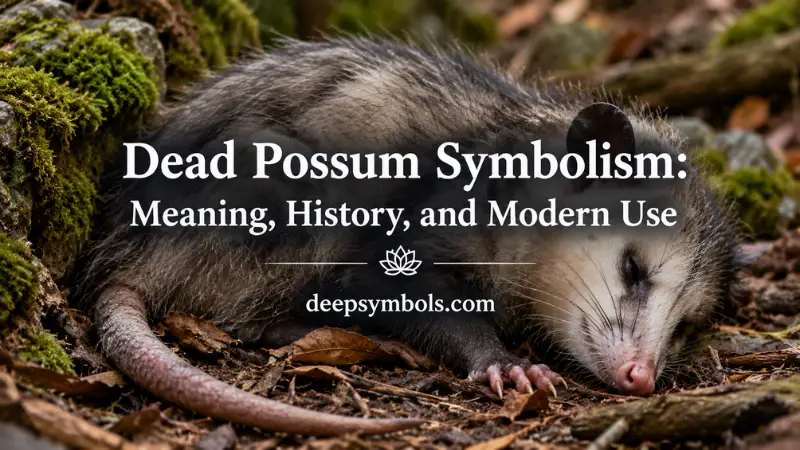
Dead possum symbolism often brings up questions about endings, survival, vulnerability, and the meaning people attach to unexpected encounters with wildlife. The possum, more accurately called the Virginia opossum in the United States, is known for its ability to adapt to different environments and its unusual defense of appearing dead when threatened. Finding one dead can feel unsettling, especially when the animal’s famous survival behavior makes the encounter seem connected to ideas about danger, avoidance, or transformation.
In modern American culture, a dead possum may become a personal symbol of a closed chapter, a difficult transition, or the need to stop avoiding an uncomfortable situation. Some people interpret the encounter spiritually, while others see it as a reminder of life’s fragility or the impact human activity has on wildlife. There is no universally established belief that finding a dead possum predicts bad luck or announces a coming change.
The possum also has an interesting place in American folklore and Southern foodways, where its reputation for resourcefulness and survival developed alongside practical experiences of living with the animal. Stories from different Indigenous traditions portray opossums in varying roles, including trickster figures, but these meanings should not be combined into one universal cultural interpretation.
Understanding the dead possum as a symbol requires separating cultural stories from personal reflection and the animal’s actual death. Its meaning depends on the circumstances, the traditions someone draws upon, and the thoughts the encounter brings to mind.
Quick Answer
Dead possum symbolism can represent endings, vulnerability, survival, avoidance, or the need to reconsider an old approach to a difficult situation. In modern American interpretation, the opossum’s famous defensive behavior inspires associations with retreat and resourcefulness, but finding a dead possum has no universally established spiritual meaning and does not predict future events.
TL;DR
- A dead possum may symbolize endings, vulnerability, or personal transition.
- The phrase “playing possum” inspires associations with avoidance and survival.
- American folklore connects the animal with resourcefulness and self-sufficiency.
- Indigenous stories portray opossums differently across communities and traditions.
- Finding a dead possum does not automatically mean bad luck.
- The animal’s actual death should be distinguished from its defensive behavior.
What Animal Does “Possum” Refer to in American Symbolism?
In the United States, the animal commonly called a possum is the Virginia opossum (Didelphis virginiana). It is a marsupial native to North America and is recognizable by its pointed snout, pale face, dark eyes, grayish fur, and long, mostly hairless tail.
Although people often associate opossums with garbage cans, roadsides, and nighttime activity, they also live in wooded areas, fields, and other habitats. Their varied diet includes insects, fruits, small animals, carrion, and food scraps.
These characteristics provide several natural starting points for symbolic interpretation. The animal’s ability to live in different environments can suggest adaptability, while its defensive behavior has inspired associations with retreat, deception, and survival.
It is also useful to distinguish North American opossums from Australian possums. They are different groups of marsupials with distinct evolutionary histories and cultural associations. This article focuses primarily on the Virginia opossum and its place in American culture.
The animal’s unfamiliar appearance has sometimes contributed to negative impressions, but its ecological role is more varied than its reputation suggests. Opossums consume a range of food sources and help remove carrion from the environment.
A dead opossum may therefore carry different meanings depending on whether someone views it as a symbol, a familiar backyard animal, or a reminder of the relationship between wildlife and human environments.
The Main Meanings of Dead Possum Symbolism
Several contemporary interpretations can help explain why a dead possum attracts symbolic attention. These are personal and cultural readings, not universal historical definitions.
Endings and closure are common associations because death makes the idea of finality immediate. Someone may connect the animal with the end of a relationship, the closing of a difficult chapter, or the realization that an old situation cannot continue as before.
Vulnerability is another interpretation. Opossums are capable survivors, but they remain exposed to vehicles, predators, disease, and environmental hazards. Their death can remind an observer that adaptability does not eliminate every risk.
Avoidance and withdrawal arise from the animal’s defensive behavior. The familiar phrase “playing possum” describes an animal that appears dead when threatened. As a metaphor, the behavior can prompt reflection on situations in which a person withdraws, delays a response, or hopes a problem will pass without confrontation.
Survival and resourcefulness provide a contrasting meaning. Opossums use a range of behaviors and food sources to survive. Their reputation can suggest the value of adapting to difficult circumstances rather than relying on one strategy.
Finally, transition and reflection can emerge when the encounter reminds someone of a personal loss or an upcoming decision. The image may encourage reflection on what needs to end, what deserves protection, and what might need to change.
No single interpretation applies to everyone. The encounter’s significance depends on personal beliefs and circumstances rather than a fixed symbolic code.
Why “Playing Possum” Matters to Its Symbolism
The opossum’s best-known defense has given it an unusual place in American language.
When severely threatened, an opossum may enter an involuntary state called thanatosis. Its body becomes limp, its breathing and heart rate slow, and it may release an unpleasant odor. The behavior can discourage a predator that prefers live prey or becomes less interested in an animal that appears dead.
Despite the expression “playing possum,” this reaction is not simply a calculated performance. It is an automatic defensive response that the animal cannot necessarily control at will.
This distinction is important when interpreting a dead possum. An animal temporarily displaying this behavior is not the same as an animal that has died.
Symbolically, however, the behavior creates several recognizable associations.
It can suggest strategic retreat: sometimes surviving a difficult situation means withdrawing instead of fighting. It can also suggest concealment, because appearing lifeless changes how a threat responds. In a personal context, it may prompt reflection on the difference between wisely avoiding danger and avoiding a problem that eventually requires attention.
A dead possum adds another layer because the defensive strategy is no longer relevant to an animal that has actually died. The encounter may make someone consider the limits of their usual coping methods or recognize that a situation has reached a genuine ending.
These are metaphors drawn from animal behavior, not supernatural messages. The opossum’s defensive response can inspire reflection without implying that the animal has consciously chosen death or that its death predicts an event in someone’s life.
Endings, Closure, and Letting Go
The sight of a dead animal can make the idea of an ending difficult to ignore. In personal symbolism, a dead possum may represent a situation that has run its course or a familiar pattern that can no longer continue.
For example, someone might associate the encounter with leaving a job that has become unsustainable, ending an unhealthy relationship, or abandoning a plan that no longer fits their circumstances.
The symbolism does not mean the encounter caused or predicted the ending. Rather, the animal becomes an image through which the observer reflects on an experience already unfolding.
The possum’s association with avoidance adds a specific dimension. Someone who has been postponing a difficult decision might use the encounter as a reminder to examine what they have been putting off. Another person may interpret it as a prompt to stop investing energy in something that cannot be restored.
However, closure does not always require immediate action. Sometimes a loss needs to be acknowledged before a person can understand what comes next.
The dead possum can therefore represent finality without requiring a negative conclusion. An ending may involve grief, relief, uncertainty, or a combination of feelings.
Its meaning is most useful when it helps a person recognize what has changed rather than convincing them that a specific future event is inevitable.
Vulnerability, Survival, and the Limits of Control
Opossums are often viewed as resilient animals because they can live in diverse habitats, eat a wide variety of foods, and use several strategies to avoid predators.
Their vulnerability is equally important. These adaptations do not protect them from every danger, particularly in environments shaped by roads, buildings, vehicles, and other human activities.
Finding a dead possum can therefore challenge the assumption that resourcefulness always guarantees survival.
As a metaphor, the encounter may encourage someone to recognize the limits of personal control. Preparation, intelligence, and adaptability can reduce risks, but no strategy can remove every uncertainty.
This interpretation may be particularly relevant during periods when someone has been trying to manage every detail of a difficult situation. The possum’s death can become a personal reminder that strength includes acknowledging limitations and accepting help when necessary.
There is also a difference between vulnerability and weakness. An animal can have effective defenses and still remain vulnerable to circumstances it cannot control. Similarly, people can be capable and self-reliant while needing support during demanding periods.
The symbolism offers a grounded message: resilience matters, but it does not require invulnerability.
Possum Symbolism in American Folklore and Southern Culture
The opossum has a distinctive place in American folk traditions, particularly in the South.
Historically, opossums were hunted and eaten by Indigenous peoples and later by European settlers and African American communities. The animal became part of regional foodways, songs, humorous stories, and practices associated with making practical use of available resources.
For some communities, possum was an important source of food during periods of economic hardship. Historical accounts of Southern life connect its hunting and preparation with resourcefulness and self-sufficiency, including experiences of African Americans living under slavery and afterward.
This history adds an important dimension to modern symbolic interpretation. The opossum was not simply an eerie animal appearing around houses and roads. It could represent an available resource that helped people sustain themselves when other options were limited.
The animal also became a figure of humor and regional identity. American expressions, folk songs, and stories helped establish the possum as a recognizable character in popular culture.
These meanings should not be romanticized or applied identically to every Southern community. The significance of the animal depended on economic conditions, cultural background, and local traditions.
For modern readers, a dead possum may therefore prompt thoughts about survival, hardship, or the end of a period marked by self-reliance. Those interpretations arise from a broader cultural context, rather than from a universal belief about dead animals.
Opossums in Indigenous Stories and Trickster Traditions
Opossums appear in some Indigenous stories of North America and Mesoamerica, but the narratives differ by community, region, and cultural setting.
In some collected Southeastern North American stories, the opossum appears as a boastful, foolish, or comic character. Certain narratives explain its defensive behavior through embarrassment or an unsuccessful attempt to outsmart another animal.
In some traditions among Indigenous peoples of Mexico, the animal known as the tlacuache appears in stories involving cleverness, resourcefulness, and the acquisition of fire. In versions of a widely known fire-bringer narrative, the animal obtains fire from powerful beings and carries it to people, with the tale explaining the appearance of its bare tail.
These stories differ in purpose and detail. They should not be treated as one unified Indigenous mythology, nor should every narrative about a trickster animal be assigned the same lesson.
The opossum’s reputation for appearing dead can make it a natural character in stories about deception, survival, and the consequences of trying to escape danger. Yet a cultural story is more than a symbolic dictionary entry: it belongs to the people who tell it and the context in which it has meaning.
For a modern reader, these narratives can offer insight into how people interpret an animal’s behavior. They do not establish that finding a dead opossum has the same significance as the animal’s role in a traditional story.
Dead Possum Symbolism in Modern American Life
In contemporary American culture, the opossum is often encountered near homes, roads, gardens, and trash bins. It can appear in wildlife photographs, humorous internet posts, cartoons, and discussions about animals that live alongside people.
This familiarity shapes its symbolic meaning. Unlike animals associated primarily with wilderness or distant landscapes, the opossum is often part of ordinary suburban life.
A dead possum on a roadside may bring attention to the dangers wildlife faces around transportation infrastructure. In a yard, it may prompt reflection on how people share space with animals that are often active after dark.
Some people interpret such encounters spiritually, associating them with closure, self-protection, or the need to reassess a situation. Others feel sadness for the animal without attaching a personal message to its death.
Popular culture also gives the opossum a humorous reputation because of its unusual appearance and defensive behavior. That humor can coexist with genuine concern for the animal’s welfare.
There is no one widely established American belief about what finding a dead possum means. Its significance generally comes from the observer’s experience, cultural background, and interpretation of the circumstances.
The most balanced approach allows personal reflection while recognizing that the animal’s death may have an ordinary biological or environmental cause.
What Does a Dead Possum Mean in a Dream?
Dreams involving dead animals do not have scientifically established universal meanings. A dead possum in a dream may reflect personal memories, recent experiences, emotions, or associations with the animal rather than a message about the future.
For someone familiar with the phrase “playing possum,” the dream might prompt reflection on avoidance. Perhaps the dreamer has been delaying a difficult conversation, withdrawing from a conflict, or hoping an uncomfortable situation will resolve itself.
For another person, the image may represent closure or vulnerability. A dead animal can become a symbol of a relationship, habit, or personal expectation that has changed.
The emotional atmosphere of the dream matters. Fear may point to feelings of uncertainty, while sadness may reflect a sense of loss. Curiosity may simply show that the dreamer is processing an unusual image.
These are possible personal interpretations, not fixed rules. A dead possum in a dream does not prove that someone is being dishonest, that a relationship will end, or that misfortune is coming.
Rather than searching for one definitive answer, it may be more helpful to ask what the animal means to the dreamer and whether its appearance connects with an experience already taking place.
Does the Location of a Dead Possum Change Its Meaning?
The location of a dead possum may shape the emotional response to the encounter, but it does not establish a universal spiritual interpretation.
Near a home: The encounter might prompt thoughts about safety, household responsibilities, or the relationship between domestic life and the natural world. These are modern personal associations rather than established rules about omens.
On a road: A roadside death may encourage reflection on vulnerability and the impact of human activity on wildlife. Vehicle collisions are a plausible cause, although the location alone does not confirm what happened.
In a garden: The sight may draw attention to the wildlife that shares a residential environment. Someone who regularly sees opossums in the yard may experience the death as a loss of a familiar visitor.
Near a doorway: Because doorways mark a boundary between inside and outside, the encounter may inspire a metaphor about change, transitions, or personal boundaries. This interpretation comes from the setting’s symbolism rather than a documented universal tradition.
The location may help someone understand why the experience felt significant, but it cannot prove that the animal is delivering a warning about the property or its occupants.
Keeping the distinction between personal meaning and physical circumstances prevents an ordinary wildlife encounter from becoming a source of unnecessary fear.
Positive and Negative Interpretations
A dead possum can inspire both constructive and unsettling interpretations.
Its association with survival may lead someone to reflect on resilience, adaptability, and the importance of using available resources. Its defensive behavior can suggest the value of stepping away from danger and recognizing when direct confrontation is unnecessary.
The negative side of the symbolism may involve avoidance, deception, fear, or the feeling that a familiar strategy has stopped working. Someone might interpret the encounter as a reminder to face a problem they have been postponing rather than continuing to withdraw.
Neither interpretation is automatically correct. A dead possum does not prove that someone has failed, acted dishonestly, or reached a harmful turning point.
Its symbolic value lies in the questions it invites. Is withdrawal protecting you or preventing progress? Are your usual coping methods still useful? Is there something you need to acknowledge before moving forward?
These questions can be helpful because they connect the encounter with real decisions rather than unsupported predictions.
A balanced interpretation recognizes that retreat can be wise in dangerous circumstances, while avoidance can become limiting when it prevents someone from dealing with an important issue.
What to Do If You Find a Dead Possum
Symbolic interpretation should not replace practical care when a real opossum is found dead.
Avoid touching the animal with bare hands, and keep children and pets away. Contact local animal control or a wildlife rehabilitator for advice about safe handling and disposal.
If the dead animal is a female, do not attempt to inspect its pouch yourself. Opossums carry their young in a pouch, and a wildlife professional can advise what to do if dependent young may be present.
If several dead animals appear in the same area, report the situation to the appropriate local authority because an environmental hazard or disease may need attention.
A roadside death may simply reflect a vehicle collision, while other causes can include predation, illness, and environmental conditions. The cause cannot always be determined from appearance alone.
These practical steps do not prevent the encounter from holding personal meaning. They recognize that the opossum was a living animal whose death deserves a thoughtful and appropriate response.
Reflection and responsible action can coexist: someone may interpret the experience as a reminder about change while also respecting wildlife and seeking help when necessary.
Common Misunderstandings About Dead Possum Symbolism
One common misconception is that finding a dead possum automatically means bad luck. There is no reliable evidence for that claim, and beliefs about animal omens vary among individuals and cultural traditions.
Another mistake is treating “playing possum” as though the animal consciously chooses to die. The defensive state is an involuntary response to extreme stress, not proof that the animal can control death or deliberately send a message.
It is also misleading to assume that every Indigenous tradition assigns the opossum one meaning. Some stories portray the animal as a trickster or comic figure, while others place it in different roles. These traditions should be understood within their particular cultural settings.
A further misunderstanding is treating modern symbolic interpretations as established ancient beliefs. Connections between a dead possum and endings, self-protection, or personal transformation may be useful metaphors, but they are not universal historical definitions.
Finally, the word possum has different meanings in different regions. In everyday American usage, it typically refers to the Virginia opossum; Australian possums are different animals with their own ecology and cultural contexts.
Recognizing these distinctions makes the symbolism more accurate and keeps personal meaning separate from biological fact.
Dead Possum Symbolism at a Glance
| Context | Possible Meaning | Important Distinction |
|---|---|---|
| Personal reflection | Endings, closure, or change | A contemporary interpretation, not a universal omen |
| “Playing possum” | Retreat, concealment, and survival | An involuntary defensive response in a threatened animal |
| American Southern culture | Resourcefulness and self-sufficiency | Connected with specific histories and foodways |
| Indigenous stories | Varies by community and narrative | There is no single Indigenous interpretation |
| Dreams | Avoidance, vulnerability, or changing habits | Personal associations matter more than fixed dream rules |
| Roadside encounter | Wildlife vulnerability and human impact | The location does not establish the cause of death |
How Dead Possum Symbolism Has Evolved
The modern interpretation of a dead possum draws from several overlapping influences, including the animal’s unusual defensive behavior, regional folklore, American cultural history, and contemporary personal symbolism.
Historically, opossums were part of the daily lives of Indigenous peoples and later settlers across parts of North America. They provided food and other useful materials, and their behavior became the subject of stories and humorous expressions.
American Southern traditions helped establish the possum as a figure associated with resourcefulness, survival, and regional identity. At the same time, trickster narratives from different Indigenous communities portrayed the animal in distinct ways, depending on the story and cultural context.
In modern culture, the phrase “playing possum” often provides the starting point for symbolic interpretations involving avoidance and self-protection. A dead possum may extend that association into reflections about endings, the limits of familiar strategies, or the need to change direction.
These modern meanings do not replace historical traditions, and they should not be presented as universal ancestral beliefs.
The symbol remains flexible because people encounter opossums in ordinary environments and recognize the unusual behavior that distinguishes them from other mammals. A dead possum can prompt reflection on survival or vulnerability without requiring a supernatural explanation.
FAQs
What does a dead possum symbolize spiritually?
A dead possum may represent endings, vulnerability, self-protection, or the need to reconsider an old approach in contemporary personal symbolism. There is no universally accepted spiritual meaning, so its significance depends on an individual’s beliefs and experiences.
Is finding a dead possum a sign of bad luck?
No reliable evidence establishes that a dead possum predicts bad luck, death, or future misfortune. The encounter may feel unsettling, but an animal’s death does not prove that another negative event will occur.
What does a dead possum mean in a dream?
A dead possum in a dream may prompt reflection on avoidance, closure, vulnerability, or changing habits. Dream meanings are personal, and the image does not reliably predict a future event.
Why is the possum associated with survival?
The Virginia opossum can adapt to different habitats and food sources, and its involuntary defensive response may help it escape some predator encounters. These behaviors contribute to modern associations with resourcefulness and self-protection.
What does finding a dead possum near your house mean?
The encounter may prompt thoughts about household safety, boundaries, change, or the relationship between people and wildlife. There is no established universal belief that a dead possum near a home predicts an event affecting the household.
What should I do if I find a dead possum?
Avoid direct contact, keep children and pets away, and contact local animal control or a wildlife rehabilitator for advice. If it is a female opossum, a professional can help determine whether dependent young may need assistance.
Conclusion
Dead possum symbolism brings together endings, vulnerability, survival, and the tension between avoidance and self-protection. The opossum’s famous death-feigning response has inspired the expression “playing possum,” although the National Park Service explains that this behavior is an involuntary reaction to extreme stress, not a consciously planned act. This distinction adds an important layer to the animal’s symbolic connection with vulnerability and survival.
In modern American culture, finding a dead possum does not have one fixed spiritual meaning. It may prompt reflection on a closed chapter, a difficult decision, or familiar coping methods that no longer serve a purpose. However, the encounter does not reliably predict bad luck or future events.
Ultimately, dead possum symbolism can serve as a reminder that protecting ourselves sometimes means withdrawing, while moving forward may require facing what we have avoided. Its most meaningful lesson is not that retreat is always right or wrong, but that survival and growth require understanding when to seek safety, when to adapt, and when to take the next step.


