
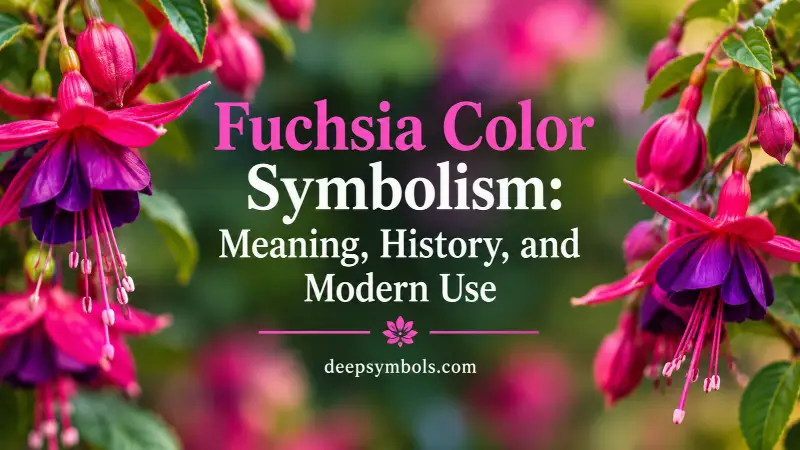
Fuchsia color symbolism is commonly associated with confidence, creativity, individuality, excitement, and expressive femininity, but the shade can communicate much more than those simple labels. Because fuchsia sits between vivid pink, red, purple, and magenta, its symbolism often combines the emotional warmth of red and pink with the imagination and sophistication associated with purple.
Unlike colors with ancient religious systems or long-established heraldic meanings, fuchsia is a relatively modern color name. Its story is closely connected to a flowering plant, developments in nineteenth-century chemistry, modern fashion, and changing ideas about personal expression. Today, Americans encounter fuchsia in clothing, cosmetics, graphic design, flowers, home décor, celebrations, branding, and digital media.
Quick Answer
Fuchsia commonly symbolizes confidence, creativity, individuality, and bold self-expression in modern American culture, especially in fashion, beauty, design, and personal style. Historically, its name comes from the fuchsia flower and the botanical name honoring German physician and botanist Leonhart Fuchs, while its modern color associations developed alongside vivid synthetic dyes and changing ideas about pink and purple.
TL;DR
- Fuchsia suggests confidence, creativity, enthusiasm, and individuality.
- Its name comes from the fuchsia flower and Leonhart Fuchs.
- The shade sits visually between strong pink, red, purple, and magenta.
- American culture often uses fuchsia for expressive personal style.
- It can feel playful, glamorous, rebellious, romantic, or artistic.
- Modern meanings depend strongly on context and color combinations.
What Fuchsia Looks Like and Why It Feels So Noticeable
Fuchsia is a highly saturated reddish-purple color that occupies an unusual position between pink and purple. It can lean warmer and more pink in one setting, or appear closer to magenta and purple in another. That variation is one reason people can describe the same shade with different color names.
The visual intensity matters symbolically. Pale pink generally recedes into a softer emotional space, while fuchsia demands attention. It has enough red to feel energetic and enough purple to appear unconventional. In clothing, a fuchsia jacket or dress can therefore communicate much more assertiveness than a muted rose or dusty pink.
The natural reference is the fuchsia plant, whose flowers commonly appear in combinations of pink, red, violet-purple, and related hues. Their distinctive pendulous, two-tone blossoms also contribute to the color’s association with theatrical beauty and visual movement.
The Main Symbolic Meanings of Fuchsia
The most useful way to understand fuchsia is to treat its meanings as overlapping rather than fixed.
Confidence is one of its clearest modern associations. A person choosing a saturated fuchsia outfit is difficult to overlook, so the color can suggest comfort with visibility and a willingness to make a statement.
Creativity is another common interpretation. Fuchsia is not a restrained color, and it frequently appears in artistic, fashion-forward, beauty, and design contexts. It suggests experimentation rather than strict conformity.
Individuality follows naturally from those qualities. Fuchsia can signal that someone does not want to disappear into conventional neutrals.
Excitement and enthusiasm are also closely connected to the shade’s brightness. Its relationship to red gives it a sense of movement and emotional immediacy without becoming identical to red.
Finally, fuchsia can symbolize expressive femininity. That association comes partly from its relationship to pink, but modern fuchsia is generally more assertive than traditional soft-pink imagery. The result can feel feminine without necessarily appearing delicate.
These associations should not be treated as universal psychological laws. Color symbolism changes according to culture, context, surrounding colors, material, and personal experience.
Why Fuchsia Combines Pink and Purple Symbolism
Much of fuchsia’s character comes from its position between other familiar colors.
Pink has long acquired associations with affection, tenderness, romance, beauty, and femininity in modern Western societies. Purple, meanwhile, is often connected with creativity, luxury, imagination, spirituality, and distinction. Contemporary design references commonly group purple with creativity and luxury while associating pink with emotional and feminine communication.
Fuchsia intensifies both without completely belonging to either category.
Compared with soft pink, it appears more assertive.
Compared with dark purple, it feels more energetic.
Compared with red, it can appear more playful and unconventional.
Compared with muted mauve, it looks more immediate and youthful.
That mixture explains why fuchsia can communicate seemingly different qualities in different environments. A fuchsia evening gown may look glamorous, while a fuchsia sneaker may look playful and youthful. A fuchsia logo may feel energetic, while a fuchsia flower arrangement can suggest celebration.
The Botanical Origin Behind the Name
The history of fuchsia begins with a plant rather than an abstract color theory.
The genus Fuchsia was named in honor of Leonhart Fuchs, a sixteenth-century German physician and botanist. The plant itself became widely known in European horticulture, and the color name eventually developed from the distinctive flowers associated with the genus.
That botanical connection is important because it distinguishes fuchsia from a purely invented commercial color name. Its name points back to a recognizable natural form.
Fuchsia plants are known for pendulous blossoms, often with contrasting sepals and petals. Their appearance ranges across pink, red, and violet-purple territory, providing a natural visual foundation for the modern color term.
The association with flowers also helps explain why fuchsia can feel simultaneously decorative and dramatic.
Nineteenth-Century Chemistry Changed the Color Landscape
Fuchsia belongs to a broader story about the arrival of vivid synthetic dyes in the nineteenth century.
During that period, chemists developed new artificial dyes capable of producing strong colors that were difficult or expensive to obtain from traditional natural sources. One important dye family produced intense reddish-purple colors and became associated with names including fuchsine and magenta.
The history of magenta is especially revealing. The word originally referred to a dye before becoming established as the name of a color, and its nineteenth-century history was intertwined with new aniline dyes and the cultural fascination with unusually bright shades.
This technological shift mattered symbolically. Brilliant colors became increasingly available in clothing, decorative goods, and printed materials, making vivid shades less associated with rarity in nature and more connected with fashion, novelty, modernity, and manufactured luxury.
Fuchsia therefore belongs to a period when color itself became part of the visual language of modern consumer culture.
Fuchsia Color Symbolism in the United States
In the United States today, fuchsia is most often understood through personal expression rather than formal tradition.
It can communicate confidence without the seriousness sometimes attached to darker red. It can suggest femininity without the sweetness of pastel pink. It can also convey creativity without the solemnity sometimes associated with dark purple.
That flexibility makes it useful in American fashion and design.
A person wearing fuchsia may want attention, but not necessarily in an aggressive way. The message can instead be, “I am comfortable being seen.” In this sense, fuchsia often works as a color of visibility.
American culture also frequently links bright colors with optimism, celebration, youthfulness, and seasonal energy. Fuchsia can therefore appear at parties, weddings, summer events, beauty campaigns, floral arrangements, and festive décor.
At the same time, modern Americans do not automatically interpret fuchsia as feminine. Its use in sneakers, sports-inspired clothing, streetwear, digital graphics, interiors, and technology-related design demonstrates how strongly context can change the message.
Fuchsia Symbolism by Context
| Context | Meaning in the USA | Common Associations | Notes |
|---|---|---|---|
| Fashion | Confidence and individuality | Bold style, glamour, visibility | Stronger impact in saturated fabrics |
| Beauty | Expressiveness and playfulness | Lip color, nails, cosmetics | Can range from youthful to sophisticated |
| Flowers | Celebration and attraction | Romance, vitality, garden beauty | Natural floral associations remain important |
| Home décor | Creativity and personality | Accent color, energy, modern style | Often balanced with neutrals |
| Branding | Energy and differentiation | Innovation, youthfulness, emotion | Meaning depends heavily on brand context |
| Digital design | Attention and creativity | Pop culture, expressive visuals | Bright screens can intensify its effect |
Fuchsia and Emotional Psychology
It is tempting to say that a particular color automatically creates a particular emotion, but human responses to color are more complicated.
Fuchsia’s visual intensity can contribute to feelings of stimulation and excitement because it is highly saturated and conspicuous. Its association with pink can make it feel socially expressive or playful, while its purple component gives it a less conventional character.
This makes fuchsia especially suited to people who want an emotional message somewhere between softness and intensity.
A soft pink room may feel gentle.
A red room may feel dramatic.
A purple room may feel contemplative or luxurious.
A fuchsia accent can bring several of those qualities together while remaining visually energetic.
Color psychology should therefore be treated as contextual rather than deterministic. Personal memories, cultural expectations, surrounding colors, lighting, and the purpose of the design all influence interpretation.
Why Fuchsia Appears in Fashion and Personal Style
Fuchsia works exceptionally well in fashion because it can transform an ordinary silhouette into a visual statement.
A fuchsia dress does not need elaborate decoration to stand out. The color itself provides much of the visual drama. This makes it useful for evening wear, special occasions, accessories, shoes, handbags, and statement coats.
Fashion’s use of strong pinks has also expanded beyond older assumptions that pink belongs exclusively to feminine clothing. Contemporary color forecasting and runway culture increasingly treat saturated colors as tools for individuality and personal identity rather than as rigid gender markers. Pantone’s fashion reporting, for example, has emphasized strong color as a way of expressing personal style and individuality.
Fuchsia can therefore symbolize a refusal to dress invisibly.
Fuchsia in Beauty, Makeup, and Cosmetics
Beauty culture gives fuchsia another symbolic role.
A fuchsia lipstick can communicate confidence and playfulness more strongly than a nude shade, while remaining visually different from classic red. Fuchsia nail color can provide an energetic accent without requiring an entire outfit to carry the same message.
The same distinction appears in cosmetics packaging. Bright pink-purple colors can attract attention and suggest creativity, youth, glamour, or emotional expressiveness.
Because branding often uses color to establish an immediate impression, fuchsia can be particularly useful when a company wants to avoid looking conservative or anonymous. However, its high visual intensity can also become overwhelming when used without balance.
Fuchsia in Flowers, Gardens, and Décor
The botanical connection gives fuchsia a meaning that many synthetic-looking color names lack.
In gardens and floral arrangements, fuchsia naturally communicates abundance, brightness, and visual contrast. Fuchsia plants can produce flowers in shades ranging from pale pinkish-white through red and violet-purple, so their presence can bring several neighboring color families into one composition.
In American interiors, fuchsia is often more effective as an accent than as an all-over color.
A fuchsia cushion, artwork, vase, chair, or floral arrangement can energize a neutral room. Against white, gray, black, cream, or natural wood, the color becomes a focal point.
That use gives fuchsia an additional symbolic association with personality: something small can change the character of an otherwise restrained environment.
Fuchsia in Tattoos and Personal Symbolism
Fuchsia is less standardized as a tattoo symbol than colors such as red, black, white, or traditional green, which means its meaning is usually highly personal.
A fuchsia flower tattoo may emphasize beauty, confidence, individuality, or feminine identity. A fuchsia butterfly can shift the symbolism of transformation toward playfulness and self-expression. A fuchsia heart may make romantic imagery feel more contemporary and visually assertive.
The important point is that the color usually modifies the main symbol rather than replacing it.
A rose still carries associations connected with love, beauty, passion, and cultural history. Making the rose fuchsia adds a particular emotional tone: unconventional romance, vivid affection, confidence, or artistic personality.
Fuchsia in Digital Culture and Pop Culture
Bright colors are particularly effective on screens, where high saturation can make visual content immediately noticeable.
Fuchsia therefore appears frequently in social graphics, beauty content, event promotions, entertainment visuals, gaming interfaces, fashion imagery, and expressive personal branding.
The color can communicate a deliberately modern aesthetic because it does not look restrained or traditional. It works especially well with black, white, neon colors, metallics, gradients, and other high-contrast combinations.
Its digital use has also weakened older assumptions about who is “supposed” to wear or prefer pink. Fuchsia is now frequently presented as a general-purpose expressive color rather than a simple gender marker.
Is Fuchsia a Feminine Color?
Fuchsia can symbolize femininity, but calling it exclusively feminine misses much of its modern use.
The association exists partly because fuchsia belongs to the pink family and because Western culture historically connected pink with women and girls. Yet fuchsia is much stronger and more visually confrontational than traditional baby pink.
That difference allows it to communicate femininity with confidence rather than delicacy.
In contemporary American culture, a person of any gender can use fuchsia to signal creativity, confidence, humor, fashion awareness, or simply a preference for vivid color.
Its gender meaning therefore depends more on context than on the color itself.
Positive and Negative Symbolism of Fuchsia
Fuchsia usually carries positive or energetic associations, but it can also have less favorable interpretations.
On the positive side, it can suggest:
- confidence
- creativity
- enthusiasm
- individuality
- celebration
- attraction
- playfulness
- expressive femininity
On the negative side, excessive fuchsia can appear loud, attention-seeking, immature, artificial, or visually exhausting.
Those interpretations are rarely inherent in the color. They usually arise from intensity and context.
A small fuchsia accent may feel sophisticated. An entire environment covered in saturated fuchsia may feel chaotic. A carefully tailored fuchsia dress may look elegant, while an overly coordinated fuchsia outfit may appear deliberately theatrical.
The distinction is not about whether fuchsia is “good” or “bad.” It is about proportion and purpose.
Common Misunderstandings About Fuchsia Symbolism
One common mistake is assuming that fuchsia has one universal symbolic definition.
It does not.
Color symbolism is shaped by history and culture, but individual associations are also influenced by fashion, branding, personal memories, and the colors placed nearby.
Another mistake is treating fuchsia and magenta as perfectly interchangeable. The terms overlap in everyday use, but color systems distinguish among many related shades. Professional color systems use numerical standards precisely because names alone cannot reliably describe every variation.
A third misunderstanding is assuming that every association attached to pink automatically applies to fuchsia. Because fuchsia is more saturated and more purple-red, it often produces a stronger and less delicate impression.
Finally, there is little reason to claim that fuchsia has a single ancient spiritual meaning. Its modern color name is comparatively recent, and much of its symbolic identity developed through botanical naming, synthetic dyes, fashion, design, and modern cultural use.
How Fuchsia’s Meaning Has Changed
The evolution of fuchsia reflects a broader change in how Americans understand color.
Earlier color symbolism often depended heavily on religion, status, regional traditions, or the availability of natural pigments. Modern color culture is more fluid. Fashion, advertising, technology, entertainment, and personal branding now influence meanings at remarkable speed.
Fuchsia illustrates this transition particularly well.
Its original identity comes from a plant and a botanical name. Its broader color history developed alongside nineteenth-century synthetic dyes. Its twentieth- and twenty-first-century meanings were increasingly shaped by fashion, cosmetics, graphic design, retail culture, and digital communication.
As a result, fuchsia has moved from being simply the name of a flower-related color to becoming a visual shorthand for bold personal expression.
FAQs
What does fuchsia symbolize?
Fuchsia commonly symbolizes confidence, creativity, individuality, enthusiasm, and expressive femininity. Its exact meaning changes according to whether it appears in fashion, flowers, branding, interiors, or personal art.
What does fuchsia symbolize in love?
In romantic contexts, fuchsia can represent passionate affection, attraction, playful romance, and confidence in expressing feelings. Compared with soft pink, it usually makes love symbolism feel more energetic and contemporary.
What does a fuchsia tattoo mean?
A fuchsia tattoo usually combines the symbolism of its main image with the color’s associations of creativity, confidence, and self-expression. A fuchsia flower, for example, can suggest distinctive beauty rather than simply repeating conventional flower symbolism.
Is fuchsia the same as magenta?
Fuchsia and magenta are closely related, and the names are sometimes used interchangeably in everyday language. Professional color systems distinguish many separate shades, however, so the exact appearance depends on the particular color standard being used.
Does fuchsia have a religious meaning?
Fuchsia does not have one universally established religious meaning comparable to some older symbolic colors. Religious interpretations usually come from the broader symbolism of flowers, pink, red, or purple rather than from fuchsia itself.
Why is fuchsia associated with creativity?
Its unusual position between vivid pink, red, and purple makes it visually distinctive, while its strong use in fashion, beauty, art, and design reinforces associations with experimentation and individuality. The connection is cultural and contextual rather than a fixed psychological rule.
Conclusion
Fuchsia color symbolism is best understood as a form of visible self-expression. Its vivid reddish-purple appearance can suggest confidence, creativity, individuality, femininity, and sophistication, while its botanical name carries a genuine historical connection to Leonhart Fuchs. The Missouri Botanical Garden’s Fuchsia Plant Finder provides useful context for that botanical history.
In modern American culture, fuchsia does not have one fixed symbolic meaning. A fuchsia flower, dress, lipstick, room, logo, or tattoo can communicate something different depending on why the color was chosen.
Ultimately, fuchsia color symbolism is about deliberate visibility. The color attracts attention, but the meaning comes from what the person or designer chooses to express through that attenti