
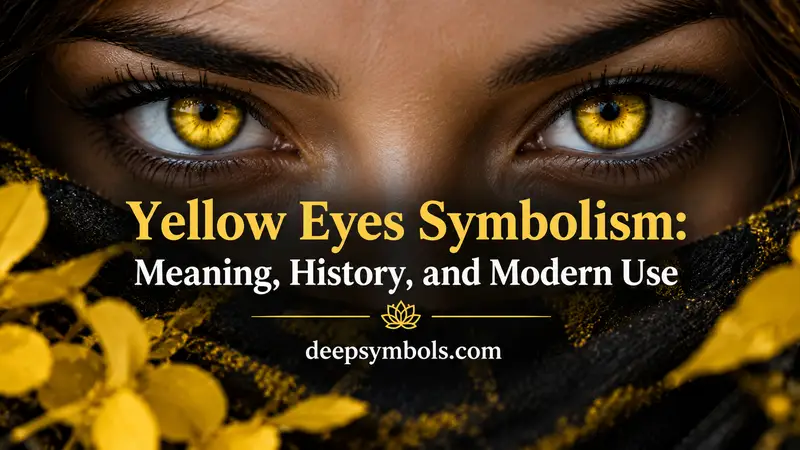
Yellow eyes can make an immediate impression. Whether they belong to a cat watching from a dark room, a wolf in a wildlife photograph, or a fictional character in a fantasy film, their golden or amber appearance often suggests alertness, intensity, and something difficult to read. Yellow eyes symbolism draws on these visual associations, as well as the cultural stories people tell about animals, supernatural beings, and unusual physical traits.
In the United States, yellow eyes appear frequently in horror movies, fantasy novels, video games, tattoo designs, and depictions of wild animals. Their meaning changes with the setting. In a photograph of an owl, yellow eyes may suggest sharp vision and hunting ability; in a supernatural story, they may signal danger, transformation, or hidden power. In a portrait of a domestic cat, the same color may simply emphasize beauty and independence.
The color itself does not have one universal symbolic meaning, and real yellow or amber eyes are not evidence of a person’s character or supernatural qualities. Understanding the symbolism requires looking at color associations, animal behavior, folklore, and the difference between real life and fictional storytelling.
Quick Answer
Yellow eyes commonly symbolize alertness, instinct, intensity, mystery, and heightened awareness in modern American culture, especially in animal imagery, fantasy, and horror. Depending on the tradition or story, golden eyes can also suggest wisdom, spiritual insight, danger, transformation, or a connection with the wild.
TL;DR
- Yellow eyes often represent alertness, instinct, and heightened awareness.
- Amber eyes in animals can suggest independence and a connection with nature.
- Horror and fantasy use glowing yellow eyes to signal danger or transformation.
- Golden eyes may symbolize wisdom or spiritual insight in particular stories.
- Real eye color does not determine personality, morality, or supernatural ability.
- Modern tattoos and artwork use yellow eyes to express individuality and intensity.
1. What Yellow Eyes Look Like and Why They Stand Out
Yellow eyes range from pale gold and honey to deep amber, sometimes with a greenish or brownish tint. In animals, this appearance can result from different combinations of iris pigmentation and, in some species, the way light interacts with structures inside the eye.
The color is especially noticeable in cats, wolves, foxes, owls, and other animals whose eyes are frequently depicted in dramatic lighting. Some people also naturally have amber-colored eyes, although the appearance varies with lighting and the way an observer perceives the iris.
In artwork and film, yellow eyes are often made brighter than they appear in everyday life. A glowing golden iris against a dark background creates a striking contrast that attracts attention and makes a character seem unusually alert or intimidating.
This visual effect helps explain the color’s symbolic associations. Yellow is highly visible, and an intense gaze can make a viewer feel observed or challenged. When artists combine the two, yellow eyes become an effective way to communicate watchfulness, confidence, menace, or supernatural qualities without dialogue.
The symbolism begins with this visual impression, but cultural context determines what the color ultimately means.
2. The Main Spiritual and Symbolic Meanings of Yellow Eyes
Yellow eyes do not have a single established spiritual meaning. Their interpretations come from the qualities people associate with gold, sunlight, animal vision, and the intensity of a direct gaze.
Several themes appear frequently in contemporary symbolism.
- Awareness and perception: Eyes are associated with seeing clearly, noticing details, and recognizing what others overlook. Golden eyes can represent alertness or a willingness to look beyond appearances.
- Instinct and independence: When associated with wild animals, yellow eyes may suggest self-reliance, sensitivity to surroundings, and confidence in unfamiliar environments.
- Mystery and the unknown: The unusual appearance of golden eyes, particularly in dim lighting or fictional imagery, can create an impression of secrecy or hidden knowledge.
- Transformation: In fantasy and supernatural fiction, yellow eyes sometimes appear when a character develops new abilities or changes into another form.
- Courage and intensity: A steady golden gaze can communicate determination, confidence, or a refusal to be intimidated.
- Danger and warning: In horror stories, yellow eyes can signal that a creature is predatory, unfamiliar, or potentially threatening.
These associations are interpretations rather than universal spiritual rules. A yellow-eyed animal does not necessarily symbolize danger, and a person with amber eyes does not automatically possess heightened intuition or unusual abilities.
The most useful approach is to consider what the eyes are doing, which creature or character they belong to, and the emotional atmosphere surrounding them.
3. Yellow Eyes and the Symbolism of Gold
Gold has a long history of associations with wealth, prestige, sunlight, and things considered precious. Because yellow eyes can resemble polished amber or golden metal, they may inherit some of these associations in visual art.
In American design, gold often suggests achievement, distinction, luxury, and confidence. A character with golden eyes may therefore appear exceptional or important before the audience learns anything about their personality.
Gold also carries associations with illumination. Sunlight makes objects visible, and golden imagery can consequently suggest clarity, revelation, or knowledge. When artists emphasize the brightness of yellow eyes, they can use that visual connection to imply that a character sees something others cannot.
However, gold does not always suggest goodness. In a darker narrative, golden eyes may represent greed, excessive ambition, or the temptation to pursue power. The same color can appear attractive and threatening at once.
This contrast makes golden eyes especially useful in storytelling. Their appearance can suggest that a character possesses something valuable while leaving open the question of whether that quality will be used wisely.
The symbolic connection comes from the cultural meaning of gold, not from any proven relationship between iris color and moral character.
4. Yellow Eyes in Animal Symbolism
Animals are among the most common subjects associated with yellow and amber eyes. Their gaze often appears intense because the eyes are central to how people interpret animal attention, movement, and behavior.
<box gap={3}>
<row align=start gap={3}>
<AsyncImage query=”close up domestic cat golden yellow eyes natural portrait” aspectRatio=”3:4″ maxWidth=”112px”/>
<box flex=”1″ gap={1}>
**Cats: independence and observation**
  Golden-eyed cats are frequently portrayed as observant, self-possessed, and independent. In popular American culture, a cat's steady gaze can suggest curiosity or quiet confidence, although actual behavior depends on the individual animal.
</box>
</row>
<divider color=”subtle”/>
<row align=start gap={3}>
<AsyncImage query=”gray wolf amber eyes close up wildlife photography” aspectRatio=”3:4″ maxWidth=”112px”/>
<box flex=”1″ gap={1}>
**Wolves: instinct and wildness**
  Amber eyes in wolf imagery can emphasize alertness, endurance, and the animal's untamed character. Fiction often uses the gaze to communicate strength or danger, while real wolves should be understood through their behavior and ecology rather than symbolic stereotypes.
</box>
</row>
<divider color=”subtle”/>
<row align=start gap={3}>
<AsyncImage query=”red fox golden amber eyes close up wildlife portrait” aspectRatio=”3:4″ maxWidth=”112px”/>
<box flex=”1″ gap={1}>
**Foxes: cleverness and adaptability**
  Foxes have a long association with cleverness in folklore. When a story emphasizes a fox's golden eyes, the image can reinforce themes of resourcefulness, caution, and the ability to navigate uncertain situations.
</box>
</row>
<divider color=”subtle”/>
<row align=start gap={3}>
<AsyncImage query=”great horned owl yellow eyes close up natural photography” aspectRatio=”3:4″ maxWidth=”112px”/>
<box flex=”1″ gap={1}>
**Owls: vigilance and perception**
  Some owls have striking yellow eyes. In artwork, these eyes can emphasize watchfulness and attention, while the owl's broader cultural associations may introduce themes of wisdom, nighttime knowledge, or mystery.
</box>
</row>
</box>
An important distinction separates natural animal symbolism from fictional exaggeration. Some animals genuinely have yellow or amber irises, while others may appear to have glowing yellow eyes because light reflects from structures inside their eyes.
The color alone does not establish whether an animal is aggressive, intelligent, or dangerous.
5. Yellow Eyes in American Folklore and Supernatural Stories
American supernatural storytelling frequently uses unusual eyes to distinguish ordinary characters from creatures that exist outside everyday experience.
In ghost stories, horror films, and modern fantasy, yellow eyes can serve as a visual warning that something is different. A creature may look almost human, but its unusual gaze suggests that it belongs to another category of being.
This technique works because eyes are important signals of identity. Viewers instinctively look toward a character’s face to understand emotion and intention. When the eyes have an unnatural color or appear to emit light, the character becomes harder to interpret using familiar social cues.
American horror also draws on older European folklore, including stories about werewolves, witches, demons, and shape-shifting creatures. These traditions vary considerably, and yellow eyes are not a universal feature of any one being. Modern films and games frequently combine different motifs to create their own visual language.
Indigenous American traditions are diverse and nation-specific, so it would be inaccurate to claim that yellow eyes have one shared meaning across Native American cultures. Any interpretation connected with a particular nation, story, or spiritual tradition should be grounded in that specific cultural context.
In contemporary American fiction, the color usually works as an artistic signal rather than evidence of a single inherited belief. It can indicate supernatural identity, concealed danger, or an unusual connection with the natural world.
6. Yellow Eyes in Horror, Fantasy, and Video Games
Yellow eyes are particularly effective in horror and fantasy because they communicate information quickly.
A filmmaker may show a pair of yellow eyes in a dark hallway before revealing the creature’s body. The audience immediately understands that something is present, but the lack of information creates suspense.
Fantasy writers use the same technique differently. Golden eyes may distinguish an ancient magical being, a supernatural hunter, or a character whose abilities have changed. The color can suggest that the character has exceptional perception or exists outside ordinary human limits.
Video games often exaggerate this effect. Bright yellow eyes can help players identify an enemy, recognize a transformed character, or anticipate a threat in a dark environment. The visual design serves both storytelling and gameplay.
| Context | Common symbolic meaning | Emotional effect |
|---|---|---|
| Horror film | Hidden danger or unfamiliar identity | Fear and suspense |
| Fantasy novel | Magic, transformation, or unusual abilities | Wonder and curiosity |
| Video game | Threat detection or supernatural status | Alertness and anticipation |
| Wildlife photography | Instinct and animal presence | Respect or fascination |
| Character portrait | Confidence, mystery, or individuality | Intensity and intrigue |
These meanings are conventions developed through storytelling. They are not fixed rules, and an artist can deliberately reverse them. A character with yellow eyes might be protective and compassionate, while a seemingly ordinary character with brown eyes might be the real antagonist.
The contrast between appearance and behavior often makes the symbolism more interesting.
7. The Psychological Associations of a Golden Gaze
People frequently interpret eyes as clues to another person’s emotional state. Eye contact can feel welcoming, uncomfortable, confident, or confrontational depending on the situation.
Color can influence that impression, especially in photographs, paintings, and fictional portraits where the artist controls the lighting and composition.
Yellow is a visually noticeable color, and a golden iris may draw attention toward the gaze. When paired with a direct stare, it can make a portrait feel intense or unusually focused. Dark backgrounds and dramatic lighting can strengthen this effect.
Several psychological associations may follow:
- Attention: The unusual color encourages the viewer to focus on the eyes.
- Confidence: A steady gaze can be portrayed as self-assured or determined.
- Uncertainty: An unfamiliar eye color may make a fictional character seem difficult to categorize.
- Curiosity: Golden eyes can invite questions about a character’s background or abilities.
- Intimidation: A prolonged stare combined with threatening body language can create tension.
These are effects of perception and artistic presentation, not reliable psychological diagnoses. Eye color alone cannot tell you whether someone is honest, dangerous, intelligent, empathetic, or emotionally strong.
In real relationships, a person’s actions, communication, and behavior offer much better evidence of their intentions than the color of their eyes.
8. Yellow Eyes and Spiritual Awakening
In modern spiritual and self-reflective writing, golden eyes may be interpreted as a metaphor for increased awareness, personal growth, or a willingness to face uncomfortable truths.
The connection usually comes from the symbolism of sight. Seeing can represent understanding, while light can represent knowledge or the discovery of something previously hidden. Together, these associations allow golden eyes to become an image of insight.
For example, an artist might depict a person with glowing yellow eyes after a moment of personal transformation. The change could represent the character’s new understanding of their circumstances or a willingness to trust their instincts.
Some contemporary spiritual interpretations also connect golden eyes with intuition and inner strength. These ideas can be meaningful as personal metaphors, but they are not universal religious teachings.
There is no established spiritual rule that a person who encounters a yellow-eyed animal is undergoing an awakening or receiving a supernatural message. Such experiences can prompt reflection without serving as proof of a hidden force or predetermined event.
A grounded interpretation focuses on the questions the image raises: What have I begun to notice? Am I responding thoughtfully to my surroundings? Have my priorities or understanding changed?
In this sense, the symbolism can encourage self-examination without requiring supernatural claims.
9. Yellow Eyes in Different Cultural Traditions
Eye symbolism appears in many societies, but the meaning of a particular eye color differs across stories, religions, and historical periods.
In ancient Egyptian religion, the eye held significant religious and protective meanings. The Eye of Horus, for example, became associated with protection, healing, and restoration. This symbol is not specifically a yellow-eye motif; its relevance lies in the broader cultural importance of the eye as a symbol.
In Greek and Roman literature, unusual appearances sometimes help distinguish gods, monsters, or extraordinary beings. However, there is no single classical tradition that assigns one consistent meaning to yellow eyes.
In European folklore, stories about werewolves and other shape-shifting beings helped establish the idea that unusual physical features could reveal a hidden identity. Modern entertainment has expanded these motifs, sometimes adding glowing yellow eyes to creatures that did not consistently possess that feature in older traditions.
In contemporary East Asian popular culture, golden eyes can appear in fantasy animation, comics, games, and supernatural fiction. Their meanings depend on the particular work and may include rarity, exceptional ability, or a nonhuman identity. These uses should not be generalized into a single Chinese, Japanese, or Korean belief about yellow eyes.
The central lesson is that the eye itself may carry cultural significance, but color-specific interpretations must be examined individually. Similar visual motifs can develop independently and acquire different meanings in different settings.
10. Positive and Negative Meanings of Yellow Eyes
Yellow eyes can suggest attractive qualities or unsettling ones. The difference usually comes from the context, the behavior of the person or creature, and the way the image is presented.
<box border radius=”lg” padding={3} gap={3}>
<box gap={1}>
<row align=”center” gap={2}>
<icon name=”sun” size=”lg” color=”#C58B16″/>
**Positive interpretations**
</row>
– Alertness and attentiveness
– Independence and self-reliance
– Wisdom or insight in fictional settings
– Courage and personal intensity
– Adaptability and connection with nature
</box>
<divider color=”subtle”/>
<box gap={1}>
<row align=”center” gap={2}>
<icon name=”moon” size=”lg” color=”#7C8494″/>
**Negative interpretations**
</row>
– Threat or predatory intent in horror
– Secrecy or concealed motives
– Aggression in certain fictional scenes
– Uncertainty about a character’s identity
– Supernatural danger in fantasy narratives
</box>
</box>
Neither list represents a universal definition. A golden-eyed owl may be portrayed as a wise observer, while a golden-eyed monster may be presented as a threat. The physical feature is similar, but the story changes the interpretation.
This flexibility is part of what makes the image effective. Yellow eyes can suggest that a character possesses an unusual quality without telling the audience whether that quality is beneficial or harmful.
11. Yellow Eyes in Tattoos, Fashion, and Art
Yellow eyes appear in tattoo culture and visual design because their color creates contrast and gives a subject a memorable focal point.
Animal tattoos are a common setting. A wolf with golden eyes may represent independence, loyalty, resilience, or a connection with wilderness, depending on the wearer’s intentions. A cat with yellow eyes might express affection for a pet, personal independence, or admiration for feline beauty.
Fantasy-inspired tattoos often use glowing eyes to communicate transformation, supernatural identity, or resistance to conventional expectations. In these designs, the symbolism may come more from a fictional character or personal narrative than from historical tradition.
Artists also use golden eyes in digital illustrations, portraits, album artwork, and fashion photography. The color can complement dark clothing, metallic accessories, or dramatic makeup, making the gaze stand out.
Some people use yellow contact lenses for costumes, theatrical performances, or cosplay. In these contexts, the eyes may be intended to reproduce a character’s appearance rather than communicate a personal spiritual belief.
When interpreting a tattoo or fashion image, it is best to avoid assuming that everyone who chooses golden eyes shares the same values. The design may reflect a favorite animal, a fictional universe, an aesthetic preference, or a specific life experience.
12. Common Misunderstandings About Yellow Eyes
One common misconception is that yellow eyes always symbolize evil. Horror films have made glowing yellow eyes a familiar warning sign, but real animals with yellow or amber irises are not inherently dangerous because of their eye color.
Another misconception is that yellow eyes automatically indicate supernatural abilities. That association belongs mainly to particular fictional and spiritual interpretations. There is no reliable evidence that iris color grants psychic powers, reveals hidden intentions, or predicts a person’s future.
It is also important to distinguish a naturally yellow or amber iris from eyes that appear to glow when light reflects from them. Cats and dogs, for example, have a reflective structure behind the retina that can produce visible eyeshine under certain lighting conditions. The resulting reflection can look yellow, green, orange, or another color.
Human amber eyes are also different from a sudden yellowing of the whites of the eyes. The iris is the colored ring around the pupil, while the sclera is the white outer portion of the eyeball. New yellow discoloration of the sclera may indicate a medical problem and warrants prompt medical assessment.
Finally, symbolism should not become a way to judge people. Eye color is a physical characteristic influenced by genetics and pigmentation, not a measure of morality, personality, trustworthiness, or spiritual development.
13. What Yellow Eyes Can Mean in Dreams
Some people look for symbolic interpretations when yellow eyes appear in a dream. The image may feel unusually vivid, especially if the eyes belong to a stranger, an animal, or a creature that seems threatening.
There is no universally accepted interpretation of yellow eyes in dreams, and the image does not predict a specific event. However, reflecting on the dream’s emotional context can help a person explore what it meant to them.
For example, yellow eyes that seem watchful but peaceful might remind someone of awareness, caution, or an instinctive response to a situation. Eyes that appear frightening might reflect the dreamer’s sense of uncertainty or the emotional atmosphere of the dream.
A familiar animal with golden eyes may simply connect with a real pet, a recent photograph, or a memory. Dreams often combine familiar details in unusual ways, so not every image requires a symbolic explanation.
Rather than assuming that yellow eyes indicate betrayal, danger, or supernatural contact, consider the following questions:
- What emotion did the eyes create: fear, curiosity, calm, or admiration?
- Did the eyes belong to someone familiar or something unknown?
- What was happening around the eyes?
- Does the dream connect with a current concern or recent experience?
The answers may provide a more personal interpretation than a fixed list of dream meanings.
14. How Yellow Eyes Symbolism Has Evolved
The modern symbolism of yellow eyes reflects several overlapping influences rather than one continuous historical tradition.
Older stories about unusual beings helped establish a connection between physical appearance and hidden identity. Later literature, stage performances, cinema, and television developed visual methods for showing that a character was dangerous, magical, or different from ordinary people.
Advances in film lighting and visual effects made glowing eyes especially memorable. A brief flash of golden light could suggest a creature’s presence without revealing its full form, allowing the audience to imagine the threat.
Fantasy games and digital art further expanded the image. Creators began using golden eyes to indicate supernatural abilities, transformation, or a character’s special status. At the same time, wildlife photography and greater familiarity with animals helped keep the color associated with natural alertness and the beauty of the animal world.
Social media has made stylized golden eyes common in character portraits, fan art, avatars, and costume photography. These uses are often aesthetic, although they can carry personal meanings related to independence, mystery, or self-expression.
Today, yellow eyes can communicate opposite qualities depending on the image. They may make a character appear wise or threatening, natural or supernatural, familiar or alien.
Their enduring usefulness comes from that ambiguity: the gaze attracts attention, while the surrounding story determines what the viewer should understand.
FAQs
1. What do yellow eyes symbolize spiritually?
Yellow eyes may represent awareness, instinct, insight, or transformation in contemporary spiritual interpretations. These are personal or cultural associations rather than universal religious teachings, so the meaning depends on the context.
2. Are yellow eyes a symbol of evil?
Not inherently. Horror and fantasy often use glowing yellow eyes to suggest danger, but naturally yellow or amber eyes occur in real animals and some people without implying anything about their character.
3. What does it mean when a person has golden eyes?
Golden or amber eyes are a natural variation in human eye color. Symbolically, writers and artists may use them to suggest individuality, intensity, mystery, or unusual perception, but eye color does not determine personality.
4. What do yellow eyes symbolize in dreams?
Their meaning depends on the dreamer’s feelings and the situation in which the eyes appear. They might evoke curiosity, caution, or fear, but there is no established rule that yellow eyes predict betrayal or a future event.
5. What does a yellow-eyed wolf symbolize?
In contemporary art and fiction, a yellow-eyed wolf may represent instinct, independence, wildness, or danger. The specific meaning depends on the story and the way the wolf is portrayed rather than on a universal folklore tradition.
6. What does a yellow-eye tattoo mean?
A yellow-eye tattoo can express mystery, confidence, transformation, or an interest in animals and fantasy. Its meaning may also come from a particular character or personal experience, so the wearer’s intention is the best guide.
7. Are yellow eyes and amber eyes the same?
The terms overlap in everyday descriptions, but amber eyes are generally understood as golden or yellow-brown irises. Lighting and individual variation affect their appearance, and amber is sometimes classified separately from hazel or light brown.
Conclusion
Yellow eyes symbolism draws on the visual intensity of a golden gaze and the cultural associations of yellow, gold, animals, and supernatural storytelling. In modern American culture, yellow eyes may suggest alertness, instinct, mystery, individuality, or transformation, depending on the character, creature, or situation in which they appear.
The meaning, however, belongs to cultural interpretation rather than biology. MedlinePlus Genetics’ explanation of eye color describes how genes and pigmentation influence the color of the iris. A person’s natural eye color does not establish whether they are trustworthy, dangerous, or spiritually gifted; those associations belong to folklore, fiction, art, and personal interpretation.
Ultimately, yellow eyes symbolism is compelling because a single visual detail can create different impressions in different contexts. Golden eyes may suggest a watchful animal, a character undergoing transformation, or an unfamiliar presence that invites closer attention. The most meaningful interpretation comes from the story surrounding the image, allowing its mystery and visual power to remain without confusing symbolic imagination with factual claims about real people.


