
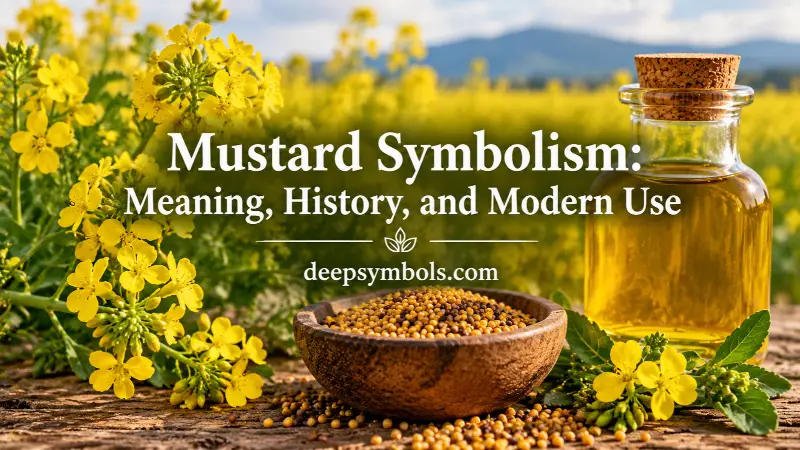
Mustard is a familiar part of everyday life, whether it appears as a bright yellow condiment at an American cookout, a flowering plant in a garden, or a tiny seed used in religious teaching. Mustard symbolism draws on these different forms to represent faith, growth, persistence, warmth, and the ability of something small to make a noticeable difference. Its meaning depends on whether people encounter it in the Bible, nature, food traditions, or visual design.
The mustard seed is especially important in Christianity. Jesus uses it in parables about faith and the kingdom of God, presenting a small seed as an image of growth beyond what its size initially suggests. This association has made mustard seeds familiar symbols of hope, patience, and spiritual development.
In the United States, mustard also has everyday cultural associations. Its bright yellow color suggests energy and visibility, while the condiment itself evokes picnics, baseball games, backyard barbecues, and casual meals. These modern associations differ from the seed’s religious meaning, but both show how an ordinary plant can become a symbol people recognize and use in different ways.
Quick Answer
Mustard symbolism commonly represents faith, growth, perseverance, and the potential for small beginnings to produce meaningful results, particularly in Christian traditions. Historically, mustard seeds have also represented spiritual development and the kingdom of God in biblical parables, while mustard’s yellow color and culinary role connect it with warmth, energy, and everyday American life.
TL;DR
- Mustard seeds symbolize faith, growth, and the potential of small beginnings.
- Jesus uses mustard seeds in parables about the kingdom of God.
- Mustard plants represent persistence, renewal, and natural growth.
- Yellow mustard evokes warmth, visibility, and casual American food traditions.
- Mustard seed jewelry often serves as a personal reminder of Christian faith.
- The symbol encourages patience without promising that every small effort will succeed.
1. What Mustard Looks Like and Why It Matters
Mustard refers to several related plants in the cabbage family, including species cultivated for their seeds, leaves, and edible oil. Depending on the variety, mustard plants produce small seeds in shades of yellow, brown, or black, along with green leaves and clusters of small yellow or pale flowers.
The plant’s different forms contribute to its symbolic range. A seed is tiny and easy to overlook, making it useful as an image of potential. A growing mustard plant represents development, while its flowers bring brightness to fields and gardens. Prepared mustard, meanwhile, is a familiar food with a distinctive color and sharp flavor.
In American daily life, the condiment is often the most recognizable form. Yellow mustard appears on hot dogs, hamburgers, sandwiches, and picnic tables. The plant itself may be less familiar to people who do not garden or work around agriculture.
The distinction matters because not every association with mustard comes from the same source. The biblical meaning primarily concerns the seed and its growth, whereas the modern cultural meaning of bright yellow mustard often comes from food, color, and shared experiences.
Understanding these forms helps explain why mustard can symbolize both spiritual development and ordinary enjoyment.
2. The Core Meanings of Mustard Symbolism
Mustard’s symbolic meanings come from its physical characteristics, religious associations, and place in everyday life. Several ideas appear repeatedly, although no single interpretation applies to every context.
Faith: In Christianity, the mustard seed represents faith and the relationship between small beginnings and extraordinary possibilities. Its significance comes primarily from Jesus’ teachings in the Gospels.
Growth and potential: A seed contains the potential to develop into a plant. Symbolically, it can represent a person’s early efforts, a new relationship, a developing skill, or an idea that has not yet reached maturity.
Perseverance: Mustard plants are cultivated for their usefulness and ability to grow under suitable conditions. This makes the plant a natural image for persistence, although the symbolism should not be confused with a claim that mustard grows successfully in every environment.
Hope: The possibility of growth offers a reason to remain hopeful during periods when progress is difficult to see. A small beginning does not guarantee success, but it leaves room for change.
Energy and warmth: Prepared yellow mustard is visually bright, and yellow is often associated with sunlight, cheerfulness, and attention in American design.
Practicality and nourishment: Mustard has served as a food crop and seasoning across many societies. It can therefore evoke resourcefulness, everyday sustenance, and the usefulness of familiar plants.
These meanings overlap, but context determines which one is most relevant. A mustard seed necklace may express religious faith, while a yellow mustard illustration in a restaurant may simply suggest food, flavor, and familiarity.
3. Mustard Seed Symbolism in the Bible
The mustard seed is one of the best-known small-seed images in the New Testament. Jesus uses it in several teachings to illustrate faith, growth, and the kingdom of God.
In Matthew 13:31–32, Mark 4:30–32, and Luke 13:18–19, the mustard seed appears in a parable about the kingdom of God or the kingdom of heaven. The seed is planted and grows into a plant large enough to provide shelter for birds in its branches.
The central contrast is between the beginning and the eventual result. Something small develops into something more substantial, offering a picture of growth that exceeds what the initial size might suggest.
Matthew 17:20 and Luke 17:6 use the mustard seed in teachings about faith. These passages connect the seed with the ability of faith to accomplish what appears impossible or to overcome seemingly overwhelming obstacles.
The precise emphasis differs between the passages. The parables about the kingdom focus on growth and expansion, while the teachings about faith emphasize trust in God rather than confidence in one’s own power.
For Christians, the mustard seed can consequently represent a beginning that should not be dismissed because it looks insignificant. A modest act of service, a new commitment to prayer, or a small step toward reconciliation may become meaningful over time.
The biblical image is not a formula for obtaining anything a person wants. Its purpose is to communicate spiritual truths through an ordinary feature of the natural world.
4. The Parable of the Mustard Seed and the Kingdom of God
The mustard seed parable offers a particularly important perspective on how Christianity understands growth.
Jesus compares the kingdom of God to a seed that is planted and develops into a plant that provides space for birds. The image begins with something small and ends with something that offers shelter.
For the original listeners, the contrast would have been easy to understand. Seeds are small, while mature plants occupy more space and become useful in ways that are not immediately visible at planting time.
The parable has often been interpreted as an image of the kingdom of God beginning in an apparently modest way and growing beyond its initial appearance. Jesus’ ministry and the early Christian community could look small in comparison with the political and religious powers of the ancient world.
The plant’s branches also contribute to the image. They provide a place for birds to rest, suggesting a result that extends beyond the seed itself.
Modern Christians may apply this idea to community service, education, charitable work, or the gradual development of a faith community. An individual action may appear limited, yet its effects can extend to other people.
However, the parable should not be reduced to a promise that every small project will become successful or influential. Its primary concern is the kingdom of God, not a universal guarantee of personal achievement.
The enduring lesson is that appearances at the beginning do not necessarily reveal the full significance of what is developing.
5. What Does Faith the Size of a Mustard Seed Mean?
The expression “faith the size of a mustard seed” is widely used in Christian conversations, artwork, jewelry, and devotional messages. It comes from Jesus’ teachings in Matthew 17:20 and Luke 17:6.
The mustard seed provides a comparison for something very small. In these passages, Jesus uses the image to challenge his followers’ understanding of faith and what God can accomplish.
The teaching is sometimes misunderstood as saying that a person only needs a tiny quantity of belief to guarantee a desired result. That interpretation can place too much emphasis on measuring faith or treating it as a technique for controlling outcomes.
A more careful reading recognizes the passages’ focus on trust in God. The seed illustrates smallness, while the surrounding teaching directs attention toward the nature of faith and the power attributed to God.
In everyday Christian life, the phrase can encourage people who feel that their faith is weak or still developing. Someone beginning to pray, returning to church after a long absence, or trying to maintain hope during a difficult period may find reassurance in the image.
It also provides a useful distinction between faith and certainty about every future event. A person can continue to trust God while acknowledging fear, uncertainty, and disappointment.
The mustard seed therefore serves as an invitation to nurture faith rather than judge it solely by how confident a person feels at a particular moment.
6. Mustard Symbolism in the United States
American interpretations of mustard combine biblical familiarity with food culture, gardening, color, and personal expression.
For many Christians in the United States, the mustard seed is a recognizable symbol of faith. It appears in church gifts, devotional books, bracelets, pendants, wall decorations, and inspirational artwork. The image is particularly common in objects intended to encourage someone during a difficult season or mark a personal religious commitment.
Outside religious settings, mustard is strongly associated with casual American food. Yellow mustard is a familiar condiment at baseball games, backyard cookouts, picnics, county fairs, and family gatherings. Its presence can evoke uncomplicated meals and shared experiences.
Mustard yellow also appears in clothing, home furnishings, graphic design, and seasonal decorations. Designers may use the color to add warmth, contrast, or a vintage quality to a room or outfit.
These associations should not be treated as a single traditional meaning. A mustard-colored jacket does not necessarily communicate faith, and a mustard seed pendant does not automatically reveal someone’s religious beliefs.
Instead, American culture demonstrates how the same plant can carry different meanings depending on where it appears. The seed may suggest spiritual trust, the growing plant may suggest potential, and the condiment may evoke food and familiarity.
7. Mustard as a Symbol of Hope and New Beginnings
Seeds are natural images of beginnings because they contain the potential for future growth. Mustard seeds fit this symbolism particularly well because their small size creates a visible contrast with the plant they can produce.
This association makes mustard relevant to periods of transition. A person beginning a new career, learning a skill, recovering from a setback, or building a relationship may see the seed as a reminder that early progress can be difficult to measure.
The image also provides a realistic understanding of hope. Planting a seed does not mean that a mature plant appears immediately. Growth requires suitable conditions, time, and care.
In this sense, mustard symbolism encourages patience without suggesting that patience alone guarantees success. It can remind people to take practical steps, seek help when needed, and allow a developing process to unfold.
A mustard seed placed in a journal, for example, may represent a personal goal that is still in its early stages. A small plant in a garden may become a reminder of a new chapter or a commitment to nurturing something worthwhile.
The symbol is most useful when it connects hope with action. Rather than promising an effortless transformation, it encourages people to recognize that meaningful change often begins before its results become visible.
8. The Mustard Plant as a Symbol of Persistence
Mustard plants can also suggest persistence and adaptability. Depending on the species and growing conditions, mustard can develop quickly and produce useful leaves, seeds, or flowers.
These characteristics make the plant a reasonable image of continued growth. Its value is not limited to appearance; mustard has practical uses in cooking, agriculture, and gardening.
Symbolically, persistence means continuing to work toward something despite obstacles. It does not require a person to ignore limitations or remain committed to a plan that is clearly harmful.
The mustard plant can therefore represent a balanced form of perseverance: responding to conditions, making adjustments, and continuing to grow when circumstances permit.
For example, a gardener may use mustard as a seasonal crop or grow it for its edible leaves and seeds. The practical work of cultivating the plant can provide a tangible reminder that progress depends on attention and appropriate care.
In personal life, this meaning can apply to education, creative work, recovery from disappointment, or the gradual rebuilding of trust. These processes rarely develop in a perfectly straight line.
The symbolism is not that persistence always produces the exact result someone wants. Rather, it emphasizes the value of continued effort, flexibility, and realistic expectations.
9. Mustard Symbolism Across Cultures and Religions
Mustard has a long history as a cultivated plant and seasoning in different parts of the world. Its uses vary according to local agriculture, cooking traditions, and religious practices.
In South Asian cuisines, mustard seeds are used in many regional dishes, and mustard oil is important in some culinary traditions. Depending on the region and preparation, mustard contributes pungency, aroma, and flavor. These everyday uses give the plant a practical cultural significance that does not depend on Christian symbolism.
In European food traditions, mustard has long served as a condiment, with regional preparations ranging from mild yellow varieties to sharper brown and whole-seed styles. Its culinary identity is therefore broader than the familiar American squeeze bottle.
Mustard seeds also appear in religious and philosophical discussions outside Christianity. In Buddhist traditions, the story of Kisa Gotami is associated with mustard seeds: she is asked to obtain a seed from a household untouched by death as part of a lesson about the universality of mortality. The story emphasizes grief, loss, and the shared human experience of death rather than the Christian association with faith.
These traditions should not be collapsed into one universal definition. A mustard seed may represent faith in a Christian devotional setting, participate in a teaching about mortality in a Buddhist context, or simply be a valued ingredient in a regional cuisine.
The cultural meaning comes from the story or practice in which the seed appears, not from an inherent spiritual property shared by every tradition.
10. Yellow Mustard and the Psychology of Color
The bright yellow of prepared American mustard creates associations that differ from the biblical meaning of its seed.
In many modern design contexts, yellow is connected with sunlight, warmth, optimism, visibility, and energy. These associations are influenced by cultural convention and context; they are not universal psychological laws.
Mustard yellow is usually deeper and more muted than a bright lemon yellow. In fashion and interior design, it can suggest warmth, autumn, vintage styling, or an earthy palette.
Restaurants and food brands may use yellow to attract attention or reinforce a product’s familiar appearance. The color of American yellow mustard is particularly recognizable because it appears so often on sandwiches and at casual gatherings.
The plant’s yellow flowers can also suggest brightness and seasonal growth, although flower color alone does not establish a fixed symbolic meaning.
It is useful to distinguish color symbolism from religious symbolism. A yellow design may communicate cheerfulness without making any reference to the Bible, while a tiny mustard seed in a religious illustration may represent faith regardless of whether the artist uses yellow prominently.
Color can strengthen an existing association, but the surrounding message determines how the image is understood.
11. Mustard Seeds in Jewelry, Tattoos, and Personal Decor
Mustard seed imagery has become a recognizable feature of Christian gifts and personal keepsakes.
Some pendants and small glass ornaments contain an actual mustard seed, allowing the wearer to carry a physical reminder of the biblical comparison. Other designs depict a seed, a growing plant, or a short religious message associated with faith.
These objects are often given during milestones such as baptisms, confirmations, graduations, weddings, or periods of personal difficulty. The specific occasion helps shape the intended meaning.
Mustard seed tattoos may serve a similar purpose. A person might choose a seed with roots or leaves to represent developing faith, a new beginning, or a commitment to continue growing. Others may select the image because of a particular biblical passage or a meaningful experience within their religious community.
In home decor, mustard seed imagery can appear in framed prints, prayer spaces, journals, and gifts. A mustard-colored cushion or wall decoration, however, may simply reflect a preference for the color rather than a religious statement.
Personal interpretation matters. The symbol can provide a reminder of an individual’s commitments, but its appearance does not prove anything about that person’s beliefs or character.
12. Mustard in Food, Hospitality, and Everyday Life
Mustard’s culinary role gives it another set of associations, especially in the United States.
Yellow mustard is closely connected with hot dogs, hamburgers, sandwiches, and casual outdoor meals. These foods often appear at summer cookouts, sporting events, picnics, and community gatherings.
As a result, mustard can evoke hospitality and shared enjoyment, even though these are cultural associations rather than formal symbolic meanings. A bottle of mustard on a picnic table may suggest an informal gathering more readily than a religious lesson.
The plant’s seeds also have practical value as a spice, and mustard leaves are eaten in various cuisines. Its history as a food crop highlights resourcefulness: one plant can provide different products depending on the variety and how it is cultivated.
Mustard’s sharp flavor adds another possible association. In ordinary language, the word can appear in expressions about strong taste or pungency, and mustard imagery may be used in food branding to suggest bold flavor.
These everyday uses demonstrate why the plant cannot be assigned one exclusive meaning. In a church gift shop, the seed may be a religious emblem; at a baseball game, prepared mustard is simply part of the food experience.
13. Common Misunderstandings About Mustard Symbolism
One common misconception is that every reference to mustard in the Bible means the same thing. The mustard seed appears in different teachings, and the context determines whether the main emphasis concerns faith, the kingdom of God, or another aspect of the passage.
Another misunderstanding is that mustard seed symbolism promises success if a person believes hard enough. Biblical teachings about faith should not be reduced to a guarantee that every wish will be fulfilled or every difficulty will disappear.
It is also inaccurate to assume that mustard has one universal meaning across cultures. Christian interpretations of the mustard seed differ from its role in Buddhist storytelling and its practical importance in South Asian cooking.
Similarly, the color mustard yellow does not automatically carry a religious message. Its associations with warmth, vintage style, or food can exist independently of the biblical seed.
Finally, claims that finding a mustard seed predicts wealth, romance, or a specific future event should be distinguished from established religious teachings. People may attach personal meaning to ordinary encounters, but those interpretations are not universal facts about the symbol.
A thoughtful reading of mustard symbolism begins with the particular plant, passage, cultural practice, or design in which it appears.
14. How Mustard Symbolism Has Evolved
Mustard’s symbolic history reflects the way familiar natural objects acquire different meanings over time.
In biblical traditions, the mustard seed became an image of faith and the kingdom of God through the teachings of Jesus. Christian communities carried these associations into sermons, devotional writing, religious art, and personal objects.
As mustard seed imagery entered modern gift culture, it became a convenient way to express encouragement. Jewelry, cards, and small keepsakes made the biblical image portable, allowing people to associate it with personal milestones and difficult periods.
At the same time, mustard’s culinary role continued independently. In American culture, yellow mustard became familiar through casual dining and food traditions, while mustard yellow developed a place in fashion and interior design.
Other cultural traditions maintained their own uses and interpretations, including stories involving mustard seeds and mortality. These meanings did not simply disappear as Christian imagery became popular in some communities.
Today, mustard symbolism can therefore operate on several levels at once: religious, personal, cultural, and visual. Its continued relevance comes from the flexibility of the seed and plant as recognizable features of everyday life.
15. What Mustard Symbolism Can Teach Us Today
Mustard symbolism offers a practical way to reflect on faith, growth, and the importance of small beginnings.
For Christians, the mustard seed can recall Jesus’ teachings about faith and the kingdom of God. It can encourage trust without suggesting that people must suppress doubt or expect immediate answers to prayer.
For others, the seed may simply represent a project, relationship, or personal change that is still developing. The image encourages patience and reminds people that the earliest stage of a process does not reveal everything about its eventual outcome.
The mustard plant also invites attention to practical care. Growth depends on appropriate conditions, and persistence often requires adaptation rather than stubbornly repeating the same action.
Its everyday presence in food and design offers a different lesson: objects can carry personal meaning without requiring a universal spiritual interpretation. A familiar condiment may evoke family gatherings, while a seed pendant may represent a specific religious commitment.
The most useful interpretation is the one grounded in context and connected to thoughtful action. Mustard can remind people to nurture what matters, respect different cultural meanings, and avoid confusing symbolic encouragement with guaranteed results.
FAQs
1. What does mustard symbolize spiritually?
Mustard most commonly symbolizes faith, spiritual growth, and the potential of small beginnings in Christian contexts. These associations come from Jesus’ teachings about mustard seeds in the Gospels.
2. What does the mustard seed mean in the Bible?
The mustard seed illustrates faith and the growth of the kingdom of God. Depending on the passage, it emphasizes either the contrast between a small beginning and a larger result or the role of faith in trusting God.
3. Why did Jesus compare faith to a mustard seed?
Jesus used the mustard seed as an image of smallness in teachings about faith. The comparison encourages trust in God rather than treating faith as a measurable force that guarantees every personal desire.
4. Is mustard a symbol of hope and new beginnings?
Yes, mustard seeds can represent hope because they contain the potential for growth. This is a modern symbolic application of the seed’s natural development, rather than a promise that every new effort will succeed.
5. What does a mustard seed necklace symbolize?
A mustard seed necklace commonly serves as a reminder of Christian faith, especially the teachings in Matthew 17:20 and Luke 17:6. Its personal meaning may also relate to a milestone, a prayer, or a difficult experience.
6. Does mustard have the same meaning in every culture?
No. Christian traditions associate mustard seeds with faith and the kingdom of God, while other cultural and religious traditions use mustard in different ways. In many cuisines, mustard is primarily valued as a food ingredient rather than a spiritual symbol.
7. What does mustard yellow symbolize?
Mustard yellow often suggests warmth, energy, autumn, and vintage style in contemporary American design. These associations come from color conventions and context, not necessarily from the biblical symbolism of mustard seeds.
Conclusion
Mustard symbolism brings together faith, hope, perseverance, and the remarkable potential of small beginnings. In Christianity, Jesus uses the mustard seed to illustrate the kingdom of God, showing how something seemingly insignificant can grow into something much greater. Mark 4:30–32 in the Bible provides the biblical foundation for this enduring image of growth and possibility.
Beyond its religious meaning, mustard can represent patience, personal development, and the importance of nurturing small opportunities. A mustard seed pendant may express devotion, a growing plant may symbolize progress, and a familiar condiment may evoke hospitality and everyday American life. Each interpretation depends on the context and the meaning people associate with it.
Ultimately, mustard symbolism reminds us that meaningful change often begins in ways that are easy to overlook. A small act of kindness, a quiet decision, or a modest beginning can develop into something lasting when given time and care. Its most valuable lesson is that growth does not always announce itself at the beginning; sometimes, the smallest starting point holds the greatest potential.