
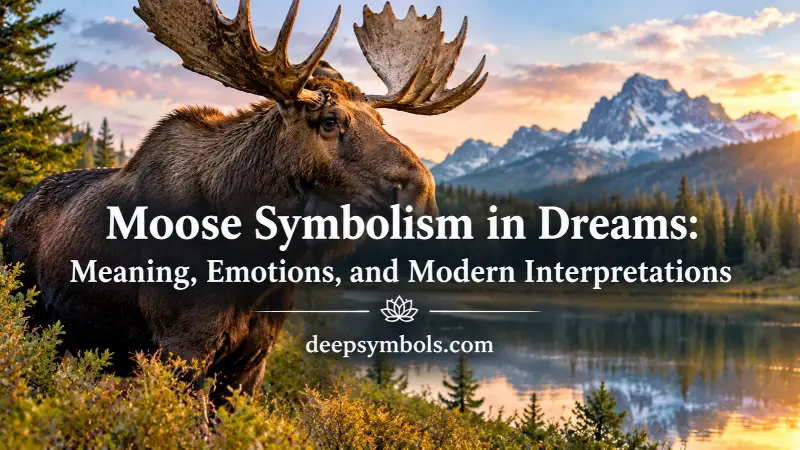
Dreams about moose often leave a strong impression because these animals combine impressive size with a calm, solitary presence. A moose standing in a forest, crossing a road, approaching a house, or charging unexpectedly can create very different emotional experiences. Moose symbolism in dreams is commonly associated with strength, independence, resilience, personal boundaries, and the need to move through life at your own pace.
In the United States, moose are strongly associated with northern forests, wilderness, and the rugged landscapes of states such as Maine and Alaska. Their size makes them commanding animals, yet they often spend time alone and generally avoid unnecessary confrontation. These characteristics provide useful starting points for interpreting a dream without assuming that every moose carries the same message.
Dream interpretation is personal rather than an exact science. A moose may represent confidence to one person and an intimidating responsibility to another. Your emotions during the dream, the animal’s behavior, and what is happening in your waking life can offer more meaningful clues than a universal symbol dictionary.
Quick Answer
Moose symbolism in dreams commonly represents strength, independence, resilience, and the need to establish healthy personal boundaries in modern American interpretations. Depending on the dream’s setting and emotional tone, a moose may also suggest patience, a desire for solitude, respect for powerful circumstances, or the need to approach a difficult situation carefully.
TL;DR
- A calm moose may represent confidence, patience, and quiet strength.
- A charging moose can reflect pressure, conflict, or a perceived threat.
- A moose in a forest may suggest independence and a need for space.
- A mother moose can evoke protection, responsibility, and family concerns.
- A moose crossing your path may prompt reflection on an important decision.
- Dream meanings depend on personal experiences, emotions, and real-life circumstances.
1. What a Moose Represents in Dream Symbolism
The moose is the largest living member of the deer family. Its long legs, broad muzzle, heavy body, and distinctive antlers make it recognizable even to people who have never encountered one in the wild.
These physical characteristics contribute to its symbolic associations. Its size suggests strength and presence, while its ability to navigate forests, wetlands, and snowy environments can bring to mind adaptability and endurance. Its solitary habits may suggest independence, although moose also interact with other animals during particular seasons and circumstances.
In a dream, these qualities can become images through which a person considers their own experiences. A large, peaceful moose might reflect growing self-confidence or the ability to remain composed under pressure. An agitated animal might represent a situation that feels difficult to control.
The animal’s size is especially relevant. A moose can appear impressive without actively threatening anyone. This distinction offers a useful interpretation: something in your life may be important or intimidating without necessarily being dangerous.
Rather than asking only what a moose means, consider what its presence made you feel. Awe, comfort, curiosity, fear, and helplessness each point toward different possibilities.
2. Strength Without Aggression
One of the most common interpretations of a moose dream is strength that does not need to prove itself.
A moose can stand quietly in its environment, occupying considerable space without actively seeking attention. This image may resonate when you are learning to trust your abilities, becoming more confident at work, or handling responsibilities that once seemed overwhelming.
The dream may invite you to distinguish between genuine strength and constant defensiveness. You do not always need to argue, compete, or demonstrate your worth to other people. Sometimes strength means remaining steady while others are unsettled.
If the moose appears calm while you watch from a distance, consider whether you are developing a more secure relationship with your own abilities. Perhaps you are becoming comfortable setting limits, making independent decisions, or accepting a responsibility without seeking everyone’s approval.
However, the same image can have a different meaning if you feel intimidated. The moose might represent someone whose authority seems overwhelming or a responsibility that has grown larger than expected.
The useful question is whether the animal’s strength feels reassuring or threatening. Your reaction can help distinguish a dream about growing confidence from one that reflects pressure or uncertainty.
3. Independence, Solitude, and Personal Freedom
Moose often live relatively solitary lives, particularly outside the breeding season. Their presence in a dream can therefore bring attention to independence, personal space, and the balance between solitude and connection.
A lone moose moving through a forest may reflect a desire to make decisions without interference. You might be considering a career change, questioning a relationship, or trying to understand what you want apart from the expectations of family and friends.
In American culture, the wilderness often represents escape from crowded schedules and social demands. A moose appearing in a remote landscape may connect with this familiar idea of getting away from everyday pressures.
Solitude, however, is not necessarily the same as loneliness. Choosing to spend time alone can provide room for reflection, while feeling isolated against your wishes may signal an unmet need for companionship.
Pay attention to the dream’s atmosphere. If the forest feels peaceful and the moose moves freely, the image may reflect a healthy desire for independence. If the landscape feels empty or frightening, it may instead reflect disconnection or uncertainty about where you belong.
The dream does not necessarily tell you to withdraw from other people. It may simply encourage you to recognize how much personal space you need to feel balanced.
4. Seeing a Moose in a Forest
A forest gives the moose a natural setting and adds another layer to the dream’s possible meaning.
Forests frequently appear in stories and personal imagination as places of discovery, uncertainty, retreat, and change. When a moose appears among trees, the combination may represent navigating a complicated situation while relying on your own judgment.
A peaceful encounter on a woodland trail could reflect a period of personal growth. You may be learning to tolerate uncertainty instead of demanding immediate answers. The moose’s steady presence may fit a situation in which patience is more useful than rushing toward a solution.
A dense, dark forest can produce a different emotional experience. If you cannot see where the moose is going or feel trapped among the trees, the dream may echo confusion about a decision or concern about what lies ahead.
Consider whether you are observing the animal or following it. Watching may suggest awareness of a quality you recognize in yourself or someone else. Following it could reflect curiosity about a new direction, although it does not establish that a particular choice is right.
There is no universal rule that a forest dream predicts a major life change. Its value lies in the questions it raises about your present circumstances and how you are responding to uncertainty.
5. A Moose Chasing or Charging You
A charging moose can turn an otherwise peaceful dream into a frightening experience. In symbolic interpretation, this kind of encounter may reflect pressure, conflict, fear, or a situation you feel unable to avoid.
The animal’s behavior matters in real life, too. Moose can become dangerous when threatened, during the breeding season, or when protecting calves. They are not always gentle simply because they are herbivores.
In a dream, being chased might reflect a deadline you have been avoiding, an unresolved disagreement, or a responsibility that seems to be closing in on you. The moose may represent the perceived size of the problem rather than a particular person or event.
If the animal charges after you approach it, consider whether you have overlooked someone’s boundaries or moved too quickly into a sensitive situation. This is only one possible reflection, not proof that you have done something wrong.
If you escape, the ending may feel reassuring because you regain a sense of safety. Yet escaping does not necessarily mean that a real-life problem has been resolved. It may be more useful to ask what would help you address the underlying pressure.
A charging moose is not a reliable omen of future danger. Fearful dreams can occur during ordinary periods of stress and do not predict that something bad will happen.
6. A Calm Moose Watching You
A moose that looks directly at you without charging or running away can create a striking dream image. Its stillness may feel peaceful, intimidating, or strangely familiar.
One possible interpretation is awareness. The encounter may reflect a situation you have begun to notice but have not yet decided how to handle. You might be recognizing a personal strength, reconsidering an important relationship, or becoming more conscious of your own needs.
The animal’s quiet attention can also invite reflection on patience. Not every question requires an immediate response, and not every decision becomes clearer through constant analysis.
If you feel calm while the moose watches you, the dream may represent acceptance of uncertainty or confidence in your ability to face a situation. If its gaze makes you uncomfortable, consider whether you feel judged, exposed, or under pressure in your waking life.
These interpretations are possibilities rather than fixed psychological rules. A dream image becomes more useful when connected with a real emotion or experience that you can identify.
7. Dreaming About a Mother Moose and Her Calf
A mother moose with a calf often brings themes of protection, caregiving, family responsibility, and vulnerability into a dream.
The image can feel comforting when the animals remain together peacefully. You may be thinking about caring for a child, supporting an aging relative, or protecting someone who depends on you. It could also reflect a growing commitment to something new, such as a creative project or an important personal goal.
A defensive mother moose creates a different atmosphere. Because real moose mothers can be dangerous when they perceive a threat to their calves, the dream may bring attention to the intensity of protective instincts or the tension surrounding family boundaries.
If you are the person approaching the calf, consider whether you feel drawn toward a new responsibility but uncertain about how to handle it. If the mother is protecting you, the dream may connect with a desire for security or reassurance.
Not every mother-and-calf dream is about parenthood. The image can also represent a vulnerable part of yourself that needs attention, rest, or protection.
The central question is what the relationship between the two animals brings to mind. Their closeness, vulnerability, and defensive behavior may offer more insight than the species alone.
8. A Moose Crossing Your Path
A moose crossing a road or trail can interrupt the direction of a dream. You may need to stop, wait, change course, or decide whether it is safe to continue.
Symbolically, this scene can be interpreted as a moment of hesitation or reconsideration. Perhaps an unexpected responsibility has interrupted your plans, or you are facing a decision that requires more attention than you originally expected.
In the United States, moose encounters are familiar concerns in parts of the northern wilderness, where animals may cross highways and rural roads. This real-world association can influence dream imagery, especially for people who have traveled through moose habitat or seen wildlife warnings.
The animal’s behavior changes the possible interpretation. If it crosses calmly and disappears into the woods, the dream may feel like a brief interruption rather than a threat. If it blocks your route or refuses to move, the scene might reflect frustration about an obstacle you cannot immediately overcome.
It is tempting to interpret a crossing animal as a definite sign that destiny is redirecting you. There is no reliable evidence that dreams predict such events. A more grounded approach is to ask whether you are rushing toward a decision that deserves a pause.
Sometimes the most useful interpretation is simply that you need to stop and assess the situation before moving forward.
9. Moose Antlers and the Symbolism of Personal Power
Antlers are among the most distinctive features of a mature male moose. Their broad, flattened shape makes them visually impressive and can contribute to associations with presence, maturity, and power.
If antlers stand out in your dream, they may represent how you understand authority, recognition, or the ability to defend your position. You might be thinking about a leadership role, trying to earn respect, or deciding how firmly to express your opinions.
Large antlers can feel magnificent in one dream and threatening in another. Admiration may suggest respect for strength or achievement, while fear may reflect concern about someone else’s influence.
Antlers also have a practical biological function: they are grown and shed in an annual cycle by adult males. That cycle can provide a personal metaphor for changing circumstances, although it should not be mistaken for an established universal dream meaning.
For example, a dream involving shed antlers might prompt you to consider whether you are letting go of an old role or reconsidering a source of identity. The interpretation is meaningful only if it connects with your own experiences.
The presence of antlers does not automatically indicate aggression, masculinity, or a coming conflict. Their significance depends on how they appear and what they mean to the dreamer.
10. Moose Symbolism in American Culture and Folklore
In the United States, moose are closely associated with the northern wilderness, especially Alaska, Maine, and other regions where they inhabit forests, wetlands, and lakeshores.
Their image often appears in outdoor tourism, wildlife photography, rustic home decor, and regional merchandise. In these settings, the moose may communicate ruggedness, wilderness, self-reliance, and a connection to the natural world.
This cultural background can shape dream interpretation. Someone who grew up near moose habitat may associate the animal with an ordinary wildlife encounter. Someone who has only seen moose in documentaries or photographs may experience it as an unusual symbol of the untamed outdoors.
Moose also appear in North American Indigenous cultural contexts, but there is no single Indigenous interpretation shared by all nations and communities. Specific meanings depend on particular traditions, stories, places, and relationships with the animal. It would be inaccurate to assign one spiritual message to every Indigenous culture.
Likewise, modern dream interpretations found online are not necessarily ancient folklore. Many connect animal characteristics with personal qualities such as strength or independence, but these associations should not automatically be presented as inherited religious teachings.
Understanding this distinction allows you to explore the moose’s cultural significance without treating speculation as historical fact.
11. Emotional and Psychological Interpretations of Moose Dreams
Dreams often incorporate memories, emotions, concerns, and familiar images. Although researchers continue to study why we dream, there is no scientifically validated dictionary that assigns a single meaning to every animal or dream scenario.
A moose may become part of a dream because you recently saw one in a photograph, watched a wildlife program, visited a northern state, or encountered an image online. It may also connect with an emotion or personal association that has little to do with the animal’s behavior.
One useful approach is to consider the emotional pattern of the dream.
- Confidence: Did the moose make you feel secure or capable?
- Fear: Did its size or movement make you feel threatened?
- Freedom: Did you admire the animal moving through open country?
- Responsibility: Did the presence of a calf or another vulnerable animal stand out?
- Frustration: Did the moose prevent you from reaching a destination?
- Curiosity: Did you want to observe or understand the animal?
These questions do not produce a formal diagnosis. They help you connect the dream with feelings that may already be present in daily life.
It is also worth considering whether the dream was simply vivid rather than emotionally significant. Not every unusual dream requires a hidden explanation, and a frightening dream alone does not indicate a psychological disorder.
12. Moose Dreams, Patience, and Personal Boundaries
The moose’s size and solitary habits make it a useful image for reflecting on boundaries and the need to respect space.
A moose standing between you and another person in a dream might bring attention to an uncomfortable relationship dynamic. Perhaps someone is demanding more of your time than you can give, or you are finding it difficult to say no to a request.
Alternatively, you may be the person taking up too much space in a situation. If the dream centers on approaching a moose that becomes defensive, it may prompt you to consider whether you are moving too quickly or ignoring signs that another person needs distance.
Patience is another possible theme. Moose do not need to move constantly to remain part of their environment. A calm animal may remind you that waiting, observing, and choosing the right moment can sometimes be more effective than forcing progress.
These interpretations are particularly relevant when the dream resembles a recognizable waking-life problem. If a boundary issue comes to mind immediately, consider what a respectful response might look like.
The dream itself does not tell you which person is right or wrong. It can, however, provide an opportunity to reflect on how you manage pressure, space, and conflict.
13. Positive and Negative Moose Dream Meanings Compared
The same animal can represent different experiences depending on its behavior and your emotional response.
| Dream scenario | Possible interpretation | Question to consider |
|---|---|---|
| Calm moose | Confidence, patience, quiet strength | Where am I becoming more secure? |
| Moose in a forest | Independence, reflection, uncertainty | Do I need space to think? |
| Charging moose | Pressure, conflict, perceived danger | What feels difficult to confront? |
| Mother moose and calf | Care, protection, responsibility | Who or what needs my attention? |
| Moose blocking a path | Delay, hesitation, reconsideration | Is there a decision I should review? |
| Moose with large antlers | Authority, presence, recognition | How do I feel about power or respect? |
These are reflective possibilities, not predictions. A calm moose does not guarantee success, and an aggressive moose does not mean that misfortune is coming.
If your dream does not fit any of these scenarios, there is no need to force it into a category. Your personal memories, the setting, and the emotions you experienced may provide a better starting point than a general interpretation.
14. Common Misunderstandings About Moose Dreams
One common mistake is assuming that every animal dream contains a supernatural message. Some people interpret dreams spiritually, while others understand them as ordinary products of memory and emotion. Neither perspective requires treating a specific dream as a guaranteed prediction.
Another misconception is that a moose always symbolizes strength. Although its size makes that association understandable, the animal may represent fear, an overwhelming responsibility, solitude, or a memorable wildlife experience instead.
It is also misleading to assume that aggressive behavior predicts an attack or that a peaceful encounter promises good fortune. Dreams do not provide a reliable method for forecasting future events.
Cultural claims require similar care. An interpretation presented as Native American, Celtic, or ancient spiritual wisdom should not be accepted without specific historical grounding. Modern symbolic interpretations are often blended together online, even when they come from unrelated traditions.
Finally, a dream should not be used as the sole basis for major life decisions. If you dream of a moose blocking a road, that does not establish that you should cancel a trip, end a relationship, or abandon a career plan.
Instead, use the dream as an invitation to examine your feelings and circumstances. Reflection can be useful without assuming that the image carries an unquestionable instruction.
15. How to Interpret Your Own Moose Dream
The most useful interpretation begins with the details you remember rather than a predetermined definition.
First, identify the animal’s behavior. Was it resting, walking, watching, charging, or protecting a calf? Its actions establish the basic scene.
Second, recall your emotional response. Fear and admiration can produce very different meanings, even when the animal looks exactly the same.
Third, consider the setting. A moose in a peaceful forest may evoke freedom, while one blocking a narrow road may bring to mind an obstacle or a difficult choice.
Fourth, connect the experience with your current life. Have you been dealing with an intimidating responsibility, seeking independence, protecting someone, or struggling to establish boundaries? A connection is worth considering if it feels natural rather than forced.
Finally, remain open to the possibility that the dream has no specific symbolic meaning. Recent experiences and ordinary mental activity can contribute to vivid dreams without creating a message that needs decoding.
Writing down the scene and your feelings shortly after waking may help you recognize patterns over time. The goal is not to find one perfect answer, but to understand whether the dream offers a useful perspective on something you are already experiencing.
FAQs
1. What does it mean to dream about a moose?
A moose dream may represent strength, independence, patience, personal boundaries, or an overwhelming situation. Its likely personal meaning depends on the animal’s behavior, the dream’s setting, and the feelings you experienced.
2. Is dreaming about a moose a good sign?
A peaceful moose may feel reassuring and suggest confidence or a desire for independence. However, there is no scientific evidence that a moose dream predicts good luck or future success.
3. What does a moose attacking you in a dream mean?
A charging moose may reflect stress, conflict, fear, or a responsibility that feels difficult to manage. It does not mean that an actual attack or other dangerous event is about to happen.
4. What does a moose symbolize spiritually?
Some people interpret a moose spiritually as a symbol of strength, endurance, independence, and respect for nature. These are modern interpretive associations rather than one universally established religious meaning.
5. What does a mother moose with a baby mean in a dream?
This scene may bring attention to caregiving, family responsibilities, protection, or concern for someone vulnerable. Your own relationships and feelings about responsibility can help clarify which interpretation fits best.
6. What does it mean when a moose crosses your path in a dream?
A moose crossing your path may prompt reflection on an interruption, an obstacle, or a decision that deserves more thought. It should not automatically be interpreted as a prediction or a sign that destiny is directing your choices.
7. Why do I keep dreaming about moose?
Recurring moose dreams may be connected with repeated emotions, ongoing concerns, memorable experiences, or recent exposure to images of the animal. If recurring dreams disturb your sleep or cause significant distress, discussing them with a qualified mental health professional may help.
Conclusion
Moose symbolism in dreams can bring together strength, independence, patience, responsibility, and personal boundaries. A calm moose may suggest quiet confidence, while an aggressive encounter might prompt reflection on pressure or conflict. These interpretations are possibilities rather than fixed meanings, because the emotions and experiences surrounding a dream can shape how its images are understood.
The University of California, Santa Cruz’s guide to dreams and their interpretation explains why dream symbols should not be treated as universal codes or reliable predictions of future events. A moose may carry cultural associations with the wilderness, resilience, or strength, but its personal meaning depends on the dreamer’s circumstances and individual associations.
Ultimately, moose symbolism in dreams is most useful as a starting point for self-reflection. Instead of assuming the animal predicts an event, consider what its presence brings to mind and whether those feelings connect with something happening in your life. The dream may help you think about boundaries, confidence, responsibility, or a difficult decision, but its value lies in the understanding you gain—not in a guaranteed message about the future.


