
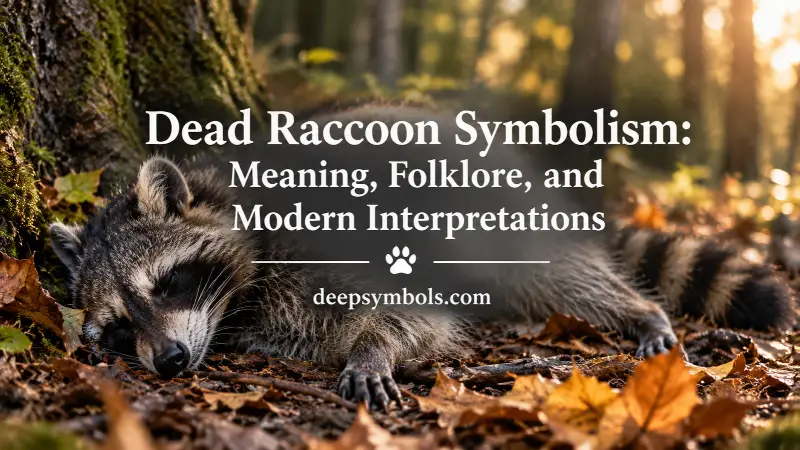
Finding a dead raccoon can be an unsettling experience, especially when the encounter happens unexpectedly on a road, near a home, or along a familiar walking route. In dead raccoon symbolism, the animal’s death may represent an ending, a change in perspective, the consequences of survival strategies, or the need to release an outdated way of approaching life. These are modern symbolic interpretations rather than established universal meanings.
Raccoons are familiar animals across much of the United States. Their masked faces, nimble paws, nocturnal habits, and ability to live near human settlements have made them recognizable figures in wildlife stories, folklore, cartoons, and popular culture. People often associate living raccoons with cleverness, resourcefulness, curiosity, and mischief.
When a raccoon is found dead, those familiar associations can take on a different emotional tone. Someone might interpret the encounter as a reminder of mortality, a symbol of transition, or simply a sad example of the risks wild animals face around roads and human development.
Understanding the symbolism requires separating personal reflection from cultural tradition and practical reality. A dead raccoon does not automatically predict bad luck, signal a supernatural warning, or announce a coming loss. Its meaning depends on the circumstances, the observer’s beliefs, and the associations the animal already holds for them.
Quick Answer
Dead raccoon symbolism commonly represents endings, change, vulnerability, and reflection on the ways people adapt to difficult circumstances. In modern American interpretations, the raccoon’s familiar associations with cleverness, survival, and mischief may turn into reminders to reconsider old habits, accept life’s limits, or approach a transition with greater awareness.
TL;DR
- A dead raccoon may symbolize endings, transition, or changing circumstances.
- The raccoon’s resourcefulness connects its symbolism with survival and adaptability.
- Its death can prompt reflection on vulnerability and the limits of control.
- American folklore often portrays living raccoons as clever, curious, and mischievous.
- Finding one does not establish a supernatural warning or predict future events.
- Modern interpretations depend on personal experience, cultural context, and the circumstances of the encounter.
1. What Does a Dead Raccoon Represent?
A dead raccoon can suggest several ideas when interpreted symbolically. Because the raccoon is commonly associated with intelligence, adaptability, and the ability to find opportunities in difficult environments, its death may invite reflection on what happens when familiar strategies no longer work.
Endings and transition are among the most immediate interpretations. Death represents the conclusion of a living process, so an encounter with a dead animal can remind someone that circumstances change and certain chapters eventually close.
Vulnerability is another possible meaning. Raccoons often appear capable and resourceful, yet they remain vulnerable to traffic, disease, habitat loss, and other dangers. Their vulnerability can challenge the assumption that cleverness or independence makes anyone invincible.
The limits of control may also come to mind. People admire raccoons for their ability to solve problems and adapt, but their lives are still shaped by forces beyond their control. Symbolically, this contrast can encourage humility and a more realistic understanding of uncertainty.
Some people associate the encounter with releasing old habits or reconsidering a situation. This interpretation draws on the raccoon’s reputation for finding unconventional solutions: its death can serve as a personal metaphor for recognizing when a once-useful approach has reached its limit.
None of these meanings is fixed. A person who loves wildlife may experience sadness, while someone already navigating a major life transition may find the encounter prompts reflection. The animal itself does not determine a single message for everyone.
2. Why the Raccoon’s Natural Traits Matter
To understand the symbolism, it helps to consider the animal itself. Raccoons are intelligent mammals known for dexterous front paws, excellent adaptability, and an ability to exploit food sources in varied environments. They live in forests, wetlands, suburbs, and cities, often taking advantage of opportunities created by human activity.
These traits have shaped the raccoon’s reputation in American culture.
Cleverness comes from the animal’s ability to investigate objects, open containers, and find food in unexpected places. A dead raccoon may prompt someone to reflect on the limits of intelligence or the difference between solving a problem and avoiding every danger.
Adaptability reflects the raccoon’s capacity to live in changing environments. Symbolically, its death may bring attention to the fact that adaptation does not guarantee success in every circumstance.
Independence is another common association. Raccoons are generally solitary foragers, although their social behavior varies. Their death can therefore become a personal image of vulnerability beneath an outward appearance of self-sufficiency.
These interpretations are modern reflections based on the animal’s recognizable traits. They should not be mistaken for established traditional beliefs about what a dead raccoon means.
3. Dead Raccoon Symbolism in American Culture
In the United States, raccoons occupy an unusual position. They are wild animals, but they frequently live near people and enter backyards, garages, attics, and trash areas. This closeness makes encounters with them more common than encounters with many other wild mammals.
American popular culture often portrays raccoons as clever troublemakers. Children’s cartoons, wildlife documentaries, humorous videos, and illustrations frequently emphasize their curious expressions and ability to get into places where they do not belong.
The dead raccoon carries a different association because it interrupts this familiar image of activity and mischief. Instead of a nimble animal searching for its next meal, the observer sees a life that has ended.
For some people, this contrast evokes the fragility of wildlife in developed environments. Roads, vehicles, fences, domestic animals, and shrinking habitats can create risks for animals that have adapted to living near people.
For others, the encounter may become a private symbol of change or a reminder to pay attention to neglected problems.
There is no single American tradition assigning a specific meaning to a dead raccoon. Its symbolism is better understood as a mixture of familiar cultural associations, personal interpretation, and the emotional impact of encountering a dead animal.
4. The Symbolism of Endings and New Beginnings
Death naturally brings the idea of an ending to mind. When interpreted metaphorically, a dead raccoon may represent the conclusion of a phase of life, a relationship, a routine, or a way of thinking.
The raccoon’s reputation for resourcefulness adds a particular dimension to this interpretation. A person may have relied on clever workarounds, constant problem-solving, or self-protection for years. Eventually, those strategies might stop helping.
In that context, the dead raccoon can serve as a reminder to recognize when a chapter has ended rather than continuing to force an approach that no longer works.
This does not mean the animal predicts an ending. Instead, the encounter may provide an opportunity to think about changes already taking place.
For example, someone leaving an exhausting job might associate the sight with the end of a period defined by constant improvisation. Another person might connect it with moving away from a familiar environment or abandoning a habit that once provided comfort.
The idea of a new beginning follows from the possibility that an ending creates room for something different. However, renewal is an interpretive extension, not a guaranteed message attached to the animal.
Sometimes an ending simply requires acknowledgment and time before the next stage becomes clear.
5. Cleverness, Survival, and the Limits of Adaptability
Raccoons are often admired for their ability to survive in changing surroundings. They can find food in unexpected places, explore unfamiliar objects, and adjust their behavior when conditions change.
A dead raccoon can complicate the familiar story that resourcefulness always leads to success.
Symbolically, the encounter may raise questions about the limits of personal adaptability. How much responsibility should someone take for solving a difficult situation? When does persistence become exhaustion? Can a person recognize that certain circumstances are beyond their control?
These questions are relevant in modern life, where independence and problem-solving are frequently celebrated. People may feel pressure to overcome every obstacle through greater effort, better planning, or more creativity.
The raccoon’s death can offer a counterpoint to that expectation. Being capable does not eliminate vulnerability, and not every adverse outcome reflects a failure of intelligence or effort.
This interpretation can be especially meaningful for someone who blames themselves for circumstances they could not reasonably control.
The lesson is not to abandon resourcefulness. It is to recognize that adaptability works alongside timing, circumstances, support, and luck. Sometimes the wisest response is not to devise another workaround but to acknowledge a genuine limit.
6. Emotional and Psychological Interpretations
An encounter with a dead animal can produce a range of emotional responses. Some people feel sadness, others experience discomfort or surprise, and some may barely react. The response often depends on personal history, familiarity with wildlife, and the circumstances of the encounter.
If the sight stays in someone’s mind, it may be because it connects with something already happening in their life.
A person experiencing grief might see the animal as a reminder of mortality. Someone facing uncertainty could associate it with a situation that feels beyond their control. Another person may simply feel concern for an animal that died in an environment shaped by human activity.
These reactions do not establish that the encounter carries an external message. Human beings naturally look for patterns and connections, especially when something unexpected interrupts an ordinary day.
Personal symbolism can still be useful. Reflecting on why an image affected you may reveal concerns or emotions that deserve attention.
A helpful question is not necessarily, “What is the universe telling me?” It might instead be, “What did this encounter make me feel, and why?”
That approach allows the experience to have personal significance without treating coincidence as proof of a supernatural cause.
7. Spiritual Meaning: Reflection Rather Than Prediction
Some spiritual interpretations connect a dead raccoon with transformation, the end of an old cycle, or the need to reconsider one’s priorities. These ideas can be meaningful as personal metaphors, but they are not universal spiritual teachings.
The raccoon does not have one widely established religious meaning across all traditions. Its significance varies with cultural background, individual belief, and the symbolic associations a person brings to the encounter.
Someone who views animals as reminders of the natural world’s interconnectedness may interpret the sight as an invitation to practice humility and compassion. Another person may use it as a prompt to reflect on change, grief, or the temporary nature of life.
A grounded spiritual response can include prayer, meditation, journaling, or simply taking time to acknowledge the feelings the encounter produced.
It is important not to turn an unsettling sight into a prediction of misfortune. A dead raccoon does not establish that someone is cursed, that a loved one will die, or that negative events are approaching.
Spiritual reflection is most constructive when it encourages awareness, thoughtful choices, and compassion rather than fear.
8. Dead Raccoon Symbolism in Folklore and Cultural Traditions
Raccoons are native to North America, and their presence in Indigenous cultures predates the development of modern American popular culture. However, Indigenous nations have distinct histories, languages, spiritual practices, and storytelling traditions. There is no single Indigenous interpretation of the raccoon that can accurately represent them all.
Raccoons appear in some North American traditional stories as clever or resourceful figures, although their roles differ between communities and narratives. Such stories should be understood within their specific cultural contexts rather than treated as evidence of one universal meaning.
European-derived American folklore has also portrayed raccoons as mischievous animals, particularly because they explore human settlements and search for food around homes.
Modern cartoons and internet humor have strengthened this reputation. Raccoons are often depicted as masked bandits, a nickname inspired by their dark facial markings and their habit of rummaging through containers.
These living-animal associations may influence how someone interprets a dead raccoon, but it would be misleading to claim that traditional folklore consistently assigns the animal’s death a particular spiritual message.
When exploring cultural symbolism, it is important to distinguish documented stories from interpretations developed by modern spiritual writers or individuals.
9. What Different Circumstances Might Suggest Symbolically
The circumstances surrounding an encounter can influence its personal interpretation. They do not, however, establish a fixed symbolic meaning.
| Encounter | Possible personal interpretation | Practical perspective |
|---|---|---|
| A dead raccoon beside a road | Vulnerability, risk, or an unexpected ending | Vehicle collisions are a real hazard for wildlife. |
| A dead raccoon near a home | Reflection on boundaries or the relationship between people and nature | Raccoons often forage near human settlements. |
| Finding one during a major life change | A personal reminder to acknowledge transition | The timing may feel meaningful without proving a prediction. |
| Seeing one while grieving | A reminder of mortality or the pain of loss | Grief can make encounters with death feel especially significant. |
| Encountering one in a natural area | Awareness of ecological vulnerability | Habitat conditions and natural causes may contribute to wildlife deaths. |
These interpretations are starting points for reflection, not rules. The same encounter can feel completely different to two people, and a person’s emotional response may change over time.
10. Dead Raccoons in Dreams
A dead raccoon in a dream may be interpreted through the qualities people commonly associate with the animal, including cleverness, curiosity, adaptability, and mischief.
For example, someone who dreams of a dead raccoon while dealing with a difficult decision might connect the image with a strategy that no longer feels useful. A person struggling with exhaustion could interpret it as a reminder that constant problem-solving has limits.
Dreams can incorporate recent experiences, emotional concerns, memories, and familiar images. Their content does not provide a reliable way to predict future events, and there is no universally accepted dream dictionary that establishes what every dead raccoon represents.
The setting and emotions within the dream may be more useful than the animal alone. Was the dream frightening, sad, peaceful, or confusing? Did the raccoon remind you of something you had recently seen?
These questions can help you explore personal associations without assuming that the dream contains a coded warning.
If the dream was upsetting, it may be enough to acknowledge the emotion and consider whether anything in daily life has been causing stress or uncertainty.
11. Positive and Negative Interpretations
Dead raccoon symbolism can feel negative because death is commonly associated with loss, vulnerability, and finality. Yet some people use the image to reflect on change, acceptance, and the possibility of moving forward.
A negative interpretation might focus on the end of a familiar arrangement, the consequences of a risky decision, or the discomfort of confronting something that cannot be controlled.
A more constructive interpretation may emphasize recognizing limits, leaving behind unhelpful habits, or responding to vulnerability with compassion.
Neither interpretation is an objective property of the animal. They are ways people organize their thoughts around an emotionally striking experience.
It is also worth remembering that a dead raccoon does not necessarily have a symbolic meaning at all. Sometimes it is simply a wild animal that died from a collision, disease, predation, or another cause.
Allowing for that possibility prevents ordinary events from becoming unnecessary sources of anxiety.
A balanced interpretation leaves room for personal reflection while respecting the difference between a meaningful feeling and a factual claim.
12. Modern Uses in Art, Tattoos, and Personal Expression
Raccoons appear in contemporary illustrations, clothing, tattoos, home decor, and online culture. Their recognizable markings and expressive faces make them appealing subjects for both humorous and serious designs.
A living raccoon tattoo might represent cleverness, independence, curiosity, or an unconventional personality. A design showing a dead raccoon is less standardized and may reflect a more personal subject, such as mortality, grief, environmental concerns, or a deliberately dark sense of humor.
In visual art, a dead animal can draw attention to the effects of roads, urban expansion, pollution, and human activity on wildlife. The image may function as a comment on the tension between modern development and the survival of wild animals.
In alternative art and fashion, death imagery may also be used to challenge conventional ideas of beauty or to explore uncomfortable aspects of existence.
There is no widely established meaning for a dead raccoon tattoo, and it would be unwise to assume a person’s intentions from the design alone. The artist’s approach, accompanying imagery, and wearer’s explanation may provide more context than the subject itself.
13. Ecological Meaning: Wildlife and Human Responsibility
A dead raccoon can prompt reflection not only on personal change but also on the environment people share with wild animals.
Raccoons are adaptable, but their ability to live near people exposes them to hazards created by human activity. Roads, vehicle traffic, improperly secured waste, buildings, and habitat fragmentation can affect their safety.
Seeing a dead raccoon beside a road may therefore draw attention to the practical consequences of sharing space with wildlife. The animal’s death may be an opportunity to think about driving cautiously in areas where animals are active, securing trash, and avoiding unnecessary disturbance to wildlife.
This ecological perspective differs from spiritual symbolism because it focuses on observable relationships between animals and their surroundings.
It also offers a constructive response to an upsetting encounter. Rather than interpreting the sight as an omen, someone might use it as a reminder to act responsibly toward the natural world.
Not every death is preventable, and the cause cannot always be determined by looking at an animal. Still, awareness of wildlife hazards can encourage more thoughtful choices in communities where people and raccoons live close together.
14. Common Misunderstandings About Dead Raccoon Symbolism
One common misconception is that finding a dead raccoon always signals bad luck. There is no universal cultural or religious rule establishing this meaning, and the encounter does not predict future misfortune.
Another misunderstanding is that the animal’s death necessarily represents the end of a relationship, the failure of a plan, or the arrival of a major life change. These are possible personal metaphors, not established facts.
It is also inaccurate to assume that every raccoon carries the same meaning in Indigenous storytelling or other cultural traditions. Specific stories belong to specific communities, and their meanings should not be generalized without reliable context.
Finally, symbolic interpretation should not replace practical judgment. If a dead raccoon is found near a road or property, the immediate concern may be safety, sanitation, or possible exposure to disease rather than spiritual significance.
A useful distinction is to treat symbolism as a way to explore personal meaning while allowing observable facts to explain the animal’s physical death.
15. How to Respond After Finding a Dead Raccoon
If an encounter has left you unsettled, you do not need to decide immediately what it means.
You might take a moment to acknowledge your reaction, particularly if the sight reminded you of a recent loss or an uncertain period in life. If reflection feels helpful, consider whether the animal’s familiar traits—adaptability, independence, or vulnerability—connect with something you are experiencing.
You can also choose to see the encounter as an ordinary part of the natural world. Both responses are valid, and neither requires a supernatural explanation.
Practical safety matters as well. Avoid touching a dead raccoon or allowing pets to approach it. Raccoons can carry diseases, and the cause of death may be unknown. If the animal is on private property, contact local animal control or wildlife authorities for advice on safe handling and disposal; if it is on a roadway, notify the appropriate local service.
If you suspect poisoning, unusual animal behavior, or a possible public-health concern, seek guidance from local authorities rather than attempting to investigate the carcass yourself.
A thoughtful response combines emotional awareness with sensible care for personal safety and wildlife.
FAQs
1. What does finding a dead raccoon mean spiritually?
Some people interpret the encounter as a reminder of change, vulnerability, or the end of an old pattern. These are personal spiritual interpretations rather than universal beliefs or established predictions.
2. Is a dead raccoon a sign of bad luck?
No reliable rule establishes a dead raccoon as a sign of bad luck. The animal may have died from an ordinary cause, and its presence does not prove that something negative will happen to you.
3. What does a dead raccoon symbolize in a dream?
A dead raccoon in a dream may bring to mind endings, changing habits, or the limits of adaptability. Dream meanings are subjective, so your emotions and personal associations are more useful than assuming the image predicts the future.
4. Does a dead raccoon symbolize transformation?
It can serve as a personal metaphor for transformation because death represents an ending, while endings sometimes precede change. However, this interpretation is not a universally recognized cultural or religious meaning.
5. What does a dead raccoon outside your house mean?
Symbolically, someone might associate the encounter with boundaries, vulnerability, or the relationship between human life and nature. Practically, raccoons frequently live near homes, and a dead animal may require safe removal by an appropriate local service.
6. Is there a biblical meaning for a dead raccoon?
The Bible does not establish a specific symbolic meaning for finding a dead raccoon. Christians may reflect on broader themes such as mortality, compassion, and care for creation, but these should not be presented as a direct biblical interpretation of the animal.
Conclusion
Dead raccoon symbolism can bring together endings, vulnerability, adaptability, and the limits of control. Because raccoons are known for their intelligence and resourcefulness, their death may prompt personal reflection on changing circumstances, old habits, or the need to approach a challenge differently. The North Carolina Wildlife Resources Commission’s guide to raccoons provides useful context for understanding the animal’s real-world adaptability and survival skills.
In modern American culture, finding a dead raccoon does not have one universal spiritual meaning. It may inspire thoughts about a closed chapter, personal loss, or the fragility of wildlife, but it does not reliably predict misfortune or guarantee a supernatural message.
Ultimately, dead raccoon symbolism is most useful when it encourages reflection without creating unnecessary fear. The encounter may remind you that circumstances change, familiar strategies sometimes stop working, and even resourceful creatures remain vulnerable. Its meaning comes from the personal significance you draw from the experience, balanced with compassion for the animal and respect for the natural world.


