
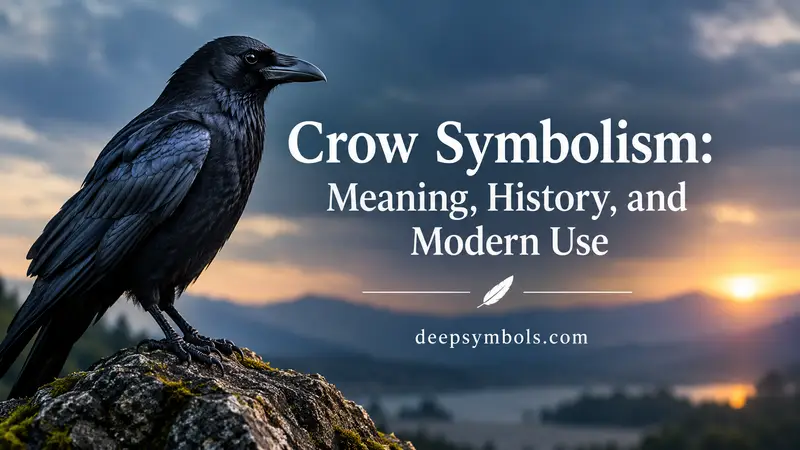
Crows are familiar birds across much of the United States, appearing in neighborhood trees, parking lots, farms, and open fields. Their black feathers, sharp calls, social behavior, and remarkable problem-solving abilities have made them recurring figures in stories, folklore, and art. Crow symbolism commonly connects these birds with intelligence, adaptability, mystery, transformation, and the ability to recognize what others overlook.
Crows have also acquired darker associations. Their presence around carrion and their appearance in stories about death have linked them with endings, warnings, and the unknown. Yet these associations do not make crows inherently unlucky or evil. In many cultural traditions, they are respected as clever observers, messengers, or figures associated with creation and change.
In modern American culture, crows occupy an interesting position between science and symbolism. People may admire their intelligence, photograph them, include them in tattoos, or interpret an unexpected encounter as personally meaningful. Understanding their symbolism requires looking at both the bird’s actual behavior and the different stories people have built around it.
Quick Answer
Crow symbolism commonly represents intelligence, adaptability, mystery, and transformation in modern American culture, especially in folklore, literature, tattoos, and nature-inspired art. Historically, crows and related corvids have also been associated with death, prophecy, creation, spiritual messages, and wisdom, with meanings varying significantly across cultural traditions.
TL;DR
- Crows symbolize intelligence, observation, adaptability, and resourcefulness.
- Their association with carrion helped connect them with death and transformation.
- Many Indigenous traditions feature culturally specific stories involving crows or related birds.
- Norse mythology connects Odin with two ravens, Huginn and Muninn.
- Crow tattoos often represent independence, mystery, resilience, or personal change.
- Seeing a crow is not reliable evidence of bad luck or a supernatural warning.
1. What Makes the Crow a Recognizable Symbol?
The American crow is a medium-to-large black bird with glossy feathers, a sturdy bill, strong feet, and a distinctive call. It commonly lives in a wide range of environments, including cities, suburbs, farmland, forests, and coastal areas.
Crows are highly adaptable. They can recognize familiar people, remember locations associated with food, solve certain problems, and learn from experience. They also communicate with one another, gather in groups, and sometimes cooperate when responding to threats.
These observable behaviors help explain why people associate crows with intelligence and awareness. A crow watching someone from a fence or returning repeatedly to a particular location can appear alert and deliberate, reinforcing its reputation as an observant bird.
Its dark plumage contributes to another layer of meaning. In many Western artistic traditions, black is associated with night, mourning, uncertainty, and the unknown. When this color appears on a bird that also feeds on carrion, the combination can invite associations with mortality and mystery.
However, the bird’s appearance does not determine a universal meaning. The same crow may represent a practical, intelligent animal to a naturalist, a memorable figure in a poem, or a personal reminder of change to someone encountering it in an unexpected moment.
2. The Core Meanings of Crow Symbolism
Several interpretations recur in contemporary American culture, although their origins and significance differ.
Intelligence and wisdom: Crows learn, remember, and solve problems. Their behavior has made them natural symbols of mental sharpness and careful observation.
Adaptability and resourcefulness: Crows thrive in changing environments and take advantage of many food sources. Symbolically, they can represent flexibility and the ability to make use of available opportunities.
Mystery and the unknown: Their dark feathers, nighttime associations in literature, and presence in supernatural stories have connected them with secrets and uncertainty.
Death and transformation: Crows sometimes feed on carrion, linking them with the physical realities of death. In symbolic settings, this association can extend to endings, grief, and the transition from one stage of life to another.
Communication and messages: Folklore sometimes portrays crows as messengers between people, gods, or different realms of existence. This is a cultural interpretation rather than a scientifically established supernatural ability.
Independence and resilience: Their resourcefulness and capacity to survive in varied environments make crows useful symbols of self-reliance and persistence.
These meanings are not interchangeable in every situation. A crow in a story about a battlefield may emphasize death, while one depicted solving a puzzle may represent intelligence. The surrounding narrative determines which association is most relevant.
3. Ancient Associations With Death and the Afterlife
Crows and ravens have long appeared in stories about death because of their feeding habits and their presence in environments where dead animals may be found. Their dark plumage and conspicuous calls have also made them memorable figures in descriptions of battlefields, wilderness, and mourning.
In parts of ancient Europe, carrion-feeding birds became associated with battle and mortality. Their appearance near the aftermath of conflict made them fitting images for the consequences of violence and the uncertainty of human life.
Over time, literature and folklore expanded these practical associations into symbolic ones. A crow could appear as a reminder of mortality, an observer of human suffering, or a figure that connected the living world with the realm of the dead.
It is important, however, to distinguish between the crow and the raven. Both belong to the corvid family, and English-language folklore sometimes blurs their identities. Some famous mythological stories specifically feature ravens rather than crows.
Nor does an association with death necessarily imply evil. Death-related imagery can represent grief, remembrance, the end of a period, or an acknowledgment of life’s limits. In modern literature, a crow may appear at a moment of loss because the bird reinforces the atmosphere of a scene, not because it predicts a real death.
The symbolism developed from a combination of natural observation, human experience, and storytelling rather than from evidence that crows possess supernatural knowledge of mortality.
4. Crow Symbolism in Native American Traditions
Crow symbolism in Indigenous North American cultures cannot be reduced to a single meaning. Hundreds of distinct Indigenous nations have their own histories, languages, teachings, and storytelling traditions, and a bird’s role in one tradition should not automatically be attributed to another.
In some Indigenous stories, crows or related corvids appear as clever, resourceful, or transformative figures. Depending on the specific tradition, a bird character may help bring about change, reveal information, act as a trickster, or participate in accounts explaining features of the world.
The trickster role deserves particular care. Trickster figures can challenge rules, expose human weaknesses, and disrupt established expectations. Their actions may be humorous, creative, destructive, or instructive. A trickster is not simply a villain, and cleverness does not always make the character morally admirable.
Stories involving ravens are especially prominent in some Indigenous cultures of the Pacific Northwest and other regions. In certain traditions, Raven is associated with creation, bringing light, or reshaping the world. These stories are culturally specific and should not be casually transferred to the American crow or treated as one universal Indigenous belief.
For contemporary readers, the most respectful approach is to identify the particular nation and story whenever possible. Indigenous narratives are living cultural traditions, not a collection of interchangeable symbols available for generalized spiritual claims.
Crow symbolism can therefore involve creativity, transformation, and cleverness in particular Indigenous contexts, but the meaning depends on the community and story being discussed.
5. Norse Mythology: Odin’s Ravens and the Search for Knowledge
One of the best-known bird symbols in Norse mythology belongs to Odin, a god associated with wisdom, war, poetry, and knowledge. Odin is accompanied by two ravens named Huginn and Muninn, whose names are commonly translated as “Thought” and “Memory.”
According to the mythological tradition, the birds travel throughout the world and return to report what they have observed. Their role connects ravens with gathering information, remembering events, and understanding what happens beyond one’s immediate surroundings.
Although these are ravens rather than crows, the distinction matters when discussing the history of corvid symbolism. Crows and ravens share many physical characteristics and belong to the same bird family, so their symbolic associations sometimes overlap in modern art and popular culture. Nevertheless, Odin’s companions should correctly be identified as ravens.
Their story has helped establish corvids as symbols of intelligence, observation, and the pursuit of knowledge. In modern fantasy, games, books, and illustrations inspired by Norse mythology, black birds frequently accompany characters who possess hidden information or unusual insight.
The broader lesson is that a dark-feathered bird does not have to symbolize danger. In this tradition, the bird’s value comes from what it observes and remembers. Its symbolism centers on awareness and knowledge rather than simply its appearance.
6. Crow Symbolism in Celtic Folklore and European Stories
Crows and ravens appear in several European mythological traditions, including Celtic stories, where related birds can be associated with warfare, sovereignty, prophecy, and supernatural events.
In Irish mythology, the figure of the Morrígan is associated with war, fate, and sovereignty. She is sometimes connected with battlefield imagery and appears in traditions involving transformations into birds, including raven-like forms. Modern retellings may use “crow” and “raven” loosely, but individual stories and translations can distinguish them.
These associations developed within particular religious and literary settings. A bird appearing around a battle could evoke danger and death, while its presence in a story involving prophecy might suggest knowledge of events beyond ordinary human understanding.
Later European folklore sometimes portrayed black birds as omens. Their calls, sudden appearances, and feeding behavior made them suitable figures for stories about misfortune or the supernatural.
However, European traditions were never completely uniform. Birds could also represent cleverness, protection, or the ability to survive difficult circumstances. Even within a single story, a bird’s role might be ambiguous rather than wholly good or bad.
Modern fantasy literature often draws from these older motifs, using crows to establish an atmosphere of ancient secrets, political intrigue, or approaching change. Such works may be inspired by European folklore without accurately reproducing a specific historical belief.
Understanding this background helps explain why crows can feel ominous in one story and intelligent or protective in another.
7. What a Crow Represents in Modern American Culture
In the United States, crows are both ordinary wildlife and recurring cultural figures. Their presence in suburban neighborhoods, parks, college campuses, and rural landscapes makes them familiar even to people who have little interest in birds.
Their intelligence is one reason they attract attention. American crows can recognize individual human faces and remember people associated with threatening or favorable experiences. They may also communicate information about potential dangers to other crows.
These behaviors have contributed to their reputation as observant animals. In everyday conversation, a crow may suggest someone who notices details, adapts quickly, or understands a situation before others do.
American culture also retains the bird’s association with death and mystery. Horror films, suspense stories, album artwork, and Halloween decorations often use black birds to create a sense of unease. A crow perched on a bare branch can establish a mood without requiring any dialogue.
At the same time, nature photography and birdwatching have encouraged people to appreciate crows as fascinating animals rather than supernatural figures. Their social behavior, vocalizations, and problem-solving abilities make them interesting subjects for observation.
The result is a flexible modern image. A crow can signify intelligence in one context, an ominous atmosphere in another, and resilience or independence in personal artwork. Americans often interpret the bird through a combination of popular culture, individual experience, and older folklore.
8. Crow Symbolism in Spirituality and Personal Reflection
Some people interpret a crow encounter as an invitation to reflect on change, awareness, or an important decision. These personal interpretations often draw on the bird’s reputation for intelligence and its place in folklore.
For example, a crow appearing during a period of uncertainty might remind someone to examine a situation more carefully. A bird repeatedly visiting a yard might become associated with a family memory or a personal turning point.
Such interpretations can be meaningful without requiring the belief that the crow has delivered a literal supernatural message.
Different spiritual traditions assign different meanings to birds, and not every tradition treats crows as messengers or omens. The idea that a crow represents transformation, for instance, is a modern symbolic interpretation in some settings, not a universal religious teaching.
A grounded approach is to consider what the encounter brings to mind. Does it encourage patience, remind you of a loved one, or prompt you to reconsider a decision? Those associations can help a person reflect on experience without claiming certainty about supernatural causes.
Crows also remind observers that nature often behaves independently of human concerns. A bird may appear because food is available, because it recognizes a familiar location, or because it is following its ordinary routine.
Spiritual reflection and natural explanation do not have to be enemies. A person can appreciate the experience personally while recognizing that the bird’s behavior has biological causes.
9. The Psychological Meaning of Seeing a Crow
An encounter with a crow can feel memorable because people naturally connect unfamiliar or striking experiences with their current emotions and concerns.
A person already worried about a major change may notice the bird’s dark feathers and interpret the encounter through feelings of uncertainty. Someone who admires wildlife may instead focus on the crow’s intelligence or independence.
This does not mean that every interpretation is arbitrary. Cultural stories influence what people notice, while personal experiences shape which meanings seem relevant. A crow featured in a childhood story, for example, may evoke curiosity or comfort rather than fear.
The bird’s behavior also matters. A crow that watches quietly from a tree may seem thoughtful, while a group calling loudly near a home may create a sense of urgency. The observer’s interpretation develops from the combination of what the bird does and what the person already associates with it.
Psychologically, the crow can therefore serve as a prompt for reflection. Its image may help someone think about independence, uncertainty, grief, or the need to pay attention.
There is no established psychological rule that seeing a crow predicts a particular event. Nor does an encounter prove that someone is entering a new phase of life. These are personal interpretations, not reliable forecasts.
The most useful meaning is often the one that encourages thoughtful action without creating unnecessary fear.
10. Positive and Negative Crow Symbolism
Crow symbolism includes both favorable and unfavorable associations. The same qualities that make the bird intriguing can also explain why different cultures and individuals interpret it differently.
Positive interpretations often emphasize intelligence, adaptability, curiosity, resourcefulness, and resilience. Crows survive in changing environments and learn from experience, making them useful symbols of practical wisdom and independence.
Negative interpretations tend to emphasize death, misfortune, secrecy, or the unknown. Their black feathers and association with carrion have contributed to these connections, particularly in European literature and horror imagery.
Neither side tells the entire story. A crow’s intelligence does not make it a spiritual guide, and its association with death does not make it a bringer of bad luck.
| Context | Common symbolic meaning | Typical interpretation |
|---|---|---|
| Nature and wildlife | Intelligence and adaptability | Learning, observation, resourcefulness |
| European folklore | Death, prophecy, or mystery | An uncertain event or ominous atmosphere |
| Norse-inspired art | Knowledge and memory | Awareness and the pursuit of information |
| Modern tattoos | Independence and transformation | Personal identity or resilience |
| Horror and literature | Darkness and foreboding | Suspense, danger, or the unknown |
The table illustrates how context shapes meaning. A crow on a wildlife photograph and a crow on a horror movie poster may look identical, yet the intended messages are very different.
11. Why Crows Appear in Tattoos, Jewelry, and Fashion
Crows are popular subjects in tattoos and alternative art because their appearance supports a wide range of interpretations. Their black silhouettes are visually distinctive, and their associations with intelligence, mystery, and transformation allow people to connect the image with personal experiences.
A crow tattoo may represent independence, especially for someone who values self-reliance or prefers to follow an unconventional path. Another person may choose the bird to commemorate a period of change, using its adaptability as a reminder of their ability to adjust to new circumstances.
Crows also appear in designs inspired by gothic aesthetics, folklore, and dark fantasy. In these settings, the bird may establish a mood of mystery or reflect an interest in stories involving the supernatural.
Some designs include moons, branches, skulls, flowers, or keys. A crow beside a moon may emphasize night and mystery, while one carrying an object might suggest discovery or the pursuit of knowledge. These combinations are artistic interpretations rather than symbols with universally accepted meanings.
Jewelry featuring crows or ravens can similarly express an interest in nature, mythology, or personal symbolism. Clothing and accessories may use the bird simply because its silhouette creates a striking visual design.
Anyone choosing crow imagery should consider the meaning they personally want to express rather than assuming the design has one fixed interpretation.
12. Crow Symbolism in Literature, Film, and Popular Culture
Writers and filmmakers often use crows to communicate information about a setting or character before the story explains it directly.
A crow calling from a bare tree can make a landscape feel isolated. A bird appearing near a character’s home may create suspense, especially if the audience has already learned to associate crows with danger or the unknown.
In poetry, crows can represent solitude, harsh weather, mortality, or the persistence of life in an unforgiving environment. Their familiar presence makes them effective subjects for observations about human experience.
Fantasy and supernatural fiction sometimes portray crows as messengers, watchers, or companions to characters with unusual knowledge. Other works use them more realistically, highlighting their social intelligence or their ability to survive near human settlements.
Popular culture also frequently blends crows and ravens. A work inspired by Norse mythology may feature a raven but be described casually as involving a crow, while a story about American wildlife may specifically depend on the behavior of the American crow.
This distinction can matter when tracing symbolism to its historical roots. Not every black bird in a story represents the same tradition, and an artist’s interpretation should not automatically be treated as an accurate account of folklore.
The crow’s continuing appeal comes from this combination of familiarity and ambiguity. It belongs to everyday life, yet its appearance can easily support stories about uncertainty, intelligence, and change.
13. What Does It Mean When a Crow Visits Your Home?
A crow visiting a home may attract attention, particularly if it returns repeatedly or behaves in an unusual way. Some people interpret these visits as reminders of change, intelligence, protection, or the need to pay attention.
There is no universal symbolic meaning attached to a crow appearing near a house. The bird may be searching for food, using a familiar perch, responding to other crows, or taking advantage of a safe place to rest.
Crows can remember locations and people, so repeated visits may reflect ordinary learning rather than a supernatural connection. Food scraps, outdoor pet food, gardens, and nearby trees can all make a property attractive to them.
If the encounter feels personally significant, it is reasonable to use it as an opportunity for reflection. A crow might remind someone to stay observant or to approach a difficult situation with patience. However, the encounter should not be treated as proof that something good or bad is about to happen.
It is also worth observing wildlife respectfully. Avoid disturbing nests, attempting to handle wild birds, or encouraging behavior that creates conflict with neighbors.
A crow near your home can be an interesting part of the natural environment, whether or not you attach a personal symbolic meaning to the experience.
14. Common Misunderstandings About Crow Symbolism
One widespread misconception is that crows always symbolize death or bad luck. These associations occur in some folklore and artistic traditions, but they are not universal. Many interpretations emphasize intelligence, adaptability, creativity, or the ability to learn.
Another mistake is treating all black birds as interchangeable. Crows, ravens, rooks, and other corvids share some characteristics, but they have different natural histories and occupy different roles in particular cultural stories.
It is also misleading to assume that every Indigenous North American tradition gives crows the same spiritual meaning. Indigenous nations maintain distinct cultural teachings, and stories involving Raven or other birds should be understood within their specific contexts.
A further misunderstanding is the belief that a crow’s appearance predicts a future event. Folklore may portray birds as omens, but there is no reliable evidence that seeing a crow forecasts death, financial success, relationship changes, or other personal outcomes.
Finally, the word “crow” can carry different associations in modern art than it did in a historical source. A contemporary tattoo design may draw on gothic aesthetics or personal experiences rather than any ancient tradition.
Recognizing these differences makes crow symbolism more informative. It allows readers to appreciate cultural stories and personal interpretations without confusing them with universal facts.
15. How Crow Symbolism Has Changed Over Time
The crow’s symbolic history reflects changing relationships between people, animals, religion, and storytelling.
In communities where crows were familiar scavengers, their presence around dead animals and battlefields helped connect them with mortality. Folklore and mythology expanded these observations into stories about prophecy, supernatural knowledge, and the boundaries between life and death.
Other traditions emphasized the bird’s cleverness or its role in explaining the world. Norse mythology, for example, gives ravens a place in stories about thought and memory, while particular Indigenous narratives assign crows or ravens roles that depend on their own cultural settings.
European literature later strengthened the bird’s association with ominous landscapes and uncertain events. Modern horror films and gothic art continue to use the crow’s dark silhouette to establish suspense.
At the same time, scientific research into corvid intelligence has encouraged greater appreciation of the bird’s learning abilities and complex behavior. Birdwatchers, wildlife photographers, and educators often present crows as fascinating animals rather than symbols of misfortune.
Contemporary personal symbolism brings these influences together. A crow may represent resilience in a tattoo, mystery in a novel, or simply the intelligence of a wild bird in a photograph.
Its meaning has not moved in a single direction from superstition to science. Older associations remain in circulation alongside modern ecological knowledge and personal interpretations.
FAQs
1. What does a crow symbolize spiritually?
A crow may symbolize intelligence, transformation, awareness, or mystery in modern spiritual interpretations. The meaning depends on the tradition and personal context; there is no single spiritual definition shared by every culture.
2. Is seeing a crow a sign of good luck or bad luck?
Seeing a crow does not reliably predict good or bad luck. Some folklore portrays crows as omens, but their actual presence is generally explained by ordinary bird behavior and environmental conditions.
3. What does a crow tattoo symbolize?
A crow tattoo may represent independence, intelligence, resilience, mystery, or personal transformation. Its meaning can also reflect an interest in wildlife, mythology, gothic art, or a particular life experience.
4. What is the difference between crow and raven symbolism?
Crow symbolism often overlaps with raven symbolism because both birds belong to the corvid family. However, famous traditions such as Odin’s companions in Norse mythology specifically feature ravens, and the two birds should not automatically be treated as interchangeable.
5. What does a crow symbolize in Native American culture?
Meanings differ among Indigenous nations and individual stories. Some traditions feature crows or related birds as clever or transformative figures, while Raven plays important roles in particular creation narratives; these teachings should be attributed to their specific cultural contexts.
6. Why are crows associated with death?
Crows sometimes feed on carrion and have been observed around battlefields and other places where animals or people have died. Folklore and literature developed these natural associations into images of mortality, mourning, and the unknown.
7. Does a crow visiting your house have a special meaning?
There is no universal religious or scientific rule assigning a special message to a crow that visits a home. You may use the encounter as a personal reminder to reflect or pay attention, while recognizing that the bird likely has ordinary reasons for being there.
Conclusion
Crow symbolism brings together intelligence, adaptability, mystery, mortality, and transformation. The bird’s real behavior helps explain its associations with observation and resourcefulness, while mythology, folklore, and literature have connected it with wisdom, death, and the unknown. The Cornell Lab of Ornithology’s American Crow guide provides scientific context for these interpretations by documenting the crow’s problem-solving abilities, social behavior, and cooperation within family groups.
In modern American culture, crows appear in wildlife observation, tattoos, fashion, literature, and popular entertainment. Their meaning depends on the setting: a crow in Norse-inspired artwork may suggest knowledge and memory, while one in a horror story may create an atmosphere of mystery or foreboding. A crow encountered outdoors, however, may simply be an intelligent wild animal going about its life.
Ultimately, crow symbolism is best understood as a collection of cultural and personal meanings rather than a fixed prediction about the future. The crow reminds us that appearances can conceal unexpected qualities and that familiar assumptions deserve a closer look. By considering the bird’s actual behavior alongside the cultural tradition or story in which it appears, we can appreciate both its natural intelligence and its enduring place in human imagination.


