
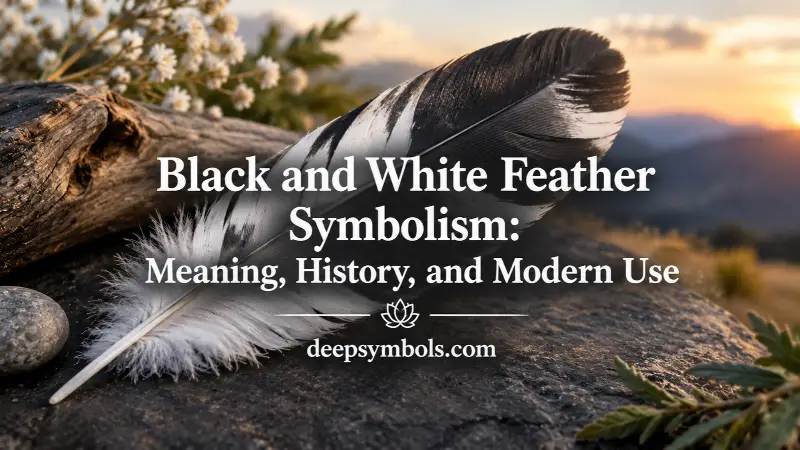
A feather with black and white markings can represent contrast, balance, transition, and the coexistence of different experiences. Black and white feather symbolism draws on the visual relationship between two opposing colors, making the feather a natural image for people reflecting on life’s uncertainties, personal growth, and the relationship between light and darkness. In modern American culture, these feathers may appear in jewelry, tattoos, artwork, nature photography, and personal expressions of remembrance or spirituality.
Feathers already carry associations with birds, flight, freedom, and the natural world. Black and white markings add another layer of interpretation because the colors have developed different meanings across art, religion, folklore, and everyday life. White is often associated with peace, innocence, or clarity, while black may suggest mystery, mourning, authority, or the unknown. Together, they can communicate contrast without necessarily implying conflict.
The meaning also depends on the feather’s source and the circumstances in which someone encounters it. A naturally patterned feather may inspire a personal reflection, while a feather used in a religious ceremony or traditional artwork may carry a specific cultural meaning. Understanding these differences helps separate established traditions from modern interpretations and personal beliefs.
Quick Answer
Black and white feather symbolism commonly represents balance, duality, protection, and the coexistence of opposing experiences in modern American culture. Feathers have also been associated with flight, spiritual connection, and freedom in different traditions, while black and white markings can suggest mourning, renewal, clarity, or the relationship between contrasting forces.
TL;DR
- Black and white feathers often represent balance and contrasting experiences.
- White commonly suggests peace, while black may evoke mystery or mourning.
- Feather symbolism has connections with birds, flight, freedom, and spiritual traditions.
- Native American meanings vary widely among distinct Indigenous nations and ceremonies.
- Tattoos and jewelry often express personal growth, remembrance, or duality.
- Finding a feather does not automatically establish a supernatural message.
1. What Does a Black and White Feather Look Like?
A black and white feather may have a white center surrounded by black edges, alternating bands, spotted markings, or distinct sections of each color. Some feathers display a sharp contrast, while others blend the two colors through gray tones or irregular patterns.
The appearance depends on the bird species. A black-and-white pattern can occur in the feathers of birds such as magpies, certain woodpeckers, and other species with contrasting plumage. Some seabirds and waterbirds also have black-and-white feather patterns, although their markings differ considerably.
These distinctions matter because a feather’s physical characteristics can help identify its likely source. Size, shape, texture, location, and the arrangement of markings may provide useful clues, but color alone is rarely enough for reliable identification.
People encounter black and white feathers in gardens, parks, woodland trails, beaches, and other places where birds live. They also see feather imagery in decorative art, clothing, spiritual products, and memorial designs.
The feather’s physical appearance provides the starting point for interpretation. Its colors may invite symbolic reflection, but the bird itself has a natural history that should not be confused with the meanings people assign to it.
2. The Main Symbolic Meanings of Black and White Feathers
The symbolism of a black and white feather often comes from the contrast between its colors and the qualities people associate with birds.
Balance and duality are among the most common modern interpretations. Black and white appear to stand at opposite ends of a visual spectrum, making their combination useful for representing two sides of an experience, such as joy and sorrow, certainty and doubt, or strength and vulnerability.
Protection and awareness are also common contemporary associations. Feathers appear in spiritual artwork and personal objects as reminders of care, guidance, or a connection with something larger than oneself. These interpretations vary by tradition and are not universal religious teachings.
Transition and personal growth offer another way to understand the image. A person moving through a major life change may see the two colors as representing an old chapter and a new one, or the difficult and hopeful aspects of the same experience.
Clarity and the unknown can also coexist in the symbol. White may suggest understanding, while black can evoke what remains uncertain. Together, they may represent the process of learning to live with unanswered questions.
These are modern symbolic interpretations rather than a single ancient code. Their usefulness lies in the way they help people describe experiences that rarely fit into simple categories.
3. What Black and White Each Represent
To understand the combined image, it helps to examine the colors separately. Their associations are shaped by cultural traditions, personal experience, and the situation in which they appear.
White is commonly connected with peace, innocence, cleanliness, honesty, and new beginnings in many American settings. White clothing may appear at weddings, for example, while white flowers can communicate sympathy or remembrance.
Black has a wider range of associations, including mourning, formality, authority, elegance, mystery, and the unknown. Black clothing is common at funerals, but it is equally prominent in professional fashion and contemporary design.
When the two colors appear together on a feather, their meanings can reinforce or complicate one another. The combination might suggest peacefulness alongside uncertainty, grief alongside hope, or a willingness to acknowledge both positive and difficult experiences.
| Context | Possible symbolic meaning | Important distinction |
|---|---|---|
| Personal growth | Learning from contrasting experiences | A personal interpretation, not a universal rule |
| Grief and remembrance | Love, loss, and continuing hope | Meaning depends on the individual and occasion |
| Spiritual artwork | Guidance, reflection, or connection | Traditions differ in their teachings |
| Fashion and design | Contrast, elegance, and visual balance | Often an aesthetic choice rather than a spiritual statement |
| Nature observation | Adaptation and the variety of bird life | Feather color alone does not establish a spiritual message |
The contrast can be meaningful without assigning black a negative role or white an exclusively positive one. Both colors have complex histories, and neither has a single meaning across all societies.
4. The Historical Significance of Feathers
Feathers have served practical, artistic, and ceremonial purposes for thousands of years. Their lightness, intricate structure, and natural variety make them distinctive materials for clothing, ornamentation, and visual art.
In many societies, feathers have also communicated social position, achievement, identity, or religious significance. Their meanings depended on the bird species, the object in which they appeared, and the customs of the people who used them.
In parts of pre-Columbian Central and South America, featherwork developed into highly skilled artistic traditions. Carefully selected feathers were used in elaborate garments, ornaments, and ceremonial objects. Their colors, rarity, and craftsmanship could communicate wealth, status, and cultural identity.
In traditional Hawaiian culture, feathered cloaks and helmets were associated with chiefly status and authority. These examples show why feathers should not be assigned one universal spiritual meaning: the significance of a feathered object could depend on a particular community’s history and social practices.
Black and white markings may have had particular significance within individual cultures, but there is no reliable basis for claiming that every historical society interpreted the combination in the same way.
The broader historical lesson is that feathers can become meaningful through the relationship between a bird, a community, and the people who use its feathers. Modern interpretations of black and white feathers should be understood alongside that diversity rather than treated as an ancient universal tradition.
5. Black and White Feather Symbolism in Native American Traditions
Feathers have important roles in the ceremonial, artistic, and social traditions of many Indigenous peoples in North America. However, Native American nations are culturally distinct, and their beliefs about birds and feathers cannot be reduced to one shared system.
Depending on the nation and context, particular feathers may be connected with honor, prayer, responsibility, spiritual relationships, or specific ceremonial practices. Their significance can depend on the species, how the feather was obtained, who uses it, and the occasion.
The colors black and white do not have one universally accepted meaning across Indigenous cultures. A black-and-white feather belonging to a particular bird might carry significance within one community that does not apply to another.
It is therefore misleading to claim that all Native Americans interpret black and white feathers as a sign of balance, protection, or a message from ancestors. Those interpretations should not be presented as established tribal teachings without specific cultural evidence.
For readers interested in Indigenous feather traditions, the most respectful approach is to learn from the particular nation or community whose practices are being discussed. This avoids treating diverse living traditions as interchangeable spiritual products.
It is also important to distinguish a general decorative feather motif from an item used in a culturally specific ceremony. Similar appearances do not necessarily indicate similar meanings.
6. Black and White Feathers in Spiritual and Religious Interpretations
Outside specific cultural traditions, some people use feather imagery as a personal reminder of faith, prayer, or spiritual reflection.
In contemporary spiritual communities, a feather may be interpreted as a sign of reassurance, guidance, or connection with the divine. A black and white feather can be used to express the idea that comfort and uncertainty may exist together, particularly during a period of change.
These interpretations are not shared by all religions, and they should not automatically be attributed to Christianity, Judaism, Islam, or another established faith.
For example, Christianity contains many references to birds, including images of divine care and protection. However, the Bible does not establish a universal teaching that finding a black and white feather delivers a particular message from God.
A Christian may personally associate the feather with prayer, hope, or trust without claiming that Scripture defines its appearance as a supernatural sign.
Similarly, someone from another religious background may interpret a feather through the beliefs and practices of their own community.
The key distinction is between a symbol that inspires personal reflection and a religious doctrine that a tradition actually teaches. Both personal meaning and established belief deserve to be described accurately.
7. The Psychological Appeal of Black and White Feathers
Black and white feathers can attract attention because the contrast is visually clear. A light section stands out against a dark one, making the pattern easy to notice and remember.
People also tend to connect visual contrasts with familiar human experiences. The difference between black and white can provide a convenient way to think about competing emotions, conflicting decisions, or changes in personal identity.
Someone experiencing grief, for example, might interpret a black and white feather as a reminder that sadness and gratitude can coexist. Another person facing a major decision might see the contrasting colors as a prompt to consider different perspectives before choosing a direction.
The meaning comes from the interaction between the object and the person’s circumstances. The feather does not need to possess an independently established psychological effect to become personally significant.
There is also a difference between finding comfort in an interpretation and treating it as proof of an external message. A meaningful coincidence can encourage reflection, but the feeling of significance alone cannot establish that an event was supernatural or predictive.
A grounded interpretation allows people to appreciate the emotional importance of an object without requiring every encounter to carry a hidden instruction.
8. Finding a Black and White Feather: What Might It Mean?
Finding a black and white feather can feel memorable, particularly when it appears during a difficult period or brings a particular person to mind.
Some people interpret such an encounter as a reminder of balance, protection, remembrance, or a new stage in life. Others simply appreciate the feather’s appearance or become curious about the bird that dropped it.
There is no universally established meaning for finding one. The Bible does not assign a specific prediction to a black and white feather, and there is no scientific basis for using its appearance to forecast an event.
If the encounter feels meaningful, consider what was happening in your life at the time. Perhaps the feather reminds you of someone you miss, encourages you to approach a decision more thoughtfully, or inspires you to spend more time in nature.
These personal associations can be valuable without being treated as objective evidence of a supernatural message.
It is also worth considering the natural explanation. Birds regularly shed feathers as part of their normal life cycle, and patterned feathers may fall in places where people walk, garden, or observe wildlife.
One practical note for people in the United States: many native bird species are protected by federal law, and possessing their feathers can be restricted even when the feathers have fallen naturally. Admire or photograph an unidentified feather where you find it rather than automatically taking it home.
9. Black and White Feather Symbolism in Dreams
A black and white feather appearing in a dream can become a personal image of contrast, uncertainty, or a search for emotional balance.
Dream interpretation, however, does not provide a universal dictionary in which each object has one scientifically established meaning. The significance of a feather in a dream depends on the dreamer’s memories, emotions, cultural background, and circumstances.
For one person, the feather may recall a bird seen during childhood. For another, it may be connected with a recent loss, a spiritual belief, or a decision that has been difficult to make.
The colors may also influence the dreamer’s interpretation. White could bring to mind peace or a fresh start, while black might suggest grief or an unresolved concern. Yet the same colors can mean something different to another person.
Rather than treating the dream as a prediction, consider the feelings it produced. Did the feather create a sense of calm, sadness, curiosity, or fear? Was it falling, being carried by the wind, or lying somewhere familiar?
These details can help connect the dream to current concerns without assuming that it reveals the future. The most useful interpretation is often the one that helps the dreamer understand their own feelings more clearly.
10. Black and White Feather Tattoos and Jewelry
Feather designs are popular in tattoos and jewelry because they combine recognizable natural forms with room for personal interpretation.
A black and white feather tattoo may represent the ability to accept contrasting aspects of life, a period of change, or the memory of someone important. Some people choose the design because it reflects their appreciation for birds and the outdoors rather than because it carries a spiritual meaning.
The design can also be combined with other imagery. A feather beside a date or name may commemorate a loved one, while one paired with birds in flight may suggest freedom or independence.
Jewelry offers a similar range of possibilities. A pendant or bracelet featuring a black and white feather can serve as a personal keepsake, a reminder of a difficult experience overcome, or simply an expression of individual style.
Because feathers hold specific significance in many Indigenous cultures, it is worth considering the origin and context of a design that imitates ceremonial objects. A general feather motif is not automatically equivalent to a culturally specific feather headdress, insignia, or sacred item.
Ultimately, the design’s meaning depends on the wearer’s intentions and the visual elements they choose. There is no single interpretation that applies to every black and white feather tattoo or accessory.
11. Black and White Feathers in Home Decor and Modern Design
In interior design, black and white feathers can contribute to a look that feels simple, dramatic, or connected to nature.
Their contrasting colors work well in monochrome artwork, printed fabrics, framed illustrations, and decorative patterns. A feather drawing may suggest movement and lightness, while the black and white palette gives the design a more structured appearance.
The image can also suit different decorative styles. In a minimalist room, a simple feather illustration may provide a natural focal point without introducing many colors. In a more eclectic space, feather motifs can complement other natural materials, handmade objects, or wildlife imagery.
In these settings, symbolism often operates alongside aesthetics. A homeowner may choose a feather because it represents freedom or balance, while another person may simply enjoy its shape and texture.
The distinction matters because not every decorative feather is intended to communicate a spiritual belief. Design choices can be meaningful, but they can also be primarily visual.
Black and white feather motifs are therefore best understood as flexible design elements whose emotional associations depend on how and why they are used.
12. Can a Black and White Feather Represent a Loved One?
Some people associate a feather with a deceased loved one, especially when they encounter one during a period of grief or remembrance.
A black and white feather may feel particularly fitting to someone who sees the two colors as representing sorrow alongside affection, or the pain of loss alongside gratitude for a person’s life.
This interpretation can be comforting. Objects often become connected with memories because they remind people of a particular person, conversation, place, or experience. A feather can become one such reminder.
However, it is important to distinguish personal comfort from a claim that the feather definitively proves a loved one is communicating from beyond death. Different people hold different spiritual beliefs, and the appearance of a feather cannot establish one explanation as fact.
A person may keep a photograph of the feather, include a similar design in a memorial, or use the experience as a prompt to remember someone with affection. These choices can honor grief without requiring certainty about the event’s supernatural significance.
The symbol’s value can lie in what it helps a person remember and how it supports their continuing relationship with a loved one’s memory.
13. Common Misunderstandings About Black and White Feathers
One common misconception is that every black and white feather carries the same spiritual meaning. In reality, interpretations vary widely, and the color combination has no universally accepted symbolic definition.
Another misunderstanding is that finding a feather automatically means an angel, spirit, or deceased relative is sending a message. This is a personal or spiritual interpretation rather than an established fact.
It is also inaccurate to assume that black always represents evil or that white always represents goodness. Black has associations with elegance, authority, and protection in some settings, while white can signify mourning in certain cultural traditions.
Claims about Native American feather symbolism also require particular care. Indigenous nations have distinct histories and practices, and broad claims about a universal meaning for black and white feathers can erase those differences.
Finally, a feather’s physical identity should not be confused with its symbolic interpretation. A black and white pattern may help identify a bird species, but it does not establish the feather’s cultural meaning or indicate that it was left for a particular person.
A careful approach leaves room for personal interpretation while recognizing the difference between established cultural practice, natural explanation, and individual belief.
14. Black and White Feather Symbolism in Modern American Life
In contemporary America, the combination of black and white is widely used to communicate contrast, balance, and visual simplicity. Feather imagery adds associations with nature, freedom, and the movement of birds.
These ideas appear in personal accessories, memorial artwork, home decorations, and social media posts. Someone sharing a photograph of a black and white feather might use it to express an appreciation for nature, reflect on a difficult experience, or communicate a personal spiritual belief.
There is no single American tradition governing these interpretations. The United States includes many religious communities, cultural backgrounds, and individual belief systems, each of which can shape how a person understands the image.
The feather can therefore be meaningful without being universally meaningful. A design that represents spiritual guidance to one person may be an artistic choice to another.
This flexibility helps explain why the image remains useful in modern visual culture. It can communicate a broad idea without requiring the audience to share every aspect of the creator’s personal beliefs.
FAQs
What does a black and white feather symbolize spiritually?
It may represent balance, contrasting experiences, reflection, or the coexistence of hope and uncertainty. These are contemporary interpretations rather than a single meaning shared by all spiritual or religious traditions.
Is finding a black and white feather a sign from an angel?
Some people interpret finding a feather as a reminder of spiritual support or reassurance. There is no reliable way to establish that the encounter is a message from an angel, so its significance depends on personal belief.
Does a black and white feather mean good luck?
Some people may associate the feather with encouragement, hope, or a favorable change. However, there is no universal cultural rule or established evidence that finding one predicts good luck.
What does a black and white feather mean in a dream?
It may prompt reflection on conflicting emotions, change, grief, or the desire for balance. Dream imagery is personal, so the feelings and experiences associated with the feather are more informative than a fixed symbolic definition.
What does a black and white feather tattoo represent?
A tattoo may represent duality, personal growth, remembrance, freedom, or a connection with nature. Its precise meaning depends on the wearer’s intentions and any additional elements in the design.
Does the Bible explain the meaning of black and white feathers?
The Bible includes bird imagery and references to feathers, but it does not establish a specific meaning for finding a black and white feather. Any personal Christian interpretation should be distinguished from what Scripture explicitly teaches.
Can I keep a black and white feather I find in the United States?
Not always. Federal protections apply to feathers from many native birds, including feathers that have fallen naturally, so identify the species and check applicable regulations before collecting or keeping one.
Conclusion
Black and white feather symbolism brings together ideas of balance, contrast, reflection, and the coexistence of different experiences. The natural appearance of bird plumage and the cultural associations of black and white can inspire interpretations involving change, remembrance, or the relationship between opposing forces. Yale University’s article on the transcultural history of feathers in art explores how feathers have carried different artistic, spiritual, and cultural meanings across societies.
In modern American life, a black and white feather may serve as a personal reminder of a loved one, a period of transition, or the need to consider different perspectives. Its significance depends on individual experience and cultural context rather than a universal spiritual rule. A feather can be meaningful without predicting the future or carrying a guaranteed supernatural message.
Ultimately, black and white feather symbolism reminds us that contrasting experiences can exist together without canceling each other out. A feather may inspire questions about balance, change, or memory, but its deepest meaning comes from the reflection it encourages. Sometimes, a symbol’s greatest value is not in providing a definite answer, but in helping us see our experiences from a more thoughtful perspective.


