
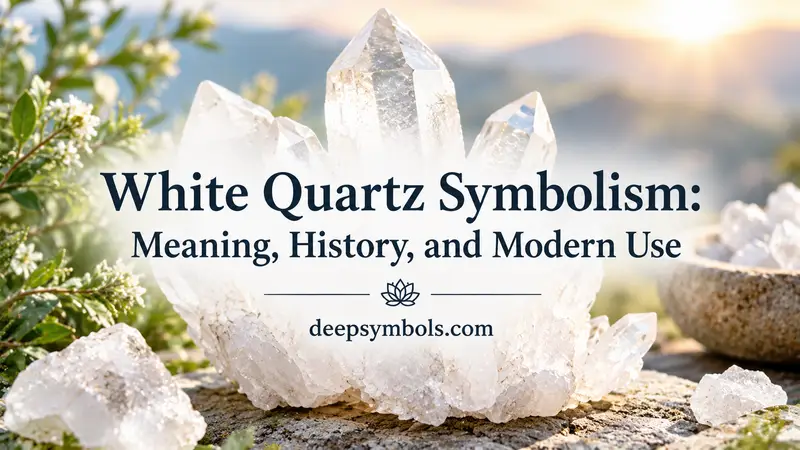
White quartz is a naturally occurring mineral prized for its pale appearance, glassy luster, and association with clarity and simplicity. In modern American crystal culture, white quartz symbolism commonly centers on clarity, balance, renewal, and a fresh perspective. Its understated appearance also makes it popular in jewelry, home decor, meditation spaces, and personal collections.
Unlike gemstones whose colors or rarity dominate their reputation, white quartz often draws meaning from its clean, translucent appearance and its natural crystalline structure. Some people associate it with clear thinking or emotional steadiness, while others appreciate it simply as an attractive mineral that connects decorative objects with the natural world. These interpretations belong to different cultural and personal traditions, and they should not be confused with scientifically established properties.
Quartz has a much longer history than the modern crystal movement. People have used quartz varieties in tools, ornaments, beads, and religious or ceremonial objects across many societies. White and translucent forms have acquired different associations depending on the period, culture, and intended use.
Understanding this stone means separating its geological identity from the meanings people attach to it. Its mineral properties explain its appearance and durability; its symbolism reveals how people use natural materials to express ideas about simplicity, renewal, and the search for clarity.
Quick Answer
White quartz symbolism most commonly represents clarity, balance, renewal, and simplicity in modern American crystal culture, jewelry, and home decor. Historically, quartz has been valued for its practical uses and ornamental qualities, while contemporary spiritual interpretations often associate pale quartz with reflection, focus, and a fresh start.
TL;DR
- White quartz commonly represents clarity, renewal, simplicity, and balance.
- Its symbolism draws partly from its pale, translucent appearance.
- Quartz has a long history of use in tools, ornaments, and beads.
- Modern American crystal culture connects white quartz with reflection and personal intention.
- Jewelry and home decor use the stone to suggest calm, understated beauty.
- Spiritual claims about quartz should be distinguished from established scientific evidence.
1. What Is White Quartz?
White quartz is a variety of quartz, a mineral composed primarily of silicon dioxide. Quartz is abundant in Earth’s crust and occurs in many colors and forms, including clear, smoky, pink, purple, and yellow varieties.
The term white quartz can describe quartz that looks milky, cloudy, or opaque because tiny inclusions, fluid-filled spaces, or other microscopic features scatter light. Milky quartz is a common form. It may appear solid white in one piece and softly translucent in another.
Its appearance varies naturally. Some specimens have a smooth, glasslike surface, while others display rough crystal faces or irregular fractures. These differences influence how the stone is used in jewelry, mineral collections, decorative objects, and interior design.
White quartz should not automatically be treated as the same material as every white gemstone. White jade, white moonstone, white calcite, and white opal have different mineral compositions and physical properties. They may share some symbolic associations, but their geological identities are distinct.
This distinction matters because symbolism often begins with the physical characteristics people notice. White quartz’s pale color, widespread availability, and crystalline appearance help explain why it is frequently associated with clarity and simplicity in contemporary settings.
2. The Main Symbolic Meanings of White Quartz
White quartz has several common symbolic associations in contemporary crystal culture. These interpretations are not universal traditions or scientifically measurable properties; they are meanings people attach to the stone’s appearance and use.
Clarity: Its pale, softly translucent appearance makes white quartz a natural metaphor for clear thinking, honest communication, and seeing a situation more objectively.
Renewal: White is often associated with fresh beginnings in American culture. A white quartz stone may serve as a personal reminder to begin again after a difficult experience or approach a decision with a different perspective.
Balance: Some crystal enthusiasts associate the stone with emotional steadiness and a sense of order. Symbolically, it can represent the desire to respond thoughtfully rather than react impulsively.
Simplicity: Unlike brightly colored gemstones, milky quartz often has a restrained appearance. It can represent an appreciation for uncomplicated beauty, modesty, and a less cluttered approach to life.
Reflection: People may use white quartz during journaling, meditation, or quiet contemplation. In these settings, the stone functions as a physical reminder to pause and consider one’s intentions.
These meanings overlap, but they are not interchangeable in every situation. Someone choosing white quartz for a new home might focus on simplicity and renewal, while someone keeping a stone on a desk might associate it with concentration.
3. Historical Uses of Quartz and Their Symbolic Importance
Quartz has served practical and decorative purposes for thousands of years. Archaeological evidence shows that quartz varieties, including fine-grained materials such as chert, were used to make tools because they could fracture into sharp edges.
Milky quartz also has a documented history in personal ornaments. In ancient Egypt, it was used for objects such as beads and pendants. Its pale appearance made it suitable for decorative work, although the meaning of any particular object depends on its archaeological and cultural context.
Quartz was also used in beads, carved objects, and other ornaments in different societies. These objects could communicate status, personal taste, participation in a tradition, or attachment to a particular material.
It would be inaccurate, however, to claim that every ancient society regarded white quartz as a universal symbol of purification or spiritual healing. Historical use of a stone does not automatically establish a particular symbolic meaning, and modern crystal interpretations should not be projected onto ancient objects without evidence.
The most reliable historical conclusion is that quartz has long been valued for its availability, durability, appearance, and usefulness. Those qualities created opportunities for people to give it additional personal, cultural, and spiritual significance.
4. White Quartz Symbolism in the United States
In the United States, white quartz is particularly visible in crystal shops, mineral collections, jewelry, wellness-oriented retail spaces, and contemporary interior design.
Its symbolic appeal often reflects modern interests in mindfulness, self-reflection, and creating a peaceful personal environment. A person may keep a milky quartz specimen beside a journal or on a desk because its appearance encourages a feeling of order and calm.
Homeowners and decorators may also choose white quartz because it complements neutral colors, natural materials, and minimalist interiors. In this setting, its symbolism is closely connected with simplicity and understated elegance rather than any specific spiritual belief.
Within American crystal culture, some people assign white quartz meanings involving focus, intention, or spiritual awareness. These interpretations vary among practitioners and communities. There is no single authoritative system defining what every white quartz specimen must represent.
The stone also appeals to people who do not believe in crystal spirituality. A mineral collector may appreciate its crystal structure, a jewelry buyer may prefer its understated appearance, and a homeowner may simply like the way it looks in natural light.
This flexibility helps explain its place in American culture: white quartz can function as a decorative material, a geological specimen, or a personal symbol without requiring everyone to share the same beliefs.
5. White Quartz and the Symbolism of the Color White
The color white contributes significantly to the way people interpret white quartz. In the United States, white frequently appears in settings associated with cleanliness, simplicity, peace, and new beginnings.
Wedding dresses, white linens, fresh paint, and minimalist interiors all contribute to the color’s familiar associations. When these ideas are applied to white quartz, the stone may suggest a fresh perspective, a clean visual environment, or a desire for greater simplicity.
White also has meanings beyond these positive associations. It can represent emptiness, coldness, sterility, or distance in particular artistic and design contexts. A white room may feel peaceful to one person but impersonal to another.
Cultural differences matter, too. White is associated with mourning in some East Asian cultural traditions, including aspects of traditional Chinese funeral practices. In many American weddings, by contrast, it is strongly associated with bridal attire and celebration.
These differences demonstrate why white quartz should not be assigned one universal spiritual meaning based on color alone.
Its symbolism develops from the interaction between the mineral’s appearance, the setting in which it is displayed, and the cultural expectations of the person interpreting it.
6. Emotional and Psychological Associations
People often choose meaningful objects because they help make abstract feelings tangible. White quartz can serve this purpose even when its owner does not believe the mineral possesses special properties.
A stone placed beside a notebook may become a reminder to slow down before making a decision. A pendant may represent a personal commitment to approach a new stage of life with patience. A specimen on a shelf may evoke memories of a trip, a gift from a friend, or an interest in geology.
In these cases, the meaning develops through personal association rather than through an inherent emotional effect of the mineral.
The stone’s light color and relatively simple appearance may also contribute to a person’s subjective impression of calm. However, individual responses to colors and objects vary, and there is no established psychological rule that white quartz produces the same emotional reaction in everyone.
This distinction is useful when considering symbolic objects more generally. An object can support reflection because its owner has connected it with a particular intention or experience.
White quartz may therefore represent the wish to think clearly, manage a transition, or create a more peaceful environment. Its value in that role comes from the meaning the person gives it and how they use that reminder in daily life.
7. White Quartz in Spiritual and Meditation Practices
Some contemporary spiritual practitioners use white quartz during meditation, prayer, journaling, or other reflective practices. They may place a stone on a table, hold it while sitting quietly, or include it in a personal arrangement of meaningful objects.
In these settings, white quartz is often associated with clarity, intention, and spiritual reflection. Some crystal traditions also describe it as a stone for purification or connection with higher awareness.
These are spiritual interpretations rather than established properties of the mineral. Practices vary, and there is no universally accepted religious doctrine assigning white quartz the same role across all traditions.
For someone who meditates, the stone can function as a simple focal point. Looking at or holding an object may help establish a familiar routine, much as a candle, photograph, or meaningful piece of jewelry can signal the beginning of a quiet period.
A person does not need to accept supernatural claims to use white quartz this way. It can simply represent a commitment to pause, reflect, and give attention to something important.
The distinction between symbolism and evidence matters: the stone may hold personal or spiritual significance, but its presence does not establish that it can independently change a person’s thoughts, circumstances, or health.
8. White Quartz in Jewelry and Personal Style
White quartz appears in pendants, rings, bracelets, earrings, and beaded necklaces. Its neutral appearance allows it to complement many clothing styles, from everyday casual wear to formal outfits.
Symbolically, a piece of white quartz jewelry may represent simplicity, a fresh start, personal reflection, or an appreciation for nature. Someone might choose it to mark a birthday, a new job, a graduation, or another transition.
Its understated color can also make it suitable for people who prefer jewelry with personal meaning but little visual ornamentation.
White quartz is sometimes confused with clear quartz, white sapphire, moonstone, or other pale gemstones. These materials have different physical characteristics and prices, so buyers should check how a piece is identified and described rather than relying on appearance alone.
The meaning of the jewelry also depends on the giver and wearer. A necklace presented after a difficult period might represent encouragement, while a ring purchased during a vacation might become a reminder of that experience.
The stone itself does not dictate these associations. Jewelry becomes symbolically meaningful through the occasions, relationships, and intentions connected with it.
9. White Quartz in Home Decor and Interior Design
White quartz fits naturally into American interiors that favor neutral palettes, natural textures, and uncluttered spaces.
A rough quartz specimen can add an organic element to a bookshelf, office, bedside table, or display cabinet. Polished pieces may suit contemporary interiors, while larger mineral formations can serve as conversation pieces in a collection.
In decorative settings, white quartz may suggest simplicity, order, and a connection with the natural world. These meanings are especially relevant when the stone is displayed alongside wood, linen, plants, or other natural materials.
Some homeowners also include crystals in meditation corners or personal reflection spaces. In these arrangements, white quartz may symbolize a deliberate effort to create time for quiet thought.
However, decorative quartz should not be confused with engineered quartz countertops. Engineered surfaces are manufactured products made from mineral materials and binding agents, and they do not necessarily carry the same personal symbolism as a natural specimen.
The most meaningful choice depends on the purpose of the object. A mineral collector may prefer a naturally formed specimen, while a decorator may prioritize color, shape, and how the piece complements a room.
10. White Quartz Tattoos and Personal Symbolism
Although quartz is less common as a tattoo motif than roses, moons, or traditional gemstones, crystal designs appeal to people interested in geology, nature, jewelry, and contemporary spiritual aesthetics.
A white quartz tattoo may represent clarity, renewal, patience, or a personal commitment to thoughtful decision-making. Some designs depict a single crystal point, while others combine quartz with flowers, stars, geometric patterns, or mountain imagery.
The surrounding design can change the interpretation. A quartz crystal drawn emerging from a rock may suggest growth or perseverance, while a small minimalist outline may express an appreciation for natural forms.
These meanings are personal rather than standardized. A tattoo featuring white quartz does not automatically indicate a belief in crystal healing, nor does it necessarily communicate spirituality.
Some people choose the design because a particular stone reminds them of a meaningful event or relationship. Others simply enjoy the geometric structure and visual contrast of a crystal illustration.
As with other mineral tattoos, asking the wearer about the design is more reliable than assuming its meaning from the image alone.
11. White Quartz Compared With Other White Stones
White quartz shares its pale appearance with several other minerals, but their symbolic associations and physical properties can differ.
| Stone | Common symbolic associations | Typical appearance |
|---|---|---|
| White quartz | Clarity, simplicity, renewal, balance | Milky or cloudy, sometimes translucent |
| Clear quartz | Clarity, focus, amplification in crystal traditions | Transparent or nearly transparent |
| Moonstone | Intuition, femininity, cycles, new beginnings | Soft glow or shifting sheen |
| White jade | Harmony, virtue, longevity in several cultural traditions | Smooth, opaque to translucent |
| White calcite | Purity, simplicity, reflection in some modern crystal traditions | Often cloudy or chalky, with varied translucency |
These associations are broad cultural or contemporary interpretations, not universal definitions. In particular, claims that one stone inherently produces a specific emotional or spiritual effect should not be treated as scientific findings.
The distinction between white and clear quartz is especially useful. Milky quartz scatters light and appears cloudy, while rock crystal is typically colorless and transparent. Modern crystal communities sometimes assign them overlapping meanings, but the names describe different visual forms of the same mineral species.
When selecting a stone, appearance, mineral identification, durability, and personal preference are more reliable criteria than promises of a guaranteed symbolic or spiritual outcome.
12. Misunderstandings About White Quartz and Crystal Healing
White quartz is sometimes marketed with claims that it can remove negative energy, balance a person’s body, cure illness, or produce specific psychological effects.
These statements should be approached carefully. There is no reliable scientific evidence that white quartz or other healing crystals can independently treat medical conditions or produce the supernatural effects sometimes attributed to them.
That does not mean people cannot find personal meaning or comfort in keeping a crystal. A meaningful object may support a reflective routine or remind someone of a goal. Those uses are different from claiming that the mineral itself has a proven medical effect.
It is also misleading to describe every white quartz tradition as ancient. Quartz has been used for thousands of years, but particular modern systems of crystal meanings have developed through different historical and cultural influences. Their age and origins should not be exaggerated.
Another misconception is that all white quartz has identical symbolic significance. Individual communities and owners interpret the stone differently, and its meaning can change with the setting.
A balanced approach recognizes the difference between geological facts, cultural history, personal spirituality, and scientific evidence. This allows people to appreciate white quartz without confusing symbolic value with a medical guarantee.
13. How White Quartz Symbolism Has Evolved
White quartz’s history illustrates how a familiar natural material can acquire new meanings as its uses change.
For early toolmakers, quartz varieties were valuable because their physical properties made them useful for shaping implements. In ancient societies, milky quartz also appeared in ornaments and decorative objects.
Over time, the stone continued to serve practical and aesthetic purposes. Its availability and range of appearances made it suitable for objects ranging from simple beads to mineral collections and jewelry.
In contemporary American culture, white quartz has gained additional associations through crystal shops, wellness practices, minimalist design, and social media. Images of carefully arranged stones often present them as reminders of focus, intention, or a more considered way of living.
This modern interpretation reflects broader cultural interests in mindfulness and personal expression. It does not mean that every contemporary association has an ancient origin.
The evolution is best understood as an accumulation of meanings rather than a single uninterrupted tradition. Geological usefulness, decorative appeal, personal memories, and modern spiritual beliefs have all contributed to the ways people interpret white quartz today.
FAQs
What does white quartz symbolize spiritually?
White quartz is commonly associated with clarity, reflection, renewal, and balance in modern crystal spirituality. These associations vary between practitioners and represent spiritual interpretations rather than scientifically established properties of the mineral.
Is white quartz considered a stone of protection?
Some contemporary crystal traditions associate white quartz with protection or the clearing of unwanted influences. There is no scientific evidence that the stone creates a protective energy field, so this meaning is best understood as a personal or spiritual belief.
What is the difference between white quartz and clear quartz symbolism?
White quartz is often associated with simplicity, balance, and clarity, while clear quartz is frequently described in modern crystal traditions as representing focus or amplification. These distinctions are not universal, and both varieties are forms of the same mineral, quartz.
Can white quartz symbolize a fresh start?
Yes. Its pale appearance and associations with clarity make white quartz a fitting personal symbol for a new beginning, a change in direction, or a commitment to more thoughtful decisions. This interpretation is especially common in contemporary decorative and spiritual settings.
What does white quartz mean in a home?
In home decor, white quartz can suggest simplicity, natural beauty, and a peaceful atmosphere. Some people also display it as a reminder of personal intentions, while others choose it simply because they appreciate its appearance.
Is white quartz mentioned in the Bible?
The Bible contains references to precious stones and crystal-like materials, but identifying a specific biblical reference as white quartz can be difficult because ancient mineral names and modern mineral classifications do not always correspond. It is better not to assign a definite biblical meaning to white quartz without clear textual or historical evidence.
Does white quartz have scientifically proven healing properties?
No reliable scientific evidence establishes that white quartz can heal illnesses, balance spiritual energy, or produce specific medical outcomes. People may still use it as a decorative object or personal reminder during meditation, but it should not replace evidence-based medical care.
Conclusion
White quartz symbolism brings together clarity, simplicity, reflection, and renewal through the stone’s natural appearance and the meanings people associate with it. Quartz has a long history as a material for jewelry and decorative objects, while its pale, translucent appearance offers a natural foundation for modern interpretations involving clarity and simplicity. The U.S. Geological Survey’s guide to quartz provides useful background on the mineral’s physical properties, historical uses, and place in contemporary crystal culture.
In modern American life, white quartz may appear in jewelry, mineral collections, home decor, or spiritual practices. Some people use it as a personal reminder to reflect on their priorities, while others appreciate its geological characteristics and understated beauty. Its symbolic meaning depends on the context and personal intention rather than on any scientifically established supernatural power.
Ultimately, white quartz symbolism reminds us that meaning can emerge from the relationship between a natural object and the person who values it. The stone can serve as a tangible reminder to approach decisions with clarity, make space for thoughtful reflection, and appreciate the natural world. Its beauty may attract attention, but the significance it holds comes from the experiences, intentions, and values that people choose to associate with it.


