
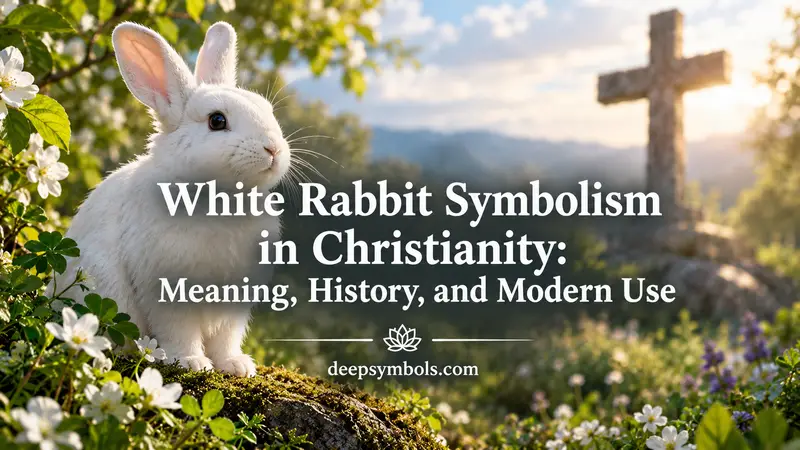
A white rabbit can bring to mind innocence, gentleness, new beginnings, and the quiet beauty of nature. In modern American culture, people may interpret a white rabbit as a reminder of hope, spiritual renewal, or the possibility of a fresh start. White rabbit symbolism in Christianity requires a little more care, however, because the Bible does not assign white rabbits a specific spiritual meaning.
Rabbits and hares appear in biblical discussions of animals, particularly in dietary laws, but they are not presented as central symbols of Christian salvation or divine revelation. The familiar associations between white animals and purity, or between rabbits and new life, developed through a mixture of biblical themes, European folklore, seasonal customs, and modern popular culture.
That distinction does not make the white rabbit meaningless to Christians. Its appearance can prompt personal reflection on God’s creation, humility, vulnerability, and the hope of renewal. Understanding the difference between established Christian teachings and later cultural interpretations helps explain why this small animal can carry spiritual significance without requiring a meaning that Scripture never explicitly gives it.
Quick Answer
White rabbit symbolism in Christianity is commonly interpreted in modern American culture as a personal reminder of innocence, hope, renewal, and God’s creation, although the Bible does not give white rabbits a specific symbolic meaning. Its modern associations draw on broader Christian themes of purity and new life, along with European folklore and Easter traditions rather than a direct biblical teaching.
TL;DR
- The Bible does not identify the white rabbit as a distinct Christian symbol.
- White often represents purity, holiness, and righteousness in Christian imagery.
- Rabbits can suggest vulnerability, gentleness, and new beginnings in modern interpretations.
- Easter rabbits come primarily from European folk customs, not the biblical Easter story.
- A white rabbit encounter may inspire personal reflection but is not a guaranteed divine sign.
- Christian interpretations should distinguish Scripture from folklore and popular spiritual beliefs.
1. What Does a White Rabbit Represent in Christian Contexts?
The white rabbit has no single, officially established meaning across Christianity. Instead, its interpretation depends on which aspects of the animal and its color a person emphasizes.
Purity and innocence are common modern associations because white has a long history in Christian art and worship. When a white rabbit appears in a religious illustration or personal devotional object, its color may suggest a clean heart, sincerity, or a desire to live faithfully.
Renewal and new beginnings are another possible interpretation. Rabbits are associated with reproduction and the arrival of spring, while Christianity connects new life with resurrection and spiritual transformation. These ideas can overlap in contemporary Easter imagery, but the connection is symbolic rather than a direct biblical identification.
Gentleness and vulnerability arise from the rabbit’s physical characteristics. A rabbit is small, alert, and often prey to larger animals. A Christian might see it as a reminder to protect vulnerable creatures and approach others with compassion.
Hope and personal reflection are also common interpretations. Someone who encounters a white rabbit during a difficult period may associate it with encouragement or a fresh perspective.
These meanings can be personally significant, but they should not be presented as a fixed Christian doctrine. The distinction between an established teaching and an individual’s symbolic interpretation is essential to understanding the subject accurately.
2. Does the Bible Mention White Rabbits?
The Bible does not specifically mention white rabbits as a spiritual symbol. It discusses animals resembling rabbits or hares in passages about food, but it does not describe a white rabbit as a messenger from God, a sign of purity, or a symbol of resurrection.
Leviticus 11:5–6 and Deuteronomy 14:7 refer to the hyrax in many modern translations, while older English translations often use terms such as “coney.” The hare is also mentioned in these dietary passages. The exact animal terminology varies by translation, and readers should avoid treating every reference as a reference to the modern rabbit.
These passages concern the animals’ classification under ancient Israelite dietary laws. They are not lessons about rabbit symbolism.
The distinction matters because many modern articles and social media posts describe the white rabbit as though it had a specific biblical meaning. Although Christians may draw personal spiritual lessons from the animal, such interpretations should not be confused with what the biblical text explicitly teaches.
A careful reading allows the white rabbit to serve as a personal reminder of faith without claiming that Scripture assigns it a special spiritual role.
3. What the Color White Means in Christianity
The color white has established associations in Christian imagery, making it an important part of modern interpretations of white animals.
In many Christian traditions, white represents purity, holiness, righteousness, celebration, and the hope of spiritual transformation. Its use in worship, religious clothing, and sacred artwork helps explain why a white animal may be interpreted differently from one with darker coloring.
Several biblical passages contribute to these associations. In Revelation 7:14, white robes are connected with those who have come through tribulation and have been made clean. Revelation 19:8 associates fine, bright, clean linen with the righteous deeds of God’s people. In Matthew 17:2, Jesus’ clothing becomes dazzling white during the Transfiguration.
These passages do not refer to white rabbits. Instead, they establish a broader visual language in which whiteness can communicate holiness, cleansing, or glory.
When someone applies these associations to a white rabbit, they are extending an existing religious theme to an animal. That interpretation can be meaningful as devotional imagery, but it remains an application rather than a direct biblical definition.
White can also carry ordinary meanings, including simplicity and gentleness. Its interpretation depends on the image, tradition, and situation in which it appears.
4. Rabbits, New Life, and Spiritual Renewal
Rabbits are well known for their ability to reproduce, making them natural candidates for associations with fertility, growth, and new beginnings.
In modern Christian settings, these associations sometimes overlap with the idea of spiritual renewal. Christians celebrate resurrection as the foundation of Easter, and the season’s springtime imagery can suggest that life emerges after a period of dormancy.
However, the rabbit’s connection with resurrection is not a teaching found directly in the Bible. The Christian doctrine of resurrection rests on the death and resurrection of Jesus, as described in the Gospels and explained elsewhere in the New Testament.
A rabbit may nevertheless function as a visual reminder of renewal in a contemporary religious setting. For example, a family might include rabbit decorations alongside spring flowers and other seasonal images as part of an Easter celebration.
The important distinction is that the rabbit illustrates an idea rather than establishes a doctrine. New life is a Christian theme; the rabbit is one of several cultural images people use to express it.
For personal reflection, a white rabbit may encourage someone to consider forgiveness, renewed commitment, or the possibility of beginning again after a difficult experience.
5. The White Rabbit and Easter Traditions in America
In the United States, the white rabbit is strongly associated with Easter celebrations, particularly through the Easter Bunny.
The Easter Bunny is a folk character associated with eggs, candy, baskets, and gifts for children. Its development is linked to European customs, especially German-speaking traditions involving an Easter hare that brought eggs to children. German immigrants helped introduce related customs to North America, where they developed into familiar family celebrations.
Over time, the Easter Bunny became a recognizable feature of American seasonal culture. Shopping displays, children’s books, school activities, decorated eggs, and family photographs helped establish the rabbit as an enduring image of spring.
Its white appearance in illustrations and commercial decorations can reinforce associations with innocence, cleanliness, and seasonal freshness. Yet Easter rabbits and eggs are not central elements of the biblical accounts of Jesus’ resurrection.
For Christians, Easter’s primary religious meaning concerns the resurrection of Jesus Christ. Rabbit imagery belongs to the surrounding cultural celebration rather than the essential content of the biblical story.
Families may embrace both traditions in different ways. Some treat the Easter Bunny as a playful activity for children, while others prefer to focus exclusively on church services and religious observances.
Recognizing this distinction makes it possible to appreciate the rabbit’s place in American culture without confusing folklore with Christian theology.
6. White Rabbit Symbolism Across Different Cultural Traditions
The white rabbit has meanings outside Christianity, and these traditions help explain why people encounter different interpretations online.
In European folklore, rabbits and hares have long been associated with fertility, seasonal change, and folklore surrounding spring. These associations contributed to the later popularity of the Easter hare and related rabbit imagery.
In Chinese culture, the rabbit is one of the twelve animals of the zodiac. It is often associated with gentleness, tact, and good fortune. The Moon Rabbit, a figure in East Asian folklore, is connected with the moon and stories involving the preparation of an elixir or other substances, with details varying across traditions.
In Japanese culture, the rabbit is also associated with the moon, particularly through a familiar folk image of a rabbit making rice cakes. This motif has its own cultural history and should not be treated as a Christian teaching.
Modern Western popular culture adds another layer through stories such as Alice’s Adventures in Wonderland, in which the White Rabbit helps lead Alice into an unfamiliar world. In this context, the rabbit can suggest curiosity, urgency, or entry into the unknown.
These traditions demonstrate that the same animal can carry several meanings. A Christian interpretation should not automatically absorb ideas from another religion or folklore tradition simply because the animal is the same.
7. Gentleness, Vulnerability, and Compassion
A rabbit’s physical characteristics offer another way to understand its possible spiritual significance.
Rabbits are generally small, alert animals that rely on quick movement and awareness to avoid predators. Their vulnerability makes them useful images of gentleness and the need for protection.
Within Christian ethics, this can prompt reflection on the treatment of vulnerable people and animals. The Bible repeatedly encourages care for those in need, although it does not specifically connect those teachings with white rabbits.
Proverbs 12:10, for example, describes the righteous person as caring for the needs of their animals. Matthew 25:35–40 emphasizes acts of care toward people who are hungry, thirsty, strangers, sick, or imprisoned.
A white rabbit in religious artwork could therefore serve as a reminder of compassion, especially when paired with imagery about stewardship or care for creation.
This interpretation is not about the rabbit possessing supernatural power. It is about using an ordinary living creature to reflect on values that Christians already recognize as important.
The rabbit’s small size can also encourage humility. It offers a contrast to images of dominance and strength, reminding viewers that gentleness and care can be meaningful qualities in their own right.
8. White Rabbits and God’s Creation
Another reasonable Christian interpretation focuses on the natural world itself.
Genesis 1 describes the creation of living creatures and presents the created world as part of God’s work. Psalm 104 celebrates the variety of life sustained within creation. These passages provide a broader theological context for appreciating animals, including rabbits.
A white rabbit might prompt someone to notice the diversity of nature, reflect on the care of living things, or feel gratitude for the natural world.
Its white coat may make it appear unusual or visually striking, but its color does not establish that it has been sent as a message from God. White rabbits can occur through natural genetic variation, selective breeding, or other biological factors, depending on the animal.
From a Christian perspective, an ordinary natural explanation and a meaningful personal reflection are not mutually exclusive. A person can appreciate an encounter with a rabbit as a moment of gratitude without claiming that it predicts a future event.
This approach also encourages responsible treatment of animals. A rabbit should not be chased, captured, or disturbed because someone believes it has appeared for a spiritual purpose.
Appreciating creation means respecting the creature itself, not merely assigning it a symbolic role.
9. What Does It Mean to Dream About a White Rabbit?
Dream interpretations involving white rabbits are common in modern popular spirituality, but Christianity does not provide a universal interpretation for this particular dream.
A person who dreams of a white rabbit might associate it with innocence, vulnerability, a fresh start, or something they feel drawn to protect. The emotional tone of the dream can influence how the image is understood.
For example, a calm rabbit in a peaceful setting might remind someone of safety or gentleness. A frightened rabbit might bring to mind a personal concern about vulnerability or responsibility. A rabbit running away could reflect a dreamer’s own associations with uncertainty or something difficult to hold onto.
These are possibilities for personal reflection, not established biblical interpretations. The Bible contains accounts of significant dreams, but it does not teach that every dream involving an animal carries a divine message.
Christians who take dreams seriously may choose to reflect prayerfully on their experiences while remaining cautious about claims that a specific image predicts the future.
It can help to consider what was happening in life when the dream occurred, what feelings it produced, and whether its themes connect with a real concern.
A dream about a white rabbit does not, by itself, prove that God is delivering a warning, promising a blessing, or directing a major decision.
10. Seeing a White Rabbit: Spiritual Sign or Coincidence?
Some people wonder whether seeing a white rabbit in a garden, on a road, or during an important moment carries a spiritual message.
Christianity does not establish a general rule that a white rabbit’s appearance is a sign of divine intervention. There is no biblical promise that seeing one predicts good fortune, an approaching relationship, financial success, or a major life change.
Nevertheless, personal encounters can become meaningful reminders. Someone who sees a white rabbit while thinking about forgiveness might use the moment to reflect on the importance of starting again. Another person might feel grateful for the beauty of creation or remember a lesson about gentleness.
The meaning in such cases comes from personal reflection, not from a universally prescribed Christian code.
It is also sensible to consider ordinary explanations. Rabbits live in many environments, and their presence may be related to food, shelter, breeding behavior, or the surrounding habitat.
A balanced Christian response can acknowledge the emotional significance of an experience without treating it as a command or prediction. Important decisions are better approached through thoughtful judgment, prayer, relevant facts, and trusted counsel than through the appearance of an animal alone.
11. White Rabbit Symbolism in Tattoos, Jewelry, and Home Decor
White rabbit imagery appears in contemporary American design, where its meaning depends on the person choosing it and the setting in which it is displayed.
A rabbit pendant or figurine may represent affection for animals, a childhood memory, or an appreciation for gentle imagery. When the rabbit is white, the owner may associate it with innocence, peace, or a new beginning.
Some people choose rabbit tattoos to commemorate a loved one, express their connection with nature, or represent personal qualities such as alertness and adaptability. A white rabbit tattoo may also draw inspiration from a favorite book, film, or game rather than religion.
In Christian homes, a rabbit decoration might appear as part of Easter celebrations or springtime displays. Families may combine it with crosses, flowers, or other decorations, although the meanings of these objects remain distinct.
Social media adds further possibilities. An image of a white rabbit might be used to communicate a sense of wonder, nostalgia, curiosity, or personal transformation.
None of these uses automatically establishes a Christian meaning. To understand a particular design, it is helpful to consider whether its creator intended a religious message, a cultural reference, or simply an attractive image.
12. Common Misunderstandings About White Rabbit Symbolism
Several common claims about white rabbits blur the distinction between Christian teaching and later interpretations.
Misunderstanding one: The white rabbit is a biblical symbol of purity. White has established associations with purity and holiness in Christian imagery, but the Bible does not specifically identify the white rabbit as an emblem of either.
Misunderstanding two: White rabbits symbolize Jesus’ resurrection. Rabbits have become associated with Easter through folk traditions and springtime customs. The resurrection itself is a central Christian teaching, but the rabbit is not identified in Scripture as its symbol.
Misunderstanding three: Seeing a white rabbit always means good luck. This idea draws on broader folklore and modern spiritual interpretations, not a universal biblical promise.
Misunderstanding four: A white rabbit in a dream predicts the future. There is no established Christian rule assigning a specific prediction to this dream image.
Misunderstanding five: All rabbit symbolism comes from Christianity. European folklore, East Asian traditions, children’s literature, and modern entertainment have all contributed to the rabbit’s wider cultural meanings.
These distinctions do not prevent people from using white rabbit imagery in a Christian setting. They simply help ensure that personal symbolism is not mistakenly presented as Scripture.
13. Comparing White Rabbit Meanings in Different Contexts
The following table summarizes how the white rabbit may be understood in several settings.
| Context | Common interpretation | Important distinction |
|---|---|---|
| Christian reflection | Innocence, gentleness, or appreciation of creation | Personal interpretation, not a specific biblical symbol |
| White color in Christian art | Purity, holiness, or righteousness | These associations apply to white imagery generally |
| American Easter customs | Spring, eggs, family celebrations, and new life | The Easter Bunny comes from folklore, not the biblical resurrection account |
| European folklore | Fertility, seasonal change, and spring | Meanings vary by story and tradition |
| Chinese and Japanese traditions | Lunar folklore and other cultural associations | These meanings belong to distinct cultural traditions |
| Modern tattoos and decor | Personal memories, gentleness, or new beginnings | The owner’s intention determines the individual meaning |
The central point is that a symbol does not carry the same meaning everywhere. Its interpretation changes according to religious context, cultural history, and individual experience.
14. How Christians Can Interpret the White Rabbit Thoughtfully
Christians who find meaning in white rabbit imagery can approach it as an opportunity for reflection rather than as a secret code that must be deciphered.
One approach is to connect the animal with a clear biblical theme. A rabbit may remind someone to appreciate creation, act with gentleness, or consider how they treat vulnerable living things. White coloring may prompt reflection on the biblical imagery of purity, while remaining distinct from a direct claim about the rabbit itself.
Another approach is to recognize the influence of family and culture. An Easter rabbit may bring back childhood memories, while a rabbit from a favorite story may symbolize curiosity or change. Those associations can be meaningful without being religious teachings.
It is also helpful to avoid making major decisions based on a supposed sign. An animal’s appearance should not replace careful judgment or be used to claim certainty about God’s intentions.
Finally, Christians can ask whether an interpretation encourages responsible behavior. If the image inspires gratitude, compassion, or a renewed commitment to faith, it can serve as a constructive personal reminder.
The goal is not to dismiss symbolism, but to distinguish personal meaning from claims about what the Bible explicitly teaches.
FAQs
1. What does a white rabbit symbolize in Christianity?
A white rabbit may represent innocence, gentleness, hope, or renewal in modern Christian reflection. However, the Bible does not assign it a specific symbolic meaning, so these associations should be understood as personal or cultural interpretations.
2. Is a white rabbit mentioned in the Bible?
The Bible mentions hares and other animals that older translations sometimes identify using different names, but it does not specifically establish a white rabbit as a spiritual symbol. The relevant passages primarily concern dietary laws rather than religious symbolism.
3. Does a white rabbit symbolize Jesus or the resurrection?
Not directly in the Bible. The rabbit became associated with Easter through European folk customs and springtime traditions, while Christian belief in the resurrection is grounded in the New Testament accounts of Jesus.
5. What does a white rabbit in a dream mean for Christians?
There is no universally accepted biblical interpretation of a white rabbit dream. A person may use the dream to reflect on vulnerability, peace, or a new beginning, but should not assume it predicts the future.
6. Is the white rabbit a symbol of purity?
White is commonly associated with purity and holiness in Christian imagery, but this does not make the white rabbit an established biblical emblem of purity. Applying that meaning to the animal is a later interpretive choice.
7. Is the Easter Bunny a Christian symbol?
The Easter Bunny is primarily a folk character associated with European seasonal customs and later American celebrations. Families may include it in Easter festivities, but it is not part of the biblical account of Jesus’ resurrection.
Conclusion
White rabbit symbolism in Christianity brings together ideas of innocence, gentleness, hope, and renewal through a mixture of cultural tradition, Christian art, and personal interpretation. Although the Bible does not establish the white rabbit as a spiritual symbol, the animal has appeared in European religious artwork and later became a familiar part of American Easter celebrations. The Smithsonian Magazine’s history of the Easter bunny provides useful context for understanding how these associations developed over time.
For modern American Christians, a white rabbit may serve as a personal reminder of new beginnings, compassion, or the renewal associated with spring and Easter. These meanings can be meaningful without treating the animal as a guaranteed omen or claiming that Scripture assigns it a specific spiritual power.
Ultimately, white rabbit symbolism in Christianity is most useful when cultural history is kept distinct from biblical teaching. A white rabbit can inspire reflection on hope, gentleness, and new life, but its significance comes from the context and intention behind the image. The lasting value lies not in assuming that the animal predicts something, but in allowing its familiar presence to encourage thoughtful faith, compassion, and a renewed appreciation for life.


