
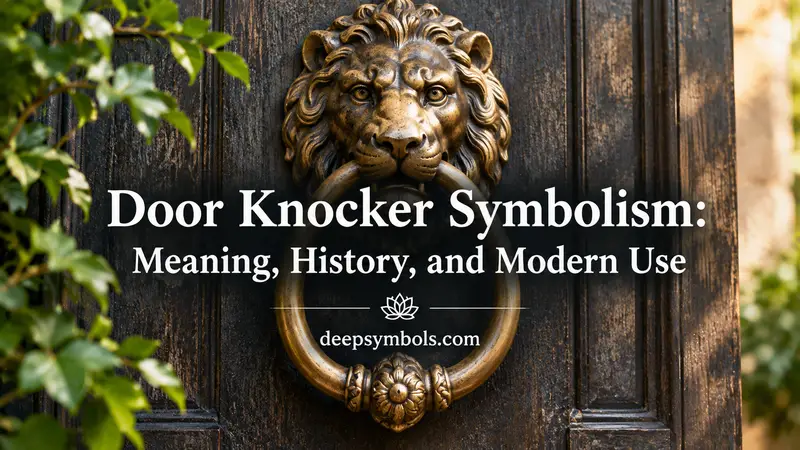
A door knocker is more than a practical object used to announce a visitor. Mounted on the outside of a door, it can communicate hospitality, authority, personal style, and the boundary between private life and the outside world. Door knocker symbolism draws meaning from the simple act of arriving at someone’s home and asking to be welcomed inside.
Door knockers take many forms, including metal rings, animal heads, human faces, hands, and decorative geometric designs. Some appear on historic mansions and traditional townhouses, while others decorate modern front doors as distinctive architectural details. Their appearance often reflects the building’s age, the owner’s taste, and the impression the entrance is intended to create.
In the United States, a door knocker can suggest an appreciation for history, craftsmanship, hospitality, or traditional home design. Its meaning may also depend on the shape itself: a lion can suggest strength, a hand can evoke welcome or religious imagery, and a simple brass ring can convey understated elegance. Understanding these associations reveals how an everyday household fixture can become a small but expressive symbol of home and identity.
Quick Answer
Door knocker symbolism commonly represents hospitality, welcome, protection, and the boundary between a private home and the outside world in modern American culture. Historically, door knockers also communicated wealth, social standing, craftsmanship, and religious or protective beliefs through their materials and decorative designs.
TL;DR
- Door knockers symbolize welcome, hospitality, and access to the home.
- Historic designs often reflected wealth, craftsmanship, and social status.
- Lions and other animal motifs can suggest strength and protection.
- Brass and bronze connect door knockers with durability and traditional architecture.
- Hand-shaped and religious designs carry meanings that vary by culture.
- Modern homeowners use decorative knockers to express taste and architectural identity.
1. What Is a Door Knocker and Why Does It Matter?
A door knocker is a hinged or movable fitting attached to a door, usually with a metal striking surface that produces a sound when lifted and released. Traditional examples often consist of a ring, a shaped handle, or a metal ornament mounted against a plate. Some modern versions are primarily decorative, although many remain functional.
Unlike an ordinary doorbell, a traditional knocker requires a visitor to make a deliberate physical gesture. The visitor lifts the fitting and strikes the door, creating an audible announcement that someone has arrived. This action makes the object closely connected with the social ritual of requesting entry.
Its symbolic importance comes from that position at the entrance. The front door marks the transition between public space and private life, and the knocker sits directly on that boundary. It announces a visitor without granting automatic access.
Because the fixture is visible before anyone enters, it can also shape a first impression. An elaborate brass knocker may make a house feel formal and traditional, while a simple iron ring can suggest rustic simplicity. A whimsical animal design may communicate playfulness.
The object therefore serves two purposes: it helps people announce themselves, and it gives the entrance a recognizable character.
2. The Core Meaning of Door Knockers
Door knockers do not have one universal symbolic meaning, but several associations recur in their design and use.
Hospitality and welcome are among the most natural interpretations. The knocker invites visitors to announce themselves and gives the resident an opportunity to respond.
Protection and security arise from the doorway’s role as a controlled entrance. A visitor must signal their presence before entering, while the person inside decides whether to open the door.
Tradition and continuity appear in historic homes and buildings that preserve older architectural details. A traditional knocker can suggest respect for established styles, family history, or craftsmanship.
Status and refinement may be conveyed through expensive materials, elaborate ornament, and carefully designed entrances. In some historical settings, decorative door hardware helped distinguish prominent residences from more modest buildings.
Identity and personal expression are important in contemporary homes. A homeowner may choose a knocker shaped like an animal, a family emblem, or a favorite motif to express personality.
These meanings depend on context. A heavy iron knocker on a country cottage may communicate durability and rustic character, while an ornate brass design on a historic townhouse may emphasize formality and architectural heritage.
The symbolism emerges from the combination of function, placement, material, and visual design rather than from a fixed meaning shared by every knocker.
3. The History of Door Knockers
Door knockers have a long history, although the precise origin of the first knocker is uncertain. Early examples of metal knockers are associated with the ancient Mediterranean world, including ancient Greek and Roman settings. Their basic purpose was practical: visitors needed a way to announce themselves without entering a residence uninvited.
As door hardware developed, knockers became more than simple striking devices. Metalworkers began producing decorative forms that combined utility with sculpture. Lion heads, rings, masks, and other elaborate motifs appeared on the entrances of important buildings.
During medieval Europe, heavy metal knockers became prominent features of some churches, public buildings, and substantial residences. Their placement on large wooden doors made them easy to use, while their designs could convey authority, religious identity, or the status of the institution or household.
The Renaissance brought particularly elaborate bronze examples. In Venice, for instance, decorative knockers on palace doors helped communicate the wealth and civic identity of the families who commissioned them. Lion imagery could refer to Venice itself, whose traditional emblem is the winged Lion of Saint Mark.
By the eighteenth and nineteenth centuries, cast-iron and brass door knockers became increasingly familiar in domestic architecture. Advances in manufacturing made a wider variety of styles available, including ornate Victorian designs.
In the United States, door knockers became part of the architectural vocabulary of traditional houses, townhouses, and historic buildings. Today, antique reproductions and contemporary designs preserve this tradition even though doorbells and electronic entry systems have taken over much of the practical work.
4. The Lion Door Knocker: Strength and Protection
<text weight=”medium” size=”sm”> </text>
<AsyncImageGroup query={[“antique brass lion head ring door knocker historic wooden door”,”Victorian lion head bronze door knocker close up”]} aspectRatio=”5:4″ layout=”bento” size=”lg”/>
The lion is one of the most recognizable motifs in traditional door-knocker design. Often shown holding a metal ring in its mouth, the lion head gives the entrance a bold, commanding appearance.
Lions have long been associated with strength, courage, authority, and guardianship in many artistic traditions. Placing one on a door can therefore suggest that the home is secure, dignified, and protected.
Historical examples show that lion knockers could also communicate more specific meanings. In Venice, lion imagery was connected with civic identity and loyalty to the city. In medieval Islamic contexts, lion-shaped knockers could appear on important buildings and communicate authority or royal associations.
These historical uses demonstrate why it is important not to assign every lion knocker exactly the same meaning. A lion might express family pride, civic allegiance, religious or political authority, or simply a preference for traditional ornament.
In modern American homes, the lion is often chosen for its classic appearance. It suits traditional brick houses, historic renovations, formal entrances, and doors made from dark wood. Some homeowners also interpret it as a reminder of strength and protection.
A lion knocker does not automatically indicate that the owner believes in supernatural guardianship. Its symbolism may be entirely aesthetic, although its traditional associations can still influence how visitors perceive the entrance.
5. Hand-Shaped Door Knockers and Their Cultural Meanings
<AsyncImage query=”antique Victorian brass hand shaped door knocker holding metal ball” aspectRatio=”16:9″ width=”100%”/>
Hand-shaped door knockers are distinctive because they turn the visitor’s own gesture into a decorative image. Many traditional examples show a hand holding a ring or metal ball, sometimes with a sleeve, bracelet, or other ornamental detail.
The hand can suggest greeting, human contact, assistance, or the act of presenting something to another person. A hand-shaped knocker may consequently evoke welcome, although the meaning depends on the design and the tradition from which it comes.
A particularly important distinction concerns the khamsa, also known as the Hamsa or Hand of Fatima in some traditions. This is generally represented as an open hand and has protective associations in several Muslim and Jewish cultural settings. It is also used in contemporary jewelry, decorative objects, and architecture.
However, a traditional closed-hand knocker holding a ring is not automatically a Hamsa. The designs can look similar at a glance, but their forms and cultural histories differ. The symbolism of a specific object should be established from its actual design and context.
For American homeowners, a hand-shaped knocker may appeal because it feels personal, historic, or visually unusual. When a design draws explicitly on a religious or cultural tradition, understanding that tradition helps prevent an inaccurate interpretation.
6. The Symbolism of Different Door Knocker Shapes
The shape of a door knocker often influences its visual message. Some motifs have established historical associations, while others acquire meaning mainly through personal taste.
| Door knocker design | Common symbolic association | Architectural impression |
|---|---|---|
| Lion head | Strength, authority, guardianship | Formal and traditional |
| Plain metal ring | Simplicity, continuity, craftsmanship | Classic and understated |
| Hand-shaped design | Greeting, human presence, sometimes cultural or religious identity | Historic and distinctive |
| Animal or bird motif | Qualities associated with the animal, depending on the tradition | Personal or decorative |
| Floral or botanical design | Nature, growth, ornament, or seasonal beauty | Welcoming and decorative |
A bird-shaped knocker, for example, might appeal to someone who enjoys nature, while a floral design can complement a cottage-style home. These associations are usually interpretive rather than universal symbolic rules.
The shape also influences how visitors experience the entrance. A heavy, elaborate knocker may feel formal, while a small, playful design can make a house appear more relaxed.
7. Door Knocker Symbolism in American Homes
In the United States, door knockers are often associated with traditional architecture, historic preservation, and a deliberate approach to home design.
They are particularly at home on Colonial Revival houses, Federal-style residences, historic brick townhouses, and traditional wooden front doors. In these settings, the knocker can help preserve the visual character of the building.
American homeowners also use door hardware to communicate individual taste. A polished brass ring may suggest a preference for classic design, while an antique iron knocker can complement a farmhouse or rustic cottage.
In historic neighborhoods, original knockers sometimes become part of a building’s architectural identity. Preserving them can help maintain a connection with the craftsmanship and domestic conventions of an earlier period.
The object also participates in an American idea of hospitality: the home is a personal space, but its entrance offers a point of contact with neighbors, guests, and the wider community.
That does not mean every household with a knocker is especially welcoming, nor that houses without one are less hospitable. The symbolism comes from cultural associations, not a reliable measure of a resident’s character.
In contemporary construction, some people install decorative knockers alongside doorbells or smart doorbells. This allows them to retain a traditional visual feature without giving up modern convenience.
8. The Doorway as a Boundary Between Public and Private Life
A door knocker’s position is central to its symbolism. It sits at the point where the outside world meets the private interior of a home.
Before a visitor enters, they announce themselves. The resident hears the sound and decides whether to respond, open the door, or remain inside. This small interaction reflects a larger social principle: access to someone’s home depends on permission.
The knocker can therefore symbolize boundaries, privacy, and mutual respect. It gives visitors a recognized way to request entry without assuming they are entitled to it.
The same idea applies metaphorically. People often distinguish between their public identity and private life, deciding which relationships, conversations, and experiences they are willing to share. The door becomes a natural image for that transition.
In literature and film, a knock at the door can signal a new arrival, an unexpected opportunity, a disturbance, or a turning point. The sound itself creates anticipation because the audience does not yet know who is outside or what the visit will bring.
These associations extend beyond the decorative object. The knocker is a physical reminder that entering a home, a relationship, or another person’s private world requires an invitation.
9. Door Knockers as Symbols of Status and Craftsmanship
Historically, decorative door knockers could communicate wealth and social position. Elaborate bronze work required skilled metalworkers, while substantial custom pieces could be commissioned for prominent buildings.
The entrance of a grand residence was an opportunity to display artistic taste and resources. A carefully designed knocker complemented the door, surrounding stonework, and other architectural details.
Museum collections preserve examples that illustrate this relationship between craftsmanship and status. Renaissance and Baroque knockers could be sculptural works in their own right, featuring expressive animal heads, complex ornaments, and carefully finished surfaces.
The symbolism was not limited to expensive materials. A motif could communicate affiliation or identity, as in the use of civic emblems on buildings associated with a particular city or household.
In modern American architecture, a custom or antique knocker may still suggest attention to detail and an appreciation for traditional craftsmanship. Yet the interpretation is less directly tied to social rank than it may have been in certain historical settings.
An inexpensive reproduction can carry the same visual style as a costly antique. The design communicates an aesthetic preference, but it cannot reliably establish the homeowner’s wealth or background.
10. Religious and Protective Interpretations Across Cultures
Door knockers have appeared in a range of religious and cultural settings, but their meanings vary.
In some medieval European contexts, knockers on church doors were part of monumental entrances that communicated the authority and importance of religious institutions. Their sculptural forms could include animals, mythical creatures, or other motifs drawn from the artistic traditions of the period.
In parts of the medieval Islamic world, bronze knockers featuring lions or other elaborate forms appeared on significant buildings. Some incorporated inscriptions or heraldic elements, making their meaning more specific than a general association with protection.
The Hamsa, used in various Muslim and Jewish traditions, has a different history as a protective hand-shaped symbol. Its presence on doors or in domestic decoration may express a desire for protection or good fortune within the relevant cultural context.
These examples show that door hardware can function as more than ornament. A motif may communicate religious identity, political authority, community affiliation, or a culturally specific understanding of protection.
It is equally important not to overstate these meanings. Not every decorative animal is a religious symbol, and not every hand-shaped knocker is an amulet. The object’s provenance, design, and intended use matter more than speculation based on appearance alone.
11. Emotional and Psychological Meaning of a Door Knocker
Door knockers can evoke feelings before a visitor even reaches the threshold. Their design contributes to the atmosphere of an entrance, shaping whether it appears formal, friendly, imposing, playful, or historic.
A polished brass knocker may evoke familiarity because it resembles hardware seen on traditional homes. A heavy iron design can communicate solidity, while an unusual sculptural piece may suggest creativity or individuality.
The act of knocking also carries an emotional dimension. Visitors may feel excitement when arriving at a friend’s house, nervousness before an important conversation, or apprehension when they do not know who will answer.
For the person inside, the sound can represent welcome or interruption depending on the circumstances. This difference highlights the importance of context: the same knock may be reassuring at one moment and unwelcome at another.
A door knocker can also become associated with memory. Someone who grew up in a house with a distinctive brass ring may connect similar designs with childhood, family visits, or a particular place.
These responses are personal rather than universal. The object’s emotional meaning grows from lived experience, cultural familiarity, and the social situation surrounding the entrance.
12. Door Knockers in Modern Design and Personal Expression
Although electronic doorbells have become common, door knockers remain popular in traditional and contemporary home design.
Homeowners may choose antique pieces for period restorations or select modern geometric designs for a more restrained entrance. Others prefer decorative animals, botanical forms, or custom pieces that reflect their interests.
Material also influences the appearance. Brass and bronze often complement traditional architecture, while black iron can create a rustic or industrial effect. Stainless steel and minimalist finishes may suit modern homes.
In the United States, a knocker may be selected to coordinate with the door handle, mailbox, house numbers, lighting fixtures, or other exterior hardware. These choices make the entrance feel intentional rather than assembled from unrelated parts.
Door knockers also appear in interior-design photography, renovation programs, architectural publications, and social media posts about historic homes. In these contexts, they are often valued for their craftsmanship and ability to give a front door character.
Most contemporary users do not need to believe in a particular symbolic tradition to appreciate the object. Its visual appeal, historical associations, and tactile quality are sufficient reasons to include it in a design.
13. Misunderstandings About Door Knocker Symbolism
One common misconception is that every door knocker carries a fixed spiritual message. In reality, many are functional objects whose decoration reflects fashion, craftsmanship, or the preferences of the person who commissioned them.
Another mistake is assuming that a lion knocker always serves as a supernatural guardian. Lions can symbolize strength and authority, but a particular example may instead represent civic identity, a family emblem, or a simple preference for traditional ornament.
Hand-shaped designs also require care in interpretation. A closed hand holding a ring should not automatically be identified as a Hamsa, since the open-hand symbol has distinct cultural and religious associations.
It is also misleading to treat a door knocker as proof of a home’s history or its occupants’ social position. Reproductions can imitate historical designs, and modern homeowners may select a motif for aesthetic reasons.
Finally, the absence of a knocker has no established negative meaning. Many houses use doorbells, intercoms, or electronic entry systems, while others simply have no need for decorative hardware.
A grounded interpretation begins with the object’s actual design and setting rather than assuming that every feature communicates a hidden message.
14. How Door Knocker Symbolism Has Evolved
Door knockers developed from practical devices for announcing a visitor into objects that can combine function, sculpture, identity, and architectural decoration.
Early metal examples were costly to produce, so elaborate knockers could be associated with substantial buildings and households able to commission skilled craftsmanship. As metalworking and casting techniques developed, a wider range of designs became available.
Medieval and Renaissance examples often combined practical use with religious, civic, or status-related imagery. Later domestic styles reflected changing architectural fashions, including the popularity of brass and cast iron in Georgian and Victorian-era entrances.
In American homes, traditional knockers became part of the visual language of historic and period-inspired architecture. Their presence could reinforce a building’s style even when the device was no longer the primary way visitors announced themselves.
Today, the knocker’s meaning is more flexible. It may express hospitality, historical appreciation, craftsmanship, personal identity, or simply a preference for a distinctive front door.
The practical function remains recognizable, but the symbolic emphasis has shifted toward design and individual choice. A modern knocker can preserve an old architectural tradition while serving as a contemporary expression of the homeowner’s taste.
FAQs
1. What does a door knocker symbolize spiritually?
A door knocker may symbolize welcome, protection, or the boundary between private and public life. Specific religious meanings depend on the design and cultural tradition; the object does not have one universal spiritual interpretation.
2. Does a lion door knocker symbolize protection?
A lion knocker is commonly associated with strength, authority, and guardianship. Historically, lion imagery could also express civic pride or political status, so the meaning of a particular example depends on its context.
3. What does a hand-shaped door knocker mean?
A hand-shaped knocker may suggest greeting, human presence, or traditional craftsmanship. It should not automatically be identified as a Hamsa, which is a distinct open-hand symbol associated with protection in several cultural traditions.
4. Why do old houses have door knockers instead of doorbells?
Traditional knockers provided a simple way for visitors to announce themselves before electric doorbells became widespread. Many historic houses retain them because they suit the architecture, preserve original features, or add decorative character.
5. Do door knockers bring good luck?
Some cultural traditions associate particular protective motifs with good fortune, but there is no universal rule that installing a door knocker brings luck. For many homeowners, its value lies in craftsmanship, appearance, or personal significance.
6. What does a brass door knocker symbolize?
Brass can suggest durability, traditional craftsmanship, and classic architectural style. Its symbolic meaning is largely contextual: an antique brass knocker may evoke heritage, while a modern one may simply complement the home’s design.
7. Is a door knocker a symbol of hospitality?
Yes, hospitality is one of its most natural associations because the knocker allows a visitor to announce their arrival and request entry. Whether the home is actually welcoming depends on the people who live there, not the hardware alone.
Conclusion
Door knocker symbolism brings together hospitality, privacy, protection, craftsmanship, and the relationship between a household and the outside world. Historically, decorative knockers could communicate more than a visitor’s arrival; their designs also reflected artistic taste, social identity, and ideas about welcome. The London Museum’s historical record of a lion-head door knocker illustrates how particular designs became associated with hospitality in nineteenth-century British culture.
In modern American homes, a door knocker may preserve architectural heritage, express personal taste, or provide a distinctive alternative to a doorbell. Its appearance can add character to an entrance, while its practical purpose remains simple: allowing visitors to announce themselves before entering.
Ultimately, door knocker symbolism reflects the balance between welcome and boundaries. A knocker invites communication, but it also recognizes that entry begins with the permission of the people inside. Whether chosen for its craftsmanship, historical associations, or decorative appeal, it serves as a reminder that a doorway connects two spaces—and that respect, hospitality, and consideration give that connection its meaning.


