
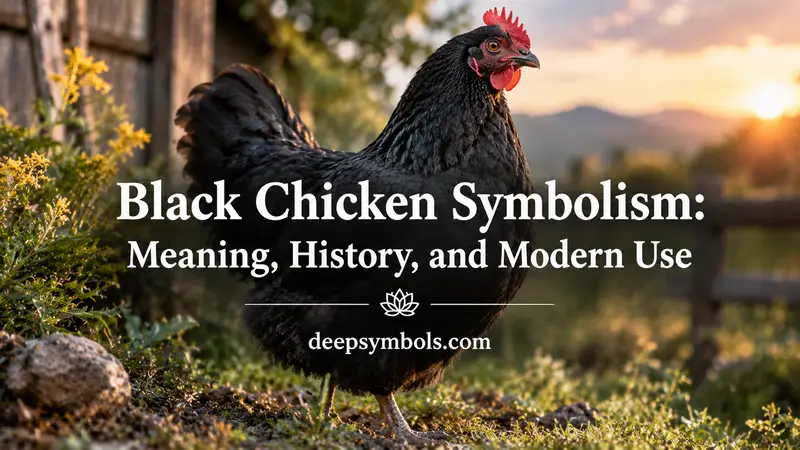
Black chickens have attracted attention in folklore, traditional spiritual practices, and everyday life because of their distinctive dark feathers and the beliefs people attach to them. Black chicken symbolism can represent protection, mystery, transformation, sacrifice, or good fortune, depending on the cultural setting. In the United States, the bird may evoke everything from farm life and heritage breeds to Halloween imagery and stories about folk magic.
The chicken itself has a long relationship with human communities. Domesticated chickens have provided food, supported household economies, and appeared in religious customs across many societies. Black-feathered varieties add another layer of interpretation because black is a color often associated with night, authority, mourning, hidden knowledge, and protection from harm.
However, a black chicken does not carry one universal spiritual meaning. Some traditions regard black animals as protective or significant in ritual settings, while others associate them with uncertainty or supernatural forces. Understanding these interpretations requires distinguishing documented cultural practices from modern superstitions and recognizing that a bird’s color does not determine its character or moral significance.
Quick Answer
Black chicken symbolism commonly represents protection, mystery, spiritual power, and transformation in modern interpretations, especially in folklore and contemporary spiritual practices. Historically, black chickens have also appeared in regional ritual traditions, agricultural life, and beliefs about luck or spiritual protection, with meanings that vary considerably across cultures.
TL;DR
- Black chickens can symbolize protection, mystery, transformation, and spiritual significance.
- Black feathers influence interpretation through associations with night, authority, and the unknown.
- Traditional beliefs vary by region and religious or cultural practice.
- In American culture, black chickens appear in farming, folklore, Halloween imagery, and alternative spirituality.
- A bird’s color does not establish whether it brings good or bad luck.
- Modern tattoos and artwork often use black chickens to express independence or mystery.
1. What a Black Chicken Looks Like
A black chicken may have entirely black feathers or a combination of dark plumage and contrasting features. Some breeds also have dark skin, beaks, legs, or combs, while others have ordinary-colored skin beneath their feathers.
One particularly striking example is the Ayam Cemani, a chicken breed originating in Indonesia that is known for extensive pigmentation. Its feathers, skin, beak, and legs are typically black, making it visually distinctive. Other breeds, including Black Australorps, have glossy black plumage that may reflect green or purple highlights in sunlight.
These birds appear in backyard flocks, agricultural settings, poultry exhibitions, and specialty breeding programs. Their unusual appearance can also make them subjects of photography, folklore-inspired art, and decorative designs.
The physical color matters to symbolism because people often interpret animals through familiar associations. Black feathers may suggest nighttime, concealment, elegance, or the unknown. Yet those associations come from human culture rather than evidence that black chickens possess supernatural qualities.
Understanding the actual bird provides a useful starting point. Its appearance helps explain why people find it symbolically interesting, while its real biological characteristics should remain separate from the beliefs attached to it.
2. The Core Meanings of Black Chickens
Black chickens can carry several symbolic meanings, but the interpretation depends on the tradition, setting, and person observing the bird.
Protection is one association found in some folk and spiritual practices. Within particular traditions, black animals may be used in rituals intended to ward off harm or address spiritual concerns. These beliefs are culturally specific rather than universal.
Mystery and the unknown arise from the connection between blackness and nighttime. A dark-feathered chicken may look unusual against a bright farmyard, making it a natural subject for stories about hidden knowledge or unusual events.
Transformation is a modern interpretive theme associated with darkness, endings, and new beginnings. Some people use black-animal imagery to represent personal change, although this is not a universal traditional meaning of black chickens.
Good fortune and spiritual significance appear in some cultural interpretations of dark-colored animals. In other settings, the same bird may be viewed with suspicion because of associations between blackness and witchcraft or misfortune.
Agricultural heritage and self-sufficiency offer a more practical interpretation. A black chicken can represent food production, rural traditions, animal husbandry, and the continuity of family farming.
These meanings should not be treated as a single ancient system of belief. Black chickens have different roles in different societies, and some modern spiritual interpretations combine ideas that originally belonged to separate traditions.
3. Why the Color Black Influences Its Symbolism
Color plays an important role in how people interpret animals. Black can suggest several contrasting ideas, which helps explain why a black chicken may be viewed positively in one setting and negatively in another.
Night is one source of these associations. Darkness limits visibility, so it has often been used in stories and art to represent what people cannot yet understand. A black-feathered bird can consequently become an image of secrecy, uncertainty, or hidden knowledge.
Black also communicates elegance, authority, and seriousness in modern American design. Black clothing, formal decorations, and minimalist artwork often use the color for its visual strength. In this context, a black chicken might represent individuality or striking beauty rather than anything supernatural.
Mourning provides another association. Black clothing has a long-established role in many Western mourning customs, particularly in the United States. This connection can influence the interpretation of dark animals in stories about death or remembrance.
However, color symbolism is not universal. In some cultural contexts, black can be associated with fertility, protection, strength, or the fertile darkness of the earth. The meaning changes according to local beliefs, religious traditions, and historical experience.
A black chicken therefore illustrates an important principle of symbolism: the same physical feature can inspire different interpretations because people learn to associate colors with different experiences.
4. Black Chickens in Folklore and Traditional Beliefs
Chickens have appeared in folklore because they live close to people and are involved in ordinary household activities. Their eggs, meat, feathers, and daily behavior have made them familiar across generations.
In some folk traditions, chickens have also played roles in divination, ritual offerings, and practices intended to address uncertainty. These practices differ substantially from one community to another. The meaning of a black chicken within a particular ritual cannot automatically be applied to all folklore involving chickens.
Dark-colored animals can acquire special importance when a tradition associates blackness with spiritual protection, concealed forces, or the boundary between ordinary and supernatural experience. Stories may portray such animals as warnings, guardians, or unusual creatures.
Other traditions give chickens more ordinary symbolic roles connected with fertility, household prosperity, food, or the rhythms of agricultural life. These meanings can coexist with religious practices without necessarily involving supernatural claims.
It is also important to distinguish a documented custom from a story repeated online. Modern accounts sometimes describe a supposed universal meaning for black chickens without identifying a specific community, historical period, or source of the belief.
A careful interpretation recognizes the diversity of folklore. Rather than assuming that every black chicken has the same symbolic purpose, it asks who holds the belief, what the bird represents in that context, and how the interpretation developed.
5. Black Chicken Symbolism in the United States
In the United States, black chickens occupy several different cultural settings, from backyard poultry keeping to Halloween decorations and contemporary spiritual practices.
For farmers and poultry enthusiasts, the bird may primarily represent practicality, breed characteristics, and the satisfaction of raising animals. Black Australorps, for example, are familiar to many poultry keepers because of their dark plumage and reputation as productive egg-laying birds.
In rural communities, chickens may also represent family heritage, self-reliance, and a connection to earlier generations. A dark-feathered chicken can be part of that heritage without carrying any special spiritual meaning.
American popular culture introduces another interpretation. Black animals often appear in Halloween decorations, horror stories, and imagery associated with witches or haunted places. A black chicken placed beside pumpkins or a witch-themed display may be intended to create an eerie atmosphere rather than communicate an established cultural belief.
Some Americans interested in folk spirituality interpret black chickens through practices influenced by particular religious or cultural traditions. These meanings should be understood within their specific contexts instead of being treated as representative of all American spiritual beliefs.
The country’s cultural diversity means that no single interpretation dominates every setting. For one person, a black chicken is an attractive backyard bird; for another, it recalls family farming; for someone else, it appears in folklore-inspired artwork.
6. Black Chickens and Protection
Protection is a recurring interpretation of black animals in certain folk and spiritual settings. The association often comes from beliefs about blackness as a way of absorbing, concealing, or countering harmful influences.
Some traditional ritual systems use animals or animal-related materials within practices intended to address misfortune, illness, conflict, or spiritual concerns. The precise role of a black chicken depends on the tradition involved, and it would be misleading to describe all such practices as identical.
In modern personal symbolism, people may interpret a black chicken as an image of boundaries, resilience, or guarding what matters. An artist might use the bird to represent a person who refuses to be intimidated, while a decorative illustration might place it beside protective motifs.
These are interpretations rather than demonstrated properties of the animal. There is no scientific evidence that a chicken’s feather color gives it the ability to repel negative energy or protect a household from supernatural harm.
A grounded reading of protective symbolism can still be meaningful. The bird may serve as a reminder to establish healthy boundaries, care for one’s home, or remain attentive to potential risks.
In this sense, the symbol can encourage practical reflection without requiring the belief that the animal itself possesses special powers.
7. Black Chickens, Luck, and Prosperity
Luck is another theme sometimes attached to black chickens, although beliefs about their fortune-bringing qualities vary considerably.
In agricultural communities, chickens have long had practical economic value. They produce eggs, provide meat, and can help households maintain a dependable food supply. A healthy flock could therefore represent prosperity in a very direct sense.
That practical connection differs from the belief that a particular bird predicts future wealth. The first concerns the tangible value of keeping livestock; the second concerns an interpretation of events or signs.
Modern spiritual and symbolic discussions sometimes describe black chickens as signs of abundance, opportunity, or favorable change. Such meanings may be personally meaningful, but they should not be presented as a universal tradition shared across cultures.
American readers may also associate chickens with thrift, resourcefulness, and the ability to make productive use of limited resources. A backyard flock can provide food while connecting a household with gardening, animal care, and sustainable living.
The distinction is useful when interpreting the bird. A black chicken may symbolize prosperity because of what chickens contribute to household life, or it may represent luck within a particular belief system. Neither interpretation proves that the bird can predict financial outcomes.
8. Religious and Cross-Cultural Interpretations
Chickens have roles in many religious and cultural settings, but the symbolism of a black chicken must be distinguished from the symbolism of chickens in general.
In some African traditional religions and Afro-diasporic religious communities, chickens may be involved in particular offerings or ritual practices. The significance of the animal, its color, and its use depends on the specific tradition and ceremony. These practices should not be generalized into one broad belief about black chickens.
In parts of Asia, chickens have connections with agricultural life, family customs, and religious or ceremonial practices. The meaning of a dark-feathered chicken, however, is not uniform across Asian cultures. Local histories and religious frameworks matter.
Christianity does not establish a universal doctrine that black chickens symbolize evil, protection, or good fortune. Chickens are not assigned one standard symbolic meaning across the Bible, and interpretations of dark animals in Christian art or folk belief should not be confused with official Christian teaching.
Similarly, the association between black animals and witchcraft in some European-derived folklore does not mean that black chickens inherently represent harmful magic.
Cultural respect requires recognizing the difference between a religious practice, a local folk belief, a popular stereotype, and an individual’s personal interpretation. A symbol can hold genuine significance within a community without its meaning applying to everyone who encounters it.
9. Black Chickens and Witchcraft in Popular Imagination
Black chickens sometimes appear in stories about witchcraft, folk magic, and supernatural rituals. In American popular culture, these images are particularly visible around Halloween, when dark animals are used to create an atmosphere of mystery or danger.
The association has several overlapping influences. European-derived folklore includes stories linking animals, nighttime, and supernatural activity. Later books, films, television programs, and seasonal decorations have repeatedly used black animals to signal the presence of magic or the unknown.
However, popular imagery often simplifies traditions that are more varied in real life. Practices described as folk magic may differ in purpose, history, and religious context. A black chicken appearing in a story about witchcraft does not establish that black chickens have the same role in every spiritual tradition.
Nor does the bird’s color demonstrate anything about the beliefs or behavior of the person who raises it. Keeping a black chicken is an ordinary agricultural or personal choice.
It is especially important not to use these associations to stigmatize religious minorities or people who practice unfamiliar spiritual traditions. A respectful account distinguishes fictional portrayals from actual cultural practices.
In contemporary America, the black chicken can be a Halloween decoration, a character in a supernatural story, or simply a dark-feathered farm animal. The setting determines which interpretation is most relevant.
10. Psychological and Emotional Meaning
The emotional response to a black chicken depends partly on personal experience and learned associations.
Someone who grew up around poultry may see a black chicken as familiar, useful, or comforting. A person who associates black animals with horror films may find the same bird unsettling. Neither reaction reveals an inherent quality of the animal; both reflect the meanings people have learned.
The bird’s unusual appearance can also encourage curiosity. A glossy black chicken may stand out among lighter-colored birds, drawing attention to its shape, movement, and feathers.
For some people, the black chicken becomes an image of independence. Its dark coloring may seem visually bold, making it suitable for artwork about individuality, confidence, or resistance to social expectations.
Others may connect the bird with mystery or transformation because black is commonly used in visual storytelling to represent uncertainty or transition. These are modern interpretive associations rather than fixed psychological rules.
Personal experiences matter as well. Someone who raises chickens may associate a particular bird with patience, responsibility, or the rhythms of daily care. In that case, its meaning comes from the relationship rather than from color alone.
The psychological value of symbolism lies in what an image helps a person articulate. A black chicken may provide a way to explore fear, confidence, belonging, or change without implying that the bird carries a universal message.
11. Black Chicken Symbolism in Dreams
Some people interpret animal dreams as reflections of emotions, concerns, or personal experiences. A black chicken in a dream can consequently become a prompt for reflection, but it does not have a scientifically established universal meaning.
A dreamer might associate the bird with uncertainty because of its color, while someone familiar with farming might connect it with household responsibilities or food. Another person may remember a real chicken they encountered recently.
The circumstances of the dream are more informative for personal reflection than a single symbol considered in isolation. Was the chicken calm, frightened, injured, or moving freely? Did the dream feel comforting, confusing, or threatening? What experiences in the dreamer’s waking life might be connected with those feelings?
For example, someone facing a difficult decision might interpret a dark bird as an image of uncertainty. That interpretation may help them describe their feelings, but it does not mean the dream predicts an unfortunate event.
There is no reliable evidence that dreaming of a black chicken foretells death, financial loss, betrayal, or supernatural danger. Dreams can incorporate memories, emotions, and ordinary daily experiences in complicated ways.
A balanced approach treats dream symbolism as a personal interpretive exercise rather than a guaranteed forecast of the future.
12. Modern Uses in Tattoos, Art, and Design
Black chickens can be used in contemporary visual art to communicate ideas that range from rural identity to folklore and unconventional style.
Tattoos: A black chicken tattoo may honor a farming background, celebrate an interest in poultry, or express a connection with folklore. Some people choose the image because it is unusual rather than because it represents a particular spiritual belief.
Illustration and decor: The bird can appear in farmhouse artwork, kitchen prints, folk-art designs, and seasonal decorations. Its dark plumage creates a strong contrast against lighter backgrounds, making it visually effective in simple compositions.
Fashion and personal identity: Clothing or accessories featuring a black chicken may communicate humor, individuality, agricultural pride, or an interest in unusual animal imagery.
Social media: Photographs of rare or visually striking breeds can attract attention among poultry enthusiasts and animal lovers. In these settings, the bird is often appreciated for its appearance or breed characteristics rather than for symbolism.
Halloween and entertainment: Artists may incorporate black chickens into witch-themed displays, fantasy illustrations, and spooky seasonal scenes. These uses draw on popular associations with mystery and supernatural storytelling.
The meaning remains personal and context-dependent. A black chicken tattoo on one person may celebrate family heritage, while an illustration on another person’s wall may simply reflect an appreciation for farm animals.
13. Misconceptions and Negative Stereotypes
One of the most common misconceptions is that black chickens automatically represent evil or bad luck. This idea often comes from generalized associations between black animals and supernatural stories rather than from a universal cultural belief.
Another misconception is that all black chickens are biologically identical. In reality, breeds differ in their appearance, behavior, size, and productive characteristics. Some have black feathers but ordinary-colored skin, while certain breeds display much more extensive pigmentation.
It is also inaccurate to assume that every ritual involving a black chicken belongs to the same religion or cultural tradition. Similar-looking practices can have different histories and meanings, and some communities may not use black chickens in rituals at all.
Claims that the bird automatically absorbs negative energy, predicts death, or guarantees prosperity should also be treated cautiously. These statements may circulate in modern spiritual discussions, but they are not established biological facts or universal religious teachings.
Negative stereotypes can have real consequences when they lead people to mistreat animals or judge individuals based on unfamiliar cultural practices. The bird’s color is not evidence that it is dangerous, unlucky, or connected with wrongdoing.
A more informed approach recognizes the difference between folklore, personal belief, entertainment, and verifiable information.
14. What a Black Chicken Can Represent Today
In contemporary life, the black chicken can represent different things depending on how it enters someone’s experience.
For a poultry keeper, it may stand for responsibility, agricultural knowledge, or the pleasure of maintaining a flock. For someone interested in folklore, it may serve as a starting point for learning how communities interpret animals and colors.
An artist might use it to suggest mystery, independence, or a departure from conventional imagery. Someone interested in personal spirituality may connect it with protection or transformation, provided those meanings are understood as personal or tradition-specific interpretations.
The bird can also remind people to question assumptions. Its dark appearance may lead an observer to expect something ominous, but the actual animal is simply a chicken with particular physical characteristics. That contrast between appearance and reality can itself become a useful theme in art or reflection.
Modern interpretations are not necessarily less meaningful than older ones, but they should not be mistaken for ancient beliefs without supporting historical evidence. Symbolism develops as people give familiar objects new roles in their lives.
The black chicken’s modern meaning is therefore best understood as a collection of possibilities rather than a single definitive message.
15. Comparing Black Chicken Meanings Across Contexts
| Context | Common symbolic association | Important distinction |
|---|---|---|
| Farming and rural life | Self-sufficiency, food, and heritage | Often practical rather than spiritual |
| Folk traditions | Ritual significance or protection | Meaning varies by community and practice |
| Modern spirituality | Transformation, boundaries, or mystery | May reflect personal interpretation |
| American Halloween imagery | Supernatural themes and the unknown | Frequently influenced by entertainment |
| Art and tattoos | Individuality, heritage, or unconventional style | Meaning depends on the artist or wearer |
This comparison shows why context matters more than color alone. A black chicken in a farmyard, a religious ceremony, and a horror illustration may communicate entirely different ideas.
FAQs
1. What does a black chicken symbolize spiritually?
A black chicken may represent protection, mystery, transformation, or spiritual significance in certain traditions and modern interpretations. There is no single meaning shared by every religion or culture, so the context of the belief matters.
2. Is a black chicken a sign of good luck or bad luck?
Beliefs vary, and a black chicken is not universally considered lucky or unlucky. Its appearance does not provide reliable evidence that a particular event will happen.
3. What does seeing a black chicken mean?
Seeing one may simply mean that a dark-feathered chicken is nearby. If the encounter feels symbolically meaningful, you can reflect on your personal associations with protection, mystery, farming, or change without assuming it predicts the future.
4. What does a black chicken symbolize in a dream?
A black chicken in a dream may prompt personal reflection about uncertainty, responsibility, or familiar experiences involving animals. Dream interpretation is subjective, and there is no established evidence that this image predicts death, misfortune, or financial outcomes.
5. Are black chickens associated with witchcraft?
Black chickens appear in some folklore and supernatural stories, including portrayals involving witchcraft. These associations are not universal, and the bird’s color does not establish a connection with any particular religious or spiritual practice.
6. What does a black chicken tattoo mean?
A black chicken tattoo may represent rural heritage, individuality, folklore, or a personal connection with poultry. Its meaning depends on the wearer’s intentions and the design rather than a standardized symbolic definition.
7. Does the Bible say black chickens are evil?
The Bible does not establish a general rule that black chickens are evil or bring bad luck. Interpretations linking dark animals with supernatural danger often come from particular folk traditions or later popular imagery rather than a universal biblical teaching.
Conclusion
Black chicken symbolism brings together mystery, protection, transformation, and cultural identity through traditions that interpret the animal in different ways. In some settings, black chickens are associated with ritual practices and protective beliefs, while in others, their appearance has little symbolic significance. Anthropologist Susanne Schröter’s study, Red Cocks and Black Hens: Gendered Symbolism, Kinship and Social Practice in the Ngada Highlands, offers a specific example of how chicken colors can express relationships and social roles within a particular cultural tradition.
In modern American culture, a black chicken may appear in folklore, artwork, backyard flocks, or Halloween imagery, with its meaning shaped by the setting and the interpretation people bring to it. Its dark feathers alone do not establish that it predicts danger, attracts good fortune, or possesses supernatural abilities.
Ultimately, black chicken symbolism reminds us that ordinary animals can carry very different meanings across human cultures. Understanding those meanings requires curiosity about their history, respect for the communities that preserve their traditions, and a willingness to distinguish cultural beliefs from established facts. The black chicken becomes most interesting not when it is assigned one universal meaning, but when we explore the different stories people have built around it.


