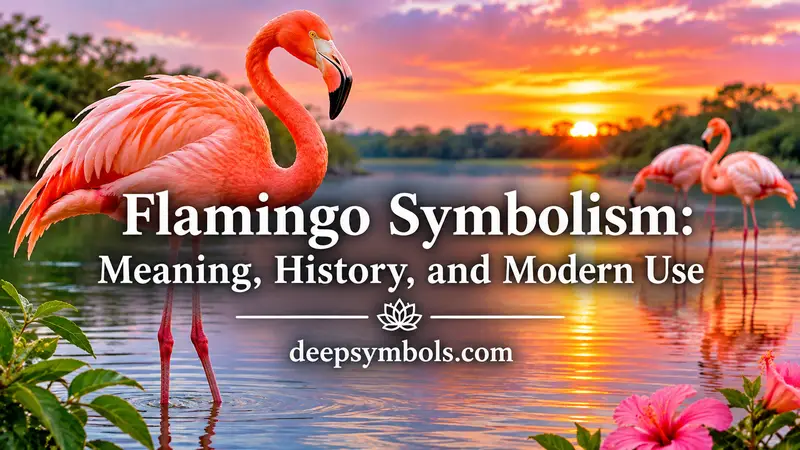
Flamingos are instantly recognizable birds, known for their long legs, curved necks, distinctive bills, and pink feathers. In modern American culture, flamingo symbolism is commonly associated with beauty, confidence, individuality, balance, and social connection. The bird’s unusual appearance and graceful movements have made it a popular image in fashion, home decoration, garden art, and popular culture.
The flamingo’s meaning also comes from its natural behavior. These birds gather in large groups, stand on one leg, and move through shallow wetlands in search of food. Their ability to thrive in demanding environments contributes to associations with adaptability, cooperation, and resilience.
In the United States, flamingos have become particularly recognizable through tropical design, lawn ornaments, summer decorations, and playful fashion. Their bright pink color also gives them a distinctive place in conversations about self-expression and personal style. Understanding their symbolism means looking beyond their appearance to the behavior, cultural history, and changing interpretations that have shaped their image.
Quick Answer
Flamingo symbolism commonly represents individuality, confidence, beauty, balance, and social connection in modern American culture. Historically and across different interpretations, flamingos have also been associated with tropical environments, adaptability, cooperation, and the ability to stand out through their distinctive appearance.
TL;DR
- Flamingos represent individuality, confidence, beauty, and social connection.
- Their pink feathers reflect pigments obtained through their diet.
- Standing on one leg inspires associations with balance and stability.
- Large flocks connect flamingos with cooperation and community.
- American lawn ornaments made flamingos recognizable symbols of playful self-expression.
- Flamingo tattoos and decorations often communicate freedom, personality, and tropical style.
1. What Does a Flamingo Symbolize?
The flamingo carries several meanings connected with its appearance and natural behavior. Its most familiar modern associations include:
Individuality: Its unusual shape and bright pink coloring make it easy to recognize. The flamingo often represents the confidence to be different rather than conforming to expectations.
Balance: Flamingos are famous for standing on one leg. This behavior has inspired associations with stability, patience, and maintaining composure.
Beauty and elegance: Their long necks, slender legs, and coordinated movements give them an elegant appearance. They are frequently used to represent grace and visual beauty.
Social connection: Flamingos live and feed in groups, sometimes gathering in enormous colonies. Their behavior supports associations with community, cooperation, and belonging.
Adaptability: Flamingos inhabit environments that many other birds cannot easily tolerate. Their ability to survive in salty and alkaline wetlands makes them fitting examples of environmental adaptation.
Playfulness: Their bright color and popularity in decorative culture have given them a cheerful, humorous identity, especially in the United States.
These meanings are not universal religious or ancient beliefs. Many are modern interpretations inspired by observable characteristics of the bird.
2. Why Flamingos Are Pink: The Natural Origin of Their Color
A flamingo’s pink coloring is one of its most important visual characteristics. However, flamingos are not naturally born with the brilliant pink appearance commonly associated with adults.
Their color develops through their diet, which contains carotenoid pigments found in algae, crustaceans, and other food sources. These pigments are processed by the birds’ bodies and contribute to the coloration of their feathers.
Young flamingos are generally grayish or whitish before gradually developing their characteristic pink tones.
This biological process gives the bird an interesting symbolic association with nourishment and transformation. Its appearance reflects the environment and food it encounters rather than an unchanging natural color.
The connection is especially useful when interpreting flamingos as symbols of personal development. Their changing appearance can suggest that identity develops through experiences, surroundings, and the things people take into their lives.
Pink also has its own cultural associations. In contemporary American design, it is often connected with affection, playfulness, femininity, celebration, and creativity. When combined with the flamingo’s unusual appearance, these associations help explain why the bird is frequently used as a cheerful decorative symbol.
3. Flamingo Symbolism and Individuality
One of the strongest modern interpretations of the flamingo is individuality.
Unlike birds with muted brown, gray, or white plumage, flamingos display a distinctive appearance that attracts attention. Their bright feathers, unusual proportions, and recognizable posture make them difficult to confuse with other birds.
This visual difference has helped the flamingo become a symbol of standing out.
In American culture, flamingo imagery frequently appears in clothing, accessories, artwork, and home decoration. People may choose the bird because it represents a willingness to embrace personal taste instead of following conventional expectations.
The flamingo can also communicate confidence without aggression. Its symbolism is generally playful and expressive rather than intimidating.
For someone who feels different from the people around them, the flamingo can represent acceptance of those differences. It suggests that being unusual does not necessarily mean being out of place.
This interpretation is especially common in decorative and lifestyle contexts, where the bird’s appearance is used to celebrate creativity and personal identity.
4. Standing on One Leg: Balance and Stability
Flamingos are well known for standing on one leg, a behavior that has attracted attention from observers and researchers alike.
The posture looks almost effortless, even though it requires the bird to maintain its body position while resting or remaining alert. Research has also shown that flamingos possess passive physical mechanisms that help them maintain this posture without constantly using muscular effort.
Symbolically, this behavior has inspired associations with balance, stability, patience, and self-control.
The flamingo can therefore represent the ability to remain steady when circumstances change. Its posture suggests that stability does not always require constant movement or visible effort.
In everyday life, this interpretation can apply to maintaining emotional composure, managing competing responsibilities, or finding time to rest without losing direction.
It is important to distinguish the symbolic interpretation from the biological explanation. Flamingos do not stand on one leg because they consciously represent spiritual balance. Their behavior has practical physical and energetic advantages.
Nevertheless, people naturally draw meaning from recognizable features of the natural world, and the flamingo’s unusual posture provides an especially memorable example.
5. Flamingos as Symbols of Community and Friendship
Flamingos are highly social birds. They commonly gather in groups and may form large colonies around suitable feeding and breeding areas.
Their group behavior makes them natural symbols of friendship, cooperation, and community.
Flamingos also use social displays involving coordinated movements and vocalizations. These behaviors help birds communicate and participate in group activities.
For humans, the sight of a large flock can suggest the importance of connection. Individuals remain distinct, but their shared behavior contributes to the survival and organization of the group.
In modern decorative culture, flamingos sometimes appear in pairs or groups. This arrangement can suggest companionship, friendship, romantic connection, or a shared sense of identity.
The symbolism is particularly appropriate for social gatherings, summer celebrations, and gifts exchanged between friends.
The flamingo’s social nature also provides a useful reminder that individuality and belonging are not opposites. A person can maintain a distinctive identity while remaining connected to a supportive community.
6. Flamingo Symbolism in American Culture
In the United States, flamingos have developed a distinctive identity through popular decoration, advertising, fashion, and entertainment.
One of the most recognizable examples is the pink plastic lawn flamingo. These ornaments became popular American garden decorations during the twentieth century, particularly after designer Don Featherstone introduced his well-known plastic flamingo in 1957.
The ornaments were inexpensive, colorful, and intentionally artificial. Their exaggerated appearance made them recognizable symbols of suburban humor and playful decoration.
Over time, plastic flamingos became associated with several aspects of American culture:
- Individual expression: Decorating a lawn with flamingos can communicate a playful personal style.
- Humor: Their exaggerated appearance makes them suitable for jokes and lighthearted displays.
- Tropical aesthetics: They evoke beaches, warm weather, and vacation environments.
- Nostalgia: Older lawn ornaments can remind people of earlier periods in American suburban culture.
- Camp style: Their artificial brightness fits an aesthetic that deliberately celebrates exaggeration and unconventional taste.
Flamingos also appear in summer parties, poolside decorations, beach-themed restaurants, and resort merchandise.
Their American identity is therefore not limited to wildlife appreciation. The bird has become a recognizable cultural object that communicates fun, personality, and a relaxed approach to decoration.
7. Flamingo Symbolism in Fashion and Interior Design
Flamingos have become familiar decorative motifs in fashion and interior design because of their distinctive shape and color.
In clothing, flamingo patterns commonly appear on summer shirts, swimsuits, dresses, scarves, and accessories. Their association with tropical environments makes them particularly suitable for warm-weather collections.
In interior design, flamingo artwork may appear in bedrooms, bathrooms, living rooms, outdoor spaces, and vacation properties. Some designs emphasize realistic bird illustrations, while others use simplified outlines or exaggerated pink figures.
The bird can contribute several visual effects:
- Pink feathers introduce a noticeable accent color.
- Long legs and curved necks create distinctive silhouettes.
- Repeated flamingo patterns add a playful decorative quality.
- Tropical imagery can suggest relaxation and vacation-inspired living.
In the United States, flamingo decorations are particularly common in spaces designed around coastal, retro, and tropical themes.
The symbol does not necessarily communicate a serious personal philosophy. Sometimes people simply enjoy the bird’s appearance and the cheerful atmosphere it creates.
Its flexibility allows it to function as both a recognizable animal motif and a form of visual self-expression.
8. Flamingo Symbolism Across Different Cultures
Flamingos inhabit parts of Africa, southern Europe, Asia, the Caribbean, and the Americas. Their cultural significance varies depending on the communities and environments in which they are encountered.
In some regions, flamingos are familiar wildlife associated with wetlands, lagoons, and coastal landscapes. Their presence can contribute to local identity and environmental awareness.
In the Caribbean, flamingos are closely associated with tropical wetlands and distinctive island wildlife. The American flamingo, in particular, is strongly connected with the Caribbean region and parts of the Americas.
In parts of Africa, flamingos are notable inhabitants of saline lakes and other specialized wetland environments. Large flocks can become important features of the local landscape and wildlife tourism.
In European settings, flamingos are often encountered in natural-history collections, wildlife photography, and conservation contexts, although some populations also inhabit natural wetlands.
It is important not to assign one spiritual meaning to all these traditions. Unlike symbols with established roles in specific religious systems, flamingo interpretations are often based on local wildlife, environmental relationships, artistic choices, and modern popular culture.
Their broad geographic distribution makes them recognizable internationally, but their meanings should always be understood within their particular cultural setting.
9. The Flamingo as a Symbol of Adaptability and Resilience
Flamingos live in environments that can be difficult for many other animals. Some species inhabit highly saline or alkaline lakes, shallow lagoons, and wetlands where food resources are specialized.
Their feeding adaptations allow them to obtain food from water and mud using their uniquely shaped bills.
These biological characteristics have inspired associations with adaptability and resilience.
The flamingo can represent the ability to function in unfamiliar or challenging circumstances without abandoning one’s identity. Its distinctive appearance remains recognizable even as it moves through different environments.
This interpretation can be applied to personal experiences involving change, uncertainty, and adjustment.
For example, someone beginning a new career, moving to another country, or rebuilding after a difficult period may identify with the flamingo as an image of adapting while remaining confident in who they are.
The symbolism is not based on a traditional biblical or religious teaching. It is a modern interpretation drawn from the bird’s ecology.
Its strongest message is that resilience involves responding effectively to circumstances rather than expecting every environment to be comfortable.
10. Flamingo Symbolism in Tattoos and Personal Identity
Flamingo tattoos are often chosen for their visual appeal, but they can also carry personal meanings.
A single pink flamingo may represent individuality, confidence, creativity, or an appreciation for tropical environments. Some people choose the bird because it reminds them of a favorite vacation, a meaningful place, or an important period in their lives.
Two flamingos may represent companionship, romance, or a close friendship. A group of flamingos can suggest family connections, community, and shared experiences.
The style of the tattoo also influences its meaning.
| Flamingo tattoo design | Common interpretation | Personal association |
|---|---|---|
| Single pink flamingo | Individuality and confidence | Self-expression |
| Two flamingos | Love and companionship | Relationships |
| Flamingo standing on one leg | Balance and patience | Personal stability |
| Flamingo with tropical flowers | Beauty and freedom | Nature and travel |
| Minimalist flamingo outline | Simplicity and creativity | Personal style |
Some people choose realistic wildlife designs, while others prefer cartoon-like flamingos with exaggerated features.
Because the bird is associated with playful American decorative culture, a flamingo tattoo can also communicate humor and an appreciation for unconventional aesthetics.
There is no universal interpretation for every flamingo tattoo. The owner’s personal story is usually more important than the design alone.
FAQs
1. What does a flamingo symbolize spiritually?
A flamingo can represent balance, individuality, adaptability, and social connection in personal spiritual interpretations. These meanings generally come from its natural behavior and appearance rather than a specific established religious tradition.
2. What does a pink flamingo symbolize?
A pink flamingo commonly represents confidence, playfulness, creativity, and individuality. In American culture, it is also associated with tropical decoration, summer celebrations, and unconventional personal style.
3. What does an upside-down pink flamingo mean?
An upside-down pink flamingo is sometimes associated with the swinging lifestyle in modern American popular culture. However, this is a niche interpretation, and the decoration should not be treated as reliable evidence of someone’s private relationships.
4. What does a flamingo symbolize in love?
Flamingos can represent companionship, affection, and social connection because they are highly social birds. Two flamingos appearing together may also be used to represent romantic relationships, although this is a modern artistic interpretation.
5. Why is a flamingo associated with balance?
Flamingos are famous for standing on one leg, a posture that has inspired associations with stability, patience, and emotional composure. Their actual behavior has biological advantages, including mechanisms that help them maintain their position while resting.
6. What does a flamingo tattoo symbolize?
A flamingo tattoo can represent individuality, confidence, freedom, friendship, or an appreciation for tropical environments. Its specific meaning depends on the design and the personal experiences of the individual wearing it.
7. Why are flamingos popular in American decorations?
Flamingos became especially recognizable through the popularity of pink plastic lawn ornaments introduced in the 1950s. Their unusual appearance, bright color, and playful character helped establish them as familiar symbols of American suburban humor and tropical style.
Conclusion
Flamingo symbolism brings together individuality, confidence, balance, beauty, and social connection. The bird’s distinctive appearance and social behavior have inspired associations with self-expression, adaptability, and community. In American culture, the pink flamingo has developed an especially recognizable identity through lawn decorations, fashion, tattoos, tropical design, and popular entertainment. The Smithsonian National Museum of American History’s record of the pink flamingo lawn ornament documents how this decorative bird became an enduring symbol of American backyard culture and popular kitsch.
A more specialized modern association connects pink flamingo decorations with swinging, particularly in some RV and campground settings. However, this remains an unverified cultural rumor rather than an established meaning. A Transwest discussion of RV park flamingos explains why the association should not be treated as proof of anyone’s relationship preferences.
Ultimately, flamingo symbolism reminds us that individuality and belonging can exist together. Its striking appearance makes it an enduring image of confidence and personal expression, while its social nature highlights the importance of connection. Whether displayed in a garden, represented in artwork, or encountered in the wild, the flamingo demonstrates how an ordinary image can acquire different meanings through culture, context, and personal experience.