
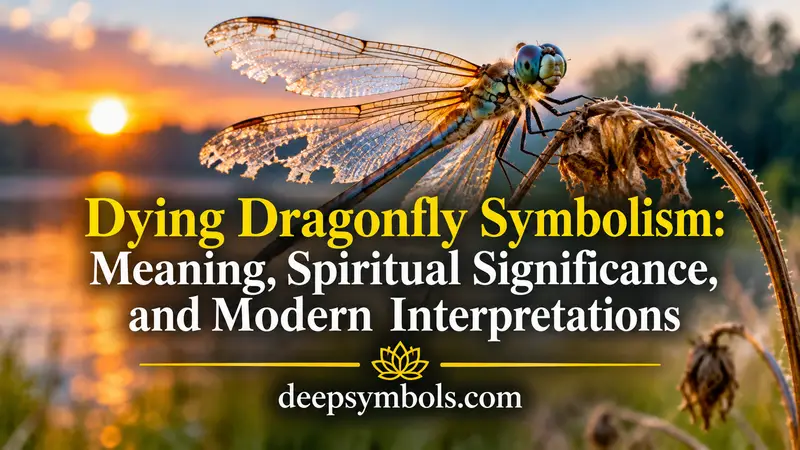
A dragonfly is often associated with change, freedom, adaptability, and the beauty of a brief moment. When someone encounters a dying dragonfly, however, the experience can feel different from seeing one flying over a pond or resting on a flower. Dying dragonfly symbolism often brings up questions about endings, emotional transitions, vulnerability, and the meaning of letting go. Its fragile condition can make an otherwise familiar insect feel like a reminder of life’s temporary nature.
In the United States, dragonflies frequently appear in nature photography, garden decorations, jewelry, tattoos, and memorial artwork. Their connection with transformation makes them meaningful to people experiencing major life changes, including the end of relationships, personal loss, or the beginning of a new chapter. A dying dragonfly introduces another dimension: the recognition that change sometimes involves loss rather than simply a fresh beginning.
There is no single universally accepted meaning for encountering a dying dragonfly. Its interpretation depends on personal beliefs, cultural background, and the circumstances in which it appears. Understanding its natural life cycle alongside its cultural associations provides a more balanced way to explore what this small insect may represent.
Quick Answer
Dying dragonfly symbolism commonly represents the end of a life chapter, vulnerability, acceptance, and the temporary nature of life in modern American interpretations. Because dragonflies are associated with transformation and adaptability, a dying one can also suggest the completion of personal change, the need to release the past, or a reminder to appreciate life’s brief moments.
TL;DR
- A dying dragonfly can represent endings and the completion of personal change.
- Its fragile condition reflects life’s vulnerability and temporary nature.
- Dragonflies have long been associated with transformation and adaptability.
- In American culture, they often appear in memorial art and personal remembrance.
- A dying dragonfly is not a scientifically established omen or prediction.
- Its natural life cycle offers a grounded perspective on symbolic interpretations.
1. What Does a Dying Dragonfly Represent?
A dying dragonfly can represent several ideas connected with endings, change, and the passage of time. Its meaning is often shaped by the contrast between the dragonfly’s usual image of movement and freedom and its visible vulnerability near the end of life.
The end of a chapter is one common interpretation. The insect may remind someone of a relationship, situation, or period of life that is coming to a close.
Acceptance and letting go are also associated with the image. A dying creature can encourage reflection on circumstances that cannot be controlled and the importance of accepting necessary endings.
Vulnerability is another central theme. Dragonflies are agile insects, but their delicate bodies remind observers that even creatures capable of remarkable movement are subject to natural limitations.
The passage of time gives the image a more reflective meaning. An encounter may encourage someone to appreciate ordinary experiences instead of assuming that opportunities and relationships will last forever.
These interpretations are personal rather than universal. A person experiencing grief may connect the insect with remembrance, while someone facing a career change may see it as a symbol of transition.
2. Why a Dying Dragonfly Can Symbolize the End of a Life Chapter
Dragonflies are commonly associated with transformation because their development involves dramatic physical changes. Their lives include an aquatic juvenile stage and a winged adult stage, making them natural examples of biological transition.
When a dragonfly approaches death, the symbolism can shift from transformation toward completion. Instead of representing the beginning of something new, the dying insect may suggest that an existing chapter has reached its natural conclusion.
In everyday American life, this interpretation can connect with experiences such as:
- Ending a long-term relationship.
- Leaving a familiar home or community.
- Retiring after many years of work.
- Completing an important personal goal.
- Moving beyond a difficult period of life.
The image does not necessarily suggest that an ending is negative. Some endings involve relief, maturity, or the freedom to pursue different priorities.
A dying dragonfly can therefore represent the emotional complexity of closing one chapter. It acknowledges that something meaningful may be ending even when that change is necessary.
3. Transformation and the Completion of Change
The dragonfly’s natural development is an important reason it has become associated with transformation.
Unlike insects that spend most of their adult lives in a familiar environment, dragonflies begin their lives underwater. Their aquatic juvenile stage, called a nymph, can last for months or even several years depending on the species. Eventually, the nymph emerges from the water, sheds its outer skin, and develops into a winged adult.
This biological process gives the dragonfly a recognizable connection with major life transitions.
A dying dragonfly introduces the idea of transformation reaching its final stage. Symbolically, this may suggest that a difficult personal process has come to an end or that someone has completed an important period of growth.
For example, a person who has recovered from a challenging experience may associate the insect with the end of a long struggle. Someone who has changed their beliefs or priorities may interpret it as a reminder that personal development includes leaving older versions of oneself behind.
However, the insect’s death does not scientifically indicate that a person’s transformation is complete. The connection is symbolic, drawing on the contrast between the dragonfly’s life cycle and human experiences of change.
4. Dying Dragonfly Symbolism and the Temporary Nature of Life
One of the most natural interpretations of a dying dragonfly concerns mortality and the limited time available to living creatures.
Adult dragonflies generally live for a relatively short period, although their lifespan varies considerably by species and environmental conditions. Their visible adult lives represent only part of a longer life cycle that often begins underwater.
This contrast can make an encounter with a dying dragonfly especially thought-provoking. The insect may remind someone that life is temporary, regardless of beauty, strength, or apparent freedom.
In American culture, similar ideas appear in memorial gardens, nature photography, poetry, and artwork featuring butterflies, birds, flowers, and other living things. These images often encourage people to value experiences that might otherwise be taken for granted.
A dying dragonfly can prompt questions such as:
- Am I spending enough time with people I care about?
- Have I been postponing something meaningful?
- Is there an experience I need to appreciate before it passes?
- What matters most during this stage of my life?
The symbolism is not necessarily about sadness. Awareness of mortality can also encourage gratitude, more intentional decisions, and greater appreciation for everyday life.
5. Emotional Vulnerability and the Need for Acceptance
A dying dragonfly can evoke sympathy because its usual agility contrasts with its weakened condition.
People often associate dragonflies with speed, balance, and the ability to move freely through the air. Seeing one unable to fly may challenge that image and bring attention to the vulnerability shared by all living creatures.
Emotionally, this can connect with periods when people feel exhausted, uncertain, or unable to maintain the confidence they once had.
Someone recovering from burnout might see the insect as a reminder that strength does not mean being active or productive at all times. A person dealing with grief may connect it with the experience of feeling fragile after a major loss.
Acceptance is an important part of this interpretation. Not every situation can be repaired, and not every difficult experience can be controlled. Recognizing limitations can be an important step toward emotional adjustment.
The dying dragonfly can therefore serve as an image of compassion toward oneself and others. Its condition encourages a gentler understanding of vulnerability rather than treating weakness as failure.
6. Dying Dragonfly Symbolism in American Culture
In the United States, dragonflies are familiar features of gardens, lakeside environments, outdoor artwork, and decorative design. Their association with transformation has also made them popular in jewelry, tattoos, and memorial objects.
A dying dragonfly is less established as a cultural symbol than a living dragonfly. Its meaning is generally developed through personal interpretation rather than through a widely recognized American tradition.
Several modern associations are nevertheless understandable.
Memorial and remembrance: Someone grieving a loss may connect the insect with the temporary nature of life and memories of someone important.
Personal transitions: People experiencing divorce, retirement, relocation, or other major changes may interpret it as an image of completion.
Environmental awareness: A dying dragonfly can draw attention to the condition of local habitats, especially when insects are affected by pollution, pesticides, or changes in water quality.
Personal reflection: Nature encounters can encourage people to pause and consider their priorities, relationships, and emotional well-being.
Unlike the familiar heart or American flag, the dying dragonfly does not have one established public meaning. Its cultural significance is more individual, making the circumstances of an encounter particularly important.
7. Historical and Cultural Associations of Dragonflies
Dragonflies have appeared in the artistic and cultural traditions of different societies, although interpretations vary considerably.
In Japanese culture, dragonflies have historically been associated with courage, strength, and victory. Their forward movement and hunting abilities contributed to their positive associations, and the insect became a recognizable motif in traditional art and decorative objects.
In some Native American traditions, dragonflies appear in stories, artwork, and cultural interpretations connected with the natural world. However, Native American cultures are diverse, and there is no single meaning shared by all Indigenous nations. It would be misleading to assign one universal spiritual interpretation to the insect.
European folklore sometimes connected dragonflies with supernatural creatures or unsettling natural imagery. Such associations differ from modern decorative interpretations that emphasize beauty and transformation.
These traditions generally concern dragonflies as living insects rather than specifically dying ones. Modern interpretations of a dying dragonfly often adapt broader associations with change, mortality, and the natural cycle of life.
Understanding this distinction helps prevent modern spiritual interpretations from being incorrectly presented as ancient or universally accepted cultural beliefs.
8. Spiritual Interpretations of Finding a Dying Dragonfly
Some people interpret finding a dying dragonfly as an invitation to reflect on their spiritual lives. These interpretations are personal and vary according to religious beliefs, cultural backgrounds, and individual experiences.
Several spiritual themes are commonly connected with the encounter.
Spiritual transition: The insect may represent a period of spiritual development reaching its conclusion. Someone reconsidering their beliefs or values might associate it with moving beyond an earlier understanding of life.
Acceptance of change: Its condition can encourage reflection on circumstances that cannot be reversed. This may include the end of a relationship, a personal disappointment, or the loss of an important opportunity.
Gratitude: Seeing a fragile creature can encourage appreciation for ordinary experiences, relationships, and moments of happiness.
Reflection and renewal: Although death represents an ending, the encounter may inspire someone to consider what they want to change in their own life.
These interpretations should not be confused with established religious teachings. The Bible, for example, does not identify a dying dragonfly as a specific spiritual sign. Christians may draw personal lessons from nature, but there is no universal biblical interpretation attached to this insect.
The most grounded spiritual approach is to use the encounter as an opportunity for thoughtful reflection rather than assuming it predicts a particular event.
9. Is a Dying Dragonfly a Sign of Death or Bad Luck?
A dying dragonfly can appear unsettling, particularly when someone already associates dragonflies with freedom, transformation, or spiritual messages. This sometimes leads to the belief that encountering one predicts death, misfortune, or an approaching personal loss.
However, there is no reliable evidence that a dying dragonfly predicts future events.
Its death is a natural biological occurrence. Dragonflies can die because of age, predation, disease, injury, unfavorable weather, or environmental conditions. An insect resting on the ground may also be exhausted or temporarily unable to fly rather than necessarily dying.
In some folklore traditions, dragonflies have received negative associations, but these beliefs differ across regions and historical periods. They should not be treated as universal cultural interpretations.
In modern American spiritual discussions, the image is more commonly explored through ideas of transition, mortality, and acceptance than through established beliefs about bad luck.
A useful distinction is between symbolic reflection and superstition. Reflecting on mortality after seeing a dying insect can be meaningful. Assuming that the insect guarantees an approaching tragedy can create unnecessary fear without a factual basis.
10. Environmental Meaning: When a Dragonfly Is Actually Dying
There is also an environmental perspective worth considering when encountering a dying dragonfly.
Dragonflies depend heavily on freshwater habitats during their early development. Their aquatic nymphs live in ponds, streams, wetlands, and other freshwater environments before emerging as winged adults.
Because of this connection, changes in water quality and habitat conditions can affect dragonfly populations. Pollution, wetland destruction, pesticide exposure, and alterations to natural waterways can create problems for these insects.
A single dead dragonfly does not establish that an area is environmentally unhealthy. Natural death is part of every insect population, and one observation cannot identify the cause.
However, repeated sightings of dead or unusually weak dragonflies in the same location may justify closer attention to local environmental conditions.
In this practical context, the dying dragonfly can represent the vulnerability of nature and the importance of protecting habitats.
This interpretation adds a meaningful dimension to its symbolism. Rather than focusing exclusively on personal spiritual experiences, the encounter can encourage people to consider their relationship with the natural world.
11. What Does a Dying Dragonfly Mean in Love and Relationships?
In matters of love, a dying dragonfly is sometimes interpreted as a symbol of a relationship approaching an important transition.
Its meaning does not have to be negative. The image may represent the completion of an earlier relationship pattern, the end of an unhealthy attachment, or the need to reconsider emotional expectations.
For someone experiencing a breakup, it may reflect the sadness of losing a connection that once mattered. For someone in a long-term relationship, it could prompt reflection on changing priorities, communication, and emotional maturity.
Several interpretations are possible:
- Ending a relationship: A connection may have reached the point where separation becomes necessary.
- Releasing the past: Old disappointments may need attention before emotional progress becomes possible.
- Changing expectations: Relationships sometimes evolve as people mature and develop different priorities.
- Accepting emotional vulnerability: Loving someone involves recognizing that relationships cannot always be controlled.
These meanings are personal interpretations, not predictions about a partner’s behavior or the future of a relationship.
A dying dragonfly should not be used as evidence that someone is unfaithful, that a relationship will end, or that a particular romantic event is approaching. Honest communication and real circumstances provide a much better basis for understanding relationships.
12. Dying Dragonfly Symbolism in Tattoos, Jewelry, and Art
Dragonflies are popular decorative subjects because their long bodies, transparent wings, and recognizable silhouettes work well in different artistic styles.
A dying dragonfly is less common as a design, but its imagery can communicate more specific personal experiences than a traditional dragonfly motif.
Tattoos: Someone may choose a weakened or resting dragonfly to represent the completion of a difficult period, acceptance of mortality, or remembrance of someone who has passed away.
Memorial jewelry: A dragonfly pendant may serve as a personal reminder of a loved one. When associated with death or loss, it can represent the fragility of life and the importance of preserving memories.
Nature-inspired artwork: Illustrations featuring a dragonfly resting on a leaf or lying near water can communicate vulnerability, seasonal change, and the natural cycle of life.
Home decoration: Dragonfly imagery in a memorial space or personal garden may represent reflection, remembrance, and appreciation for nature.
Some people prefer realistic designs, while others choose abstract wings, muted colors, or delicate line drawings to communicate a more reflective mood.
The meaning ultimately depends on the person choosing the design. A dying dragonfly tattoo does not have a standardized interpretation, and its significance may be entirely connected with an individual’s personal experience.
13. The Emotional and Psychological Meaning of Encountering a Dying Dragonfly
An encounter with a dying creature can produce a surprisingly strong emotional reaction. This response often comes from recognizing vulnerability in something that normally appears active and capable.
Dragonflies are associated with movement, balance, and flight. Seeing one struggling to move can create a contrast that encourages people to think about their own limitations.
Psychologically, several responses may explain why the experience feels meaningful.
Personal association: If someone is already experiencing a major life change, they may connect the insect’s condition with their own circumstances.
Empathy: Seeing a vulnerable animal can produce sadness and a desire to help, reflecting a natural concern for living creatures.
Mortality awareness: The encounter can bring attention to the temporary nature of life and encourage appreciation for meaningful experiences.
Reflection during uncertainty: People sometimes use images from nature to organize difficult emotions or express experiences that are hard to describe directly.
This does not mean the insect has communicated a supernatural message. Human beings naturally interpret their surroundings through memories, emotions, and personal experiences.
The encounter may still become meaningful. Its value can come from the reflection it inspires rather than from an objectively established spiritual message.
14. How to Respond When You Find a Dying Dragonfly
If you encounter a dragonfly that appears to be dying, a considerate response is to observe it without causing additional stress.
First, avoid immediately assuming that it cannot recover. A dragonfly may be resting, temporarily weakened, or recovering from an injury.
If it is in an exposed or dangerous location, you may be able to move it carefully using a leaf or another suitable surface. Avoid handling its delicate wings or applying pressure to its body.
If it appears severely injured or is naturally reaching the end of its life, allowing it to remain undisturbed may be the most appropriate choice.
The encounter can also provide an opportunity to observe the insect’s physical characteristics. Its transparent wings, large compound eyes, and elongated body reveal the adaptations that make dragonflies effective flying predators.
From a symbolic perspective, responding with patience and compassion gives the experience a practical meaning. Instead of treating the insect simply as an omen, you can recognize it as a living creature deserving consideration.
15. Comparing Dying Dragonfly Meanings Across Different Contexts
The meaning of a dying dragonfly changes depending on the circumstances in which it appears and the personal associations attached to it.
| Context | Possible symbolic meaning | Common emotional association |
| Personal life changes | Completion of a chapter | Acceptance and reflection |
| Grief or loss | Mortality and remembrance | Sadness and gratitude |
| Spiritual reflection | Release and transition | Peace and contemplation |
| Romantic relationships | Emotional change or separation | Vulnerability and healing |
| Environmental setting | Fragility of natural habitats | Concern and compassion |
| Art and tattoos | Personal transformation and endings | Memory and individuality |
These interpretations are not fixed rules. They provide different ways of understanding the image while recognizing that personal circumstances influence its significance.
FAQs
1. What does a dying dragonfly symbolize spiritually?
A dying dragonfly can symbolize endings, acceptance, vulnerability, and the completion of personal change. Some people also interpret it as an invitation to reflect on their spiritual development, although no universal religious meaning is established.
2. Is seeing a dying dragonfly a bad omen?
No reliable evidence suggests that a dying dragonfly predicts bad luck, death, or misfortune. Its condition is generally explained by natural causes, and any spiritual meaning attached to the encounter is a matter of personal interpretation.
3. What does a dying dragonfly mean in love?
In personal interpretations, it can represent a relationship changing, emotional separation, or the need to release past attachments. It does not reliably predict a breakup or reveal another person’s feelings.
4. Does a dying dragonfly symbolize transformation?
Yes, it can represent the completion of a period of transformation or the closing of an important life chapter. This interpretation builds on the dragonfly’s natural development from an aquatic nymph into a winged adult.
5. What does a dead dragonfly symbolize in a dream?
A dead dragonfly in a dream may reflect concerns about change, missed opportunities, emotional exhaustion, or the end of an important personal experience. Dream meanings are subjective and should be considered in relation to the dreamer’s emotions and circumstances.
6. What does a dying dragonfly mean in Christianity?
Christian interpretations may connect the encounter with mortality, humility, and appreciation for God’s creation. However, the Bible does not assign a specific prophetic meaning to a dying dragonfly.
7. Is a dying dragonfly a symbol of renewal?
It can represent the possibility of renewal following an ending, particularly when someone is moving beyond a difficult experience. The symbol is best understood as a personal reminder that endings and new beginnings can be connected.
Conclusion
Dying dragonfly symbolism brings together endings, transformation, vulnerability, acceptance, and the temporary nature of life. The dragonfly’s remarkable development from an aquatic larva into a winged adult provides a natural foundation for associations with change and renewal. The British Dragonfly Society’s guide to dragonfly life cycles explains how these insects spend much of their lives underwater before emerging into their comparatively brief adult stage.
In modern American culture, a dying dragonfly may inspire reflection on personal transitions, emotional loss, the passage of time, or the importance of appreciating life. However, encountering one does not predict misfortune or guarantee a supernatural message. Its symbolic meaning depends on personal experience and the interpretation someone brings to the moment.
Ultimately, dying dragonfly symbolism reminds us that every stage of life deserves attention and respect. Its fragile condition can encourage us to accept change, appreciate meaningful experiences, and approach vulnerable living things with compassion. Rather than treating the encounter as a prediction of what comes next, we can understand it as an opportunity to reflect on life’s impermanence and recognize the value of each moment.


