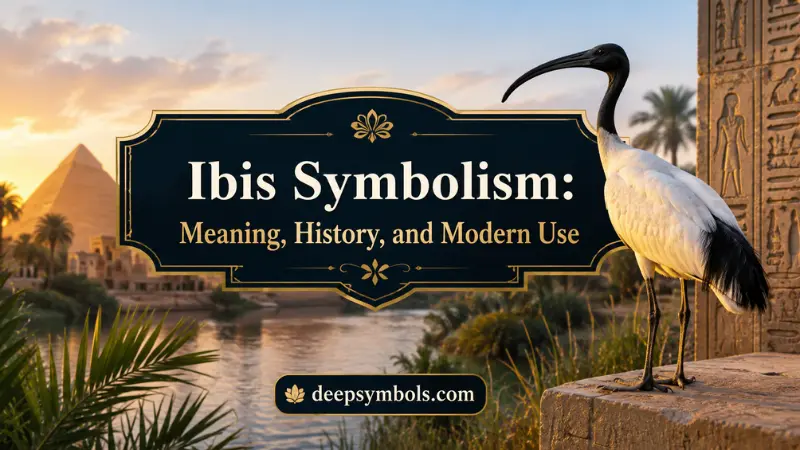
If you’ve ever spotted a white ibis picking through a Florida lawn or noticed one grinning back at you as a college mascot, you’ve probably wondered what the bird actually stands for. Ibis symbolism carries more weight than most backyard birds get credit for, and the reasons trace back thousands of years to the banks of the Nile.
The ibis is a long-legged wading bird with a distinctive curved bill, and it has carried symbolic meaning since ancient Egypt, where it was tied to the god Thoth. That connection to wisdom and writing never really faded — it just picked up new layers as the bird’s image traveled through Greek, Christian, Caribbean, and eventually American culture. Today, the same bird shows up in tattoo studios, coastal home decor, and on the sidelines of a college football game, each context adding its own spin.
Understanding ibis symbolism matters if you’re choosing a tattoo, decorating a coastal home, naming a sports team, or just trying to make sense of a bird you keep seeing near the water. The meaning isn’t fixed — it shifts depending on species, color, and setting, and knowing those distinctions helps you use the symbol accurately instead of leaning on vague spiritual language that doesn’t actually explain anything.
Quick Answer
Ibis symbolism in modern American culture most often represents resilience, calm persistence, and quiet intelligence, especially in Florida-based branding and coastal design where the bird is a familiar wetland resident. Historically, the ibis was sacred to the ancient Egyptian god Thoth, making it a symbol of wisdom, writing, and communication between the human and divine worlds.
TL;DR
- Ancient Egypt linked the ibis to Thoth, the god of wisdom and writing
- Modern U.S. meaning centers on resilience, patience, and coastal identity
- The American white ibis inspired the University of Miami’s mascot, Sebastian
- Scarlet ibis symbolism differs, tied to vitality, mortality, and Caribbean pride
- Tattoo culture reads the ibis as a quiet emblem of balance and endurance
- Color and species change the meaning more than most people realize
What the Ibis Looks Like and Where You’ll Encounter It
An ibis is a mid-sized wading bird best identified by its long, downward-curving bill, which it uses to probe mud and shallow water for crustaceans, insects, and small fish. In the United States, the most commonly seen species is the American white ibis, found throughout Florida, the Gulf Coast, and other southeastern wetlands, where flocks gather in marshes, lawns, golf courses, and even suburban retention ponds.
Elsewhere in the world, other species carry their own visual identity. The sacred ibis of Africa has a bald black head and neck against white plumage. The scarlet ibis of South America and Trinidad is a vivid, almost unreal shade of red. The crested ibis of East Asia is pale pink with a distinctive plume. Each version of the bird has picked up its own symbolic thread, which is part of why “ibis symbolism” isn’t one single idea — it’s a family of related meanings anchored by geography and color.
Core Meaning: What the Ibis Represents Today
Strip away the mythology for a moment and look at what people actually associate with the ibis now. Three ideas come up again and again: patience, resilience, and quiet intelligence.
Patience comes from watching the bird itself — an ibis feeding in shallow water moves slowly and deliberately, probing the mud again and again rather than striking fast like a heron. Resilience is a newer, distinctly American layer, built almost entirely from the bird’s reputation for surviving Florida’s hurricane season. Quiet intelligence is the oldest thread, a direct carryover from the bird’s ancient role as the living form of a god associated with knowledge.
None of these meanings require mystical language to explain. They’re grounded in observable behavior, regional folklore, and a documented mythological record — which is part of why the symbol has held up so well across such different contexts.
Ancient Roots: The Ibis and the God Thoth
The ibis’s symbolic career begins in ancient Egypt, where it was the sacred animal of Thoth, the god credited with inventing writing and overseeing wisdom, magic, and the measurement of time. Thoth was typically shown either as a baboon or, more often, as a man with the head of an ibis, and the bird’s curved bill was visually linked to the crescent moon, tying it further into Thoth’s role as a keeper of lunar cycles and calendars.
The ibis hieroglyph did double duty in the written language itself. It could represent Thoth’s name directly, and it also functioned as a marker attached to words related to knowledge, counting, and writing — meaning the bird was literally built into the vocabulary of record-keeping. Given that connection, it’s not surprising that ibises were mummified by the millions and buried in catacombs dedicated to Thoth, particularly near Hermopolis, the center of his worship. The bird wasn’t just a symbol on a wall; it was treated as a living extension of the god.
From Egypt to Greece: A Symbol That Traveled
When Greek writers encountered Egyptian religion, they folded Thoth into their own pantheon by associating him with Hermes, sometimes calling him Hermes Trismegistus, or “Hermes Thrice-Great.” That merger carried the ibis along with it, linking the bird to messages, mediation, and movement between worlds — themes already present in Thoth’s Egyptian role as a messenger and scribe for the gods.
The Greek historian Herodotus also recorded a more practical piece of ibis folklore: a belief that the birds helped protect Egypt from winged serpents, an idea that framed the ibis as a guardian figure as much as an intellectual one. That dual identity — protector and record-keeper — is part of what let the symbol adapt so easily once it left Egypt and Greece behind.
Symbolism in the United States: The Primary Lens
American engagement with ibis symbolism is almost entirely regional, rooted in the bird’s visible presence throughout Florida and the Gulf Coast rather than in any direct inheritance from Egyptian religion. Most Americans who recognize ibis symbolism encountered it through one specific channel: the University of Miami.
The Sebastian the Ibis Story
In 1926, University of Miami students named their yearbook “The Ibis,” informally adopting the bird as the school’s identity before it ever became an official mascot. The choice wasn’t random. Local Everglades folklore held that the ibis was the last animal to take shelter before a hurricane hit and the first to reappear once the storm passed — a behavioral claim that turned the bird into a natural symbol for a football program that would eventually be named the Hurricanes.
By the late 1950s, students had built an actual ibis costume, and the character was eventually named Sebastian after the residence hall where the student performing the role lived. Sebastian is still Miami’s mascot today, and the folklore behind him has done more to shape American ibis symbolism than any Egyptian myth — for most U.S. sports fans, “ibis” now means resilience and storm-tested toughness before it means anything else.
Coastal and Everglades Identity
Beyond the mascot, the American white ibis functions as an informal emblem of Florida’s wetland ecosystems. It appears in state park branding, nature center logos, and Everglades conservation material, where it represents the health of shallow-water habitats the bird depends on for feeding. Because ibises are sensitive to water quality and habitat loss, their presence — or absence — is sometimes used as an informal signal of wetland health, which adds an environmental layer to the symbolism that’s specific to American conservation culture.
Cross-Cultural Meaning Beyond the United States
Outside the U.S., ibis symbolism shifts depending on which species and cultural tradition you’re looking at.
In Trinidad and Tobago, the scarlet ibis is the national bird, chosen at independence in 1962 partly because its vivid red plumage echoes the red band on the national flag. There, the bird represents national vitality and pride rather than wisdom, and its image appears on currency and the national coat of arms.
In East Asia, the crested ibis carries a very different weight. The species nearly went extinct in Japan in the early 2000s, and conservation efforts since then have turned the bird into a symbol of ecological recovery and cross-border cooperation between Japan and China, where breeding programs have worked to rebuild wild populations.
In parts of the Hebrew Bible, wading birds including varieties associated with the ibis are listed among birds considered ritually unclean, a detail that stands in sharp contrast to the reverence shown to the bird in Egyptian religion just across the border. That contrast is worth noting because it shows the ibis was never universally sacred — its meaning always depended on which tradition was doing the interpreting.
Emotional and Psychological Associations
People drawn to ibis symbolism today tend to describe similar feelings: steadiness, focus, and a kind of unhurried confidence. The bird’s slow, methodical feeding style reads to many as a model for patience under pressure, and its association with Florida’s storm folklore adds a layer of quiet endurance — the idea of waiting out a crisis rather than fighting it head-on.
That combination — patience plus resilience — is different from the more aggressive symbolism attached to predatory birds like hawks or eagles. The ibis doesn’t represent conquest or dominance. It represents the ability to keep functioning, and even keep feeding, in an environment that’s frequently unstable.
Modern Usage: Tattoos, Design, and Everyday Life
Tattoo Culture
Ibis tattoos are less common than hawk, owl, or raven designs, which is part of their appeal for people who want a bird symbol that isn’t overused. Common interpretations lean on the same themes already discussed: wisdom inherited from the Thoth connection, resilience borrowed from Florida hurricane folklore, and balance drawn from the bird’s black-and-white or white-and-orange coloring. Some designs lean into the Egyptian hieroglyphic style directly, referencing Thoth explicitly, while others go for a more naturalistic wetland bird, especially among people with a personal or regional connection to Florida.
Home Decor and Coastal Design
In coastal and “Old Florida” interior design, ibis imagery shows up on wallpaper, table linens, and wall art as a regional signifier, similar to how flamingos or pelicans function in the same design category. The symbolism here is lighter than the tattoo context — it’s less about wisdom or resilience and more about signaling a connection to Southern wetland aesthetics.
Sports and Institutional Branding
Sebastian the Ibis remains the most visible example of ibis branding in American life, but the bird also appears in smaller regional contexts — nature centers, water management districts, and local business logos throughout Florida — almost always leaning on the resilience angle rather than the ancient wisdom angle.
Controversies and Misunderstandings
The most common mix-up involves conflating different ibis species and assuming their symbolism is interchangeable. The white ibis tied to Florida folklore, the sacred ibis tied to Thoth, and the scarlet ibis tied to Trinidad and Tobago all carry distinct meanings shaped by different histories — treating them as one generic “ibis symbol” flattens all three.
There’s also a frequent overstatement online of the bird’s mystical qualities, with some sources describing the ibis using vague spiritual language not well supported by the historical record. The documented Egyptian connection to Thoth is real and well established; claims about the ibis as a universal “spirit guide” delivering personal messages are a much later, and much less grounded, addition.
Finally, the hurricane folklore behind Sebastian the Ibis is a piece of regional storytelling, not an ornithological fact. Ibises don’t have documented storm-sensing behavior beyond the general tendency of many bird species to seek shelter as barometric pressure drops. The story endures because it’s a good story, not because it’s been scientifically verified.
How the Meaning Has Evolved Over Time
The ibis started as a specific religious symbol tied to one Egyptian god, then broadened as it moved through Greek reinterpretation, appeared in scattered biblical references, and eventually landed in twentieth-century American college sports as a folk symbol of storm resilience. Each stop added a layer rather than replacing what came before — modern ibis tattoos, for instance, often reference both the ancient wisdom angle and the newer resilience angle in the same design.
That layering is fairly unusual. Most animal symbols either stay tied to their original mythology or get fully reinvented in a new context. The ibis has managed to do both at once, which is part of why the symbol still feels coherent despite spanning thousands of years and several unrelated cultures.
Ibis Symbolism at a Glance
| Context | Meaning in the USA | Common Associations | Notes |
|---|---|---|---|
| Florida wetlands / Everglades | Ecological health, regional identity | Wading birds, conservation | White ibis is the most commonly seen species |
| University of Miami mascot | Resilience, courage | Hurricanes, storm folklore | Rooted in a 1926 yearbook naming, not ancient myth |
| Tattoo culture | Wisdom, balance, quiet endurance | Egyptian hieroglyphs, minimalist line art | Less common than hawk or owl tattoos |
| Coastal home decor | Regional charm, “Old Florida” style | Flamingos, pelicans, wetland motifs | Symbolism is decorative rather than spiritual |
| Ancient Egyptian religion | Wisdom, writing, divine communication | Thoth, hieroglyphics, mummified ibises | The historical foundation for all later meanings |
FAQs
What does an ibis tattoo symbolize?
Ibis tattoos typically represent wisdom, patience, or resilience, depending on the design. Egyptian-influenced designs lean on the bird’s connection to Thoth, while naturalistic designs often reference regional pride, especially among people connected to Florida.
Is the ibis a symbol of good luck?
There’s no strong historical basis for the ibis as a universal luck symbol, though some modern sources describe it that way. Its more consistent historical association is with knowledge and communication rather than fortune.
Why is the ibis connected to Egyptian mythology?
The ibis was the sacred animal of Thoth, the Egyptian god of wisdom and writing, who was often depicted with an ibis head. The bird’s curved bill was also linked visually to the crescent moon, reinforcing Thoth’s role in tracking lunar time.
Why did the University of Miami choose an ibis as its mascot?
Local folklore held that the ibis was the last animal to take shelter before a hurricane and the first to reappear afterward, which made it a fitting symbol for a school whose teams are named the Hurricanes. The bird was informally adopted in 1926 before becoming a full mascot decades later.
Does the ibis mean the same thing in every culture?
No. The white ibis in Florida carries resilience symbolism tied to hurricane folklore, the scarlet ibis represents national pride in Trinidad and Tobago, and the sacred ibis in ancient Egypt represented wisdom and divine communication through Thoth. Species and region both shape the meaning.
What’s the difference between white ibis and scarlet ibis symbolism?
White ibis symbolism in the U.S. centers on resilience and wetland identity, largely shaped by Florida folklore. Scarlet ibis symbolism is tied more to vitality, national pride in Trinidad and Tobago, and in American literature, mortality and fragility through the short story “The Scarlet Ibis.”
Is the ibis considered a spiritual animal?
It’s treated that way in some modern spiritual writing, usually built on its ancient Egyptian associations with wisdom and divine messages. That said, this framing is a modern interpretation layered onto a much more specific historical religious role, rather than a documented spiritual tradition in its own right.
Conclusion
Ibis symbolism holds together across an unusually wide span of history because each new context added meaning instead of erasing what came before. What started as the living form of an Egyptian god of wisdom became, centuries later, a Florida mascot built on hurricane folklore — and both readings are still active today, depending on where you encounter the bird. The ibis was closely associated with Thoth, an ancient Egyptian deity linked with wisdom, writing, and knowledge, as explored in The Metropolitan Museum of Art’s overview of ancient Egyptian art and religion.
That range is exactly why it’s worth being specific rather than reaching for one all-purpose explanation. A white ibis on a Florida lawn, a scarlet ibis on Trinidad’s coat of arms, and a hieroglyphic ibis carved into an Egyptian temple wall are all technically the same kind of bird, but they’re not telling the same story.
Next time an ibis shows up — on a football sideline, in a tattoo, or wading through a marsh — the meaning behind it is less about mystery and more about which piece of its long history happens to be showing.