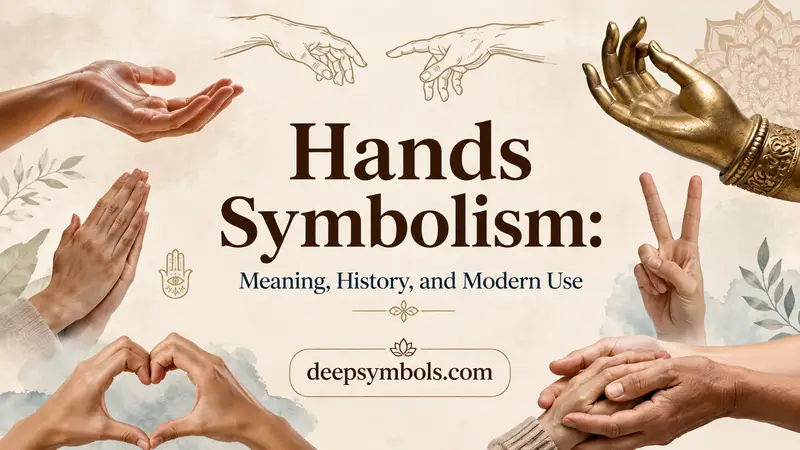
Hands are among the most recognizable symbols in human culture because they communicate without requiring spoken language. A hand can welcome someone, offer help, make a promise, signal agreement, express grief, or create something meaningful. Hands symbolism therefore changes according to gesture, context, culture, and the relationship between the people involved.
In the United States, hands appear everywhere from wedding ceremonies and religious art to tattoos, political imagery, advertising, sports, and social media. Their meanings are often connected to ideas people experience directly: action, communication, work, connection, protection, trust, and personal agency. (For how gesture meaning shifts across borders more broadly, see our guide to body language and gesture symbolism.)
Quick Answer
Hands symbolism commonly represents communication, help, connection, action, and human ability in modern American culture, especially through gestures such as waving, shaking hands, reaching out, or offering assistance. Historically, hands have also represented blessing, authority, devotion, labor, protection, and commitment across religious and cultural traditions.
TL;DR
- Hands commonly symbolize communication, action, connection, and assistance
- Hand gestures can communicate agreement, respect, welcome, or warning
- Religious traditions often use hands to represent blessing and authority
- Working hands are associated with labor, skill, independence, and dignity
- Tattoos and jewelry use hands to express relationships and personal values
- Meaning changes significantly according to gesture and cultural context
What Hands Commonly Symbolize in the United States
American culture gives hands a strong association with doing. People use their hands to build, write, cook, repair, create art, care for others, and perform countless everyday tasks, and because of that connection with action, hands often symbolize capability rather than passive intention. Two of the strongest threads in that symbolism — action and communication — each get a full section of their own just below.
The important point to hold onto throughout is that there’s no single universal meaning for a hand. The gesture, position, number of hands, surrounding imagery, and cultural setting all matter more than the hand itself.
The Hand as a Symbol of Human Action
One of the oldest and most intuitive meanings of the hand is action. The hand is the part of the body through which people physically interact with the world — we pick things up, shape materials, draw, write, plant, repair, cook, and care for others with our hands, and that practical relationship explains why hands frequently symbolize work and accomplishment.
Expressions such as “lend a hand” and “hands-on” reinforce this idea in American English. A person described as having “a steady hand” may be associated with reliability or skill, while “working with one’s hands” can suggest craftsmanship and practical knowledge. This symbolism appears in public imagery too — a hand holding a tool may represent labor, a hand planting a seed can suggest cultivation or environmental responsibility, and a hand creating an object can represent craftsmanship, creativity, or independence. In this sense, the hand doesn’t merely symbolize ability. It represents ability put into practice.
Hands as Symbols of Communication
Hands communicate even when people say nothing at all. A wave can welcome someone or signal farewell. A raised palm can ask someone to stop. An open hand may appear friendly and nonthreatening, while a closed fist can suggest determination, resistance, solidarity, or anger instead.
American Sign Language provides an especially important example of hands as a structured form of communication specifically. Hand shape, movement, position, and facial expression work together to convey language, which makes it different from casual hand gestures — it’s a complete linguistic system, not a set of informal signals. Everyday American culture also uses informal gestures constantly on top of that: athletes celebrate with hand signs, friends use gestures as inside jokes, and people communicate reactions through photographs and video. This makes hands especially suitable symbols for expression without speech.
Open Hands, Reaching Hands, and Helping Hands
The position of the hand can completely change its symbolic meaning. An open hand often suggests openness, generosity, welcome, honesty, or peace — an open palm can also communicate that a person isn’t carrying a weapon, though its interpretation depends heavily on the situation around it.
A reaching hand commonly represents connection or assistance. Images of one person reaching toward another often communicate rescue, compassion, friendship, or emotional support. A helping hand has become a familiar American expression for practical assistance, and charities, community organizations, and volunteer campaigns frequently use hand imagery because it quickly communicates cooperation and service without needing further explanation. Two hands holding one another can suggest mutual support rather than one-sided assistance, a distinction that becomes particularly relevant in images about friendship, caregiving, family, and community.
Hands in Religious and Spiritual Symbolism
Hands have important roles in many religious traditions, though their meanings aren’t identical across religions. In Christianity, hands appear in imagery involving blessing, prayer, healing, service, and the laying on of hands, and Christian art has used particular hand positions to communicate blessing or divine authority specifically.
In Judaism, hands appear in religious symbolism through traditions such as the priestly blessing, in which a particular hand position is associated with the blessing of the congregation. The hamsa, a hand-shaped symbol found across parts of Jewish, Muslim, and broader Middle Eastern cultural tradition, has also been associated with protection and good fortune, though its history and interpretation are more complicated than a single modern definition suggests. In Hindu and Buddhist tradition, hand positions known as mudras can carry specific religious and philosophical meaning, representing qualities such as compassion, meditation, teaching, protection, or spiritual understanding depending on the position.
These examples show why it’s misleading to say a hand has one universal spiritual meaning. Religious symbolism depends heavily on the tradition, gesture, and historical context involved.
Hands and American Ideas About Work
Few symbolic associations are stronger than the relationship between hands and labor. The phrase “working hands” can evoke construction workers, farmers, mechanics, artists, craftspeople, cooks, nurses, and countless other occupations at once — the hand becomes a visible representation of effort and practical knowledge without needing to specify which profession exactly.
This symbolism is particularly significant in a country where ideas about self-reliance, craftsmanship, entrepreneurship, and hard work have played a major role in cultural identity. A photograph of weathered hands may communicate years of labor without showing the person’s face at all. Calloused hands can suggest experience and physical effort. A skilled hand holding a tool may represent expertise on its own.
At the same time, this imagery can oversimplify people’s lives if taken too literally. Not every form of meaningful work is physical, and symbolic representation of labor shouldn’t imply that intellectual, emotional, or caregiving work is somehow less valuable by comparison.
Hands in Love, Marriage, and Relationships
Hands frequently symbolize relationships because touching hands is one of the simplest forms of physical connection available. Holding hands can communicate affection, companionship, reassurance, and trust, and unlike more intimate gestures, it’s also socially acceptable in many public settings — which makes it a common representation of romantic relationships specifically.
Wedding symbolism makes this especially visible. Rings are placed on fingers during marriage ceremonies, and photographs often focus on joined hands wearing wedding bands, turning the hands into a visual representation of a promise between two people. Hands can symbolize family relationships too — a child’s small hand held by an adult’s hand can suggest protection and care, while several hands joined together can represent family unity or shared responsibility instead. In tattoos, hand imagery may therefore represent a partner, parent, child, friendship, or another important relationship depending on the wearer’s story.
Hands and Mourning or Remembrance
Hands can carry quieter meanings when used in memorial imagery specifically. A pair of hands folded together may suggest prayer, reflection, or mourning. A hand reaching toward the sky can symbolize remembrance, longing, or the desire to remain connected with someone who has died.
Memorial tattoos sometimes incorporate hands with names, dates, flowers, photographs, or religious imagery, and the meaning here is usually personal rather than universally fixed. Hands can also represent the final act of caring for someone — in photographs and memorial art, holding a loved one’s hand may communicate companionship during grief more effectively than a written statement ever could. This makes hand symbolism particularly suitable for remembrance, since the gesture itself can represent presence and connection rather than absence alone.
Common Hand Symbols and Their Meanings
Different gestures have developed recognizable meanings in American culture, though even familiar gestures can change meaning according to setting or audience.
| Hand Symbol or Gesture | Meaning in the USA | Common Associations | Notes |
|---|---|---|---|
| Open palm | Welcome, honesty, peace, greeting | Trust, communication | Meaning depends on position and context |
| Handshake | Agreement, respect, introduction | Business, cooperation | Customs have changed over time |
| Holding hands | Affection and connection | Romance, friendship, family | Can also communicate reassurance |
| Helping hand | Assistance and service | Charity, community | Common in nonprofit imagery |
| Raised hand | Participation, greeting, attention | School, conversation, protest | Can have different meanings elsewhere |
| Closed fist | Determination, solidarity, resistance | Protest, activism, strength | Context strongly affects interpretation |
Why Hands Appear So Often in Tattoos
Hand imagery works particularly well in tattoos because it can communicate a personal story without requiring many words. A tattoo of two hands holding each other may represent love or family. A praying-hands design may express religious faith or personal devotion. A hand holding a flower can connect human action with nature, beauty, remembrance, or growth all at once.
Hands can also symbolize creativity specifically. An artist might choose a hand holding a pencil or brush to represent a commitment to making things. A musician may use hand imagery connected to an instrument instead. A working hand with a tool can honor a family profession or personal craft. Because hands are so strongly associated with individual action, they can also represent agency — the idea that a person has the ability to make choices and shape their own life. The meaning of a hand tattoo should be interpreted alongside the rest of the design rather than from the hand alone, though, since the same basic image can carry very different weight depending on what surrounds it.
Hands in Art, Advertising, and Popular Culture
Artists have long used hands to communicate emotion without relying on facial expression. A reaching hand can create tension. A protective hand can communicate care. A pointing hand can direct attention. Two hands separated by a small distance can suggest longing or an incomplete relationship, all without a single word of dialogue.
Advertising uses similar visual shortcuts. A hand holding a product emphasizes human interaction with that product directly. Hands preparing food can communicate craftsmanship or family tradition. A group of hands working together can suggest teamwork at a glance. Digital culture has expanded these meanings further through emojis and reaction icons — a waving hand, folded hands, thumbs-up, raised hand, handshake, and other hand-based symbols let people communicate quickly in text conversations, though digital gestures aren’t always interpreted consistently. Emojis can carry different emotional meaning depending on age group, platform, relationship, and context.
How Culture Changes the Meaning of Hand Gestures
One of the biggest mistakes in interpreting hand symbolism is assuming every gesture means the same thing everywhere. A gesture considered friendly in one country can be rude or inappropriate somewhere else entirely, and the position of the palm, number of fingers displayed, direction of movement, and even which hand is used can all influence interpretation differently across cultures.
This matters when American symbols get used in international advertising, travel, social media, or fashion. A gesture that seems harmless to a U.S. audience may carry a different history elsewhere. Even within the United States, gestures can vary by community and situation — a hand sign at a sporting event may have one meaning among fans and another in everyday conversation entirely. The safest approach is to interpret hand gestures contextually rather than universally, every time.
When Hand Symbolism Becomes Political or Controversial
Some hand gestures have acquired political meaning. The raised fist, for example, has appeared in different movements associated with solidarity, resistance, labor, civil rights, and political activism, and its meaning can’t be separated from the movement and historical moment in which it appears in any given image.
Other gestures have become controversial because extremist groups or political communities have adopted or distorted symbols that may previously have had ordinary meaning. This creates a real challenge for interpretation: a gesture shouldn’t automatically be labeled extremist merely because someone has used it in a particular context, since the same shape can carry entirely different weight depending on who’s using it and why. Likewise, familiar gestures can carry different meanings internationally, so a responsible interpretation considers the complete image, accompanying text, location, audience, and historical context together rather than the gesture in isolation.
This distinction matters because symbolic meaning is not always permanent — communities can adopt, change, challenge, or reject meanings over time, and yesterday’s reading of a gesture isn’t necessarily today’s.
The Psychological Meaning of Hands
Hands can symbolize personal agency because they’re directly involved in changing our surroundings. When people imagine themselves accomplishing a task, their hands are often part of that mental picture — we use them to manipulate objects, care for others, protect ourselves, and express ourselves in ways few other body parts can match.
This helps explain why hand imagery can feel so personal. A hand can represent what someone does, not simply who someone is — which is a meaningfully different kind of symbol than, say, a face or a name. These associations aren’t fixed psychological laws so much as patterns that arise naturally from familiar human experience with touch, action, work, communication, and social interaction, repeated so often that the connection barely needs explaining.
How Hands Symbolism Has Changed Over Time
The basic connection between hands and action is ancient, but specific interpretation has changed considerably over time. Religious art gave particular gestures formal meaning. Social custom developed around handshakes, greetings, and gestures of respect. Industrial society strengthened the association between hands and skilled labor specifically. Modern advertising then turned hands into simplified visual signals of cooperation, service, and human connection on top of all of that.
Digital communication has added another layer more recently, with people now using illustrated hands and hand gestures to express emotion in spaces where physical gestures are impossible. At the same time, globalization has made Americans more aware that gestures don’t always carry universal meaning — a hand symbol once understood mainly within a local setting can now circulate instantly across international audiences with no shared context attached. The result is a flexible symbolic vocabulary in which old meanings remain recognizable while new ones continue to emerge alongside them.
Common Misunderstandings About Hand Symbolism
The first misconception is that every hand gesture has one fixed meaning. In reality, context can change interpretation dramatically, as covered throughout this guide.
Another mistake is treating a modern interpretation as an ancient fact. A gesture may look old or traditional while its current popular meaning actually developed relatively recently. It’s also easy to assume religious hand symbols carry identical meaning across faiths — they don’t, and similar-looking gestures can carry very different theological or cultural association depending on the tradition. Finally, symbolic interpretation shouldn’t be used to judge a person based solely on a gesture. Context matters: a photograph, tattoo, emoji, or hand sign should be considered alongside its surrounding imagery and the person’s stated purpose whenever possible, not read in isolation.
FAQs
What do hands symbolize spiritually?
Hands can symbolize blessing, prayer, service, healing, protection, or religious authority depending on the tradition. Their spiritual meaning should be interpreted within the specific religion rather than treated as universal.
What does a hand tattoo symbolize?
A hand tattoo can represent connection, creativity, family, love, work, faith, remembrance, or personal agency. The surrounding design usually provides the strongest clue to its intended meaning.
What does an open hand symbolize?
An open hand often suggests welcome, honesty, generosity, peace, or willingness to communicate. In some situations, however, an open palm can mean “stop,” so context determines the message.
Why do hands symbolize hard work?
Hands are directly involved in physical labor, craftsmanship, building, repairing, and creating. This practical association has made hands a common representation of skill, effort, independence, and useful work.
What do two hands holding each other symbolize?
Two hands holding each other commonly represent affection, support, trust, companionship, or family connection. In memorial contexts, the same image may represent remembrance and continuing emotional attachment.
Are hand gestures universal?
No. Some gestures have broadly recognizable meanings, but their interpretations can differ substantially between cultures and communities. A gesture should always be considered within its social and cultural setting.
What does a raised fist symbolize?
A raised fist can symbolize solidarity, resistance, determination, or collective action. Its specific political meaning depends on the movement, historical period, and context in which it appears.
Conclusion
manands Symbolism remains powerful because hands are involved in so many basic human experiences: helping, creating, communicating, promising, resisting, connecting, and caring. Their meaning changes with the gesture, situation, culture, and imagery surrounding them, so there is rarely one universal interpretation. In American culture, hand symbolism continues to appear in art, religion, tattoos, memorials, activism, weddings, and everyday communication. For broader cultural context, the Smithsonian National Museum of American History provides a useful resource for exploring how everyday objects and practices can reflect American life. Ultimately, understanding Hands Symbolism means looking beyond the hand itself and considering what the gesture is doing, expressing, or communicating. body so useful as a symbol.