
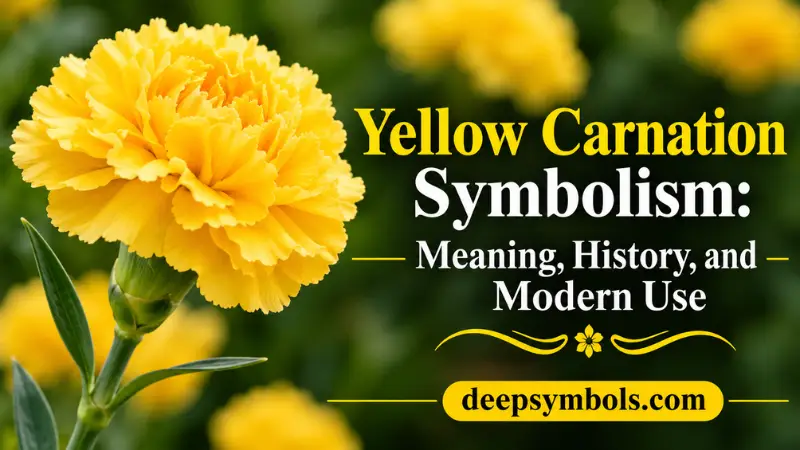
Yellow carnations are bright, recognizable flowers often associated with friendship, cheerfulness, and warm feelings. Their ruffled petals and sunny color make them popular in bouquets, gardens, and floral arrangements. However, yellow carnation symbolism is more complicated than a simple expression of happiness. Depending on the occasion and cultural tradition, the flower can communicate friendship, disappointment, rejection, or even a desire to repair a relationship.
In the United States, carnations are commonly used for celebrations, Mother’s Day arrangements, school events, weddings, and memorial services. Red and pink carnations often have more established associations with romantic affection and maternal love, while yellow varieties carry a wider range of interpretations. Their meaning can change depending on the recipient, the arrangement, and the message accompanying the flowers.
Understanding the yellow carnation requires looking at the history of carnations, the cultural associations of yellow, and the changing language of flowers. These influences explain why the same cheerful-looking bloom can represent both positive emotions and complicated relationships.
Quick Answer
Yellow carnations commonly symbolize friendship, happiness, optimism, and cheerful affection in modern American floral culture. In the traditional language of flowers, however, they have also been associated with disappointment, rejection, and unreturned affection, making their meaning dependent on context.
TL;DR
- Yellow carnations commonly represent friendship, happiness, and optimism.
- Victorian flower traditions sometimes associated them with rejection and disappointment.
- Their bright color connects them with sunshine, warmth, and celebration.
- In American culture, they appear in gifts, gardens, and special occasions.
- Their meaning differs from the romantic associations of red carnations.
- Modern bouquets can use yellow carnations to express encouragement and appreciation.
1. What Does a Yellow Carnation Look Like?
The yellow carnation is a flowering plant recognized by its layered, ruffled petals and distinctive fragrance. Its botanical name is Dianthus caryophyllus, the same species that produces red, pink, white, and other cultivated carnation varieties.
Yellow carnations range from pale buttery shades to vivid golden tones. Some have nearly solid-colored petals, while others feature subtle color variations around the edges. Their full blooms and long stems make them suitable for bouquets, floral centerpieces, and decorative arrangements.
Carnations are also valued for their relatively long vase life. With proper care, cut flowers can remain attractive for an extended period, which helps explain their popularity in commercial floristry.
The flower’s physical appearance contributes to its symbolism. Its bright yellow petals naturally suggest sunlight and warmth, while its soft, layered structure gives it a gentle appearance. These visual qualities help explain why yellow carnations are often selected for cheerful arrangements, even though their historical floral meanings can be less positive.
2. The Main Meanings of Yellow Carnations
Yellow carnations carry several symbolic associations, and their interpretation depends on the cultural setting and the intentions of the person giving them.
Friendship: Yellow flowers are frequently chosen to celebrate companionship without suggesting romantic commitment. A yellow carnation can serve as a thoughtful gift for a friend, colleague, or family member.
Happiness and optimism: The sunny color creates an association with positive emotions, encouragement, and a cheerful outlook. Yellow carnations can brighten a room or mark a happy occasion.
Disappointment: In traditional Victorian floriography, yellow carnations were associated with disdain and rejection. This historical interpretation contrasts with their more cheerful contemporary presentation.
Affection without romance: Their bright appearance and less explicitly romantic associations make them suitable for expressing appreciation and warmth.
Emotional complexity: Because the flower has both positive and negative historical associations, it can represent the complicated nature of human relationships.
The most useful distinction is between contemporary floral practice and historical flower dictionaries. A florist today is unlikely to assume that a customer ordering yellow carnations intends to communicate rejection.
3. Victorian Origins of Yellow Carnation Symbolism
The negative meaning of yellow carnations is closely connected with the Victorian language of flowers, also called floriography.
During the nineteenth century, flower dictionaries became popular in Britain, France, and the United States. These publications assigned meanings to different flowers, allowing people to imagine that bouquets could communicate feelings that were difficult to express openly.
The system included both affectionate and unfavorable messages. Red flowers might express admiration, while certain other varieties could communicate refusal, disappointment, or distrust.
Yellow carnations acquired an especially unfavorable association in several Victorian flower dictionaries. They could represent disdain, rejection, or a lack of affection toward the recipient.
This interpretation made the flower particularly interesting in romantic relationships. Someone who received yellow carnations from a suitor might understand the gift as a refusal rather than an expression of love.
However, Victorian floriography was never a completely standardized communication system. Different dictionaries sometimes assigned different meanings to the same flower, and there is limited evidence that ordinary people consistently followed these codes when exchanging bouquets.
The tradition is still important because it explains why yellow carnations appear in historical discussions of rejection and disappointment.
4. What Yellow Represents in American Floral Culture
Color plays an important role in how people interpret flowers. In contemporary American culture, yellow is frequently associated with sunshine, warmth, optimism, and happiness.
These associations make yellow flowers popular for occasions that celebrate friendship, encouragement, and positive experiences.
Yellow carnations benefit from this broader color symbolism. Their appearance can suggest a cheerful personality, a welcoming attitude, or appreciation for someone who brings happiness into everyday life.
The color can also communicate emotional warmth without the romantic intensity often associated with red roses or red carnations.
For example, a bouquet of yellow carnations might be appropriate for:
- Celebrating a friend’s birthday.
- Congratulating someone on a personal achievement.
- Welcoming a new neighbor.
- Thanking a helpful colleague.
- Sending encouragement during a challenging period.
- Decorating a spring or summer gathering.
These uses reflect modern floral conventions rather than a universal symbolic code. The recipient’s preferences and the occasion remain more important than any supposed fixed meaning.
5. Yellow Carnations and Friendship
Friendship is one of the most approachable contemporary interpretations of yellow carnations.
Unlike flowers strongly associated with romantic courtship, yellow carnations can communicate affection without creating an expectation of romantic commitment. Their cheerful color makes them suitable for expressing appreciation toward people who contribute positively to everyday life.
A friend might receive yellow carnations after completing an important project, celebrating a birthday, or overcoming a difficult personal experience.
They can also be used to recognize friendships that have lasted many years. In this setting, the flower represents shared memories, loyalty, and the enjoyment of companionship.
The meaning becomes especially appropriate when the recipient appreciates flowers but prefers something less traditionally romantic than red roses.
Yellow carnations are not an official universal flower of friendship, however. Their association comes from contemporary color conventions and personal floral choices rather than one universally recognized historical tradition.
6. Yellow Carnations in American Celebrations and Traditions
In the United States, carnations are widely available throughout the year. Their durability, variety of colors, and relatively affordable price make them practical for personal gifts and large floral arrangements.
Yellow carnations can appear at birthdays, graduation parties, community celebrations, and other occasions where a bright decorative flower is appropriate.
Their connection with carnations as a broader flower family also brings them into conversations about Mother’s Day.
The American Mother’s Day tradition has a particularly strong association with carnations. Anna Jarvis, who helped establish the national holiday, selected white carnations to honor her mother. The flower subsequently became associated with maternal affection and remembrance.
White carnations are especially connected with this original tradition, while red carnations have also become associated with honoring living mothers in later customs.
Yellow carnations do not have the same established Mother’s Day meaning, but they can still be included in a personal arrangement when their color suits the recipient.
Other American occasions where yellow carnations may be used include:
- Graduations: Their bright appearance can complement celebrations of achievement.
- Birthdays: They make cheerful additions to birthday bouquets.
- Retirement parties: They can communicate appreciation and goodwill.
- Spring gatherings: Their sunny color fits seasonal decorations.
- Thank-you gifts: They offer a simple expression of gratitude.
The flower’s meaning is usually shaped by the occasion rather than a strict historical rule.
7. Yellow Carnations Compared With Other Carnation Colors
Carnations come in several colors, and each has developed different associations through floral traditions, popular culture, and personal interpretation.
| Carnation color | Common symbolic meaning | Typical modern association |
|---|---|---|
| Yellow | Friendship, cheerfulness, and historically rejection | Encouragement and appreciation |
| Red | Love, admiration, and affection | Romance and passionate attachment |
| Pink | Gratitude, affection, and maternal love | Mother’s Day and appreciation |
| White | Purity, remembrance, and sincerity | Weddings and memorial arrangements |
| Purple | Capriciousness in some Victorian traditions | Individuality and decorative expression |
These meanings are not universal. For example, pink carnations became especially associated with maternal love through American Mother’s Day traditions, while white carnations became connected with remembrance and honoring mothers who had died.
Yellow carnations stand apart because their historical association with rejection contrasts with their cheerful contemporary appearance.
This difference makes them particularly interesting when comparing the traditional language of flowers with modern floral customs.
8. The Emotional and Psychological Meaning of Yellow Carnations
The emotional associations of yellow carnations come partly from the flower itself and partly from the way people respond to color.
Yellow is a visually noticeable color that many people connect with daylight, warmth, and positive experiences. In floral arrangements, it can make surrounding colors appear brighter and give a composition a lively appearance.
Yellow carnations may therefore communicate:
Optimism: Their sunny appearance can represent a positive outlook and the expectation of better circumstances.
Encouragement: Giving someone yellow flowers can be a thoughtful way to acknowledge a difficult experience and offer support.
Appreciation: Their cheerful appearance makes them suitable for expressing gratitude without suggesting romantic intentions.
Independence: Some people select yellow flowers because they prefer bright, distinctive arrangements rather than traditional romantic designs.
Emotional caution: For people familiar with Victorian flower meanings, yellow carnations may recall rejection or disappointment.
It is important not to treat these reactions as universal psychological rules. People have different experiences with flowers, colors, and personal relationships. Someone may associate yellow carnations with a happy childhood memory, while another may recognize their historical negative meaning.
The emotional meaning ultimately depends on the individual and the circumstances surrounding the gift.
9. Yellow Carnations in Different Cultural Traditions
Flower symbolism changes between cultures, and yellow carnations do not have one internationally accepted interpretation.
In European traditions, the nineteenth-century language of flowers helped establish several negative meanings for yellow carnations. These associations became part of the broader history of floriography.
In the United States, contemporary floral culture generally gives greater attention to the cheerful appearance of yellow flowers than to the older Victorian code. Many people choose them for friendly gifts and decorative arrangements without considering their historical associations.
In East Asian cultures, yellow can have additional associations with status, prosperity, imperial history, or other cultural values. However, these meanings should not automatically be transferred to yellow carnations. A color’s cultural significance does not establish an identical meaning for every flower.
In Mediterranean countries, carnations have long histories as ornamental flowers and appear in different national and regional traditions. Their meanings can vary according to local customs, political history, celebrations, and religious occasions.
The important distinction is that flower symbolism develops through specific cultural practices. A yellow carnation’s meaning in one country or historical period should not be assumed to apply everywhere.
10. Yellow Carnations in Tattoos, Jewelry, and Personal Style
Although roses are more common in floral tattoo designs, carnations also have a place in personal artwork and decorative fashion.
A yellow carnation tattoo can communicate optimism, friendship, remembrance, or an appreciation for someone who brought happiness into the person’s life.
Some people choose the flower because it reminds them of a family member, an important friendship, or a meaningful event. Others simply appreciate its ruffled petals and distinctive appearance.
Different design choices can add further meaning.
- A single yellow carnation: May represent independence, personal happiness, or appreciation.
- Yellow carnations with other flowers: Can represent relationships, shared memories, or a combination of emotional qualities.
- A yellow carnation with a name: May honor a friend or family member.
- A yellow carnation with a date: Can commemorate a meaningful occasion.
- A realistic botanical design: May express an interest in gardening, nature, or the flower itself.
Yellow carnation jewelry and clothing patterns can serve similar purposes. A flower pendant or embroidered design may represent an individual’s favorite bloom without carrying any specific historical message.
As with most floral tattoos, personal intention is more reliable than assuming that every yellow carnation design communicates the same thing.
11. Yellow Carnations in Gardens, Weddings, and Home Decor
Yellow carnations are valued not only for their symbolic associations but also for their practical decorative qualities.
Their layered petals provide texture, while their bright color creates contrast with greenery and other flowers. Florists can use them as focal flowers or combine them with blooms in complementary shades.
In wedding arrangements, yellow carnations may contribute to a cheerful, informal, or garden-inspired atmosphere. They can be paired with white flowers for a softer appearance or with orange and red blooms for a warmer palette.
For home decoration, yellow carnations can brighten dining tables, entryways, and living spaces. Their relatively long vase life makes them useful for people who want an arrangement that remains attractive for several days.
In gardens, carnations can be grown in containers, borders, and flower beds, depending on the variety and local growing conditions. They generally prefer well-drained soil and plenty of sunlight.
Their decorative role is important because not every person chooses a flower for its symbolism. Sometimes the reason is simply that the bloom looks attractive and suits the surrounding environment.
12. Negative Meanings and Common Misunderstandings
The most significant misunderstanding about yellow carnations concerns their historical association with rejection.
People who encounter Victorian flower dictionaries may conclude that giving someone yellow carnations is always an insult. That interpretation overlooks how much floral customs have changed.
A modern American florist is more likely to interpret the flower according to the customer’s requested color scheme and occasion than assume the sender intends to communicate disdain.
Another misconception is that yellow carnations have an official or universally recognized meaning of friendship. Although this is a reasonable contemporary interpretation, there is no single international authority defining the flower’s symbolism.
It is also inaccurate to assume that yellow flowers always communicate happiness. Yellow can have different meanings depending on cultural traditions, personal memories, and the specific flower involved.
The historical meaning should therefore be understood as one part of the carnation’s cultural development, not as a permanent rule governing every modern bouquet.
When the intention behind a floral gift matters, a short personal message is more reliable than expecting the recipient to interpret an old flower dictionary.
13. How Yellow Carnation Symbolism Has Changed Over Time
The history of yellow carnations illustrates how symbolic meanings can change as social customs evolve.
In nineteenth-century Europe and America, flower dictionaries helped establish a complicated language in which specific varieties and colors communicated emotional messages. Yellow carnations were sometimes assigned unfavorable meanings, including disdain and rejection.
During this period, flowers were also popular decorative objects. Bouquets, floral arrangements, and botanical illustrations appeared in domestic spaces, making flower symbolism part of a wider visual culture.
As the twentieth century progressed, the practice of decoding flowers became less important in everyday communication. Commercial floristry increasingly emphasized appearance, availability, seasonal arrangements, and personal preference.
Modern Americans generally recognize yellow as a cheerful floral color, and yellow carnations are often selected for their appearance rather than their Victorian associations.
The flower has not lost its historical meaning entirely. Instead, that interpretation now exists alongside contemporary associations with friendship, appreciation, and optimism.
This evolution explains why two people can look at the same yellow carnation and understand it differently. One may see an attractive flower for a celebration, while another may recognize its older association with rejection.
14. When Is It Appropriate to Give Yellow Carnations?
Yellow carnations are suitable for many occasions, especially when the intention is to communicate warmth, encouragement, or appreciation.
They can be thoughtful gifts for friends, relatives, colleagues, and people celebrating personal achievements.
For romantic occasions, however, the choice requires more consideration. Someone familiar with Victorian floriography might interpret yellow carnations differently from someone who associates them with sunshine and friendship.
If the purpose is to express romantic commitment, red or pink carnations may communicate the intention more clearly.
For a sympathy arrangement, yellow carnations can be included when their color is appropriate to the family’s preferences and the overall design. However, white flowers are often a more traditional choice for memorial settings in the United States.
A simple message can also remove uncertainty. Explaining that the flowers were chosen because they represent friendship or because their color reminded the sender of the recipient makes the intention clear.
Ultimately, the relationship between the giver and recipient matters more than an old symbolic definition.
FAQs
1. What does a yellow carnation symbolize spiritually?
A yellow carnation can represent optimism, friendship, gratitude, and emotional warmth. These are contemporary personal interpretations rather than meanings established by a specific religious tradition.
2. Do yellow carnations symbolize rejection?
Yes, yellow carnations were associated with disdain and rejection in some Victorian flower dictionaries. This historical meaning is not generally assumed in modern American flower giving.
3. Are yellow carnations good flowers to give a friend?
Yes. Their bright color and less explicitly romantic associations make them suitable for birthdays, congratulations, and expressions of appreciation. A personal note can make the intended message even clearer.
4. What does a yellow carnation mean in love?
Historically, it could communicate rejection or unreturned affection in Victorian floriography. Today, its meaning is less fixed and may express warmth or appreciation without necessarily indicating romantic commitment.
5. Are yellow carnations associated with Mother’s Day?
Carnations are strongly associated with American Mother’s Day, particularly white carnations through the holiday’s early traditions. Yellow varieties can be included in personal arrangements, but they do not have the same established historical association.
6. What is the difference between yellow and red carnation symbolism?
Red carnations traditionally represent love, admiration, and affection, while yellow carnations have been associated with friendship and cheerfulness in contemporary floral culture. Victorian traditions also connected yellow carnations with disdain and rejection.
7. Are yellow carnations considered unlucky?
No universal tradition establishes yellow carnations as unlucky. Their negative reputation comes mainly from historical flower dictionaries, and modern floral customs generally do not treat them as a sign of bad fortune.
Conclusion
Yellow carnation symbolism brings together friendship, optimism, appreciation, and contrasting historical associations. Although the flower’s cheerful appearance makes it a natural choice for expressing warmth and happiness, Victorian floral traditions sometimes assigned yellow carnations a less positive meaning associated with disdain, disappointment, and rejection. The University of Missouri Extension’s article on the Victorian language of flowers explains how these historical meanings developed and why flower colors could communicate very different messages.
In modern American culture, yellow carnations can be used in birthday bouquets, friendship gifts, garden arrangements, and decorative displays. Their meaning depends on the occasion, cultural background, and relationship between the giver and recipient. Rather than following every Victorian convention, people today can use these flowers to express appreciation, celebrate friendship, or bring a cheerful touch to meaningful occasions.
Ultimately, yellow carnation symbolism demonstrates how floral meanings change across generations. A flower once associated with rejection can become a personal expression of warmth and appreciation. Its lasting appeal lies in this flexibility, reminding us that the meaning of a gift comes not only from historical tradition but also from the intentions, relationships, and experiences that surround it.


