
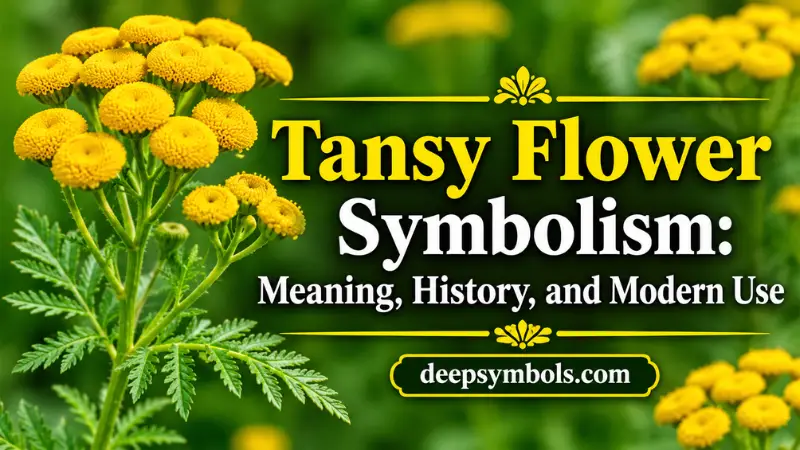
The tansy flower is a distinctive perennial plant recognized by its clusters of small, button-shaped golden-yellow blooms and finely divided green leaves. Its unusual appearance and long history in European herbal traditions have connected it with remembrance, protection, immortality, resistance, and the passage of time. Tansy flower symbolism is particularly interesting because the plant has represented both preservation and death, depending on the cultural tradition and historical context.
Tansy (Tanacetum vulgare) is native to parts of Europe and Asia and was introduced to North America, where it has become naturalized in many areas. Its history includes medicinal practices, household customs, religious observances, and folklore. People once valued the plant for its strong scent and practical uses, while its flowers and evergreen foliage contributed to associations with endurance and lasting memory.
In the United States, tansy is now encountered in gardens, roadsides, naturalized landscapes, and discussions about traditional herbal plants. Its symbolism is less familiar than that of roses or lilies, but its historical associations make it a meaningful subject for anyone interested in flower language, folklore, and the relationship between plants and human beliefs.
Quick Answer
Tansy flower symbolism commonly represents remembrance, protection, endurance, and immortality, particularly through its historical association with preservation and traditional European customs. It has also been connected with mourning, death, and resistance, while its golden-yellow flowers can suggest lasting strength and vitality in modern floral interpretation.
TL;DR
- Tansy traditionally represents remembrance, protection, and endurance.
- Its name and history connect it with ancient Greek traditions.
- European households used tansy in seasonal customs and traditional remedies.
- Its association with preservation contributed to ideas of immortality.
- Victorian flower language connected tansy with resistance and declarations of war.
- Modern gardeners value its distinctive flowers but must consider its invasive potential.
1. What Does the Tansy Flower Look Like?
Tansy is a hardy perennial herb belonging to the daisy family, Asteraceae. Its most recognizable feature is its dense arrangement of small, rounded, golden-yellow flower heads. Unlike many familiar garden flowers, tansy generally has no prominent petals surrounding its flower heads, giving the plant a button-like appearance.
The flowers grow in flat-topped clusters above upright stems. Its leaves are deeply divided and fernlike, creating a contrast between the delicate foliage and the compact golden blooms.
Tansy commonly grows along roadsides, field margins, disturbed ground, and garden boundaries. Its strong, distinctive scent makes it recognizable even before its flowers are noticed.
These physical characteristics contribute to its symbolic associations:
- Golden color: Can suggest vitality, endurance, and lasting strength.
- Button-shaped flowers: Create an impression of order and persistence.
- Hardy growth: Reflects adaptability and survival.
- Strong fragrance: Connects the plant with traditional household protection and preservation.
Unlike delicate flowers that require careful cultivation, tansy can survive in challenging conditions. Its ability to establish itself in different environments helps explain why endurance and persistence are natural modern interpretations of the plant.
2. The Main Symbolic Meanings of Tansy
Tansy has several symbolic meanings, many of which developed from its historical uses rather than from its appearance alone.
Remembrance: Tansy’s association with memorial customs and preservation connects it with remembering people and events. It can represent the desire to keep someone’s memory alive.
Protection: Traditional European households used the strongly scented plant in practical ways, including as an insect-repellent herb. These customs helped establish its association with keeping unwanted influences away.
Immortality: The plant’s historical relationship with preservation contributed to the idea of something enduring beyond ordinary decay.
Resistance: Victorian flower language associated tansy with resistance and declarations of war. This interpretation gives the flower a more confrontational meaning.
Mourning and death: Its presence in historical funerary and memorial contexts connects it with grief, remembrance, and mortality.
Endurance: Tansy’s ability to grow vigorously in varied conditions makes persistence a fitting contemporary interpretation.
These meanings are not interchangeable in every situation. A tansy arrangement intended for remembrance communicates something different from a living plant growing in a garden. Understanding the context helps explain which interpretation is most appropriate.
3. The Ancient Greek Connection: Immortality and Preservation
One of the most interesting aspects of tansy’s history is the origin of its name. The word is traditionally connected with the Greek athanasia, meaning immortality or deathlessness. This connection helped establish the plant’s association with lasting life and preservation.
The name’s history is closely related to the plant’s traditional uses. Tansy was valued for its strong aromatic properties, and its flowers were known for remaining attractive for a relatively long time. Historical accounts also connect the plant with attempts to slow decay and protect bodies after death.
The Metropolitan Museum of Art’s discussion of medieval gardens explains how the plant’s name became associated with immortality and how its use in preservation contributed to that interpretation.
This history gives tansy a distinctive symbolic contrast. It represents the desire to preserve life and memory, even though its traditional uses also brought it into contact with death and funerary practices.
For modern readers, immortality is best understood symbolically rather than literally. Tansy can represent the lasting influence of a person, the preservation of important memories, and the human desire to leave something meaningful behind.
4. Tansy in Medieval European Traditions
During the medieval period, tansy was cultivated in European herb gardens and valued for its practical properties. It appears in historical records of cultivated plants, including the ninth-century Capitulare de villis, a document associated with Charlemagne’s agricultural and estate administration.
Monastic gardens also included tansy among the plants grown for household and medicinal purposes. Its bitter leaves and aromatic qualities made it useful in traditional preparations.
The plant’s reputation was shaped by several practical associations:
- Its strong scent made it useful in household customs.
- Its leaves were incorporated into traditional herbal preparations.
- Its flowers and foliage were associated with preservation.
- Its persistence in cultivation reinforced its reputation for endurance.
These uses helped tansy become more than an ornamental plant. It occupied a place in everyday life, where gardening, medicine, food preparation, and religious customs frequently overlapped.
Medieval people did not necessarily interpret every use of tansy as symbolic. Many applications were practical responses to the needs of households and communities. Nevertheless, repeated associations with protection, preservation, and seasonal customs helped create the meanings later attached to the flower.
5. Tansy and Easter: Renewal and Seasonal Traditions
Tansy also has a historical connection with Easter food traditions in parts of Europe, particularly England.
A traditional dish known as tansy was prepared using eggs and herbs, including tansy leaves. Some versions resembled an herb-flavored omelet or pancake. These dishes were especially associated with the Easter season.
The connection between tansy and Easter developed through historical food customs rather than through a universal religious rule about the flower.
Easter itself celebrates resurrection and renewal in Christianity. Because tansy appeared in seasonal preparations around this period, modern readers may find associations with renewal, continuity, and the return of spring appropriate.
However, it is important not to confuse the plant’s culinary history with official Christian symbolism. Tansy is not a universally recognized Christian emblem of resurrection.
Its seasonal history nevertheless offers an interesting interpretation: a familiar garden herb became part of celebrations marking the transition from winter toward new growth.
6. Tansy Symbolism in American Culture
In the United States, tansy has a particularly interesting history because European settlers brought traditional knowledge of the plant with them.
Early American households used common tansy for several practical purposes. It was incorporated into traditional remedies, used in household insect-control practices, and sometimes associated with preserving bodies before modern embalming became widely available.
The plant also became part of certain New England mourning customs. Historical accounts describe tansy being used around burial preparations, while some regional traditions included bringing tansy bouquets to cemeteries.
These practices help explain why remembrance and mortality are important parts of its American symbolism.
Today, Americans are more likely to encounter tansy as a naturalized roadside plant, a subject of gardening discussions, or an example of historical herbal medicine than as a traditional ceremonial flower.
Its modern interpretations can include:
- Remembrance: Honoring someone who has died.
- Independence: Representing resistance and personal strength.
- Endurance: Surviving difficult circumstances.
- Protection: Recalling traditional household practices.
- Historical connection: Maintaining an interest in older customs and botanical traditions.
The American story of tansy also includes an ecological complication: common tansy is considered invasive in several states. Its vigorous growth is not always desirable, particularly where it competes with native vegetation.
This creates an interesting distinction between symbolic admiration for endurance and the environmental responsibility required when cultivating a nonnative plant.
7. Tansy as a Symbol of Remembrance and Mourning
Remembrance is one of the most historically grounded interpretations of tansy.
The plant’s association with funerary practices developed partly because it was used around bodies and burial preparations. Its aromatic properties and traditional reputation for discouraging insects made it useful before modern preservation methods became available.
In some New England communities, tansy has also been associated with cemetery visits and memorial customs.
These historical connections give the flower a place in discussions of grief and remembrance. Unlike flowers that primarily communicate romantic affection, tansy can represent the desire to maintain a connection with someone who has died.
A person might interpret tansy as a reminder that memories survive physical loss. The flower’s historical association with preservation makes it particularly suitable for this interpretation.
It can also represent respect for family history, ancestors, and traditions passed from one generation to another.
This meaning should not be confused with a universal funeral custom. Tansy has not been used in every American community, and its association with mourning is regional and historical rather than a standard modern practice.
8. Victorian Flower Language: Resistance and Defiance
The Victorian language of flowers gave tansy a more confrontational meaning.
In nineteenth-century floriography, different flowers and plants were assigned messages that could communicate emotions indirectly. Tansy was associated with resistance and, in some flower dictionaries, the declaration, “I declare war against you.”
This interpretation is particularly interesting because it differs from the plant’s associations with preservation and remembrance.
The connection may reflect older beliefs about tansy’s protective and repellent properties. A plant historically used to discourage unwanted insects could easily become associated with resistance, rejection, or opposition.
Victorian flower dictionaries were not consistent. Different publications sometimes assigned different meanings to the same plant, so tansy’s association with defiance should be understood as one historical interpretation rather than a universally accepted definition.
Nevertheless, this meaning remains useful when interpreting the flower in historical floral arrangements or contemporary artistic designs.
A tansy-inspired illustration may communicate independence, the refusal to surrender, or the determination to establish personal boundaries.
9. The Golden-Yellow Color and Its Symbolic Meaning
Tansy’s bright yellow flowers contribute to its visual symbolism. Their color creates a strong contrast with the plant’s dark green foliage and makes the flower clusters especially noticeable in natural landscapes.
In modern American color associations, yellow commonly suggests sunlight, warmth, optimism, attention, and vitality.
These associations can add another layer to the interpretation of tansy.
Vitality: The golden flowers can suggest life, activity, and the ability to continue growing.
Optimism: Yellow is frequently associated with cheerful surroundings and positive expectations.
Awareness: Bright yellow attracts attention, making it suitable for designs intended to communicate alertness or recognition.
Endurance: Combined with tansy’s hardy growth, the color can suggest strength through changing seasons.
However, yellow flowers do not have one universal meaning. In certain floral traditions, yellow can also communicate jealousy, separation, or caution.
The interpretation depends on the cultural setting, the accompanying flowers, and the purpose of the arrangement.
For tansy, its historical associations are generally more significant than its color alone.
10. Tansy in Folklore and Traditional Protection
Tansy’s strong fragrance contributed to its reputation as a protective household herb.
In European folklore and traditional practices, aromatic plants were sometimes used to discourage insects, unwanted animals, or perceived harmful influences. Tansy became part of this broader tradition because of its practical household applications.
People placed aromatic herbs in homes, clothing, storage areas, and other spaces where they were believed to offer protection.
Tansy’s historical use in shoes and household settings also helped strengthen its association with protection during travel and everyday activities.
Some traditional beliefs attributed additional protective qualities to plants beyond their demonstrated physical effects. These interpretations belong to historical folklore and should not be treated as evidence of supernatural powers.
For modern symbolic interpretation, tansy can represent:
- Establishing personal boundaries.
- Keeping unwanted influences at a distance.
- Protecting family traditions.
- Maintaining emotional strength.
- Creating a sense of security.
Its protective symbolism is best understood as a reflection of historical household practices rather than a claim that the plant can prevent misfortune.
11. Emotional and Psychological Meaning of Tansy
Tansy’s symbolism can communicate several emotional experiences, particularly those involving loss, independence, and persistence.
Its association with remembrance makes it relevant to people who want to honor someone important. The flower can represent the emotional desire to preserve memories and maintain a connection with the past.
Its historical meaning of resistance offers another interpretation. A person going through a difficult transition might identify with tansy because it represents standing firm rather than giving in to pressure.
The flower’s hardy growth can also suggest resilience. This interpretation is especially relevant when someone has experienced personal setbacks but continues working toward recovery.
Tansy can therefore represent different emotional experiences:
- Grief: Remembering someone after loss.
- Determination: Refusing to surrender personal convictions.
- Resilience: Continuing through difficult circumstances.
- Nostalgia: Maintaining connections with family and history.
- Independence: Establishing boundaries and personal identity.
These meanings are personal interpretations, not established psychological effects of the plant.
The value of flower symbolism lies in the associations people create between natural objects and their own experiences.
12. Tansy in Modern Gardens, Art, and Personal Style
Although tansy is not as common in commercial floral arrangements as roses, tulips, or lilies, its unusual appearance gives it a recognizable place in botanical art and naturalistic garden design.
Its golden flower clusters work well in illustrations, pressed-flower projects, botanical prints, and historical garden displays.
Some people also incorporate tansy-inspired imagery into decorative designs because its button-shaped flowers offer a distinctive alternative to familiar floral motifs.
Modern uses include:
Botanical artwork: Artists may use tansy to represent natural landscapes, traditional herb gardens, and historical plant knowledge.
Garden design: Its upright stems and yellow flowers create a noticeable visual feature, although its invasive potential requires careful management.
Floral illustrations: The plant’s distinctive flower heads make it suitable for vintage botanical prints and nature-inspired designs.
Jewelry and accessories: Tansy-inspired patterns can communicate individuality, historical interest, and a connection with nature.
Tattoos: A tansy tattoo may represent remembrance, perseverance, protection, or resistance, depending on the wearer’s personal interpretation.
Unlike roses, which have widely recognized romantic associations, tansy is more likely to communicate a specific interest in folklore, botanical history, or unconventional flower symbolism.
13. Cross-Cultural Interpretations and Historical Differences
Tansy’s cultural associations developed primarily through European botanical, culinary, and household traditions. Its history should not be confused with the symbolism of other plants that happen to share similar colors or appearances.
In ancient Greek-related naming traditions, the association with immortality became one of the most recognizable historical interpretations of tansy.
In medieval European communities, its practical use in gardens and household preparations contributed to associations with preservation and protection.
In England, its connection with Easter foods created an additional seasonal association.
In North America, European settlers continued some of these traditions, including household and funerary applications. Certain Indigenous communities also developed their own knowledge and uses of plants identified as tansy, but these should be discussed within their specific cultural contexts rather than generalized into one shared Indigenous interpretation.
The Northern Cheyenne, for example, are documented as having used common tansy in traditional herbal preparations.
These different histories demonstrate that a plant can acquire several meanings through the experiences of the people who encounter it. Tansy’s symbolism is therefore not a single universal belief shared by all cultures.
14. Safety, Toxicity, and Environmental Misunderstandings
Tansy’s historical reputation as a medicinal and protective plant should not encourage casual consumption or unsupervised herbal use.
Common tansy contains biologically active compounds, including thujone in some preparations. Consuming significant amounts can cause serious toxicity, and the plant can also be harmful to livestock.
Historical medicinal applications do not establish modern safety or effectiveness. In particular, tansy has been associated with attempts to influence menstruation and pregnancy, but it should never be used to induce abortion or manage pregnancy-related concerns.
There is also an environmental issue. Common tansy is invasive in parts of North America and can spread through seeds and underground roots. Dense growth can displace desirable vegetation and reduce the quality of certain habitats.
Gardeners should check local invasive-species guidance before planting or distributing it.
These facts do not erase tansy’s historical importance. They simply demonstrate why traditional plant knowledge should be considered alongside modern botanical and safety information.
15. Comparing the Main Meanings of Tansy
| Context | Symbolic meaning | Historical or modern association |
|---|---|---|
| Ancient naming traditions | Immortality and preservation | Connection with Greek athanasia |
| European household customs | Protection | Aromatic and insect-repellent uses |
| Funerary traditions | Remembrance and mourning | Historical burial and preservation practices |
| Victorian flower language | Resistance and defiance | Declaration of opposition |
| Modern garden interpretation | Endurance and vitality | Hardy growth and golden blooms |
The table illustrates why tansy cannot be reduced to one symbolic meaning. Its associations developed through different historical uses, and the meaning most appropriate to a particular design or arrangement depends on its context.
FAQs
1. What does the tansy flower symbolize spiritually?
Tansy can represent protection, remembrance, endurance, and the desire for lasting life. These interpretations come primarily from its historical associations with preservation, household customs, and funerary traditions rather than from a single established religious teaching.
2. Why is tansy associated with immortality?
The plant’s name is traditionally connected with the Greek word athanasia, meaning immortality or deathlessness. Its reputation for lasting flowers and historical preservation uses helped reinforce this association.
3. Does tansy symbolize death or remembrance?
It can represent both because of its historical connection with funerary practices and preservation. In modern interpretations, remembrance is often the more appropriate meaning when the flower is associated with memorials or personal memories.
4. What does tansy mean in the Victorian language of flowers?
Tansy was associated with resistance and, in some historical flower dictionaries, a declaration of war or opposition. These meanings reflect the nineteenth-century tradition of assigning messages to individual flowers, although interpretations varied between publications.
5. Is tansy a symbol of protection?
Yes, protection is one of its historical and modern symbolic associations. Its strong scent and traditional household uses contributed to this meaning, although the plant should not be considered a supernatural protective object.
6. Is tansy mentioned in the Bible?
Common tansy is not specifically identified in the Bible by its modern botanical name. Its symbolism comes mainly from European folklore, traditional herbal practices, and Victorian flower language rather than biblical teachings.
7. Is tansy safe to grow or use at home?
Tansy can be grown ornamentally where it is not considered invasive, but it requires responsible management because it spreads readily. It can also be toxic when consumed, so it should not be used as a homemade medicine or food ingredient without appropriate professional guidance.
Conclusion
Tansy flower symbolism brings together preservation, remembrance, protection, resistance, and mortality. Its historical associations developed through European household traditions, medicinal practices, and the belief that its lasting qualities could represent immortality. The Metropolitan Museum of Art’s historical account of tansy explains the connection between the plant’s name and the Greek concept of being deathless. In early American history, tansy also appeared in funeral wreaths and burial shrouds, as documented by Montana State University Extension.
In Victorian flower traditions, tansy acquired an additional association with resistance, offering a different interpretation centered on independence and determination. These historical meanings demonstrate how a single flower can communicate both the desire to preserve what matters and the strength to withstand difficult circumstances.
Ultimately, tansy flower symbolism reminds us that flowers can represent much more than beauty and affection. Its history connects remembrance with endurance, preservation with mortality, and resistance with personal strength. Whether encountered in a historical garden, an old floral dictionary, or a modern botanical collection, tansy offers a reminder that the desire to remember, protect, and withstand change has remained an important part of human experience.


