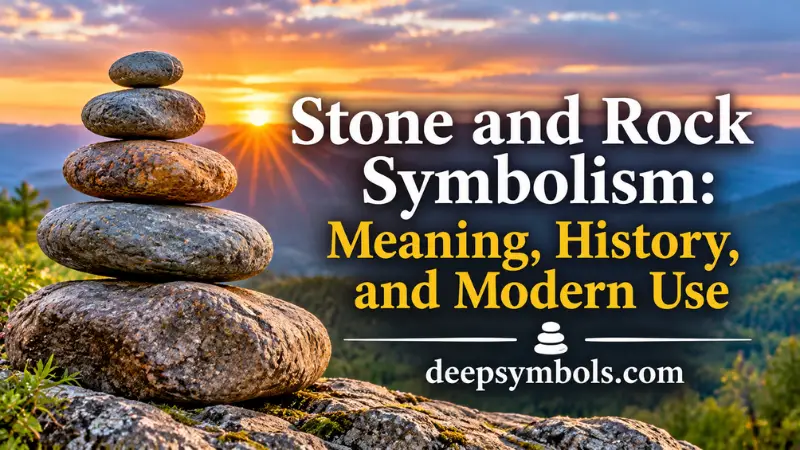
Stones and rocks are among the most familiar elements of the natural world, yet people have assigned them meanings far beyond their physical properties. Stone and rock symbolism commonly connects these natural materials with strength, endurance, stability, permanence, and the ability to withstand hardship. From ancient monuments and religious structures to memorial stones and modern jewelry, rocks have represented qualities that people want to preserve across generations.
In the United States, stones appear in many settings that communicate identity and memory. A gravestone marks a life remembered, a foundation stone represents the beginning of a lasting structure, and a mountain rock can suggest resilience and independence. Even a small stone carried in a pocket may serve as a personal reminder of a relationship, experience, or important decision.
Their meanings are not always positive. A stone can also represent emotional coldness, stubbornness, obstacles, or a burden that becomes difficult to carry. Understanding these different interpretations requires looking at the physical nature of rocks, their place in ancient cultures, their religious associations, and the ways Americans use them today.
Quick Answer
Stone and rock symbolism commonly represents strength, stability, endurance, and permanence in modern American culture, especially in architecture, memorials, jewelry, and personal expression. Historically, stones have also represented sacred foundations, protection, spiritual authority, memory, and the lasting connection between people and the natural world.
TL;DR
- Stones represent strength, endurance, stability, and lasting foundations.
- Ancient civilizations used rocks for monuments, sacred places, and burial structures.
- Christianity connects stones with faith, spiritual foundations, and Christ.
- American memorials use stone to preserve names, memories, and historical events.
- Smooth stones can suggest peace, while rough rocks communicate hardship.
- Modern tattoos and jewelry use stones to express resilience and personal identity.
1. What Stones and Rocks Symbolize
The most common symbolic association of a stone is strength. Unlike many natural materials, rocks can remain intact for extremely long periods, resist environmental pressure, and form the foundations of mountains and landscapes. Their physical durability makes them natural representations of endurance.
Stones also symbolize stability. A building rests on a foundation, a wall depends on carefully placed rocks, and a pathway made of stone can remain usable for generations. These practical qualities have helped establish connections between stone and reliability.
Other common meanings include:
- Permanence: Something intended to survive the passage of time.
- Protection: A solid barrier against external threats.
- Wisdom: Knowledge developed through experience and patience.
- Memory: A physical object that preserves a person’s story.
- Resilience: The ability to withstand pressure and difficulty.
- Grounding: A connection with the physical world and present circumstances.
- Stubbornness: Resistance to change or emotional openness.
These meanings depend on the setting. A stone used in a memorial may communicate remembrance, while a large boulder blocking a road may represent an obstacle. The material remains the same, but its symbolic role changes with human experience.
2. Why Stones Represent Strength and Endurance
Stone’s association with strength comes directly from its physical characteristics. Many rocks withstand weathering, pressure, and repeated environmental changes. Some formations remain visible for millions of years, making them natural examples of endurance on a human timescale.
People have used this durability to express qualities they admire in themselves and others. A person described as having a rock-solid character is understood to be dependable. Someone who remains steady during a crisis may be called a rock for their family or friends.
The phrase “solid as a rock” reflects this cultural association. It suggests reliability, consistency, and resistance to circumstances that might weaken another person.
In American culture, this meaning appears in sports, business, relationships, and everyday conversation. A dependable teammate might be described as the team’s foundation, while a supportive family member may be called someone’s rock.
However, strength does not always mean refusing to change. A rock can survive by enduring pressure, but human resilience may also require flexibility, patience, and adaptation. The symbolism is most useful when it represents the ability to remain grounded without becoming emotionally rigid.
3. Ancient Origins of Stone Symbolism
Stone has played an important role in human history because early communities depended on it for tools, shelter, monuments, and burial structures.
Prehistoric people shaped stone into cutting tools, hunting equipment, and objects used in everyday work. Its durability made it useful in environments where wood, plant materials, and other resources could deteriorate more quickly.
As societies developed, stones became associated with religious authority and collective memory. Large structures built from stone required planning, labor, and cooperation. Their survival across generations helped connect the material with permanence and social continuity.
Ancient Egypt provides notable examples. Pyramids, temples, statues, and obelisks used stone to communicate royal authority, religious beliefs, and ideas about death and the afterlife.
In ancient Mesopotamia, stone monuments and carved boundary markers recorded laws, political achievements, and religious messages. These objects helped preserve information beyond the lifetime of the people who created them.
In ancient Greece, stone temples and sculptures became central to public and religious architecture. Their materials communicated durability and the importance of the gods and civic institutions they represented.
Stone therefore acquired symbolic meaning through both practical use and cultural intention. It could protect a community, preserve its history, and give visible form to beliefs that people wanted future generations to remember.
4. Stone Symbolism in the United States
In the United States, stone is closely connected with foundations, national memory, architecture, and the idea of lasting achievement.
One familiar example is the use of foundation stones in public buildings. A cornerstone marks the beginning of construction and can represent the principles on which an institution or community is built. Government buildings, churches, schools, and historic structures sometimes include commemorative stones that record their establishment.
American memorial culture also relies heavily on stone. Gravestones preserve names and dates, while monuments honor people who shaped national and local history. The Lincoln Memorial in Washington, D.C., demonstrates how architectural stone can communicate national remembrance and civic ideals.
Natural landscapes contribute another dimension. Places such as the Grand Canyon, Yosemite, and the Rocky Mountains encourage associations with permanence, independence, and the power of the natural environment.
Stones also appear in ordinary American life. A family may keep a rock collected during a vacation, place decorative stones around a garden, or use a carved stone as a meaningful gift.
These practices reflect a preference for physical objects that preserve memories. A photograph can record a moment, but a stone taken from a meaningful location may also represent the experience of having been there.
5. Biblical Meaning of Stones and Rocks
The Bible uses stones and rocks in several important ways. Their meanings include faith, spiritual foundations, protection, judgment, remembrance, and the presence of God.
One of the most recognizable passages is Matthew 7:24–27, where Jesus compares a wise person who hears and follows his teachings to someone building a house on rock. When rain and floods arrive, the house remains standing because its foundation is secure.
This image connects rock with dependable faith and the importance of building one’s life on sound principles.
In Matthew 16:18, Jesus uses the image of a rock in speaking to Peter. This passage has particular importance in Christian theology, especially in discussions of Peter’s role and the foundation of the church. Different Christian traditions interpret aspects of the passage differently.
The Bible also describes God as a rock. In Psalm 18:2, the psalmist uses images of a rock, fortress, and deliverer to describe divine protection. Here, rock represents security that does not depend on changing human circumstances.
Stones can also serve as reminders of significant events. In Joshua 4, the Israelites take twelve stones from the Jordan River as a memorial of their crossing. The stones become a physical reminder for future generations of what the community experienced.
These passages demonstrate that biblical stone imagery is not limited to physical strength. It also concerns faithfulness, remembrance, and the foundations on which people build their lives.
6. The Difference Between a Stone and a Rock Symbolically
Although people often use the words stone and rock interchangeably, their symbolic associations can differ slightly in everyday language.
A rock commonly suggests something large, natural, and physically imposing. It may represent strength, protection, obstacles, or the permanence of the landscape.
A stone often suggests a smaller or more deliberately used object. It may be shaped, carried, placed in a memorial, or incorporated into jewelry. As a result, it can represent personal memory, commitment, healing, or a meaningful experience.
For example, a large boulder may symbolize an overwhelming challenge, while a small polished stone may serve as a reminder of patience or emotional balance.
These distinctions are not strict historical rules. They are interpretive tendencies based on how people encounter the objects in daily life.
7. Different Types of Stones and Their Symbolic Meanings
Not all stones create the same associations. Their colors, textures, sizes, and natural formations influence how people interpret them.
Smooth stones commonly suggest peace, patience, and emotional balance. Their rounded surfaces often result from prolonged contact with water or other materials, making them useful images of gradual change.
Rough stones can represent hardship, raw strength, and the challenges people encounter before personal growth. Their unfinished appearance may also suggest authenticity and a connection with nature.
Large boulders often symbolize obstacles, permanence, and overwhelming responsibilities. In contrast, a small stone may represent an individual memory, a personal commitment, or a modest beginning.
White stones can communicate purity, peace, clarity, or a fresh beginning. In certain biblical passages, white stones carry specific religious associations.
Black stones may suggest mystery, protection, grief, authority, or emotional seriousness. Their interpretation depends heavily on cultural and personal context.
River stones are often associated with patience and transformation because flowing water gradually changes their surfaces.
These associations are not universal definitions. A stone’s natural appearance provides a starting point for interpretation, while its cultural setting determines much of its meaning.
8. Stones as Symbols of Protection and Security
People have used stones as protective materials for thousands of years. Walls, fortifications, shelters, and boundary markers demonstrate how rocks provide physical security.
This practical role has influenced their symbolic meaning. A stone wall can represent safety, privacy, and the ability to defend something valuable. A stone foundation suggests that a structure has a dependable base.
In religious and traditional settings, stones have also been used as protective objects. Some communities placed stones near homes, burial sites, or sacred locations because they associated particular materials or formations with spiritual significance.
In contemporary American culture, protective stone imagery appears in landscaping, jewelry, architecture, and decorative objects. Someone might keep a polished stone as a personal reminder of security during a stressful period.
It is important to distinguish cultural beliefs from established facts. A stone can provide physical protection when used in construction, but claims that an ordinary rock automatically prevents negative spiritual influences belong to personal or spiritual belief systems rather than scientifically demonstrated properties.
Symbolically, the stone’s strongest protective meaning comes from its association with shelter, reliability, and a secure place to stand.
9. Stones in Memorials, Mourning, and Remembrance
Stone has a particularly important role in American mourning traditions. Gravestones, memorial plaques, and monuments provide lasting places where people can remember those who have died.
The durability of stone makes it suitable for preserving names, dates, and personal messages. Families may choose granite, marble, limestone, or other materials depending on appearance, cost, tradition, and practical requirements.
A gravestone can symbolize the desire to preserve someone’s identity beyond death. It gives family members and friends a physical location where they can reflect, leave flowers, and remember shared experiences.
Stone memorials also appear in public spaces. War memorials, historical monuments, and commemorative markers recognize people and events that communities consider important.
In some Jewish mourning traditions, visitors place small stones on graves instead of flowers. This practice has several interpretations, including remembrance and the enduring presence of the visitor’s respect. It should not be treated as a universal Jewish requirement, since customs differ among communities.
The contrast between flowers and stones is meaningful. Flowers are temporary, while stones are durable. Both can express affection, but stone emphasizes continuity and the wish to preserve memory.
10. Cross-Cultural and Religious Meanings of Stones
Stone symbolism appears in many cultural and religious traditions, although the meanings vary considerably.
In ancient Egypt, stone monuments connected religious beliefs with royal authority and the afterlife. Their durability helped communicate the desire for continuity beyond an individual’s lifetime.
In ancient Greece, stones and sacred buildings were associated with religious worship, public identity, and civic life. Marble sculptures and temples represented the importance of gods, heroes, and community institutions.
In Hindu traditions, certain stones receive religious significance through their association with particular deities and sacred practices. The Shaligram stone, for example, is revered by many Vaishnavas as a representation of Vishnu. It is not simply a decorative rock but an object of religious devotion.
In Buddhism, stone appears in temples, statues, stupas, and other sacred structures. Stone images of the Buddha can communicate teachings about wisdom, compassion, and spiritual awakening.
In Islamic history, stone architecture has also played an important role in sacred spaces. The Kaaba in Mecca, for example, is a central structure in Islamic worship and contains the Black Stone, which has particular religious significance. Its role should be understood within Islamic tradition rather than generalized into a universal meaning for black stones.
These examples show that stones are not assigned identical meanings across cultures. A material associated with strength in one setting may represent a sacred presence or religious commitment in another.
11. Emotional and Psychological Meaning of Stones
The physical qualities of stones make them useful metaphors for human emotions and personality.
A person described as having a heart of stone is usually understood to be emotionally distant, unresponsive, or unwilling to show compassion. This expression uses the material’s hardness to communicate a perceived lack of emotional warmth.
By contrast, someone described as being a rock represents emotional dependability. Such a person provides reassurance during uncertainty and remains supportive when others are struggling.
Stones can also symbolize emotional burdens. Expressions such as carrying a heavy weight suggest responsibilities, guilt, grief, or unresolved problems. A large stone may become an artistic representation of something a person finds difficult to overcome.
On a more positive level, smooth stones and natural rock formations may encourage feelings of calm and connection with the outdoors. People sometimes collect stones from meaningful locations because the objects help preserve memories of travel, family experiences, or personal milestones.
These emotional associations are interpretive rather than diagnostic. A person’s relationship with a particular stone depends on individual memories and cultural background.
12. Why Stones Appear in Tattoos and Personal Jewelry
Stone imagery has become a popular subject in tattoos and personal accessories because it can communicate strength and identity without requiring complicated designs.
A mountain or rocky landscape tattoo may represent independence, determination, adventure, or a significant personal journey. Someone who has overcome a difficult period may choose a boulder or cliff as a reminder of resilience.
A small stone tattoo can carry a more personal meaning. It may commemorate a meaningful place, represent a family connection, or symbolize a commitment to remain grounded.
Jewelry introduces another dimension. Natural stones, polished pebbles, and carved pendants are often chosen for their colors, textures, and personal associations.
Some people also wear gemstones because of traditional beliefs about their spiritual or emotional properties. Such beliefs vary among cultures and modern wellness communities. They should not be confused with scientifically established effects.
For example, a person may wear a particular stone as a reminder to remain calm or confident. The object can serve as a personal symbol even without possessing the supernatural qualities sometimes attributed to it.
The most meaningful designs are often those connected to a specific experience rather than a generic definition of strength.
13. Stones in Modern American Homes, Gardens, and Design
Stone remains an important material in American architecture and interior design. Its appearance can communicate permanence, natural beauty, simplicity, and craftsmanship.
Granite countertops, stone fireplaces, brick pathways, and natural-stone walls are common examples. These materials often create a sense of durability and connection with the landscape.
Garden design uses stones in different ways. Decorative pebbles can create a clean, organized appearance, while large natural rocks may become focal points in landscaping. Rock gardens combine plants and stones to suggest a landscape shaped by time and environmental conditions.
Water features sometimes include smooth river stones because their rounded forms complement flowing water. In these settings, stone can contribute to an atmosphere of calm and natural balance.
Minimalist interior design also makes use of stone textures and surfaces. Marble, slate, limestone, and granite can create visual contrast without relying on elaborate decoration.
In modern American homes, stone can therefore represent both practical quality and personal taste. A material that once served primarily as a basic building resource has become an important part of decorative expression.
14. Common Misunderstandings About Stone and Rock Symbolism
One common misunderstanding is that every stone represents strength and stability. Although these are widespread associations, stones can also represent isolation, emotional hardness, obstacles, and burdens.
Another misconception is that all stones have specific spiritual powers. Different traditions attribute religious or protective significance to particular objects, but these beliefs should be distinguished from scientific evidence.
It is also inaccurate to assume that every ancient stone monument had the same purpose. Some structures served as burial places, others marked territory, and still others were designed for worship, political authority, or public remembrance.
Stone symbolism should also be separated from gemstone symbolism. Diamonds, rubies, sapphires, and other minerals have their own histories and cultural associations. Their meanings may overlap with broader ideas about stones, but they should not automatically be treated as interchangeable.
Finally, modern interpretations should not be presented as ancient traditions without evidence. A contemporary belief that a particular rock promotes emotional balance may be meaningful to an individual, but it does not establish that ancient civilizations understood the object in the same way.
Understanding these distinctions makes stone symbolism more accurate and culturally respectful.
15. How Stone Symbolism Has Evolved Over Time
The meaning of stone has developed alongside human civilization.
In prehistoric communities, stone was essential for survival. It provided tools, weapons, and building materials, creating early associations with usefulness, protection, and strength.
As communities established permanent settlements, stone became increasingly important in architecture and public monuments. Its durability allowed societies to preserve religious beliefs, political achievements, and collective memories.
Religious traditions added further layers of meaning. Stones became associated with sacred places, spiritual foundations, burial practices, and the remembrance of important events.
During later periods, stone also became a material for artistic expression. Sculptors used it to preserve images of rulers, religious figures, and cultural heroes. Memorial traditions strengthened its association with remembrance and permanence.
In modern America, the material continues to serve practical purposes while carrying emotional and cultural meanings. It appears in monuments, homes, gardens, jewelry, tattoos, and personal keepsakes.
The underlying association with durability has remained recognizable, but its interpretation has expanded. A stone can represent national history, private grief, personal resilience, religious devotion, or simply a connection with nature.
Its meaning continues to change because people use familiar natural materials to express the values and experiences that matter in their own time.
FAQs
1. What does a stone symbolize spiritually?
A stone commonly symbolizes strength, stability, protection, faith, and endurance. In religious traditions, particular stones may also represent sacred presence, spiritual foundations, or remembrance.
2. What does a rock symbolize in the Bible?
Biblical rocks often represent God as a source of security, dependable faith, and a strong spiritual foundation. Jesus’ comparison of a wise builder to someone who builds on rock in Matthew 7:24–27 is a particularly recognizable example.
3. What does finding a stone symbolize?
Finding a stone may represent a meaningful memory, a new perspective, personal grounding, or a connection with nature. Its significance depends on the circumstances and the meaning an individual assigns to the encounter.
4. What does a smooth stone symbolize?
A smooth stone commonly represents patience, peace, balance, and gradual transformation. Its rounded surface can serve as a metaphor for how time and experience shape a person’s character.
5. What does a large rock symbolize in dreams?
A large rock in a dream may represent stability, protection, responsibility, or an obstacle that feels difficult to overcome. Dream interpretations are subjective, and the surrounding events and personal associations matter more than any universal definition.
6. Why are stones used in memorials and graves?
Stone is durable and can preserve names, dates, and messages for generations. Its lasting physical presence makes it a natural material for expressing remembrance, respect, and the desire to honor someone’s life.
7. What is the difference between stone symbolism and gemstone symbolism?
Stone symbolism generally concerns broad ideas such as endurance, stability, permanence, and protection. Gemstone symbolism focuses on particular minerals and their individual cultural, historical, decorative, and spiritual associations.
Conclusion
Stone and rock symbolism brings together strength, endurance, stability, protection, faith, and remembrance. Throughout history, stones have served as building materials, religious objects, monuments, and personal keepsakes, giving them meanings that extend beyond their physical properties. Tim Edensor’s scholarly article, “The Affective and Sensory Potencies of Urban Stone,” explores how stone connects people with memory, cultural identity, historical places, and the enduring presence of memorials.
In modern American culture, stones and rocks remain meaningful in historic architecture, cemeteries, gardens, jewelry, and personal collections. A mountain rock may represent determination, a gravestone may preserve a loved one’s memory, and a small river stone may remind someone to remain patient through changing circumstances. Each interpretation develops through the object’s appearance, history, and personal significance.
Ultimately, stone and rock symbolism reflects the human desire for something dependable in a changing world. Although stones can weather, crack, and transform, they continue to represent endurance and the passage of time. Whether associated with faith, resilience, memory, or belonging, they remind us that lasting foundations are built through patience, perseverance, and the experiences that shape our lives.