
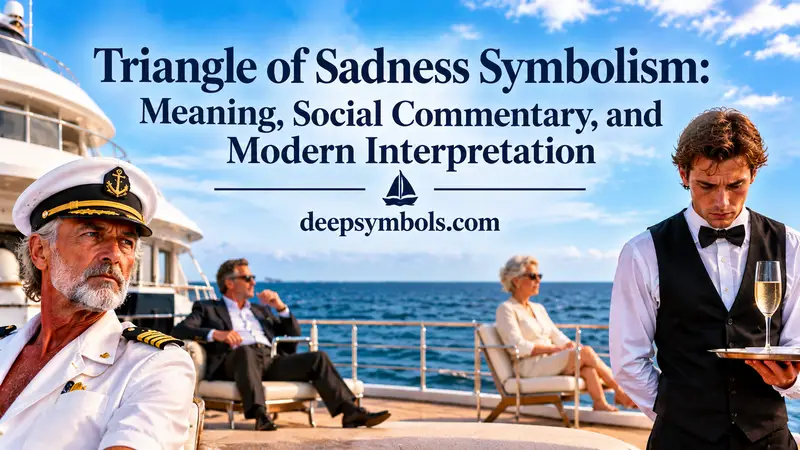
The phrase Triangle of Sadness is best known through the 2022 satirical film directed by Ruben Östlund. Its symbolism explores beauty, wealth, social status, class divisions, and the fragile relationships between people when familiar social structures collapse. Triangle of Sadness symbolism is especially relevant to modern audiences because it questions how appearance and money influence the way people judge themselves and others.
The title refers to a cosmetic term associated with the area between the eyebrows, where frown lines can develop. In the film, however, this small facial detail becomes part of a much broader examination of beauty standards and social privilege. The story follows wealthy passengers and service workers aboard a luxury yacht before a disaster changes their positions within the group.
Rather than treating wealth and beauty as reliable signs of personal worth, the film exposes how quickly status can disappear when circumstances change. Its humor is uncomfortable by design: characters who once controlled others become dependent on people they previously considered socially inferior.
The result is a satirical exploration of modern inequality, human behavior, and the difference between appearing powerful and actually having the ability to survive.
Quick Answer
Triangle of Sadness symbolism most commonly represents the instability of beauty, wealth, social status, and power in modern society. Through satire, the film challenges consumer culture, economic inequality, appearance-based judgment, and the assumption that wealthy or attractive people are naturally more important or capable.
TL;DR
- The triangle refers to facial expressions and society’s beauty standards.
- The film criticizes wealth, privilege, and economic inequality.
- Physical attractiveness becomes a form of social and professional currency.
- The yacht represents luxury, consumption, and class separation.
- The shipwreck reverses established relationships between powerful and dependent people.
- Survival challenges conventional ideas about status, authority, and human worth.
1. What Is the Triangle of Sadness?
Triangle of Sadness is a satirical film that examines the relationship between appearance, money, power, and social class. Its title comes from a beauty-industry expression referring to the area between the eyebrows, where wrinkles associated with frowning can appear.
The phrase has a connection to cosmetic treatments because this area is sometimes targeted with Botox and other aesthetic procedures. In that setting, the goal is often to soften visible signs of aging or tension.
The film takes this relatively ordinary beauty reference and uses it as an entry point into a much larger social critique.
Its characters inhabit a world where appearance can influence employment, romantic relationships, and public recognition. Models are expected to maintain marketable looks, wealthy travelers use money to establish social importance, and service workers are expected to accommodate people with greater financial power.
The title therefore operates on two levels: it refers to a specific feature of facial appearance while introducing the broader sadness, insecurity, and inequality hidden beneath polished social images.
2. The Symbolism of Beauty Standards and Physical Appearance
One of the film’s central concerns is the way physical attractiveness becomes a form of social currency.
In the fashion and modeling industries, appearance can determine professional opportunities. People are often evaluated according to measurements, facial features, age, clothing, and their ability to fit changing commercial expectations.
The film’s main characters, Carl and Yaya, experience this pressure through their work and relationship. Their conversations reveal how beauty and money can influence romantic expectations, professional negotiations, and personal identity.
Carl’s insecurity about his appearance and Yaya’s position as a successful model expose the unequal expectations placed on people in the beauty industry.
The symbolism extends beyond modeling. Advertising, entertainment, social media, and fashion frequently present carefully constructed images of attractive and successful lives.
The film questions whether these images represent genuine happiness or simply meet the expectations of a market that rewards certain appearances.
Its criticism is not that beauty has no value. Instead, it challenges the practice of treating physical attractiveness as a reliable measure of intelligence, character, or human worth.
3. What the Triangle Between the Eyebrows Represents
The title’s reference to the area between the eyebrows gives the film an important visual starting point.
In cosmetic terminology, the glabellar region is the area between the eyebrows and above the nose. Repeated facial movements can contribute to the development of vertical lines commonly called frown lines.
In beauty culture, these lines are sometimes treated as imperfections that should be reduced or removed.
Symbolically, the area can be associated with expressions of frustration, worry, concentration, and emotional tension. The film uses the beauty-industry reference to raise questions about society’s desire to control visible signs of aging and negative emotion.
The deeper irony is that people may invest considerable effort in presenting a calm, youthful, attractive appearance while living with insecurity, financial anxiety, and social pressure.
The title consequently draws attention to the difference between outward presentation and internal experience.
A smooth forehead cannot guarantee happiness, just as expensive clothing and luxurious surroundings cannot guarantee emotional security.
4. Wealth and the Illusion of Superiority
Wealth is one of the film’s most important symbols. The luxury yacht creates an environment where money determines comfort, influence, and access to services.
The wealthy passengers expect their preferences to be accommodated. Their financial position gives them the impression that they deserve special treatment, even when their demands are unreasonable.
This behavior exposes the difference between financial success and personal character.
The film does not suggest that every wealthy person behaves selfishly. Instead, it satirizes a social structure in which money can protect people from the consequences of their actions and encourage them to believe they are more important than others.
The yacht’s passengers also demonstrate how wealth can become part of personal identity. Their possessions, travel experiences, and social connections communicate status to other people.
When these external advantages disappear, the characters must confront a world in which their money no longer provides the same protection.
The film’s treatment of wealth encourages viewers to question whether financial privilege represents genuine ability or merely access to resources that other people do not possess.
5. The Luxury Yacht as a Symbol of Capitalism and Class Division
The yacht is more than a beautiful setting. It represents a carefully organized world of consumption, service, and economic inequality.
Its passengers enjoy expensive meals, private accommodations, and entertainment, while the crew works to maintain their comfort.
The division between passengers and employees reflects a broader economic structure in which some people consume services while others provide the labor that makes those experiences possible.
The yacht also illustrates how luxury depends on invisible work. Passengers may focus on the quality of their surroundings without considering the labor, organization, and resources required to sustain them.
This arrangement becomes particularly important when the vessel encounters disaster.
The environment that once reinforced social hierarchy becomes unstable, revealing how dependent the wealthy passengers are on people whose work they previously took for granted.
In modern American culture, the yacht can be compared with exclusive resorts, private clubs, luxury travel, and gated communities. These spaces often communicate financial success while separating privileged experiences from the everyday conditions of other people.
6. The Shipwreck as a Symbol of Social Collapse
The shipwreck represents the sudden breakdown of familiar social structures.
Before the disaster, wealth and employment determine how people interact. Passengers receive attention, while employees are expected to follow instructions and maintain professional boundaries.
After the group becomes stranded, those arrangements lose much of their practical value.
Money cannot automatically provide food, shelter, or safety. Expensive clothing and social connections become less useful when survival depends on practical knowledge and cooperation.
The shipwreck therefore exposes the fragility of status.
It also creates an opportunity to examine how people behave when the institutions and comforts that normally protect them disappear.
The film uses this reversal to challenge the assumption that social position reflects natural superiority. A person who once appeared powerful may become dependent, while someone previously overlooked may become essential.
The disaster does not create inequality from nothing, but it reveals how much conventional authority depends on circumstances.
7. The Reversal of Power Between the Characters
One of the film’s most important symbolic developments is the reversal of social power.
On the yacht, authority is largely connected to money, employment, and social position. The passengers have the financial resources to demand services, while the crew is expected to meet their expectations.
After the shipwreck, the situation changes. Traditional social advantages become less useful, and practical abilities begin to determine who has influence.
This reversal challenges the assumption that wealthy people are naturally more capable of leading others.
It also reveals that power is often situational. Someone may appear important in one environment but become dependent when the rules change.
The film uses this contrast to examine the relationship between authority and competence. It asks whether people deserve influence because of their abilities or simply because they occupy privileged positions.
8. Abigail and the Symbolism of Practical Survival
Abigail becomes particularly important after the shipwreck because she possesses practical knowledge that the other characters lack.
As a member of the yacht’s service staff, she previously occupied a lower position in the social hierarchy. On the island, however, her experience and survival skills become essential.
She understands how to obtain food, organize resources, and respond to immediate physical needs. These abilities give her influence over people who previously enjoyed greater social status.
Abigail represents the importance of practical intelligence and experience. Her position demonstrates that competence cannot always be measured through wealth, education, or professional prestige.
However, the film does not portray her new authority as entirely uncomplicated. As her influence grows, she also begins to exercise control over others.
This development adds another layer to the symbolism. Being disadvantaged in one social arrangement does not automatically make someone immune to abusing power in another.
Abigail’s story raises an uncomfortable question: when people who have experienced inequality finally gain control, do they create a fairer system or reproduce the same behavior under different circumstances?
9. Food, Hunger, and the Meaning of Human Dependence
Food becomes a central symbol after the characters are stranded.
On the yacht, meals represent luxury, hospitality, and the passengers’ ability to purchase comfort. Food is prepared and served according to expectations established by wealth and professional service.
On the island, its meaning changes completely.
Food becomes a necessity rather than a luxury. The ability to find, prepare, and distribute it determines survival and influences relationships.
This transformation exposes how quickly consumer habits become irrelevant when basic needs are threatened.
The contrast also highlights human dependence on labor. People who once expected meals to appear without effort must now confront the work involved in obtaining food.
In this sense, food represents more than physical nourishment. It becomes a measure of practical ability, cooperation, and authority.
The film uses hunger to strip away social performances and reveal how much human behavior depends on material circumstances.
10. The Island as a Symbol of a New Social Order
The island represents a temporary world in which the rules of the previous society no longer function in the same way.
There are no familiar luxury services, professional titles, or reliable financial advantages. Instead, the characters must respond to their immediate environment.
The island initially appears to offer a chance to begin again. People who were previously separated by class now face the same basic problems.
Yet the new arrangement does not automatically create equality.
Different abilities give certain individuals greater influence, and relationships become shaped by access to resources. The island gradually develops its own hierarchy.
This is one of the film’s central ironies: even after the collapse of an established social structure, people begin creating new systems of control.
The island can therefore be understood as a miniature version of society. It demonstrates that inequality is not maintained only through money. It can also emerge through control of food, knowledge, labor, and essential resources.
11. Gender, Relationships, and Social Expectations
The film also examines how gender expectations influence relationships and personal identity.
Carl and Yaya’s relationship reflects tensions surrounding money, attractiveness, professional success, and traditional expectations about romantic partnerships.
Their conversations suggest that relationships are not always separated from economic considerations. Financial security, career opportunities, and physical appearance can influence how partners negotiate their responsibilities.
The film uses uncomfortable humor to expose the assumptions people bring into romantic relationships.
Gender also becomes relevant to the distribution of authority on the island. The change in circumstances challenges traditional expectations about who should lead, provide, and make decisions.
These developments are not presented as a simple argument that one gender is naturally more capable than another. Rather, the story examines how social arrangements influence who receives authority and how that authority is exercised.
For American viewers, these themes connect with wider discussions about gender roles, financial independence, workplace expectations, and relationships in a culture where traditional and modern ideas frequently coexist.
12. The Symbolism of the Film’s Satirical Humor
Humor is one of the main tools used to communicate the film’s criticism.
Rather than presenting inequality through a conventional dramatic lecture, the story uses exaggerated situations, uncomfortable conversations, and absurd contrasts.
The result encourages audiences to laugh while recognizing the uncomfortable realities behind the jokes.
The film’s satire targets several social behaviors:
- Treating wealth as evidence of superior character.
- Judging people primarily through physical appearance.
- Expecting service workers to accept unreasonable demands.
- Confusing luxury with personal happiness.
- Assuming that social authority reflects genuine competence.
The humor also prevents the story from offering an overly simple moral conclusion. Characters from different social positions display selfishness, insecurity, and contradictory behavior.
This makes the satire more complicated than a straightforward division between good and bad people.
Its humor asks viewers to examine the systems that reward certain behaviors and the assumptions that allow inequality to appear normal.
13. Capitalism, Consumer Culture, and Modern American Society
Although Triangle of Sadness is not specifically a story about the United States, its themes are recognizable within American consumer culture.
The United States places considerable visibility on professional achievement, luxury products, celebrity lifestyles, and personal branding. Advertising frequently connects material possessions with success, attractiveness, and social recognition.
The film challenges these associations by showing how easily expensive possessions lose their importance when circumstances change.
Its yacht setting can be compared with exclusive vacations, private resorts, luxury shopping, and other experiences that separate wealthy consumers from the people who provide their services.
The story also raises questions about economic inequality. People may appear to participate in the same social environment while experiencing very different levels of security and control.
For example, a luxury hotel guest and a hotel employee may share the same building but have fundamentally different relationships with its resources.
The film’s criticism is not limited to individual wealthy people. It examines the structures that allow financial power to influence social relationships.
Its message remains relevant to discussions about labor, privilege, consumerism, and the difference between having money and contributing meaningfully to society.
14. Psychological Meaning: Insecurity, Identity, and the Need for Control
Beneath its social satire, the film explores psychological questions about identity and self-worth.
People often build their identities around things that provide recognition: physical appearance, income, professional success, possessions, and social connections.
These characteristics can influence confidence, but they can also create insecurity when a person’s value becomes dependent on external approval.
Carl’s experiences illustrate the emotional pressure associated with appearance and professional identity. The wealthy passengers reveal another form of insecurity through their dependence on comfort, recognition, and control.
The island setting exposes how fragile these identities can become.
When familiar advantages disappear, characters must confront a version of themselves that cannot rely on the same social signals.
The film also explores the human desire for control. People who feel powerless may become particularly attached to authority when circumstances finally allow them to exercise it.
This psychological dimension makes the story more than a criticism of wealthy lifestyles. It examines how individuals respond to insecurity and how easily the desire for recognition can become a struggle for dominance.
15. Controversies and Common Misinterpretations
The film’s symbolism can be misunderstood when its satire is reduced to a single political message.
One interpretation treats it as a simple attack on wealthy people. Although the film clearly criticizes privilege and economic inequality, it also portrays selfishness and manipulation among characters who occupy different social positions.
Another misunderstanding is that the island represents a perfect alternative to modern society. The new arrangement contains its own inequalities, demonstrating that changing the distribution of power does not necessarily eliminate exploitation.
The film also invites discussion about beauty standards, but it should not be interpreted as suggesting that physical attractiveness has no social or professional consequences. Its criticism concerns the way society assigns excessive importance to appearance.
Finally, the title’s cosmetic reference should not be confused with the entire meaning of the film. The triangle between the eyebrows introduces the subject of appearance, while the broader narrative explores class, capitalism, power, and human behavior.
A balanced interpretation recognizes that the film uses several connected symbols rather than presenting one simple answer about society.
16. How the Meaning of Triangle of Sadness Has Evolved in Modern Culture
Since its release in 2022, Triangle of Sadness has become a recognizable example of contemporary social satire. Its themes have continued to attract discussion because they connect with ongoing debates about wealth, celebrity culture, beauty standards, and economic inequality.
The film’s title has also become useful for discussing the gap between outward appearance and internal experience. People may look successful while experiencing insecurity, pressure, or dissatisfaction.
Its broader social message is particularly relevant in an era of carefully curated online identities. Social media allows people to present expensive lifestyles, attractive appearances, and apparently successful relationships without revealing the difficulties behind those images.
The film encourages audiences to question what these public performances communicate and what they leave out.
Its symbolism can be summarized through several connected ideas:
| Symbol or elementSymbolic meaningSocial message | ||
|---|---|---|
| Triangle between eyebrows | Beauty standards and appearance | Society places pressure on physical presentation. |
| Luxury yacht | Wealth and privilege | Financial status creates social separation. |
| Shipwreck | Collapse of established authority | Power can disappear when circumstances change. |
| Abigail | Practical competence and authority | Skills can matter more than social position. |
| Island | A new social arrangement | New hierarchies can emerge after old ones collapse. |
| Food and hunger | Dependence and survival | Basic needs can reshape relationships. |
These interpretations help explain why the film remains relevant beyond its original story. Its symbols encourage audiences to examine the values that influence everyday judgments about success, attractiveness, and personal worth.
FAQs
1. What does Triangle of Sadness symbolize?
Triangle of Sadness symbolizes the instability of wealth, beauty, social status, and power. The film uses satire to expose inequality and demonstrate how quickly people’s positions can change when familiar social structures disappear.
2. What does the triangle of sadness mean on the face?
The phrase refers to the area between the eyebrows, also known as the glabellar region. In cosmetic terminology, it is associated with frown lines that can develop through repeated facial movements.
3. What does the yacht symbolize in Triangle of Sadness?
The yacht represents luxury, consumerism, economic privilege, and class separation. Its passengers’ dependence on the crew exposes the labor and inequality supporting wealthy lifestyles.
4. What does Abigail symbolize in Triangle of Sadness?
Abigail represents practical intelligence, survival skills, and the changing nature of authority. Her rise in influence demonstrates how quickly social hierarchies can change when access to essential resources becomes more important than money.
5. What does the island symbolize in the film?
The island represents a temporary social environment where traditional status and financial advantages lose much of their importance. However, the emergence of new power relationships shows that replacing an old hierarchy does not automatically create equality.
6. Is Triangle of Sadness a criticism of capitalism?
Yes, the film strongly satirizes consumerism, economic inequality, luxury culture, and the influence of wealth. However, its criticism also extends to human selfishness, insecurity, and the tendency to exploit power regardless of social position.
7. What is the main message of Triangle of Sadness?
The film suggests that wealth, attractiveness, and social position do not necessarily reflect a person’s character or abilities. It challenges viewers to question social hierarchies and recognize how dependent power can be on circumstaces.
Conclusion
Triangle of Sadness symbolism brings together beauty, wealth, social hierarchy, power, and the fragility of human status. The film’s title refers to a cosmetic term associated with the frown lines between the eyebrows, reflecting society’s preoccupation with appearance and the pressure to maintain an attractive image. The Cannes Film Festival’s interview with director Ruben Östlund provides useful context for understanding how these ideas develop throughout the film, particularly when the shipwreck overturns the power relationships aboard the luxury yacht.
The yacht, the island, and the changing roles of the survivors reveal how wealth and authority depend on circumstances rather than inherent ability. When social advantages disappear, practical knowledge and survival skills become more valuable than money, beauty, or reputation. Yet the film also suggests that people who gain power can reproduce the same inequalities they once experienced.
Ultimately, Triangle of Sadness symbolism challenges the assumption that appearance determines worth or that wealth guarantees superiority. Its deeper message is that genuine human value is revealed through behavior, adaptability, and the way people treat others when familiar privileges disappear. The film leaves viewers with an uncomfortable but important question: when status no longer protects us, what qualities remain to define who we really are?


