
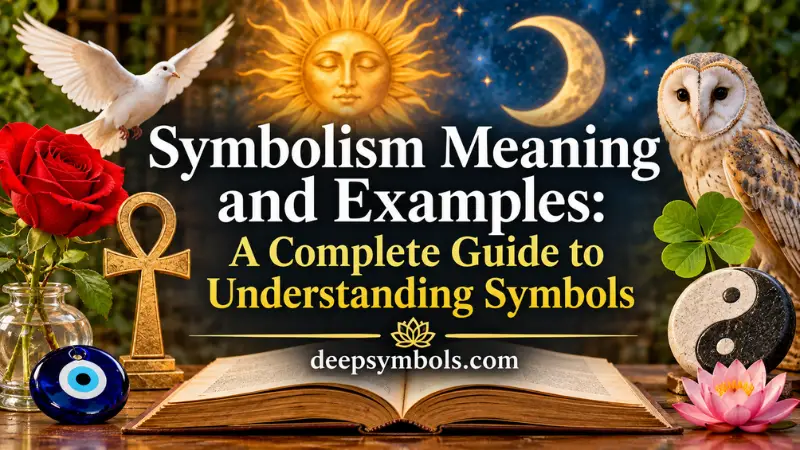
Symbols are part of everyday life. A red heart can communicate love, a white dove can represent peace, and a national flag can express identity and belonging. Understanding symbolism meaning and examples helps explain how ordinary objects, colors, animals, images, and actions communicate ideas beyond their literal appearance. A symbol gives a visible form to something that may otherwise be difficult to express.
People use symbolism in literature, religion, art, advertising, architecture, and popular culture. Writers use it to add meaning to characters and settings, while artists use recognizable images to communicate emotions and social ideas. In the United States, symbols also play an important role in national identity, holidays, public memorials, and personal expression.
Symbolism is not limited to complicated works of art or famous literary texts. A wedding ring, a candle at a memorial, or a graduation cap can carry meaning because people understand the ideas associated with it. Learning how symbolism works makes it easier to recognize the messages hidden in familiar images and everyday experiences.
Quick Answer
Symbolism commonly represents ideas, emotions, beliefs, or experiences through objects, colors, animals, images, and actions in modern American culture. Historically, it has appeared in religious traditions, mythology, folklore, literature, and visual art as a way to communicate meanings beyond the literal form of something.
TL;DR
- Symbolism uses recognizable images to represent larger ideas.
- Ancient civilizations used symbols in religion, mythology, and public life.
- Colors, animals, objects, and natural elements can carry symbolic meanings.
- American culture uses symbolism in holidays, flags, memorials, and popular media.
- Writers and artists use symbols to develop themes and emotional connections.
- Context determines whether a symbol communicates hope, danger, love, or loss.
1. What Is Symbolism?
Symbolism is the use of an object, image, color, character, place, or action to represent an idea beyond its literal meaning.
For example, a dove is a bird, but it is also widely recognized as a symbol of peace. A rose is a flower, yet it can represent romantic love, beauty, affection, or remembrance. The meaning comes from cultural associations, historical traditions, and the context in which the image appears.
Symbolism allows people to communicate complicated ideas through familiar forms. Instead of explaining every emotion or belief directly, a person can use an image that already carries recognizable associations.
In literature, symbolism helps authors develop themes without stating every message openly. In visual art, it allows artists to communicate ideas through composition, color, and recognizable objects. In everyday life, people use symbolic objects to express identity, affection, and personal values.
A symbol does not always have one universal definition. A snake, for example, may represent danger, temptation, healing, wisdom, or transformation depending on the cultural and historical setting.
Understanding symbolism therefore requires looking beyond the object itself and considering what it represents in a particular situation.
2. The Difference Between a Symbol and Its Literal Meaning
A symbol has a literal form and a symbolic interpretation. These two levels work together, but they are not identical.
Consider a key. Literally, it is a small object used to open a lock. Symbolically, it may represent freedom, opportunity, access, knowledge, or a new beginning.
The difference becomes clearer in everyday examples:
- A candle is a source of light, but it can symbolize hope, remembrance, or spiritual guidance.
- A bridge connects two locations, but it can represent reconciliation or transition.
- A clock measures time, but it may symbolize mortality, urgency, or the passage of life.
- A seed grows into a plant, but it can represent potential, patience, and personal development.
The symbolic meaning depends on how the object is presented and understood.
A key given to someone moving into a new home may represent independence. The same key used in a mystery novel could represent a hidden truth or an important discovery.
This distinction is particularly useful when interpreting literature and artwork. Rather than identifying an object and immediately assigning it a meaning, readers should examine how it functions within the larger work.
3. Historical Origins of Symbolism
Symbolism is much older than modern literature or artistic movements. Ancient societies used images, objects, and signs to communicate religious beliefs, political authority, cultural identity, and ideas about the natural world.
Ancient Egyptians developed an extensive system of hieroglyphs and religious imagery. The ankh, a cross-like symbol with a loop at the top, became associated with life and the idea of continued existence. The scarab beetle was connected with renewal and the movement of the sun.
In ancient Mesopotamia, visual symbols appeared in religious objects, seals, and representations of rulers and deities. These images communicated authority, social organization, and religious identity.
Ancient Greek and Roman traditions also relied on symbolic objects and animals. The owl became associated with Athena, while the laurel wreath represented victory and honor. Such associations influenced later European art and literature.
Religious traditions developed their own symbolic languages through sacred objects, colors, architecture, and ritual practices. Symbols helped communities communicate beliefs across generations, including when literacy was limited.
Over time, these visual traditions influenced medieval manuscripts, Renaissance paintings, architecture, literature, and modern design.
Symbolism did not originate in one civilization. It developed independently in different societies as people found ways to express abstract ideas through recognizable images.
4. Common Types of Symbolism
Symbolism appears in many forms. Some symbols are based on natural objects, while others come from cultural traditions, religious practices, or human-made designs.
Object symbolism: Everyday objects can represent larger ideas. A ring may symbolize commitment, a key may represent opportunity, and a mirror may suggest self-reflection.
Animal symbolism: Animals often represent human qualities or cultural beliefs. Lions are associated with courage and authority, while butterflies commonly represent transformation and renewal.
Color symbolism: Colors communicate emotions and social meanings. Red often suggests passion or danger, while white may represent peace, purity, or mourning depending on the culture.
Nature symbolism: Natural elements frequently represent experiences and changes in human life. Trees may symbolize growth, mountains may represent challenges, and rivers may suggest the passage of time.
Religious symbolism: Sacred objects and images communicate spiritual beliefs. Crosses, candles, prayer beads, and sacred animals can carry meanings within specific religious traditions.
Literary symbolism: Writers use objects, settings, and characters to develop themes. A storm may represent conflict, while a journey may symbolize personal growth.
These categories sometimes overlap. A white dove is both an animal symbol and a color-related symbol, while a religious candle can represent light, hope, and spiritual devotion.
5. Color Symbolism and Its Meaning
Colors are among the most familiar forms of symbolism because people encounter them in clothing, advertising, celebrations, flags, and artwork.
However, color meanings are influenced by cultural traditions and circumstances. A color that communicates celebration in one setting may carry a different meaning in another.
| Color | Common symbolic meanings | Modern American examples |
|---|---|---|
| Red | Love, passion, danger, courage | Valentine’s Day, warning signs, national imagery |
| Blue | Trust, calmness, loyalty, stability | Business branding, uniforms, political imagery |
| White | Peace, purity, innocence, remembrance | Weddings, memorials, religious ceremonies |
| Black | Authority, elegance, mourning, mystery | Formal clothing, funerals, fashion |
| Green | Nature, growth, renewal, prosperity | Environmental campaigns, gardens, financial imagery |
| Yellow | Happiness, warmth, caution, energy | Sunflower designs, warning signs, cheerful decorations |
In the United States, red and pink are particularly visible during Valentine’s Day, while green becomes prominent around environmental awareness and St. Patrick’s Day celebrations.
Color symbolism also appears in religious traditions. White may represent purity in certain Christian ceremonies, while green is associated with growth and renewal in many settings.
These meanings are not universal rules. For example, white is associated with mourning in several East Asian traditions, while American wedding customs frequently use it to communicate purity and celebration.
The surrounding context is essential when interpreting a color.
6. Animal Symbolism: What Different Animals Represent
Animals have long served as symbols because people associate their physical characteristics and observed behaviors with human experiences.
A lion’s strength and commanding presence have made it an image of courage, leadership, and royalty. An owl’s nighttime activity and ability to navigate darkness have contributed to its association with wisdom and knowledge in several Western traditions.
Other familiar examples include:
- Butterfly: Transformation, renewal, and personal change.
- Eagle: Freedom, independence, strength, and national identity.
- Dove: Peace, gentleness, and spiritual hope.
- Fox: Adaptability, cleverness, and resourcefulness.
- Bear: Protection, strength, and resilience.
- Wolf: Loyalty, independence, instinct, and social bonds.
- Sparrow: Humility, vulnerability, and divine care in biblical interpretation.
Animal meanings can differ considerably between cultures. The snake, for instance, represents healing and medicine in some traditions, while biblical narratives associate it with temptation and deception.
American popular culture also gives animals additional meanings through sports mascots, national imagery, advertising, and children’s stories.
When studying an animal symbol, it is important to distinguish actual animal behavior from the cultural meanings people have attached to it.
7. Symbolism in Literature and Poetry
Writers use symbolism to communicate ideas that extend beyond a story’s immediate events. An object or setting may become meaningful because of its repeated appearance, its relationship to a character, or its connection with the central theme.
One famous example is the green light in F. Scott Fitzgerald’s The Great Gatsby. It is associated with Gatsby’s hopes and his desire for a future connected with Daisy. As the story develops, the light also becomes connected with longing, distance, and the difficulty of achieving an idealized dream.
In George Orwell’s Animal Farm, the farm initially represents the possibility of political change and a society organized around equality. As the animals’ revolution develops, the setting becomes associated with corruption, authoritarianism, and the betrayal of original ideals.
Nathaniel Hawthorne’s The Scarlet Letter uses the letter A as a central symbol. Its meaning changes through the story as characters and society interpret it differently, demonstrating how a symbol can develop rather than remain fixed.
Poetry also relies on symbolic imagery. A winter landscape may suggest emotional isolation, while spring can represent renewal or a new stage of life.
Good literary interpretation considers more than a symbol’s dictionary meaning. Readers should examine how the author introduces it, how its meaning changes, and how it supports the work’s larger themes.
8. Symbolism in American Culture and National Identity
Symbols play an important role in how Americans understand their history, communities, and shared identity.
The American flag is one of the most recognizable examples. Its stars and stripes represent the country’s states and historical foundations, while its wider cultural meaning includes national identity, independence, sacrifice, and civic belonging.
The Statue of Liberty is another major American symbol. Located in New York Harbor, it has become associated with liberty, opportunity, and immigration. Its image appears in textbooks, films, travel materials, and public celebrations.
The bald eagle serves as the national bird and a familiar representation of strength and independence. Its appearance on government seals, currency, and official insignia reinforces its connection with American public life.
American holidays also rely heavily on symbolism. The turkey, harvest imagery, and autumn decorations are commonly associated with Thanksgiving. Fireworks and the colors red, white, and blue are prominent during Independence Day celebrations.
These symbols can unite people, but they can also generate disagreement. National imagery may carry different meanings for people whose historical experiences and political perspectives differ.
Understanding American symbolism therefore requires recognizing both its shared associations and the debates surrounding its use.
9. Religious and Spiritual Symbolism
Religious traditions use symbols to communicate beliefs about creation, morality, divine presence, death, and the relationship between humanity and the sacred.
In Christianity, the cross represents the crucifixion of Jesus and is associated with sacrifice, redemption, faith, and resurrection. The dove is connected with the Holy Spirit in biblical imagery, while light often represents truth and divine guidance.
In Judaism, the Star of David is a widely recognized symbol of Jewish identity and community. The menorah has a long history in Jewish religious life and carries important associations with worship and tradition.
In Hindu traditions, the lotus frequently represents purity, spiritual development, and the possibility of rising above difficult circumstances. The Om symbol is associated with sacred sound and spiritual understanding.
In Buddhism, the Dharma wheel represents the Buddha’s teaching and the path toward liberation. Its use in Buddhist art and religious settings reflects a specific spiritual framework.
These examples show why religious symbols should be interpreted within their traditions. A symbol may have different meanings in different communities, and a simplified explanation can overlook important theological distinctions.
Respectful interpretation recognizes the beliefs and historical practices that give a religious image its significance.
10. Nature Symbolism in Everyday Life
Nature provides some of the most recognizable symbolic images because natural processes often resemble human experiences.
Trees are commonly associated with growth, stability, family connections, and longevity. Their roots can suggest ancestry and belonging, while branches may represent development and future possibilities.
Water can symbolize purification, renewal, emotional depth, or change. Rivers frequently appear in literature as images of movement and the passage of time, while rain may represent cleansing or sadness depending on the setting.
Mountains can represent endurance, challenges, achievement, or spiritual reflection. Their height and difficult terrain make them useful images for journeys that require patience and effort.
Flowers also carry specific cultural associations. Roses are commonly connected with love, lilies with mourning or purity in various traditions, and sunflowers with warmth and optimism.
Seasons offer another form of natural symbolism. Spring often represents beginnings, summer suggests abundance, autumn can communicate maturity or transition, and winter may represent hardship, rest, or endings.
These meanings are not inherent properties of nature. They develop through human observation, cultural traditions, religious narratives, and artistic interpretation.
11. Symbolism in Art, Architecture, and Design
Artists and designers use symbols to communicate messages visually. The placement of objects, the use of color, and the arrangement of shapes can influence how viewers interpret an image.
Renaissance paintings frequently included religious symbols, such as lilies representing purity or skulls reminding viewers of mortality. These details added layers of meaning beyond the main subject.
Architecture also uses symbolic forms. Domes can communicate grandeur and authority, while arches and towers may express religious or civic identity. The design of memorials often incorporates symbolic features that encourage reflection on sacrifice, loss, or remembrance.
Modern graphic design uses symbolism in a more simplified form. A heart-shaped logo can suggest care, while a leaf may communicate environmental responsibility. A shield can imply protection, and a rising sun may suggest progress or new beginnings.
In the United States, brands frequently use these visual associations to communicate identity quickly. However, symbols can also be used manipulatively when an organization uses images of compassion or environmental responsibility without supporting those values through its actions.
Effective visual symbolism depends on a clear relationship between the image and the message it is intended to communicate.
12. Symbolism in Tattoos, Fashion, and Personal Identity
People often choose symbols for tattoos, clothing, and jewelry because they allow personal beliefs and experiences to become visible.
A butterfly tattoo may commemorate recovery or a major life change. A compass can represent direction, independence, or a desire to stay focused on personal goals. A tree may symbolize family history, while a heart can express love or remembrance.
Jewelry carries similar associations. Wedding rings represent commitment in many American traditions, while religious pendants may communicate faith or connection with a spiritual community.
Fashion also uses symbolic imagery. Certain colors, patterns, and designs may communicate cultural identity, political affiliation, personal taste, or membership in a particular group.
However, symbolic meanings can change as designs move between communities. A symbol with religious or historical significance may become a fashion trend, sometimes without its original context being understood.
Before adopting a symbol, particularly one associated with another culture or religious tradition, it is worth understanding its history and significance.
Personal expression is most thoughtful when it respects the meanings that communities have developed around their symbols.
13. Symbolism in Movies, Television, and Popular Culture
Film and television use visual symbolism to communicate information without relying entirely on dialogue.
A character repeatedly shown near windows may be associated with confinement, longing, or the desire for freedom. A recurring storm might reflect emotional conflict, while a particular color may distinguish different characters or stages of a story.
Filmmakers also use familiar cultural symbols to establish a setting quickly. A graduation cap suggests academic achievement, a wedding ring signals commitment, and a national flag communicates a relationship with a particular country or identity.
Popular entertainment can also transform established symbols. A traditional image may gain a new meaning through a film, television series, or music video, especially when it becomes associated with a memorable character or event.
Superhero stories provide many examples of symbolic clothing and objects. A costume may communicate responsibility, courage, or the struggle between personal identity and public expectations.
Social media has accelerated the circulation of these meanings. Images, memes, and emojis can acquire new associations as people reuse them in different conversations.
The meaning of a popular culture symbol is therefore not always permanent. It can develop through repeated use and changing audience interpretations.
14. How to Identify Symbolism in a Story or Image
Recognizing symbolism requires observation and attention to context. Not every object in a story or artwork represents a hidden idea, so interpretation should be supported by evidence.
A useful approach begins with the following questions:
- What object, image, or action stands out? Look for something unusual, repeated, or given special attention.
- Does it appear more than once? Repetition may suggest that the author or artist wants the audience to notice it.
- What happens around it? Its meaning may depend on the characters, events, or emotions connected with it.
- What cultural associations does it have? Consider religious, historical, and social traditions that may influence its interpretation.
- Does its meaning change? A symbol may develop as a character or story progresses.
- How does it support the larger message? A strong interpretation should connect the symbol to the work’s central themes.
For example, imagine a novel in which a character repeatedly sees a locked door. At first, it may simply be part of the setting. If the character later struggles with personal freedom or hidden family history, the door may also represent secrecy, limitation, or an opportunity that remains inaccessible.
The important point is to explain why an interpretation makes sense rather than assigning a meaning without supporting details.
15. Common Misunderstandings About Symbolism
Symbolism is sometimes misunderstood because people assume that every image has one fixed definition.
In reality, symbols can carry different meanings depending on historical period, cultural background, and context. A snake may represent healing in one tradition and deception in another.
Another common mistake is confusing symbolism with coincidence. An object appearing once in a story does not automatically make it a meaningful symbol. Its importance should be supported by repetition, emphasis, cultural associations, or its relationship to the larger theme.
Some interpretations also rely too heavily on modern meanings. A symbol used in an ancient religious text should not automatically be interpreted according to contemporary advertising or popular culture.
Cultural appropriation can create additional problems when meaningful symbols are removed from their original settings and used as decoration without understanding their significance. This is particularly important for sacred objects and symbols connected with Indigenous communities.
Finally, symbolism should not be confused with allegory. Symbolism generally uses particular images or objects to suggest broader ideas, while allegory develops a more extended system in which characters, events, or settings represent additional meanings.
Recognizing these distinctions makes interpretation more accurate and respectful.
FAQs
1. What is the simple meaning of symbolism?
Symbolism is the use of an object, image, color, or action to represent an idea beyond its literal meaning. For example, a dove can represent peace, while a heart commonly represents love and affection.
2. What are five common examples of symbolism?
Five familiar examples include a dove for peace, a heart for love, a butterfly for transformation, a key for opportunity, and a tree for growth. Their meanings may change depending on cultural traditions and the context in which they appear.
3. What is symbolism in literature?
Symbolism in literature occurs when authors use objects, characters, settings, or events to communicate larger ideas. For example, a storm may represent conflict, while a journey may reflect personal development or a character’s search for identity.
4. Why is symbolism important in everyday life?
Symbolism allows people to communicate feelings, beliefs, and identities through recognizable images. It appears in national flags, religious objects, wedding rings, memorials, clothing, and digital messages.
5. Can one symbol have multiple meanings?
Yes, a symbol can communicate different ideas depending on its cultural background and situation. A snake, for example, may represent danger, wisdom, healing, or transformation in different traditions.
6. What is the difference between symbolism and metaphor?
Symbolism uses an image or object to represent a broader idea, while a metaphor describes one thing in terms of another to create a comparison. The two can overlap when a metaphorical image also carries a recurring symbolic meaning.
7. How can I recognize symbolism in a painting or photograph?
Look for repeated objects, unusual colors, meaningful arrangements, and images that connect with the subject’s emotions or story. Consider the historical and cultural setting before deciding what an element represents.
Conclusion
Symbolism meaning and examples reveal how people use familiar images and objects to communicate ideas, emotions, beliefs, and shared experiences. From ancient Egyptian religious imagery to American national emblems, literary objects, wedding traditions, and modern digital communication, symbols give visible form to concepts that words alone may not fully express. National Geographic’s explanation of symbolism explores how objects, colors, animals, and everyday signs represent deeper meanings across different areas of human life.
Understanding symbolism meaning and examples helps readers recognize how familiar images communicate love, courage, freedom, faith, transformation, and loss. A dove may represent peace, a heart may express affection, and a sunrise may suggest a new beginning. However, these meanings can change depending on cultural traditions, historical circumstances, and personal experiences.
Ultimately, symbolism encourages us to look beyond appearances and consider the ideas that give familiar things their significance. Whether encountered in literature, artwork, religious practices, or everyday objects, symbols help connect individual experiences with broader human beliefs and emotions. Their greatest value lies in the meanings people create, share, and preserve through them.


