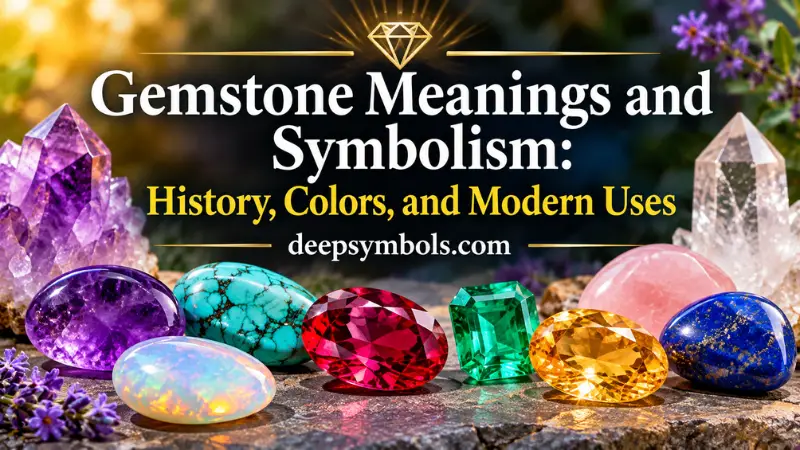
Gemstones have been valued for their beauty, rarity, and cultural significance for thousands of years. From diamonds exchanged in engagement rings to turquoise worn in traditional jewelry, different stones have acquired associations with love, protection, wisdom, prosperity, and personal identity. Gemstone meanings and symbolism help explain why people attach emotional, spiritual, and historical importance to particular minerals beyond their appearance.
In the United States, gemstones appear in jewelry, wedding traditions, birthstone gifts, fashion, religious objects, and personal collections. A sapphire may represent loyalty in an engagement ring, while an emerald is often associated with renewal and prosperity. These meanings influence how people choose stones for gifts, anniversaries, and personal milestones.
However, gemstone symbolism does not come from one universal tradition. Ancient civilizations, religious communities, folklore, trade networks, and modern popular culture have all contributed to the meanings associated with precious and semiprecious stones. Understanding these different influences makes it easier to distinguish documented historical beliefs from contemporary spiritual interpretations.
Quick Answer
Gemstone meanings and symbolism commonly represent love, protection, wisdom, prosperity, healing, and personal identity in modern American culture. Historically, gemstones were associated with royal authority, religious devotion, medicinal beliefs, social status, and spiritual protection across ancient Egyptian, Greek, Roman, Asian, and other cultural traditions.
TL;DR
- Gemstones represent emotions, personal values, and cultural beliefs.
- Ancient civilizations associated precious stones with authority and religious protection.
- Birthstones connect gemstones with birth months and personal identity.
- Color influences associations such as love, wisdom, renewal, and prosperity.
- Modern Americans use gemstones in jewelry, gifts, tattoos, and meditation.
- Historical beliefs should be distinguished from scientifically established properties.
1. What Gemstones Represent in Different Cultures
Gemstones have served different purposes depending on the beliefs, resources, and traditions of the societies that valued them. Some communities treated stones as protective objects, while others used them to demonstrate wealth, religious commitment, or connections with the natural world.
In ancient Egypt, turquoise, lapis lazuli, carnelian, and other colorful materials appeared in jewelry and amulets. Their colors and forms carried religious associations, and some objects were intended to protect the wearer during life or accompany them into the afterlife.
Ancient Greek and Roman societies valued gemstones for their beauty, craftsmanship, and supposed protective qualities. Engraved stones could function as personal seals, religious offerings, and amulets. Wealthy individuals also collected them as expressions of status and artistic appreciation.
In South Asian traditions, gemstones have connections with astrology and religious practices. The Hindu concept of Navaratna, meaning nine gems, associates particular stones with nine celestial influences. Jewelry containing these stones is traditionally connected with auspiciousness, balance, and prosperity.
In China, jade has historically held particular importance. It has been associated with virtue, refinement, social distinction, and spiritual ideals. Its cultural significance extends beyond its monetary value and includes ideas about character and proper conduct.
These traditions demonstrate that gemstones do not possess one universal symbolic meaning. Their significance develops through the cultural stories, religious practices, and social customs surrounding them. Jewellery and Amulets+2
2. The Historical Connection Between Gemstones and Protection
Protection is among the oldest recurring associations of gemstones.
Ancient people often wore stones as pendants, rings, bracelets, and amulets because they believed particular materials could guard against danger, illness, misfortune, or harmful supernatural influences.
Ancient Egyptian jewelry provides particularly clear examples. Amulets were made from natural stones, metals, and manufactured materials such as faience. Their shapes, colors, and religious imagery were selected for particular protective or funerary purposes.
Greco-Roman engraved gems also sometimes included images of gods, animals, and religious figures. People carried or wore these objects as personal ornaments and protective charms.
During medieval Europe, beliefs about the medicinal and protective properties of stones continued. Certain gemstones were thought to influence health, courage, temperament, and personal fortune.
These beliefs belong to the history of medicine and religion, not modern scientific evidence. A gemstone may be personally meaningful as a reminder of safety or confidence, but wearing one has not been scientifically demonstrated to prevent illness or protect someone from physical danger.
Today, protective gemstone jewelry remains popular among people interested in traditional beliefs, spirituality, and personal symbolism. Its significance is best understood as cultural or personal rather than a guaranteed physical effect. The Metropolitan Museum of Art+2
3. Popular Gemstones and Their Symbolic Meanings
Individual gemstones have developed recognizable associations through folklore, religious traditions, literature, jewelry customs, and modern popular culture. The following meanings are common interpretations rather than universal definitions.
Diamond — Commitment and endurance
Diamond Source – Round Brilliant Natural Diamond
Diamonds are commonly associated with lasting love, strength, clarity, and commitment. Their hardness and durability have helped establish their reputation as symbols of enduring relationships.
In the United States, diamonds are especially prominent in engagement rings and wedding jewelry. Their modern association with marriage developed through a combination of historical traditions and twentieth-century advertising.
Ruby — Passion and vitality
Loose Ruby Gemstones | NW Gems & Diamonds – NWG
The ruby’s intense red color has encouraged associations with passion, courage, vitality, and romantic devotion. Historically, red gemstones were also connected with royalty, prestige, and protective beliefs.
Ruby jewelry is often selected to communicate strong affection or celebrate important personal milestones.
Sapphire — Wisdom and loyalty
Sapphire | IGI certified | natural, blue color, oval-cut, 9×7.5mm, 2.5 – Eden Garden Jewelry™
Blue sapphires commonly represent wisdom, faithfulness, sincerity, and dignity. Their association with royalty and formal jewelry has strengthened their connection with trust and responsibility.
In American engagement jewelry, sapphire is a popular alternative to diamond, particularly for people who prefer colored stones.
Emerald — Renewal and prosperity
G-EMZ | Certified Natural Gemstones Curated in Germany
Emeralds are associated with growth, renewal, abundance, and hope. Their green color connects them with vegetation and the return of life during spring.
Emerald jewelry is also linked with elegance and luxury, making the stone popular for anniversaries and significant gifts.
Amethyst — Reflection and calm
amethyst mineral specimen stone rock geology gem crystal
Amethyst has historically been associated with moderation, clear thinking, spiritual reflection, and protection. Its name comes from a Greek word connected with the idea of not being intoxicated.
In modern crystal culture, it is frequently associated with relaxation and meditation, although these proposed healing effects have not been established scientifically.
Turquoise — Protection and good fortune
Spiderweb Bisbee Blue Turquoise – Identifying & Discovering – Turquoise People
Turquoise has a long history of use across Southwest Asia, the Americas, and other regions. It has been associated with protection, good fortune, and spiritual significance in several traditions.
In the American Southwest, turquoise is especially important in the artistic and cultural histories of Indigenous communities, including Navajo and Pueblo peoples.
Jade — Virtue and harmony
tumbled green Nephrite (jade) mineral gemstone
Jade is particularly associated with Chinese cultural traditions, where it has represented virtue, refinement, integrity, and social distinction. Its importance extends beyond decorative jewelry into sculpture, ceremonial objects, and historical works of art.
Opal — Creativity and individuality
Rainbow Colorplay Australian Coober Pedy White Opal 1.80 Carat
Opal is often associated with imagination, originality, and emotional expression. Its changing flashes of color make it a popular choice for people who prefer distinctive jewelry.
Some European folklore also connected opals with luck or misfortune, demonstrating how one gemstone can acquire contradictory reputations.
Garnet — Loyalty and commitment
A Guide to Garnets — Donna Laine Fine Jewellery
rust-saxophone-p8cp.squarespace.com
Garnet is commonly associated with devotion, friendship, strength, and enduring relationships. Its deep red varieties have encouraged connections with warmth and vitality, although garnets also occur in several other colors.
4. Gemstone Colors and Their Emotional Associations
Color plays an important role in gemstone symbolism. People often connect a stone’s appearance with familiar emotional and natural associations.
These connections are influenced by cultural experience, visual perception, and personal preference rather than fixed psychological laws.
| Gemstone color | Common symbolic associations | Representative stones |
|---|---|---|
| Red | Passion, courage, vitality, love | Ruby, garnet |
| Blue | Wisdom, loyalty, peace, trust | Sapphire, aquamarine |
| Green | Growth, renewal, prosperity | Emerald, jade, peridot |
| Purple | Reflection, spirituality, creativity | Amethyst, tanzanite |
| Yellow | Optimism, abundance, confidence | Citrine, yellow sapphire |
| White or clear | Purity, clarity, commitment | Diamond, clear quartz |
| Black | Strength, mystery, grounding | Black onyx, obsidian |
Color meanings can change across cultures. White, for example, may represent purity and celebration in some Western wedding traditions, while it has important mourning associations in several Asian cultural traditions.
Likewise, red can represent romance in American jewelry but may also signify prosperity and celebration in Chinese cultural settings.
A gemstone’s color is therefore only one part of its symbolism. Its historical use, cultural background, and the occasion on which it is given can be equally important.
5. Gemstones in the Bible and Christian Traditions
Gemstones appear in several important biblical passages, particularly in descriptions of sacred clothing, religious settings, and heavenly imagery.
One of the best-known examples is the breastplate of the high priest Aaron in Exodus 28:17–21. The breastplate contains twelve stones arranged in four rows, with each stone associated with one of the twelve tribes of Israel.
The precise modern identification of every biblical stone is uncertain because ancient mineral names and translation practices did not always correspond to today’s gemological classifications.
Gemstones also appear in descriptions of the New Jerusalem in Revelation 21. The city’s foundations are decorated with precious stones, creating an image of extraordinary beauty, sacred order, and divine glory.
In Christian history, gemstones have also been incorporated into crosses, reliquaries, religious rings, chalices, and other objects associated with worship.
Some Christians interpret individual stones through traditional spiritual associations, but the Bible does not provide a universal modern gemstone dictionary. It is important to distinguish the actual biblical passages from later folklore and contemporary crystal interpretations.
For religious readers, gemstones can represent beauty, craftsmanship, devotion, and the use of valuable materials in sacred settings without requiring belief in supernatural properties.
6. Birthstones and Their Importance in American Culture
Birthstones are among the most familiar ways Americans connect gemstones with personal identity.
The tradition associates a particular gemstone with each month of the year. People often choose birthstone jewelry for birthdays, anniversaries, family gifts, and personal collections.
Although the practice has ancient religious and astrological connections, the modern monthly birthstone system developed gradually.
The twelve stones of Aaron’s breastplate in Exodus became associated with later interpretations involving the twelve months and zodiac signs. Over subsequent centuries, different European and Asian traditions developed their own gemstone associations.
In the United States, a standardized modern birthstone list was adopted by the National Association of Jewelers in 1912. The list has since been adjusted, and some months now have multiple accepted choices.
The modern list commonly used in American jewelry includes:
| Month | Modern birthstone | Common association |
|---|---|---|
| January | Garnet | Friendship and loyalty |
| February | Amethyst | Reflection and calm |
| March | Aquamarine | Peace and clarity |
| April | Diamond | Commitment and endurance |
| May | Emerald | Renewal and prosperity |
| June | Pearl or Alexandrite | Purity and transformation |
| July | Ruby | Passion and courage |
| August | Peridot or Spinel | Growth and vitality |
| September | Sapphire | Wisdom and loyalty |
| October | Opal or Tourmaline | Creativity and individuality |
| November | Topaz or Citrine | Optimism and abundance |
| December | Turquoise, Zircon, or Tanzanite | Protection and good fortune |
These symbolic associations are common modern interpretations, not official properties assigned to the stones. International Gem Society+1
7. Gemstones in Hinduism and Eastern Spiritual Traditions
Gemstones have an important place in several South Asian religious and astrological traditions.
One notable concept in Hindu tradition is Navaratna, which means nine gems. Each gemstone is traditionally associated with a celestial influence in Vedic astrology. The nine-gem arrangement typically includes ruby, pearl, red coral, emerald, yellow sapphire, diamond, blue sapphire, hessonite, and cat’s eye.
The stones are believed in these traditions to correspond with different planetary influences. Jewelry containing all nine gems may be worn as an expression of auspiciousness, spiritual balance, and traditional astrological practice.
In some Hindu astrological systems, an individual gemstone is recommended according to a person’s birth chart. These recommendations are religious or astrological beliefs rather than scientifically verified methods of changing a person’s future.
Jade has a different but equally important history in Chinese culture. It has traditionally represented virtue, integrity, refinement, and social standing. Its use in ceremonial objects, ornaments, and artistic carvings reflects a cultural appreciation that extends beyond monetary value.
In Buddhist traditions, precious stones also appear in religious imagery and teachings. The idea of the Three Jewels—Buddha, Dharma, and Sangha—uses the language of preciousness metaphorically to describe the central foundations of Buddhist life.
These examples show why gemstone symbolism should be approached with cultural sensitivity. A stone may have a specific religious or historical role that cannot be reduced to a general modern interpretation.
8. Gemstones, Royalty, and Social Status
For much of recorded history, gemstones were closely connected with political authority and wealth.
Rulers wore precious stones in crowns, ceremonial clothing, rings, necklaces, and other objects that communicated their position. The rarity of certain gems made them suitable for displaying resources and access to international trade networks.
In ancient societies, gemstones also appeared in royal tombs and religious treasures. Their presence in burial objects demonstrated that valuable materials could retain importance beyond ordinary life.
European monarchies continued this tradition through elaborate crowns, scepters, and ceremonial jewelry. Diamonds, rubies, sapphires, and emeralds became particularly recognizable elements of royal display.
The symbolism of these stones often combined beauty with authority. A gemstone could suggest wealth, but its placement in a crown or royal object also communicated legitimacy, continuity, and political power.
American culture developed a somewhat different relationship with precious stones. The United States does not have a monarchy, but gemstones remain associated with achievement, luxury, marriage, and important life events.
Engagement rings are a particularly clear example. A diamond can represent commitment while also communicating the financial and emotional importance attached to a relationship.
The historical connection between gemstones and status still influences modern jewelry, although personal taste and sentimental value increasingly shape individual choices.
9. Gemstones and Emotional or Psychological Meaning
People often choose gemstones because they connect a particular color, material, or traditional meaning with an emotional experience.
A sapphire may remind someone of loyalty. An emerald might represent a fresh beginning after a difficult period. A garnet may commemorate a friendship that has lasted for decades.
These associations can make jewelry personally meaningful even when the wearer does not believe in supernatural properties.
There are several reasons gemstones can become emotionally significant.
Personal memories: A gemstone received from a family member may become a lasting reminder of that relationship.
Life milestones: Birthstones, engagement rings, and anniversary jewelry connect particular stones with important stages of life.
Identity: Someone may choose a gemstone because its appearance reflects their personality, cultural background, or preferred style.
Emotional reassurance: A meaningful stone can serve as a physical reminder of confidence, commitment, or personal goals.
Continuity: Jewelry passed between generations can preserve family memories and traditions.
The emotional value of a gemstone often comes from the story attached to it rather than the mineral itself.
For example, a modest ring inherited from a grandparent may have greater personal importance than an expensive diamond purchased without an emotional connection.
10. Gemstones in Modern Jewelry, Tattoos, and Fashion
Gemstones remain popular in contemporary American fashion because they combine natural variation with recognizable cultural associations.
Jewelry: Rings, necklaces, bracelets, and earrings are among the most common ways people use gemstone symbolism. Engagement rings often communicate commitment, while birthstone necklaces celebrate family relationships and personal milestones.
Tattoos: Gemstone tattoos can represent personal values, birth months, remembrance, or an important period in someone’s life. A ruby may represent passion, while an amethyst design may reflect a personal interest in spirituality.
Fashion: Gemstone-inspired colors appear in clothing, accessories, handbags, and decorative designs. Designers often use emerald green, sapphire blue, or ruby red to suggest particular moods or visual styles.
Home decor: Crystals and polished stones appear in decorative bowls, sculptures, shelves, and interior design. Some people display them because they appreciate their natural patterns, while others attach personal or spiritual meaning to them.
Social media: Gemstone collections, crystal arrangements, birthstone gifts, and jewelry designs are frequently shared online. Their appeal combines visual interest with personal storytelling.
These uses show that gemstone symbolism is not limited to traditional religious or historical settings. It continues to develop through individual expression and contemporary design.
11. Gemstones and Their Association With Healing
Healing is one of the most frequently repeated themes in modern gemstone culture.
Amethyst, rose quartz, clear quartz, turquoise, and other stones are commonly associated with particular emotional or spiritual benefits. Some modern crystal traditions describe rose quartz as a stone of love, amethyst as a symbol of calm, and clear quartz as an emblem of clarity.
These descriptions belong to contemporary spiritual and alternative wellness practices. They should not be confused with established medical treatments.
There is no reliable scientific evidence that wearing or holding a particular gemstone can cure a disease, remove emotional disorders, balance bodily energy, or replace medical care.
However, people may find personal comfort in meaningful objects. Holding a stone during meditation, for example, can provide a physical point of focus. This does not demonstrate that the mineral itself produces a healing effect.
A responsible interpretation separates three different ideas:
- Historical belief: What earlier cultures believed a gemstone could accomplish.
- Personal symbolism: What the stone means to an individual today.
- Scientific evidence: What research has actually demonstrated about the mineral.
Keeping these categories separate allows people to appreciate gemstone traditions without making unsupported health claims.
12. Misunderstandings and Misuse of Gemstone Symbolism
Gemstone meanings are frequently simplified in modern popular culture. This can create confusion about their historical and cultural backgrounds.
One common misunderstanding is that every gemstone has a single universal meaning. In reality, a stone’s associations vary across societies and historical periods. Jade, for example, has specific cultural importance in China that cannot be fully explained by simply calling it a prosperity stone.
Another misconception is that every gemstone possesses scientifically established healing powers. Traditional beliefs about protection and wellness are historically important, but they do not establish medical effectiveness.
Cultural appropriation is another consideration. Some gemstone jewelry incorporates Indigenous designs, sacred objects, or traditional motifs without acknowledging their cultural origins. This can reduce meaningful artistic traditions to fashion trends.
Turquoise provides an important example. It has a long history among Indigenous peoples of the American Southwest, including Navajo and Pueblo communities. Its significance is connected with specific artistic practices, materials, histories, and cultural relationships. It should not be treated as a generic decoration representing all Native American traditions.
There are also commercial misunderstandings involving natural, treated, synthetic, and imitation gemstones. These categories are not interchangeable. A synthetic gemstone can have essentially the same chemical composition as its natural counterpart while being created in a laboratory.
Understanding these distinctions helps consumers make informed choices and appreciate the cultural history behind the stones they wear.
13. How Gemstone Symbolism Continues to Change
Gemstone meanings have evolved alongside trade, religion, technology, fashion, and changing ideas about personal identity.
In ancient societies, gemstones were often connected with religious rituals, royal authority, and protective beliefs. Their rarity and natural colors made them valuable materials for ornaments and ceremonial objects.
During the medieval and Renaissance periods, gemstone traditions expanded through religious jewelry, royal collections, medical theories, and folklore. Different stones became associated with particular virtues, emotions, and supposed physical benefits.
The nineteenth and twentieth centuries brought significant changes in jewelry production and consumer culture. Improved gemstone cutting, international trade, and advertising made precious stones more accessible to a wider population.
Birthstone jewelry became particularly familiar in American households, giving people a simple way to connect gemstones with birthdays and family relationships.
Today, online communities and modern crystal culture have introduced additional interpretations. People may select stones based on traditional meanings, personal experiences, aesthetics, or contemporary spiritual interests.
Scientific gemology has also helped distinguish minerals according to their composition, structure, treatments, and origins. This makes it possible to appreciate a gemstone’s natural characteristics without assuming that every traditional belief about it is factual.
The result is a flexible symbolic language in which ancient customs, personal memories, and modern fashion can exist alongside one another.
14. How to Choose a Gemstone Based on Its Meaning
Choosing a gemstone can be a personal decision that combines appearance, tradition, and emotional significance.
A useful starting point is to consider the reason for choosing the stone.
- For a romantic gift: Diamonds, rubies, and garnets are commonly associated with commitment, passion, and devotion.
- For friendship: Sapphire and garnet are traditional choices associated with loyalty and lasting relationships.
- For a new beginning: Emerald and peridot are often connected with growth and renewal.
- For personal reflection: Amethyst is frequently associated with contemplation and spiritual interests.
- For family celebrations: Birthstones offer a personal connection to birthdays and family milestones.
- For cultural heritage: Consider stones and designs connected with your own family’s traditions and history.
Practical considerations matter as well. Hardness, durability, treatment, cost, and the way a gemstone will be worn should influence a purchase.
For everyday rings, for example, durability is especially important because the stone will experience regular contact and possible impact.
It is also worth asking a jeweler whether a gemstone is natural, laboratory-grown, treated, or imitation. These differences affect price, care, and the information available about the stone’s origin.
The most meaningful gemstone is not necessarily the rarest or most expensive. It is often the one that best reflects the occasion, personal connection, or tradition behind the choice.
FAQs
1. What do gemstones symbolize spiritually?
Gemstones commonly symbolize protection, wisdom, love, prosperity, spiritual reflection, and personal growth. Their specific meanings depend on the cultural, religious, or spiritual tradition in which they are used.
2. Which gemstone represents love and relationships?
Ruby, rose quartz, diamond, and garnet are frequently associated with love and relationships. Diamonds are particularly connected with lasting commitment, while rose quartz is commonly used in modern crystal culture to represent affection and compassion.
3. What gemstone symbolizes protection?
Turquoise, black onyx, amethyst, and certain forms of jasper have historical associations with protection. These meanings come from cultural traditions and personal beliefs rather than scientifically demonstrated protective effects.
4. Do gemstones have meanings in the Bible?
Yes. Gemstones appear in Exodus 28 in the high priest’s breastplate and in Revelation 21 in the description of the New Jerusalem. Their biblical significance is connected with sacred objects, religious imagery, and divine glory rather than a universal modern list of gemstone meanings.
5. Why do different cultures give gemstones different meanings?
Cultural beliefs, religious traditions, natural resources, trade, and historical experiences influence how people interpret gemstones. The same stone can represent prosperity in one tradition and spiritual protection in another.
6. Are gemstone healing properties scientifically proven?
No reliable scientific evidence establishes that gemstones can cure diseases or produce specific medical benefits through their supposed energies. People may still appreciate them as meaningful objects for meditation, personal reflection, and emotional reminders.
7. What is the difference between a birthstone and a regular gemstone?
A birthstone is a gemstone traditionally associated with a particular month of birth. A regular gemstone does not necessarily have a connection to someone’s birth month and may instead be selected for its appearance, historical meaning, or personal significance.
Conclusion
Gemstone meanings and symbolism bring together love, protection, wisdom, prosperity, spiritual devotion, and personal identity. Throughout history, precious stones have represented more than beauty or financial value. Different civilizations connected them with religious beliefs, cultural traditions, social status, and protective qualities. The Victoria and Albert Museum’s exploration of gemstone meanings, myths, and magic provides historical examples of how stones such as amethyst, jade, and bloodstone acquired significance beyond their physical appearance.
In modern American culture, gemstones remain meaningful in engagement rings, birthday gifts, family heirlooms, jewelry, and personal collections. A diamond may represent commitment, jade may communicate virtue, and turquoise may reflect cultural heritage and protection. These associations vary across traditions, and personal experiences can give a stone additional meaning.
Ultimately, gemstone meanings and symbolism remind us that an object’s significance is not determined by its price or rarity alone. A gemstone may preserve a family memory, represent an important relationship, or express a deeply held belief. Its greatest value often comes from the history, emotions, and personal connections people associate with it, making gemstones lasting expressions of identity, heritage, and human experience.