
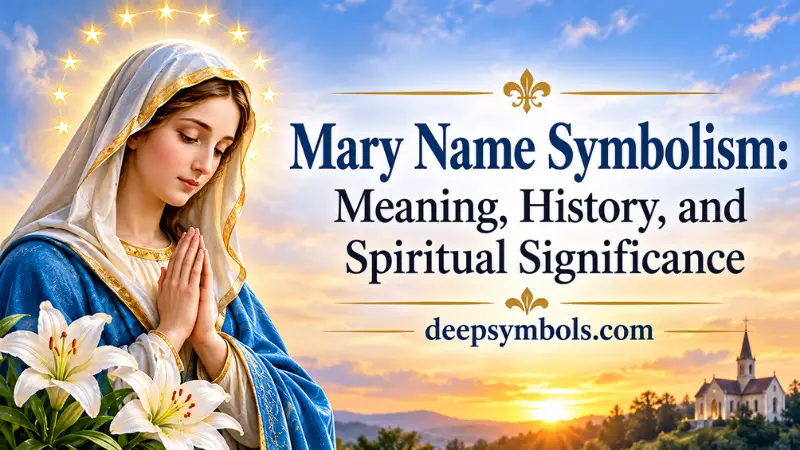
The name Mary carries associations with faith, devotion, compassion, motherhood, and spiritual strength. Recognized across generations and cultures, it has a particularly important place in Christianity because of Mary, the mother of Jesus. Mary name symbolism reflects more than religious tradition; it also connects with ideas of humility, love, perseverance, and the influence of women in family and spiritual life.
Mary comes through the Greek and Latin forms of the ancient Hebrew name Miriam. Its precise original meaning remains uncertain, and different linguistic interpretations have developed over time. Common proposed meanings include beloved, wished-for child, bitter, and rebellious, although none should be presented as a universally established translation.
In the United States, Mary has a long history as a traditional given name, especially among Christian families. It appears in religious artwork, family naming traditions, literature, churches, and personal devotion. Its continued recognition makes it an interesting example of how a biblical name can develop cultural, emotional, and spiritual associations far beyond its original language.
Quick Answer
Mary name symbolism commonly represents faith, motherhood, compassion, humility, and devotion in modern American culture, particularly through its association with Mary, the mother of Jesus. Historically, the name derives from Miriam, an ancient Hebrew name whose uncertain meaning has been associated with several interpretations, including beloved, bitterness, and rebellion.
TL;DR
- Mary represents faith, motherhood, compassion, and spiritual devotion.
- The name developed from the ancient Hebrew name Miriam.
- Its original linguistic meaning remains debated among scholars.
- Christianity connects Mary with humility, obedience, and maternal love.
- The name became especially popular in American Christian families.
- Modern interpretations include strength, kindness, resilience, and family heritage.
1. What Does the Name Mary Represent?
Mary is commonly associated with qualities that reflect the life and religious importance of Mary, the mother of Jesus.
Its most recognizable symbolic meanings include:
Faith and devotion: Mary is remembered in Christian tradition for accepting her role in the birth of Jesus and remaining connected to his life and ministry.
Motherhood and nurturing: Her relationship with Jesus has made the name an enduring representation of maternal care, protection, and unconditional love.
Humility: Mary’s response to the angel Gabriel in the Gospel of Luke is often interpreted as an example of humility and willingness to serve God.
Compassion: Christian devotional traditions frequently associate Mary with mercy, tenderness, and concern for people experiencing suffering.
Strength and perseverance: Her presence in the Gospel accounts, including the events surrounding Jesus’s crucifixion, contributes to interpretations of emotional courage and endurance.
Purity and spiritual commitment: In many Christian traditions, Mary represents devotion to God and a life directed by religious conviction.
These meanings are primarily cultural and religious associations rather than literal translations of the name. Someone named Mary does not automatically possess these qualities, but the name carries a long history of associations with them.
2. The Hebrew Origins of the Name Mary
Mary developed from the Hebrew name Miriam, which appears in the Old Testament.
Miriam is an important biblical figure, particularly because she was the sister of Moses and Aaron. Her story appears in Exodus, where she plays a role in the events surrounding the Israelites’ escape from Egypt.
The name later passed through related linguistic forms. Miriam was represented in Aramaic and Greek as forms such as Mariam and Maria, eventually producing the Latin Maria and the English Mary.
The precise meaning of Miriam remains uncertain. Linguists and biblical scholars have discussed several possible explanations, including connections with bitterness, rebellion, belovedness, and other ancient linguistic roots.
The interpretation of Mary as meaning “bitter” is often connected with the Hebrew word mar, meaning bitter. However, this is a proposed explanation rather than a definitive translation of the complete name.
Another interpretation associates the name with a wished-for or beloved child. These explanations have become common in modern baby-name discussions, although their historical linguistic foundations are not equally certain.
Understanding this uncertainty is important because the name’s spiritual significance developed partly through religious history rather than through a single agreed-upon dictionary meaning.
3. Miriam in the Bible: The Name Before Mary
Before Mary became associated with the mother of Jesus, Miriam was already an important name in biblical history.
In Exodus 2, Miriam appears as the sister of the infant Moses. When Pharaoh’s daughter discovers the baby in the Nile, Miriam approaches her and suggests finding a Hebrew woman to nurse him. This allows Moses’s own mother to care for him during his early childhood.
Miriam later appears as a prophetess in Exodus 15:20–21. Following the Israelites’ crossing of the Red Sea, she leads the women in celebration with tambourines and singing.
Her biblical character contributes several additional associations to the broader history of the name:
- Courage: Miriam acts during a dangerous period in her people’s history.
- Leadership: She takes an active role among the Israelite women.
- Faith: Her story is connected with the deliverance of the Israelites.
- Celebration: Her song expresses gratitude following a major event in biblical history.
- Family loyalty: Her early actions help protect her younger brother.
Miriam and Mary are not the same biblical person. However, the linguistic relationship between their names connects two important women in the biblical tradition.
This earlier history also shows that the name’s religious significance did not begin with Christianity.
4. Mary, the Mother of Jesus, and Her Spiritual Significance
The strongest symbolic association of Mary comes from the New Testament.
In the Gospel of Luke, Mary receives a message from the angel Gabriel announcing that she will give birth to Jesus. Her response, traditionally understood as an expression of acceptance and faith, becomes central to Christian interpretations of her character.
Luke 1:38 records her willingness to accept the message according to God’s word. This moment has helped establish Mary as a representation of trust, humility, and obedience in Christian teaching.
Her role continues throughout the Gospel narratives. She appears in accounts of Jesus’s birth, childhood, and early ministry. In John’s Gospel, she is also present at the wedding at Cana and at the crucifixion.
For many Christians, Mary’s significance extends beyond her biological relationship with Jesus. She represents a model of faithfulness and devotion.
Catholic and Eastern Orthodox traditions give Mary particularly prominent devotional roles, while many Protestant traditions emphasize her importance as a faithful biblical figure without adopting the same practices of Marian devotion.
Despite differences among Christian denominations, Mary remains one of the most recognizable women in Christian religious history.
5. The Symbolism of Mary in Christianity
Christianity associates Mary with several spiritual qualities that developed through biblical interpretation, religious teaching, and devotional practice.
Motherly love: Mary’s relationship with Jesus has made her an enduring image of maternal affection and care.
Humility: Her willingness to accept God’s calling is frequently interpreted as an example of placing faith above personal recognition.
Purity: Christian traditions, particularly Catholic and Eastern Orthodox Christianity, connect Mary with spiritual purity. Catholic teaching about the Immaculate Conception is a specific doctrine concerning Mary’s conception, not simply a general statement that every person named Mary represents purity.
Faithfulness: Mary is remembered for remaining connected to Jesus throughout important moments of his life.
Intercession: Catholic and Eastern Orthodox devotional traditions ask Mary to pray for believers, reflecting their understanding of her special relationship with Christ.
These associations explain why Mary has remained a favored name in Christian communities. Parents choosing the name may wish to express religious devotion, honor a family member, or connect a child with a respected figure from Scripture.
6. Mary as a Symbol of Motherhood and Unconditional Love
One of the most familiar meanings attached to Mary is motherhood.
Christian art frequently portrays Mary holding the infant Jesus, creating an image of protection, tenderness, and maternal responsibility. This representation appears in paintings, sculptures, stained-glass windows, and religious decorations.
The Madonna and Child is among the most recognizable subjects in Christian visual art. The relationship between mother and child communicates affection and care while also expressing theological ideas about the incarnation of Jesus.
For many American Christian families, Mary represents a model of maternal devotion. Her image may appear in homes, churches, prayer spaces, and memorial settings.
The symbolism also reaches beyond strictly religious interpretations. In broader American culture, the name can evoke traditional family values, generational connections, and the importance of maternal relationships.
However, Mary’s symbolic role should not be reduced to motherhood alone. Her biblical story also involves faith, personal responsibility, courage, and participation in important religious events.
Her significance therefore includes both the care she represents and the strength associated with her individual actions.
7. The Star of the Sea: Why Mary Is Associated With This Symbol
One of the most recognizable religious titles associated with Mary is Stella Maris, a Latin expression traditionally translated as “Star of the Sea.”
The title became established in Christian devotional tradition and is especially associated with Mary as a guide and source of spiritual hope.
In religious artwork, this association may be represented through stars, a blue mantle, or images of Mary positioned above the sea.
The star can communicate guidance during uncertainty, while the sea represents the difficulties and unpredictability of human life.
For sailors and coastal communities, the image of a guiding star has an understandable connection with navigation and safety. Over time, the religious title developed a broader devotional meaning.
It is important to distinguish this Christian title from the actual linguistic origin of the name Mary. “Star of the Sea” is a traditional religious interpretation associated with Mary, not an established literal translation of the Hebrew name Miriam.
Today, the title remains recognizable in Catholic churches, Marian prayers, religious jewelry, and artwork.
8. The Seven Sorrows of Mary and the Meaning of Perseverance
Another important Christian association is Our Lady of Sorrows, a devotional tradition that reflects on the suffering Mary experienced during the life and death of Jesus.
The Seven Sorrows traditionally include major events such as the prophecy of Simeon, the flight into Egypt, the loss of the child Jesus, and Mary’s presence during his crucifixion.
These events portray Mary as a mother who experiences fear, uncertainty, separation, and grief.
The symbolism is significant because it presents her as more than an idealized figure of comfort. Her story also includes emotional pain and difficult experiences.
For Christian believers, this aspect of Mary’s identity can represent:
- Perseverance during suffering.
- Compassion for people experiencing grief.
- Strength through difficult circumstances.
- Faith during periods of uncertainty.
- Maternal love that continues through hardship.
In American Catholic communities, images of Our Lady of Sorrows may appear in churches, prayer materials, and religious artwork.
The tradition also helps explain why Mary can symbolize emotional resilience alongside tenderness and compassion.
9. The Meaning of Mary in Modern American Culture
Mary has played an important role in American naming traditions for generations.
Its popularity has been supported by Christian religious heritage, family naming customs, and the influence of biblical names in English-speaking communities.
For much of the twentieth century, Mary was among the most popular girls’ names in the United States. Social Security birth records show that it held the number-one position for many years during the early and middle twentieth century.
Its popularity later declined as parents increasingly selected a wider variety of traditional and contemporary names. Nevertheless, Mary remains familiar and culturally recognizable.
In modern American culture, the name may communicate several things:
Religious heritage: Families may choose Mary to honor the mother of Jesus or express their Christian background.
Family tradition: Some parents pass the name from grandmothers, mothers, or other relatives to younger generations.
Classic identity: Mary is widely recognized as a traditional English name with a long history.
Cultural continuity: Its continued use connects contemporary families with earlier generations.
Personal simplicity: Some parents appreciate its familiar pronunciation, spelling, and straightforward style.
The name can therefore carry both personal and collective significance, even when the person using it does not have a strong religious connection.
10. Mary in Catholic, Orthodox, and Protestant Traditions
Mary’s religious symbolism varies across Christian denominations.
| Christian tradition | Mary’s significance | Common associations |
|---|---|---|
| Roman Catholic | Central figure in Marian devotion | Motherhood, intercession, purity, and compassion |
| Eastern Orthodox | Highly honored as Theotokos | Faithfulness, holiness, and the mother of God |
| Protestant | Respected biblical figure | Obedience, humility, and faith |
| Anglican | Honored through Scripture and selected devotional traditions | Motherhood, devotion, and Christian example |
In Catholicism, Mary has a prominent devotional role. Titles such as Our Lady of Guadalupe, Our Lady of Lourdes, and Our Lady of Fatima reflect different historical and religious traditions.
Eastern Orthodox Christianity gives Mary the title Theotokos, meaning “God-bearer,” emphasizing her role as the mother of Jesus Christ.
Many Protestant communities honor Mary primarily through the biblical accounts, recognizing her faith and place in the story of Jesus without sharing all Catholic or Orthodox devotional practices.
These differences should not be treated as disagreements about whether Mary was important. Rather, they reflect different understandings of how Christians should honor her.
11. Mary in Art, Literature, and American Religious Heritage
Mary has influenced religious art and cultural expression for centuries.
Paintings of the Annunciation, Nativity, Madonna and Child, and Pietà have helped communicate different aspects of her story. Artists often use visual details such as a blue mantle, a white veil, lilies, or a crown to express particular religious ideas.
In American churches, these images appear in stained-glass windows, statues, paintings, and devotional spaces.
Mary also appears in American literature and music, particularly in works influenced by Christian tradition. Hymns and prayers frequently emphasize her role as the mother of Jesus and her relationship with faith.
One especially recognizable example in American religious life is Our Lady of Guadalupe. Her image is deeply important to Mexican and Mexican American Catholic communities and is associated with devotion, cultural heritage, maternal protection, and religious identity.
This tradition demonstrates that Mary’s cultural significance is not limited to European Christian history. Different communities have developed their own devotional expressions that reflect local experiences and religious practices.
12. The Emotional and Psychological Associations of the Name Mary
Names can influence how people understand family history, identity, and cultural belonging. Mary carries associations that may be particularly meaningful because of its long religious and historical presence.
For some people, the name evokes a grandmother, mother, or another important family member. Its emotional meaning may come from personal memories rather than religious doctrine.
For others, Mary represents faith and a connection to Christianity. A person raised in a religious household may associate the name with church celebrations, prayers, biblical stories, and family traditions.
The name can also suggest qualities such as:
- Kindness and compassion.
- Emotional stability and patience.
- Traditional values and family connection.
- Strength during difficult experiences.
- A sense of spiritual responsibility.
These are cultural associations, not personality traits determined by a person’s name.
A woman named Mary may have a completely different identity from the traditional expectations associated with the name. Its symbolism provides cultural context, but it does not define someone’s character or future.
13. Mary in Modern Naming, Jewelry, and Personal Identity
Although Mary is less dominant in contemporary baby-name rankings than it was during the twentieth century, it remains an established choice for American families.
Parents may use Mary as a first name, middle name, or part of a compound name such as Mary Jane, Mary Ann, or Mary Elizabeth.
The name also appears in personal and religious objects.
Jewelry: Necklaces and bracelets may feature the name Mary, a Marian medal, or an image of the Virgin Mary. These objects can express devotion or serve as family keepsakes.
Tattoos: Some people choose the name to honor a mother, grandmother, daughter, or religious figure. Others combine it with crosses, roses, or Marian imagery.
Home decor: Religious paintings, framed prayers, and decorative statues may include Mary’s name or image.
Memorial objects: The name may appear on gravestones, remembrance jewelry, and family memorials.
Social media: People may use the name in religious posts, family tributes, and personal expressions of faith.
These modern uses demonstrate how an ancient name continues to function as a form of personal expression.
14. Common Misunderstandings About Mary Name Symbolism
Several popular interpretations of Mary require historical clarification.
Mary does not have one universally established Hebrew meaning. The name comes through Miriam, whose precise etymology remains disputed. Interpretations such as beloved, bitter, and rebellious should be treated as proposals rather than definitive translations.
Star of the Sea is a devotional interpretation. It is a traditional Christian title associated with Mary, not a confirmed literal meaning of her name.
Mary and Miriam are historically connected but belong to different biblical contexts. Miriam is the sister of Moses, while Mary is the mother of Jesus. Their names are related through linguistic development.
The name does not determine personality. Associations with kindness, patience, or compassion come from cultural and religious traditions, not scientific evidence about people named Mary.
Christian traditions do not all approach Mary in the same way. Catholic, Orthodox, and Protestant communities differ in their devotional practices and theological interpretations.
Recognizing these distinctions makes it possible to appreciate the name’s significance without confusing religious tradition, linguistic history, and personal belief.
15. How the Meaning of Mary Has Evolved
Mary’s history illustrates how a name can develop new associations as it moves between languages, religions, and generations.
Its earliest biblical form is connected with Miriam, a woman remembered for her courage and leadership in the Old Testament.
The name later appeared in Greek and Latin forms and became especially prominent through the New Testament accounts of Mary, the mother of Jesus.
Christian communities gradually developed additional interpretations through religious art, prayers, theological teaching, and devotional traditions. Titles such as Mother of God, Our Lady, and Star of the Sea added layers of religious significance.
In medieval and early modern Europe, Mary became an especially important name in Christian naming practices. European settlement and immigration helped establish it in the United States, where it remained highly popular for generations.
During the twentieth century, its use became strongly associated with traditional American naming customs. Although its popularity has declined compared with earlier decades, its religious and cultural recognition remains substantial.
Today, Mary can represent Christian devotion, family heritage, classic naming traditions, and personal identity. Its meaning continues to depend on the experiences and beliefs of the people who use it.
FAQs
1. What does the name Mary mean spiritually?
Mary spiritually represents faith, humility, motherhood, compassion, and devotion to God. These associations primarily come from the biblical life of Mary, the mother of Jesus, and later Christian traditions.
2. What is the original Hebrew meaning of Mary?
Mary developed from the Hebrew name Miriam, but its exact original meaning is uncertain. Common proposals include bitterness, rebellion, and belovedness, although no single interpretation is universally accepted.
3. Does Mary mean Star of the Sea?
Star of the Sea is a traditional Christian title associated with Mary, expressed in Latin as Stella Maris. It is a devotional interpretation rather than a confirmed literal translation of the name’s Hebrew origin.
4. What does Mary symbolize in Christianity?
Mary symbolizes faithfulness, maternal love, humility, spiritual devotion, and perseverance. Catholic and Orthodox traditions also associate her with intercession and particular devotional titles.
5. Is Mary a powerful biblical name?
Mary is historically significant because of the women who bear related forms of the name in Scripture. Miriam, the sister of Moses, and Mary, the mother of Jesus, are especially important figures in Jewish and Christian traditions.
6. What does the name Mary symbolize in modern American culture?
In the United States, Mary commonly represents Christian heritage, traditional family values, maternal love, and generational continuity. It is also recognized as a classic name with a long history in American society.
7. Is Mary a good name for a baby girl?
Mary is a meaningful choice for parents who appreciate biblical history, traditional names, and Christian heritage. Its familiar spelling and pronunciation also make it a recognizable option that works well as either a first or middle name.
Conclusion
Mary name symbolism brings together faith, motherhood, compassion, humility, perseverance, and family heritage. The name developed from the Hebrew Miriam through Greek and Latin forms before becoming familiar throughout Christian cultures. Although its exact linguistic meaning remains uncertain, its religious and cultural significance has grown through generations of biblical interpretation and Christian devotion. Oxford Academic’s scholarly overview, “Mary” in Oxford Bibliographies in Biblical Studies, explores how the mother of Jesus influenced Christian theology, religious traditions, art, and devotional practices.
In modern American culture, Mary carries both religious and personal significance. For some, it represents devotion to the mother of Jesus; for others, it honors a beloved family member or preserves a connection with family traditions and cultural identity. These different associations show how a name can acquire meaning through both religious history and personal experience.
Ultimately, Mary name symbolism extends beyond a single translation or definition. Its enduring significance reflects faith, compassion, family heritage, and the influence of women whose stories continue to shape religious and cultural life. Whether chosen for its biblical connection or its place in family history, Mary remains a name that carries generations of memory, devotion, and meaning.


