
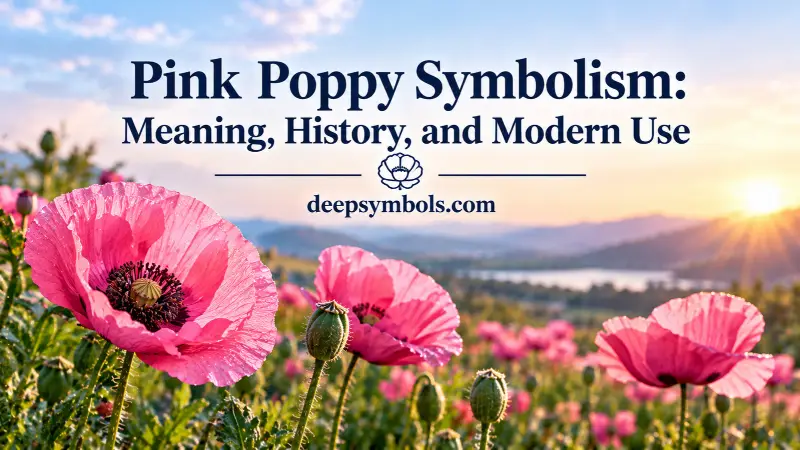
Pink poppies bring together the delicate appearance of a flower and a range of associations with tenderness, affection, remembrance, and renewal. Their soft petals, often set against dark centers and slender stems, make them popular in gardens, floral arrangements, artwork, and decorative designs. Pink poppy symbolism is especially relevant to people who want to express gentle affection, appreciate natural beauty, or mark a period of personal change.
Unlike the red poppy, which has a well-established association with military remembrance in the United States and other countries, the pink poppy does not have one universally recognized symbolic meaning. Its interpretation depends on the flower variety, the occasion, and the person choosing it. Pink flowers commonly suggest warmth and tenderness, while the poppy’s history adds associations with sleep, remembrance, and the persistence of life.
In modern American culture, pink poppies can serve as garden flowers, thoughtful gifts, memorial arrangements, or subjects for botanical art. Understanding their symbolism means considering both the cultural associations of the color pink and the distinctive history of the poppy itself.
Quick Answer
Pink poppies commonly symbolize tenderness, gentle affection, beauty, and renewal in modern American floral symbolism. Their broader associations draw on the poppy’s history as a flower connected with sleep, remembrance, and life returning after disturbance, although pink poppies do not have a single standardized meaning across cultures.
TL;DR
- Pink poppies commonly suggest tenderness, affection, and gentle beauty.
- Pink ornamental varieties do not share the red poppy’s established military symbolism.
- Poppies have historical associations with sleep, remembrance, and renewal.
- In American gardens, pink poppies often represent natural beauty and seasonal change.
- Pink poppy tattoos can express healing, remembrance, or personal growth.
- Their meaning depends on context rather than a universal symbolic code.
1. What Does a Pink Poppy Look Like?
A pink poppy typically has delicate, papery petals arranged around a central cluster of stamens. Depending on the species and cultivar, its flowers may appear pale blush, soft rose, salmon pink, or rich magenta. Some varieties have dark centers, while others display lighter centers and more evenly colored petals.
The petals can look almost translucent in sunlight, giving the flower a fragile appearance. Yet poppies grow in a range of environments and can produce abundant blooms under suitable conditions. This contrast between delicate petals and the plant’s ability to flower makes the poppy an appealing image of vulnerability alongside resilience.
Pink poppies appear in ornamental gardens, wildflower-inspired planting schemes, bouquets, paintings, textile patterns, and nature photography. Their appearance often suits designs intended to feel romantic, peaceful, nostalgic, or connected to the natural world.
It is also important to recognize that pink poppies are not one single botanical variety. Different poppy species and cultivated forms can produce pink flowers, so the exact plant matters when discussing its physical characteristics or growing requirements.
Symbolically, the color and the flower contribute different associations. Pink often suggests gentleness, while the poppy’s delicate petals and recurring seasonal blooms can suggest beauty, change, and the temporary nature of life.
2. The Core Meanings of Pink Poppies
Pink poppies can communicate several related ideas, although these meanings are interpretations rather than a formal symbolic system.
Tenderness and affection: Pink is commonly associated with warmth, caring, and gentle emotional expression. A pink poppy can therefore represent affection that feels sincere and understated rather than dramatic.
Beauty and appreciation: The flower’s delicate petals and vivid color make it a natural emblem of visual beauty. In art and garden design, it can express appreciation for the small details of the natural world.
Renewal and new beginnings: Poppies return to bloom according to their growing cycles, making them suitable images of seasonal change and fresh starts. This association can be especially meaningful after a difficult period.
Remembrance and reflection: The wider history of poppy symbolism includes remembrance, particularly through red poppies associated with World War I. A pink poppy may evoke memory or reflection in personal artwork, although it is not the standard American military remembrance emblem.
Vulnerability and resilience: The thin petals can suggest fragility, while the plant’s capacity to grow and flower offers a contrasting image of persistence.
These meanings can overlap. Someone might choose a pink poppy illustration to commemorate a loved one while also expressing hope for the future. Another person may simply appreciate the flower’s color and form without assigning it a particular message.
The interpretation becomes clearest when the flower is considered alongside the occasion and the intention behind its use.
3. What Pink Symbolism Adds to the Poppy
Color plays a major role in how people interpret flowers. In contemporary American culture, pink is frequently connected with tenderness, affection, sweetness, appreciation, and emotional warmth.
These associations are not universal rules. Pink can also communicate playfulness, youthful energy, individuality, or boldness when used in brighter shades. Nevertheless, softer pinks often create a gentler impression than vivid red or deep purple.
When pink appears in a poppy, it can shift the flower’s visual message toward affection and quiet beauty. A red poppy may immediately remind many Americans of military remembrance, while a pale pink poppy is more likely to be read as an ornamental flower or a personal expression of care.
This distinction illustrates how color influences meaning without completely determining it. The poppy’s history remains part of its broader cultural identity, but the pink variety does not automatically inherit every association attached to red flowers.
Pink poppies can therefore be appropriate for occasions involving friendship, gratitude, personal reflection, or appreciation of nature. They may also appear in romantic settings, although the flower is not as universally associated with romance as the red rose.
The color adds emotional nuance rather than creating a fixed message.
4. The Historical Origins of Poppy Symbolism
Poppies have a long history in human culture, but their meanings have developed through several distinct traditions.
In ancient Greek and Roman contexts, poppies were associated with sleep and the world of dreams. These associations were influenced by the properties of certain poppy species, including the opium poppy, Papaver somniferum. Classical imagery connected poppies with deities and ideas involving sleep, fertility, and agricultural abundance.
The Greek god Hypnos, associated with sleep, and the Roman god Somnus were sometimes depicted in artistic traditions involving sleep-related plants and imagery. Poppies also appeared in connections with Demeter and Ceres, deities associated with agriculture and fertility.
These historical associations should not be interpreted as evidence that ancient cultures assigned a distinct meaning to pink poppies specifically. The symbolism generally concerned poppies as a broader category, particular species, or their role in mythology and material culture.
Over later centuries, poppies appeared in literature, painting, decorative arts, and botanical illustration. Their striking flowers made them useful images of beauty, sleep, mortality, and the passing of time.
The familiar pink ornamental poppy belongs to this wider history, but its modern associations are also shaped by contemporary ideas about flower colors. Its symbolism is best understood as a combination of older poppy imagery and newer interpretations of pink.
5. Why the Red Poppy Represents Remembrance
The history of the red poppy is especially important when interpreting pink poppies accurately.
During World War I, red field poppies grew in areas of disturbed ground across parts of Europe. Their presence near battlefields became closely associated with the conflict’s devastation and the soldiers who died there.
In 1915, Canadian physician and military officer John McCrae wrote the poem In Flanders Fields, connecting poppies with the graves of fallen soldiers. After the war, American humanitarian Moina Michael helped establish the practice of wearing red poppies in remembrance of those who served and died.
The American Legion adopted the poppy as a memorial emblem in 1920, and veterans’ organizations developed programs that used artificial poppies to raise funds and support veterans and their families. The tradition remains visible around Memorial Day and other military commemorations.
The red poppy consequently has a specific historical association that goes beyond general flower symbolism. It represents sacrifice, remembrance, and the responsibility to honor those affected by war.
Pink poppies do not occupy the same established position in American remembrance traditions. A pink flower may be used personally in a memorial arrangement, but it should not automatically be presented as a recognized replacement for the red poppy.
Understanding this distinction preserves the historical meaning of the red poppy while allowing pink varieties to carry their own personal and decorative associations.
6. Pink Poppy Symbolism in American Culture
In the United States, pink poppies are most naturally encountered in gardens, floral photography, decorative artwork, and informal gift-giving rather than in standardized public ceremonies.
Their soft coloring suits cottage gardens, pollinator-friendly planting schemes, and arrangements designed to create a relaxed, natural appearance. Artists may use pink poppies to suggest spring, nostalgia, tenderness, or a quiet appreciation of nature.
Pink poppy imagery can also appear on greeting cards, stationery, fabrics, and home decorations. In these settings, its meaning is often shaped by the overall design. A pink poppy combined with handwritten lettering may communicate personal affection, while a botanical illustration may emphasize beauty and scientific interest.
The flower can also carry meaning in personal milestones. Someone beginning a new chapter might choose poppy imagery to represent change and growth. Another person might use it in a memorial illustration because the flower reminds them of a garden shared with a loved one.
These interpretations are personal rather than nationally standardized. There is no single American holiday or widely recognized ceremony devoted specifically to pink poppies.
That flexibility is part of the flower’s appeal. People can use it to communicate a particular feeling without relying on an established public tradition.
7. The Poppy as a Symbol of Renewal and Resilience
Poppies can represent renewal because their growth follows seasonal patterns and some species readily establish themselves in disturbed ground. The sight of flowers returning after a landscape has changed can suggest the possibility of new life following disruption.
This association has both botanical and cultural dimensions. Poppies are not all alike in their growing behavior, and not every species thrives under the same conditions. Still, the image of a flower appearing in an altered landscape can provide a compelling comparison for human recovery.
A pink poppy may therefore represent a fresh beginning after a period of grief, uncertainty, or personal change. Its soft color adds a sense of gentleness to the idea of starting again.
This interpretation does not mean that recovery is always quick or easy. Rather, the flower offers a visual reminder that change can create opportunities for growth, even when the process involves loss or disruption.
In personal artwork, a pink poppy emerging among green leaves can suggest the return of confidence after hardship. In a garden, successive blooms may represent the continuity of life through changing seasons.
The meaning is especially appropriate when the emphasis is on gradual renewal rather than sudden transformation.
8. Pink Poppies and Emotional Well-Being
Flowers often become associated with emotional experiences because people encounter them during meaningful moments. A bloom received as a gift, grown by a family member, or remembered from a favorite garden can become connected with a specific person or period of life.
Pink poppies may evoke calmness, tenderness, nostalgia, or hope because of their color and delicate appearance. These responses vary from person to person, however, and there is no universal psychological reaction to the flower.
Soft pink shades are often used in design to create a gentle or welcoming atmosphere. When paired with a poppy’s open petals and natural form, they can produce an impression of ease and informality.
The flower may also help someone express emotions that are difficult to communicate directly. A small pink poppy illustration can serve as a gesture of sympathy, gratitude, or encouragement without claiming to explain another person’s feelings.
Its role in emotional expression is symbolic rather than medical. Looking at or growing flowers may be enjoyable and meaningful, but a pink poppy should not be described as a proven treatment for grief, anxiety, or other health conditions.
Its value lies in the personal connections and reflections it can encourage.
9. Cross-Cultural Meanings of the Poppy
Poppy symbolism differs across cultures because it has developed through different religious, artistic, and historical traditions.
In classical Mediterranean mythology, poppies were connected with sleep and agricultural fertility. These associations reflect the roles of poppy species in ancient stories, religious imagery, and understandings of the natural world.
In many European countries and Commonwealth traditions, the red poppy became a symbol of military remembrance after World War I. Its meaning is tied to the war’s history and to public practices honoring the dead and supporting veterans.
In China and other cultural settings, the poppy’s meaning may depend on the particular species, literary context, artwork, or historical association. It would be misleading to claim that all Chinese traditions, or all Asian cultures, assign the flower one identical meaning.
Pink itself also carries different associations depending on cultural context, social conventions, and historical period. Its contemporary connection with tenderness in American design should not be treated as a universal rule.
Pink poppy symbolism is therefore best approached with cultural care. The flower can serve as a personal emblem of affection or renewal, while its historical associations vary according to the tradition being discussed.
10. Pink Poppies in Gardens and Floral Design
Garden design offers one of the clearest settings for interpreting pink poppies.
Their open flowers can bring a soft focal point to a planting scheme, particularly when paired with ornamental grasses, other wildflowers, or plants with fine foliage. Pale pink varieties may create a quiet, romantic appearance, while brighter shades can add energy and contrast.
In floral art, pink poppies can suggest an informal, natural style. Their delicate petals and distinctive centers offer visual interest without the highly structured appearance of some cultivated flowers.
They may also complement flowers associated with other meanings. Combined with white blossoms, pink poppies can suggest simplicity and tenderness. Paired with darker flowers, they can create contrast between softness and intensity.
For gardeners, the flower’s real growing needs matter more than its symbolic meaning. Poppy species differ in their preferred conditions, life cycles, and suitability for different regions. Some are annuals, while others are perennial, and not all varieties are appropriate for every climate.
The symbolism of a garden also develops through the gardener’s choices. Someone who plants pink poppies to celebrate a new home may associate them with fresh beginnings, while another person may simply enjoy their color and seasonal appearance.
In this way, the flower becomes part of a personal relationship with the landscape.
11. Pink Poppy Tattoos, Jewelry, and Personal Art
Pink poppies can be used in tattoos and personal artwork to communicate meanings that combine floral beauty with individual experience.
A small pink poppy tattoo may represent tenderness, a personal milestone, or an appreciation of nature. A larger design incorporating several blooms may evoke seasonal change, renewal, or the memory of a meaningful place.
Some people choose poppy imagery for memorial tattoos. In these cases, the flower’s broader associations with remembrance may contribute to the design, but the pink color may reflect the person’s favorite flower or a private connection rather than an established public convention.
Pink poppies can also appear on pendants, brooches, embroidered clothing, notebooks, and decorative objects. Such items may function as reminders of a loved one, symbols of affection, or simply expressions of botanical interest.
The meaning becomes more specific when the design includes names, dates, initials, or other personal details. A pink poppy placed beside a birth date may commemorate a life event, while one incorporated into a garden-themed illustration may emphasize growth and beauty.
There is no universal rule that assigns one meaning to every pink poppy tattoo or accessory. The wearer’s intention remains the most reliable guide to its personal significance.
12. Pink Poppies in Literature, Art, and Photography
Poppies are visually striking subjects because their thin petals, contrasting centers, and slender stems create a recognizable silhouette. Artists and photographers can use these features to communicate both delicacy and vivid color.
Pink poppies may appear in paintings that emphasize spring landscapes, romantic gardens, or the fleeting quality of flowers. Their short-lived blooms can serve as a reminder that beauty often exists within a limited period.
In poetry and fiction, a poppy may evoke sleep, dreams, memory, or the passing of time. These associations have historical roots, but the exact interpretation depends on how the flower is used within the work.
A pink poppy in a contemporary photograph might simply document a garden. In a memorial image, the same flower could suggest remembrance and personal reflection. In an illustration about recovery, it may represent the return of life after hardship.
Artists can also challenge conventional flower symbolism. A vivid pink poppy placed against an urban background might emphasize nature’s presence within a built environment rather than romance or nostalgia.
This flexibility allows the flower to function as a visual subject, an emotional cue, or a metaphor without requiring a single fixed meaning.
13. Positive and Difficult Interpretations of Pink Poppies
Pink poppies are often interpreted positively, but their associations can also include more complicated emotions.
| Context | Possible meaning | Why the interpretation fits |
|---|---|---|
| Gift or bouquet | Affection and tenderness | Pink commonly conveys gentle warmth. |
| Garden or landscape | Renewal and seasonal beauty | Flowering plants reflect changing natural cycles. |
| Memorial artwork | Remembrance and reflection | The broader poppy tradition includes commemoration. |
| Tattoo or keepsake | Personal growth or memory | The meaning can reflect an individual’s experience. |
| Painting or poem | Beauty and transience | A flower’s brief bloom can suggest the passing of time. |
The more difficult associations arise partly from the poppy’s broader history. Its connection with sleep can evoke rest and peacefulness, but in some artistic contexts it can also suggest unconsciousness or escape.
Similarly, remembrance may bring comfort while also recalling grief. A pink poppy used to honor a loved one can represent affection and continuing memory without removing the sadness of loss.
These contrasts do not make the flower inherently negative. They show that symbolic meaning often reflects the circumstances in which an image appears.
14. Common Misunderstandings About Pink Poppy Symbolism
One common misconception is that pink poppies have a universally recognized meaning. In reality, associations such as tenderness, renewal, and gentle affection are interpretive conventions, not an official symbolic code.
Another misunderstanding is that pink poppies carry exactly the same meaning as red remembrance poppies. Although both are poppies, the red flower has a specific historical role in military commemoration, especially in American and Commonwealth traditions. Pink ornamental varieties are not the standard emblem used in those ceremonies.
It is also misleading to assume that all poppies have the same botanical properties. Different species vary in their appearance, growing requirements, and chemical composition. Symbolic descriptions should not be confused with botanical or medical claims.
Finally, the flower should not automatically be interpreted as a supernatural sign. Someone may personally associate a pink poppy with a deceased loved one or a meaningful event, but that connection is personal rather than proof of a universal spiritual message.
A thoughtful interpretation distinguishes cultural history from individual belief. This approach allows pink poppies to carry meaningful associations without overstating what is historically established.
15. How Pink Poppy Symbolism Continues to Evolve
The meaning of pink poppies continues to develop through gardening, visual art, fashion, and personal expression.
Older associations with sleep, dreams, and the passing of time remain available to contemporary artists. The red poppy’s role in remembrance also shapes the broader cultural understanding of poppies, even when a pink variety is being discussed.
At the same time, modern floral design often places greater emphasis on color and appearance. Pink poppies may be chosen because they fit a particular palette, create a gentle mood, or complement an arrangement intended to express affection.
Social media and digital art have also made floral imagery easy to share and reinterpret. A photograph of a pink poppy can accompany a message about personal growth, a memory, or appreciation for nature without requiring the audience to accept one official definition.
This evolution reflects a broader feature of symbolism: meanings are influenced by history, but they are also shaped by the people who use images in their everyday lives.
Pink poppies remain useful symbols because they can communicate an emotional impression while leaving room for personal interpretation. Their significance depends on the relationship between the flower, the setting, and the message someone wants to express.
FAQs
1. What does a pink poppy mean spiritually?
A pink poppy may represent tenderness, renewal, remembrance, or appreciation for life’s beauty in a personal spiritual context. These meanings are interpretations rather than universally established religious teachings, so the significance depends on an individual’s beliefs and experiences.
2. Are pink poppies a symbol of love?
Pink poppies can express gentle affection because pink flowers are commonly associated with warmth and tenderness in American floral design. However, the pink poppy is not as firmly established as a symbol of romantic love as the red rose.
3. Do pink poppies symbolize remembrance?
They can represent personal remembrance, particularly in artwork or memorial arrangements chosen for that purpose. The red poppy, however, has the more established historical association with military remembrance in the United States and several other countries.
4. What does a pink poppy tattoo symbolize?
A pink poppy tattoo may represent personal growth, affection, beauty, remembrance, or a meaningful life transition. Its precise meaning depends on the wearer’s experience and the other elements included in the design.
5. What is the difference between pink and red poppy symbolism?
Pink poppies are commonly interpreted through associations with tenderness, beauty, and personal expression. Red poppies have a specific historical role as emblems of military remembrance, sacrifice, and support for veterans.
6. Do pink poppies symbolize new beginnings?
They can, because flowering plants provide a natural image of seasonal change and renewed growth. This interpretation is especially appropriate in gardens, personal artwork, or gifts marking a transition into a new stage of life.
7. Are pink poppies associated with death?
Poppies as a broader category can appear in mourning and remembrance traditions, and their historical associations with sleep can sometimes evoke mortality. Pink poppies do not universally symbolize death, however, and their meaning depends on the cultural or personal
Conclusion
Pink poppy symbolism brings together tenderness, beauty, renewal, and remembrance. The flower’s delicate appearance invites personal interpretations, while the wider history of poppies adds associations with fertility, life, sleep, and mortality. The Metropolitan Museum of Art’s article, “A Flower to Remember,” explores these historical connections and shows how poppies have carried different meanings across artistic and cultural traditions.
In modern American culture, pink poppies may express affection, mark a personal transition, decorate a garden, or preserve a meaningful memory. Unlike the red poppy, which has a well-established public association with remembrance of war, the pink variety does not have one widely standardized symbolic meaning. Its significance depends on the occasion, the surrounding context, and the intention behind the flower.
Ultimately, pink poppy symbolism offers a way to connect natural beauty with personal experience. Whether growing in a garden or appearing in a painting, the flower can remind us that tenderness and renewal often emerge through ordinary moments of attention, care, and change. Its meaning becomes most valuable when it reflects something genuinely meaningful to the person who encounters it.


