
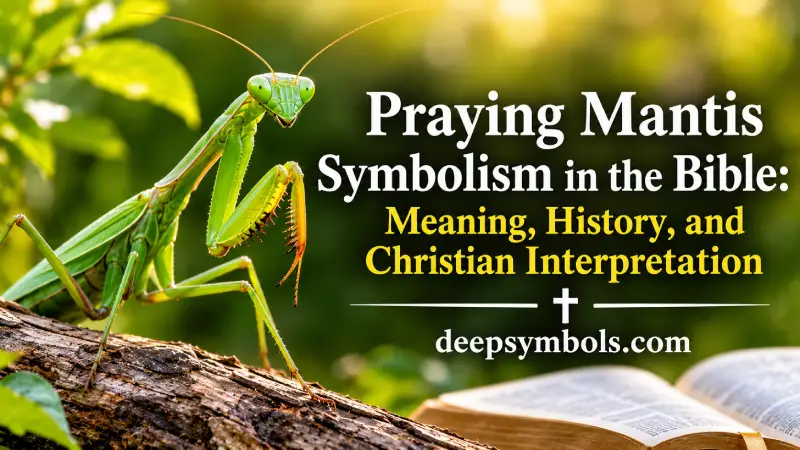
Meta Description: Discover what praying mantis symbolism in the Bible means, whether Scripture mentions this insect, and how Christians interpret its appearance today.
Introduction
The praying mantis is an unusual insect recognized by its triangular head, large eyes, and folded front legs that resemble hands held together in prayer. Its distinctive posture has made it an interesting symbol of patience, stillness, attentiveness, and spiritual reflection. Praying Mantis Symbolism in the Bible is a topic that attracts Christian readers who want to understand whether this insect has a religious meaning or represents a message from God.
Although the praying mantis looks as if it is praying, the Bible does not specifically mention this insect or assign it an established Christian symbolic meaning. Its name comes from the appearance of its folded forelegs, not from a biblical description or proof that the insect engages in human-like prayer.
Nevertheless, Christians sometimes use the mantis as a modern reminder of prayer, patience, humility, and trust in God. Understanding the difference between biblical teaching, cultural symbolism, and personal interpretation helps readers appreciate the insect without attributing meanings to Scripture that are not actually there.
Quick Answer
Praying mantis symbolism in the Bible is commonly interpreted by modern Christians as a reminder of prayer, patience, stillness, and spiritual attentiveness, although the Bible does not specifically mention the praying mantis. These associations come from its folded-leg posture and modern personal interpretations rather than an established biblical tradition.
TL;DR
- The Bible does not specifically mention the praying mantis.
- Its folded front legs resemble a person praying.
- Modern Christians associate it with patience, prayer, and reflection.
- Biblical insects such as ants and locusts have separate scriptural meanings.
- Its hunting behavior can suggest patience and careful observation.
- Seeing a mantis is not a guaranteed supernatural message or biblical sign.
1. What Does a Praying Mantis Look Like?
The praying mantis is an insect with a long body, a triangular head, prominent compound eyes, and two specialized front legs. These front legs fold close to its body, creating the appearance of hands joined in prayer.
Its head can turn to follow movement, giving the insect an unusually attentive appearance. Most mantises also remain remarkably still while waiting for prey, relying on camouflage and carefully timed movements to catch other insects.
Praying mantises come in different sizes and colors, including green, brown, and combinations that help them blend into vegetation. In the United States, people commonly encounter them in gardens, fields, shrubs, and other areas with abundant insects.
The insect’s physical appearance explains much of its modern symbolism. Its posture suggests prayer, its stillness suggests patience, and its focused movements suggest awareness.
However, these are human interpretations of animal behavior. The insect folds its legs because of its anatomy and hunting behavior, not because it is performing a religious act.
2. Does the Bible Mention the Praying Mantis?
One important distinction is that the Bible does not identify the praying mantis by name. Although Scripture discusses numerous insects, including ants, bees, locusts, grasshoppers, and flies, it does not provide a specific description or symbolic interpretation of the praying mantis.
This distinction matters because some modern articles present the insect as though it were an established biblical symbol of prayer or divine communication. That interpretation may be meaningful as personal reflection, but it should not be presented as a direct teaching of Scripture.
Several biblical passages about insects can provide broader context:
- Proverbs 6:6: Uses the ant as an example of diligence and wisdom.
- Proverbs 30:25: Describes ants as small creatures that prepare their food.
- Isaiah 40:22: Compares human beings to grasshoppers in a passage emphasizing God’s greatness.
- Joel 2:25: Mentions locusts in the context of devastation and restoration.
- Matthew 23:24: Uses the gnat to illustrate the contrast between minor and major matters.
These references demonstrate that biblical writers sometimes use insects to communicate spiritual and moral lessons. However, their meanings should not automatically be transferred to the praying mantis.
The most accurate Christian interpretation begins with this distinction: the insect can inspire biblical reflection, but its symbolism is not directly established by Scripture.
3. Why Is the Praying Mantis Associated With Prayer?
The insect’s name is the main reason people connect it with religious devotion.
When resting, a praying mantis often raises its front legs and folds them together near its head. This position resembles the way people hold their hands when praying, particularly in traditional Western religious imagery.
The English name reflects this appearance. The word mantis comes from an ancient Greek term associated with a prophet or diviner. Its religious associations therefore developed through language, observation, and cultural interpretation rather than through Christianity alone.
The insect’s appearance has also influenced names in other languages. In French, it has historically been called prie-Dieu, meaning someone who prays to God, referring to its distinctive posture.
For American Christians, the resemblance creates an easy connection with familiar religious practices. A person who sees a mantis resting on a garden plant may immediately think of prayer, quietness, or spiritual reflection.
However, its folded legs serve a biological purpose. They are specialized hunting limbs equipped with spines that help the insect capture and hold prey.
The difference between appearance and behavior is important. The mantis looks as though it is praying, but its posture is part of its natural way of life.
4. Patience and Waiting for the Right Moment
Patience is one of the most recognizable modern interpretations of the praying mantis.
Unlike insects that constantly move around searching for food, mantises often remain still for extended periods. They observe their surroundings and wait until prey comes within reach.
This behavior can provide a useful comparison with Christian teachings about patience and self-control.
James 5:7–8 encourages believers to be patient, using the farmer waiting for valuable crops as an illustration. The passage emphasizes that meaningful growth often requires time rather than immediate results.
Similarly, Galatians 6:9 encourages Christians not to become tired of doing good because the results may come at the appropriate time.
Although neither passage refers to the praying mantis, its behavior can help modern readers visualize these lessons.
The insect’s stillness may remind someone to:
- Avoid rushing important decisions.
- Remain committed during difficult periods.
- Give personal growth enough time.
- Think carefully before reacting.
- Recognize that not every opportunity requires immediate action.
In this sense, the mantis can serve as a personal reminder of patience rather than a supernatural instruction about what someone should do.
5. Spiritual Stillness and Listening to God
The praying mantis is often associated with stillness because of its ability to remain motionless while observing its environment.
For Christians, this behavior can bring to mind the importance of quiet prayer and reflection.
Psalm 46:10 contains the familiar instruction to be still and recognize God. The verse appears within a psalm about God’s authority and the security believers can find in him.
Stillness in this context does not mean doing nothing or avoiding responsibility. It means recognizing that constant activity, anxiety, and distraction can make thoughtful spiritual reflection difficult.
The mantis can provide a visual reminder of this idea.
Its quiet posture may encourage someone to put aside distractions, spend time in prayer, and consider important decisions carefully.
Modern American life often involves demanding schedules, digital communication, work responsibilities, and constant entertainment. For people who struggle to find quiet moments, the image of a motionless mantis may offer a simple reminder to make room for reflection.
The biblical lesson comes from Scripture, not from the insect itself. Nevertheless, observing nature can encourage people to think more carefully about teachings they already value.
6. Focus, Awareness, and Spiritual Discernment
Another possible interpretation of the praying mantis is focused attention.
The insect has large compound eyes and a highly flexible head that allows it to follow movement. It can carefully observe its surroundings before deciding when to act.
This behavior can be compared with the Christian importance of discernment.
In 1 Thessalonians 5:21, believers are encouraged to examine everything carefully and hold on to what is good. The passage emphasizes thoughtful evaluation rather than accepting every idea without consideration.
The mantis can serve as a modern illustration of that principle.
Its focused attention may remind Christians to:
- Examine information before accepting it.
- Think carefully about personal decisions.
- Recognize the difference between wisdom and impulse.
- Avoid being distracted by unnecessary conflict.
- Pay attention to their spiritual responsibilities.
This interpretation is particularly relevant in an age when people encounter large amounts of information through social media, online discussions, and digital news.
A praying mantis does not possess human spiritual discernment. Its hunting behavior is instinctive. However, its attentive appearance can help communicate the value of thoughtful observation.
7. Humility and the Importance of Small Creatures
The praying mantis is not a large animal, yet its hunting abilities make it an effective predator.
This contrast can inspire reflection on humility and the difference between outward appearance and actual ability.
In Christian teaching, humility is not the same as weakness. It involves recognizing one’s limitations, avoiding excessive pride, and treating others with respect.
Philippians 2:3 encourages believers to act with humility and consider others rather than being motivated by selfish ambition.
The mantis can serve as an illustration of how outward size does not necessarily determine capability.
Its appearance may also encourage appreciation for small creatures that people sometimes overlook. Insects play important roles in natural ecosystems, including helping regulate populations of other insects.
For American gardeners, praying mantises are familiar beneficial predators. They consume various insects and contribute to the natural relationships within gardens and outdoor environments.
The Christian reflection here is straightforward: something small does not have to be insignificant.
This is a personal lesson drawn from observing nature, not a symbolic definition directly assigned to the mantis in the Bible.
8. The Praying Mantis in Ancient Cultures and Religious Traditions
The praying mantis has attracted attention in several cultures because of its unusual posture and hunting behavior.
In ancient Greek tradition, the word mantis was associated with prophecy and divination. The insect’s distinctive appearance contributed to beliefs that it possessed unusual abilities.
Some historical accounts describe mantises as creatures associated with guidance or supernatural knowledge. Certain European traditions also connected them with helping lost travelers or children find their way.
In parts of Africa, mantises have appeared in traditional religious and cultural stories. Their meanings vary considerably between communities, so it would be inaccurate to assign one interpretation to an entire continent.
Chinese cultural traditions have also associated the mantis with qualities such as alertness, restraint, and martial skill. Its hunting movements have influenced depictions of the insect in traditional art and martial arts.
These traditions are culturally distinct from biblical Christianity.
For American readers, this distinction is useful because modern spiritual websites sometimes combine Christian language, ancient folklore, and personal beliefs without explaining their different origins.
A respectful interpretation recognizes that the praying mantis has different meanings across cultures. None of these traditions should automatically be treated as biblical teaching.
9. Praying Mantis Symbolism in Modern American Christian Culture
In the United States, the praying mantis is often interpreted through its name and recognizable appearance.
Christian readers may associate it with prayer, reflection, patience, and the importance of maintaining a relationship with God.
It can appear in:
- Christian nature photography.
- Devotional illustrations.
- Religious social media discussions.
- Personal artwork and garden decorations.
- Nature-inspired jewelry and tattoos.
- Conversations about recognizing God’s creation.
Some people use the insect as a reminder to slow down and spend more time in prayer. Others appreciate it simply as an unusual example of the complexity of nature.
There is no widely established Christian holiday or formal church tradition centered on the praying mantis.
Its modern religious meaning is primarily personal and interpretive rather than institutional.
This distinction helps explain why different Christians may respond differently when they encounter one. Some see an opportunity for reflection, while others simply appreciate the insect as part of the natural world.
Both responses can coexist without requiring the insect to carry a universal religious message.
10. What Does a Green Praying Mantis Symbolize?
Green is a common color among praying mantises, although some species are brown or display other shades.
In modern symbolism, green is frequently associated with growth, renewal, nature, and restoration.
These associations can connect with familiar biblical imagery.
Psalm 23 describes green pastures as part of the psalmist’s picture of God’s guidance and care. The image communicates nourishment, rest, and security.
Isaiah 43:19 uses the image of something new emerging, presenting restoration and a new beginning through the picture of a way being made in the wilderness.
A green praying mantis may therefore inspire personal reflection about:
- Spiritual growth.
- A fresh beginning.
- Renewal after difficult circumstances.
- Appreciation for creation.
- The importance of nurturing faith.
However, the Bible does not assign a specific spiritual meaning to the green praying mantis.
Its color-based interpretation combines general color associations with biblical themes rather than representing a direct scriptural teaching.
11. What Does It Mean When a Praying Mantis Appears in Your House?
Finding a praying mantis inside a home can be surprising because these insects are generally associated with gardens, vegetation, and outdoor environments.
Some modern spiritual interpretations describe a mantis entering a home as a sign of peace, protection, good fortune, or an invitation to pray.
These interpretations come from folklore and contemporary beliefs, not from a specific biblical passage.
From a practical perspective, a mantis may enter through an open door or window while searching for shelter or following insects.
Christians who find one inside their homes may choose to use the encounter as an opportunity for reflection.
For example, it might remind someone to:
- Make time for personal prayer.
- Approach family disagreements patiently.
- Appreciate the natural world.
- Think carefully before making an important decision.
- Practice gratitude for ordinary experiences.
There is no biblical reason to assume that a mantis entering a house predicts an event or communicates a guaranteed message from God.
A thoughtful Christian interpretation can appreciate the encounter without turning it into a prediction.
12. Is Seeing a Praying Mantis a Sign From God?
This is one of the most common questions surrounding praying mantis symbolism.
Some people believe that seeing a mantis at a particular moment may carry personal spiritual significance. For example, someone struggling with anxiety might interpret its appearance as a reminder to pray and become more patient.
Such personal reflections can be meaningful.
However, the Bible does not establish the praying mantis as a specific messenger from God. It does not teach that seeing one means a prayer has been answered, a danger has been removed, or an important event is about to happen.
Christians can approach these experiences through biblical discernment.
First Thessalonians 5:21 encourages believers to examine things carefully. This principle is useful when evaluating claims about supernatural signs.
A person can appreciate a surprising encounter with nature without feeling pressured to discover a hidden message in it.
The difference is between personal inspiration and biblical certainty.
If seeing a mantis encourages someone to pray, show patience, or appreciate creation, that response can be positive. But the encounter itself should not be treated as proof of divine communication.
13. The Praying Mantis in Dreams and Personal Reflection
Some people search for the meaning of a praying mantis appearing in a dream.
Modern dream interpretations commonly associate the insect with patience, concentration, quiet observation, and careful decision-making.
A mantis appearing peacefully in a dream may remind someone of the need to slow down. An aggressive mantis might reflect feelings of pressure, conflict, or the need to protect personal boundaries.
However, these interpretations are not established biblical dream meanings.
The Bible contains accounts of significant dreams, including those associated with Joseph in Genesis and Daniel in the Old Testament. These narratives have specific religious and historical contexts.
They do not establish a universal dictionary in which every animal appearing in a modern dream carries a fixed spiritual message.
Christians can reflect on their dreams while avoiding the assumption that every image predicts the future.
If a praying mantis appears in a dream, useful questions might include:
- Have I been rushing an important decision?
- Do I need more time for prayer?
- Am I paying attention to something important?
- Have I been reacting emotionally instead of thoughtfully?
These questions turn the dream into an opportunity for personal reflection rather than an unsupported supernatural prediction.
14. Common Misunderstandings About Praying Mantis Symbolism
Several misunderstandings can develop when modern spiritual interpretations are presented as biblical facts.
The Bible describes the praying mantis as a holy insect.
It does not. Scripture does not specifically identify the praying mantis or assign it a sacred status.
A praying mantis always represents answered prayer.
There is no biblical teaching that connects every mantis encounter with an answered prayer.
The insect actually prays.
Its folded front legs resemble a prayer position, but they are specialized structures used to capture prey.
A mantis entering a home guarantees good fortune.
This interpretation comes from folklore and personal beliefs rather than Scripture.
Every praying mantis appearance has a hidden spiritual message.
Christians may find personal meaning in nature, but not every encounter needs to be interpreted as a supernatural sign.
Understanding these distinctions protects the difference between biblical teaching and cultural storytelling.
It also allows readers to appreciate the mantis without creating religious claims that cannot be supported by Scripture.
15. Biblical Lessons You Can Reflect on When Seeing a Praying Mantis
Although the praying mantis does not have an established biblical meaning, its natural characteristics can inspire reflection on several Christian principles.
| Mantis characteristic | Possible Christian reflection | Related Bible passage |
|---|---|---|
| Folded front legs | Make time for prayer | Matthew 6:6 |
| Motionless posture | Practice stillness and trust | Psalm 46:10 |
| Patient hunting behavior | Wait without losing faith | James 5:7–8 |
| Focused observation | Examine things carefully | 1 Thessalonians 5:21 |
| Small physical size | Practice humility | Philippians 2:3 |
| Green natural appearance | Reflect on growth and restoration | Psalm 23:2–3 |
These comparisons are devotional applications rather than direct interpretations of the insect in Scripture.
The distinction is important because biblical passages should retain their original meaning. A mantis can remind someone of a lesson found in the Bible without becoming the source of that lesson.
For many Christians, this is a balanced way to appreciate nature and strengthen personal reflection.
FAQs
1. What does a praying mantis symbolize in the Bible?
The Bible does not specifically mention the praying mantis, so it has no officially established biblical symbolism. Modern Christians commonly associate it with prayer, patience, stillness, and spiritual awareness because of its distinctive appearance.
2. Is a praying mantis a sign from God?
Scripture does not identify the praying mantis as a special sign or messenger from God. However, seeing one may personally remind someone to pray, reflect, and appreciate creation.
3. What does a praying mantis mean spiritually?
Modern spiritual interpretations commonly connect the mantis with patience, concentration, mindfulness, and prayer. These associations come primarily from its behavior and appearance rather than direct biblical teaching.
4. What does a green praying mantis symbolize in Christianity?
A green mantis may inspire thoughts about renewal, growth, and God’s creation. These associations connect general color symbolism with biblical imagery such as the green pastures in Psalm 23, rather than a specific scriptural reference to the insect.
5. Is it good luck to see a praying mantis?
Some cultural traditions consider seeing a praying mantis fortunate or meaningful. Christianity generally emphasizes God’s providence rather than treating animals as guaranteed sources of luck.
6. What does a praying mantis in your house mean spiritually?
Some modern interpretations associate a mantis entering a home with peace, reflection, and protection. The Bible does not establish this encounter as a spiritual prediction, and the insect may simply have entered through an open door or window.
7. Does dreaming about a praying mantis have a biblical meaning?
The Bible does not provide a specific interpretation for dreaming about a praying mantis. A Christian may use such a dream as an opportunity to reflect on patience, prayer, and personal decisions without assuming it predicts the future.
Conclusion
Praying Mantis Symbolism in the Bible brings together personal reflection, prayer, patience, humility, and spiritual awareness. Although the Bible does not explicitly mention the praying mantis, its unusual posture can remind Christians of the importance of stillness, devotion, and thoughtful decision-making. The University of Kentucky’s Department of Entomology guide to praying mantids explains that the insect’s folded front legs are actually specialized for catching prey, providing a scientific explanation for its familiar prayer-like appearance.
For modern Christians, the praying mantis can serve as a personal reminder to make time for prayer, exercise patience, seek wisdom, and appreciate the natural world. These reflections can connect with biblical teachings without claiming that Scripture assigns the insect a specific spiritual meaning or that its appearance predicts a future event.
Ultimately, Praying Mantis Symbolism in the Bible is best understood through the distinction between biblical teachings and personal interpretation. Its distinctive posture can inspire thoughts about faith, humility, and spiritual discipline, but the deeper lesson comes from the Christian values reflected in Scripture. The praying mantis reminds believers that meaningful reflection often begins with slowing down, observing carefully, and approaching life’s decisions with patience and wisdom.


